You walked out of the interview knowing it did not go well. Maybe you fumbled the behavioral question about conflict resolution. Maybe your research narrative came out disjointed, lacking the clean arc that program directors expect from competitive applicants. Or maybe you were simply flat, technically competent on paper but forgettable in the room, the kind of candidate who gets a polite "we enjoyed meeting you" email and then silence. Now the Second Look invitation sits in your inbox, and you are wondering whether it is a courtesy or a lifeline.
It is a lifeline. But only if you know how to use it.

The Anatomy of a Mediocre Interview: Recognizing the Gap Between Paper and Presence
Let me break this down specifically. A mediocre interview is not the same as a catastrophic one. If you said something genuinely offensive or displayed a glaring professionalism lapse, no Second Look strategy will rescue you. But the vast majority of "bad" interviews fall into a narrower, far more recoverable category: you were unremarkable. You gave correct but generic answers. You failed to create a narrative thread that connected your experiences to this specific program. You engaged at a surface level, answering questions adequately without ever demonstrating the intellectual curiosity or interpersonal warmth that makes a faculty member lean forward and think, "I want this person on my team Tuesday morning."
The psychological footprint of a weak interview is persistent. Faculty interviewers rank candidates immediately after their sessions, often within the same day, while impressions are fresh. If your conversation lacked memorable anchors, a specific clinical insight, a moment of genuine humor, a thoughtful question that reframed the discussion, you were likely placed in the middle tier. Not rejected. Not prioritized. Just sort of... there. This is the gap between paper and presence: your ERAS application got you the interview, but your interview performance failed to convert that opportunity into a ranking advantage.
Here is what most applicants misunderstand about the Second Look. It is not a polite visit. It is not a casual meet-and-greet where you show up, shake hands, and reinforce whatever impression already exists. Program directors and selection committees use Second Looks as a real-time calibration tool. They are asking: "Does this person look different to me now than they did in November?" If the answer is yes, and the difference is positive, rank list movement happens. If the answer is no, or worse, if the Second Look confirms the initial underwhelming impression, you have actively solidified your lower-tier placement.
The stakes are real. I have seen applicants jump eight to twelve rank positions after a strategically executed Second Look. I have also seen applicants drop off the rank list entirely after a Second Look that revealed poor social awareness or desperation. The difference between these outcomes is not luck. It is preparation, behavioral calibration, and understanding exactly what the program is evaluating when you walk back through those doors.
Deconstructing the Second Look: What Program Leadership Actually Evaluates
Let me be precise about what happens during a Second Look from the program's side of the table. Faculty and coordinators are no longer testing your knowledge base. They already have your board scores, your clinical evaluations, your letters of recommendation. The primary interview already assessed your baseline communication skills and your rehearsed responses to standard questions. What remains untested, and what the Second Look is designed to probe, is cultural fit, professional maturity, and teachability in an unscripted environment.
The unscripted nature of the Second Look is its defining feature. Your primary interview was a performance. You prepared answers, you anticipated questions, you controlled the narrative within the constraints of a structured 20-minute conversation. The Second Look strips away that structure. You are walking through units. You are sitting in on morning report. You are eating lunch with current residents who have no incentive to be polite to you. You are observing the program in its natural state, and the program is observing you in yours.
This is where the real evaluation happens. Faculty members who interact with you during a Second Look are assessing behavioral domains that never surface in a formal interview:
Social integration capacity. How do you interact with residents when no faculty are watching? Do you ask questions that demonstrate genuine curiosity about their daily experience, or do you monopolize conversations with self-promotion? Current residents talk to each other and to chiefs. Their feedback reaches the selection committee. A resident who tells a chief, "That applicant was genuinely interested in how we handle overnight sign-out" carries more weight than a faculty member's lukewarm interview score.
Situational awareness. Do you read the room? When a senior attending is explaining a complex case during rounds, are you listening intently, asking a follow-up question that shows you tracked the clinical reasoning? Or are you checking your phone, looking bored, or asking a question that was already answered five minutes ago? Situational awareness is a proxy for clinical reliability. Programs want residents who will not need to be told twice.
Professional equilibrium. The Second Look environment is less controlled than the primary interview. Schedules shift. Faculty you wanted to meet are pulled into emergent cases. The lunch location changes at the last minute. How you respond to these minor disruptions signals your resilience and adaptability. Applicants who roll with changes gracefully and maintain engagement score points. Applicants who become visibly flustered or repeatedly express disappointment about missed meetings reveal a rigidity that programs find concerning.
Conversational depth. This is the domain that most directly enables you to overwrite a poor initial impression. If your primary interview answers were generic, "I value teamwork, I am passionate about patient care, I appreciate this program's reputation", the Second Look gives you a second chance to demonstrate specificity. Conversations with faculty and residents during the Second Look are longer, less structured, and allow for organic deep dives into clinical interests, research directions, and program-specific strengths. This is where you replace forgettable with memorable.
The core insight: every behavioral domain evaluated during a Second Look can work in your favor if you approach the visit with deliberate strategy. The unscripted environment that exposes weak candidates is the same environment that allows strong, prepared candidates to demonstrate dimensions of their personality and professionalism that a structured interview never captured.
The Strategic Reset: Executing a Behavioral and Narrative Pivot
Now we get to the operational core. You have one visit to change minds. Here is how you execute that pivot without triggering the desperation alarm that programs detect instantly.
Addressing the Elephant Without Naming It
You will not say "I think I underperformed during my interview." You will not apologize for your earlier performance. You will not ask how you are currently ranked. What you will do is demonstrate, through behavior and conversation, that you are a more engaged, more specific, more professionally mature version of the person who interviewed months ago. The narrative pivot is implicit, not explicit. You let the contrast speak for itself.
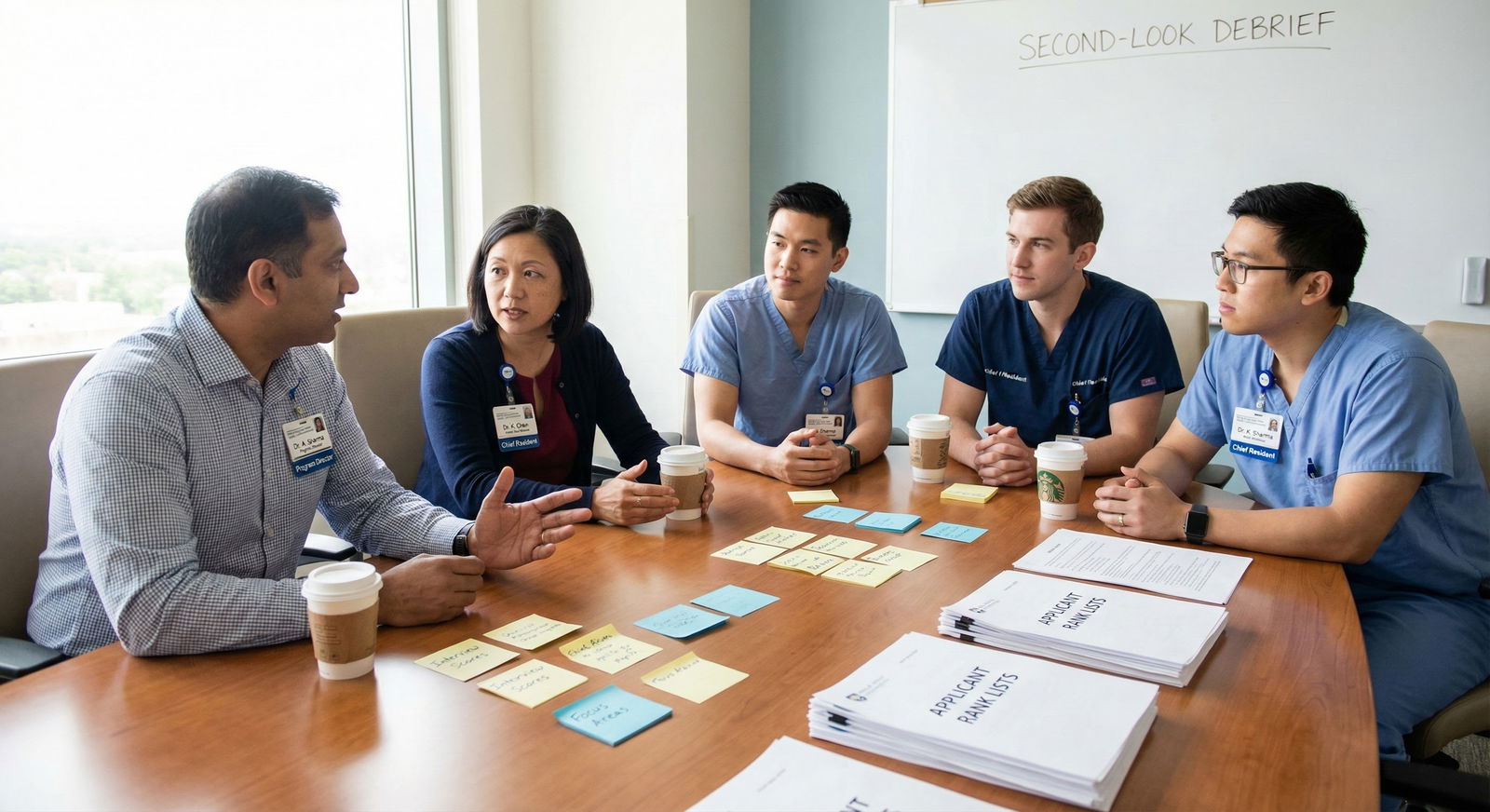
The mechanism is straightforward. Faculty who interview hundreds of applicants develop pattern recognition. They remember the candidates who stood out and forget the ones who blurred together. When you return for a Second Look and present as sharper, more curious, more conversationally fluent than your initial interview suggested, the faculty member experiences a cognitive dissonance that works in your favor. "This is not the same person I met in November." That realization prompts a re-evaluation. They pull up their original notes. They reconsider. They discuss you with colleagues. Rank list movement begins.
Crafting High-Yield Conversational Hooks
Every conversation during your Second Look needs a hook, a specific, memorable element that anchors you in the faculty member's or resident's memory. Generic questions do not create hooks. "What do you like most about the program?" is invisible. "I noticed your recent publication in the American Journal of Emergency Medicine on sepsis bundle compliance, has that changed your department's protocol implementation strategy?" is a hook. It demonstrates that you have done targeted research on the program's scholarly output since your interview. It signals sustained interest, not performative interest.
Prepare three to four high-yield hooks before your visit:
- A scholarly update. New research you have presented, a manuscript accepted since your interview, a conference poster. This directly addresses the gap between your paper and your presence by showing continued academic momentum.
- A program-specific clinical insight. Something you learned about the program's patient population, trauma designation, specialty clinics, or community health initiatives that connects to your specific career interests. This requires actual research into the program beyond the website's marketing language.
- A resident-reported strength. A specific aspect of the program that current residents highlight as genuinely valuable, flexible scheduling, robust simulation curriculum, strong mentorship culture. Referencing this during faculty conversations demonstrates that you have already begun integrating into the program's internal narrative.
- A forward-looking question. Not "What makes this program great?" but "How is the program adapting to [specific challenge or development]?" This signals that you think like a future resident who will participate in the program's evolution, not just consume its existing resources.
Active Listening as a Diagnostic Tool
Here is where most Second Look strategies fail. Applicants prepare their hooks, deliver them competently, and then disengage. They treat the visit as a presentation rather than a conversation. The programs notice.
Active listening during a Second Look is a diagnostic tool, not for you, but for the program. When a faculty member describes a clinical initiative, listen for the underlying need. Are they expanding a service line? Are they struggling with a specific patient population? Are they piloting a new educational curriculum? These disclosures are opportunities. When you respond not with a prepared talking point but with a targeted observation, "That sounds like it would require significant coordination between the ED and the hospitalist team; how has that cross-departmental relationship evolved?", you demonstrate the kind of clinical systems thinking that programs value in residents.
Turning passive hospital tours into targeted assessments requires discipline. You are not a tourist. You are a diagnostician evaluating whether this program fits your training needs and, critically, whether you can articulate how you will contribute to it. Programs want residents who add value, not just residents who consume educational resources. When you demonstrate that you have thought about what you bring to the program, not just what the program brings to you, you separate yourself from the majority of applicants who frame everything as a one-way value proposition.
High-Yield Interpersonal Tactics for Maximum Rank Impact
The interpersonal dynamics of a Second Look are layered. You interact with multiple stakeholders, each with different influence on the rank list, and each requiring a calibrated approach.
Program Coordinators: The Underrated Gatekeepers
Program coordinators are the most underestimated influencers in the residency selection process. They are not scoring your clinical knowledge. They are assessing your professionalism, your communication style, and your basic human decency. I have seen coordinators advocate forcefully for applicants who were thoughtful, organized, and respectful during their Second Look arrangements. I have also seen coordinators quietly flag applicants who were demanding, dismissive, or treated administrative staff as invisible.
Your interaction with the coordinator begins before you arrive. Respond to communications promptly. Be clear about your logistics. Express genuine appreciation for their coordination effort without excessive flattery. During the visit, check in with the coordinator, thank them in person, and follow up with a brief, professional note afterward. This is not strategic manipulation. This is basic professional behavior that, remarkably, many applicants fail to demonstrate.
Chief Residents: The Cultural Translators
Chief residents are the bridge between the applicant world and the resident world. They remember their own interview cycles. They know what genuine interest looks like versus performed interest. Their feedback to the program director carries weight because they are the ones who will work alongside you daily.
Engage chiefs as future colleagues, not as evaluators. Ask about their specific roles, their quality improvement projects, their experience balancing clinical and administrative responsibilities. Listen to what they volunteer about the program's culture, the good and the frustrations. When a chief tells you about a systemic challenge the program faces, do not rush to propose solutions. Acknowledge the complexity. Ask how residents are involved in addressing it. This demonstrates respect for existing structures and a collaborative rather than prescriptive mindset.
The Program Director: The Final Arbiter
If you have the opportunity to interact with the program director during your Second Look, recognize that this conversation carries the highest density of rank list influence. The PD has already reviewed your file, considered your initial interview performance, and formed a preliminary assessment. Your goal is not to re-interview. Your goal is to present new information that warrants reconsideration.
Approach the PD conversation with your highest-yield hook ready. If you have a meaningful scholarly or clinical update since your interview, this is the moment to share it naturally. If you have a specific question about the program's direction that demonstrates deep engagement, deploy it. Keep the conversation concise. PDs are busy. A focused, substantive three-minute exchange is more impactful than a rambling ten-minute monologue.
Avoiding the Over-Correction Trap
The most common Second Look failure mode is over-correction. Applicants who know their initial interview was weak often compensate by being excessively enthusiastic, aggressively self-promotional, or transparently desperate. These behaviors are immediately recognizable and actively harmful.
Signs of over-correction include:
- Excessive complimenting. Telling every faculty member how exceptional the program is, how it has always been your top choice, how you cannot imagine training anywhere else. This rings hollow unless you can back it with specific, substantive reasons.
- Conversation domination. Filling every silence with talking points, interrupting to insert your achievements, steering every conversation back to your qualifications. This signals insecurity, not confidence.
- Performative engagement. Asking questions you clearly do not care about just to appear interested. Faculty can distinguish genuine curiosity from box-checking behavior.
- Visible anxiety about ranking. Asking indirect questions about your standing, fishing for reassurance, or repeatedly emphasizing your commitment to the program in a way that suggests you are trying to compensate for a known weakness.
The antidote to over-correction is simple: be a competent, curious, professionally polished future resident. Not a salesperson. Not a supplicant. A colleague-in-training who is genuinely evaluating whether this program fits your goals and demonstrating, through natural conversation, that you would be a strong addition to the team.
The Post-Visit Communication Strategy
After your Second Look, you have one opportunity to reinforce your narrative through written communication. This is not a second cover letter. It is a brief, targeted message that accomplishes three things.
First, express genuine gratitude for the visit with specific reference to something that occurred, a conversation, a clinical observation, a resident interaction that gave you new insight into the program. Specificity demonstrates authenticity. Generic thank-you notes are invisible.
Second, provide a concise update if you have one. A new publication, a completed rotation, a presentation delivered since your visit. Keep it to one or two sentences. This is not the place for a full CV recap.
Third, reiterate your interest in the program with a specific reason that connects to what you observed during the Second Look. "My visit reinforced my interest in the program's approach to [specific initiative or strength], and I would welcome the opportunity to contribute to this work as a resident."
Respect Match communication guidelines. Do not ask about your rank position. Do not imply or state that the program is your number one choice unless it genuinely is and you understand the implications of that statement. Do not send multiple follow-up messages. One well-crafted communication is sufficient and professional.
Key Takeaways
- A weak initial interview is entirely salvageable if you approach the Second Look with strategic self-awareness and deliberate behavioral calibration. The unscripted environment of the Second Look is designed to reveal dimensions of your professionalism and interpersonal capacity that a structured interview could not capture.
- Program leadership uses Second Look visits to evaluate cultural fit, professional maturity, and teachability in real-world clinical environments. Faculty, chiefs, and coordinators each assess different behavioral domains, and their collective feedback drives rank list adjustments.
- Avoid over-correction at all costs. Desperation, excessive self-promotion, and performative engagement are immediately recognized and actively damaging. Maintain a balance of high-yield curiosity, professional polish, and genuine interest in the program's specific strengths. Let the contrast between your initial interview and your Second Look performance speak implicitly. That contrast is your most powerful advocacy tool.