
It’s late January. You’ve finished your last interview, your inbox isn’t popping anymore, and now everyone on Reddit and SDN is arguing about second looks. Your classmates are casually dropping lines like, “Yeah, I’m flying back to Hopkins and Mayo for second looks… you know, just to show interest.”
And you’re sitting there wondering:
Is this actually a thing programs care about, or is this just expensive cosplay?
Let me tell you how this really plays behind the closed doors of the conference room where rank lists get made.
The reality check: what second looks are (and are not)
Most applicants completely misunderstand the role of second-look visits. They project their anxiety onto the process and then assume programs are reading deep meaning into every flight they book or do not book.
They’re not. At least, not the way you think.
There are essentially three “eras” of second look culture:
- The old-school era (pre-virtual interviews) – second looks were common, sometimes encouraged, and occasionally did influence ranks.
- The COVID/early-virtual era – most places either banned or heavily discouraged them, and the party line became: “Second looks have zero impact on your rank.”
- The current messy hybrid era – officially, almost everyone says they don’t matter. Unofficially? They’re a small, context-dependent signal that can help at the margins, and occasionally damage you if you handle them badly.
Here’s the uncomfortable truth:
Second looks almost never move you from the middle of the list to the top. But they absolutely can:
- Break ties between similar applicants
- Clarify whether your “interest” email was real or just template spam
- Hurt you if you come across as needy, inappropriate, or tone-deaf to boundaries
The people who get burned are the ones who treat second looks like a performance instead of what they actually are: a professional, low-stakes interaction that programs observe mostly for red flags and occasionally for bonus points.
How PDs actually think about second looks
You need to understand the mental model program directors and ranking committees use.
Nobody is sitting there with an Excel column reading “Second Look? (Y/N)” and adding +3 points for yes. That fantasy lives on applicant forums, not in PD spreadsheets.
What they’re doing instead is this:
1. Sorting you into one of three “interest” buckets
Most programs I’ve worked with, sat in on, or consulted for implicitly put applicants into these categories:
| Interest Level | Typical Signals | How Second Looks Fit |
|---|---|---|
| Clearly High | Strong post-interview emails, specific questions, good interview day fit | Second look may confirm enthusiasm |
| Neutral/Unknown | Generic communication, no red flags, average interaction | Second look can clarify interest |
| Probably Low | Ghosted after interview, seemed disengaged, odd comments | Second look rarely fixes this |
They don’t call them that, but functionally that’s what’s happening.
When you do a second look, the PD is asking:
“Does this visit confirm what we already thought about this applicant, or contradict it?”
If you interviewed well, sent a thoughtful follow-up, and then show up for a second look with good questions and calm energy, your “Clearly High” bin is now written in permanent marker.
If you were a lukewarm interview, sent no follow-up, and then suddenly show up for a second look babbling about how we’re your ‘number one’… that gets read as anxiety, not conviction.
2. Looking for red flags more than gold stars
This one you’re not going to like, but it’s true.
On interview day, programs are looking for reasons to like you. On a second look, they are more frequently watching for reasons not to move you up.
Because by this point the file is mostly written. The interview notes are in. Your step scores and letters haven’t changed. The rank meeting is scheduled.
Second looks are where we see:
- Entitlement (“So realistically, where on your list would I be?”)
- Poor boundaries (cornering PDs in clinic, texting residents at weird hours)
- Social off-ness that didn’t show on the structured interview day
- Level of neediness (“I’ve emailed three times and never heard back, so I just showed up…”)
I’ve literally seen someone drop 20+ spots because their second look revealed that their interview-day persona was heavily curated and not sustainable.
3. Noticing fit more than flattery
Bad second looks are transparent. You show up, gush about how the program is “perfect,” and then ask questions you could answer with 90 seconds on the website.
Good second looks look different. They’re specific. Grounded. They sound like:
“I’ve been thinking more about your clinician-educator track. If I came here, how early could I realistically get involved in medical student teaching?”
or
“When I interviewed, we didn’t get to see the ICUs. I’m really interested in critical care – could I get a better sense of how the MICU rotations differ between PGY-1 and PGY-2?”
PDs don’t care that you flew back just to say you’re interested. They care that you’ve thought carefully about whether you fit what they actually offer.
Where second looks matter a bit, a lot, or not at all
Every specialty and every program culture is different. The weight given to second looks is not uniform.
Let me break down the patterns I’ve seen across programs.
Programs where second looks actually carry some weight
These tend to be:
- Small to mid-size community programs
- Newer programs still building a reputation
- Mid-tier academic programs that lose applicants to big-name competitors
For these programs, a second look from a solid but not super-elite applicant can feel like reassurance: “Ok, if we rank them high, they might actually come.”
They still won’t tell you that officially. But in the rank room, the conversation sounds like:
“We like Candidate A and Candidate B about the same. A came back for that second visit, asked good questions, seemed genuinely into what we do. B we haven’t heard from at all.”
Nine times out of ten, A gets the higher spot. Not because of the second look alone, but because the second look broke the tie.
Programs where second looks mostly do not move the needle
Big-name, highly competitive academic programs? They are not sweating whether you came back.
Harvard. UCSF. Penn. MGH. Those places are not sitting around thinking, “Gosh, I hope this 260/260 AOA with 12 papers really likes us enough to come back for a second look.”
They assume if you matched there, you’ll show up.
These programs sometimes even explicitly say: “Second looks will not impact our rank list.” And in those places, that statement is mostly true. Mostly.
What they do use second looks for at that level is:
- Extra data on borderline social fit
- Quiet vetting of applicants who made someone on the committee uneasy
- A courtesy for you, not a lever for them
If you’re a star candidate and you don’t do a second look, nobody cares. If you’re a marginal candidate and do a second look, nobody magically upgrades you to star.
Programs where second looks can backfire badly
There are also programs with strong anti–second look cultures now, especially post-COVID. Some PDs see them as inequitable (favoring applicants with money and geography) and are actively annoyed by them.
You’ll recognize these places by phrases like:
- “Second looks are neither expected nor encouraged.”
- “No additional in-person visits will be offered before rank lists are certified.”
- “Second looks will not be considered during ranking.”
Those statements are not just legal boilerplate. Sometimes they’re coded language that says: “Respect our boundaries or we will remember that you did not.”
If you push your way into a second look after being explicitly told they don’t matter or won’t be offered, that gets passed around the committee. Not in a flattering way.
What specific behaviors PDs watch during a second look
Let’s go granular. Because this is where the hidden scoring actually happens.
Your communication before the visit
PDs and coordinators notice:
- Did you ask politely for a second look or demand one?
- Did you accept “we don’t offer them” the first time, or try to negotiate?
- Did you give reasonable dates and flexibility, or insist on something that worked only for you?
Programs keep mental tabs on applicants who are high-maintenance before they’re even residents. Nobody wants to import drama.
Who you choose to meet (and how)
Smart applicants don’t only aim for the PD. They try to talk with:
- A chief resident
- One or two junior residents
- Someone tied to their specific interest (research director, fellowship director, etc.)
What PDs hear afterward is:
“Yeah, Candidate X came back. Chill. Asked good questions. Didn’t waste time. Seemed normal.”
or
“They cornered me in the workroom and wouldn’t stop asking, like, what their chances are if they rank us number one.”
Your goal is to leave your fingerprints everywhere in a good way: a few short, positive interactions with multiple people who will be in that rank meeting.
Your questions
The content of your questions tells PDs whether you’re naive, entitled, realistic, or genuinely curious about fit.
Bad questions sound like:
- “So, how competitive would I be for [hyper-elite fellowship] from here?”
- “Do residents ever moonlight PGY-1?” (when the website clearly says no)
- “What Step scores do you usually rank?”
Good questions are specific, anchored in what you already know, and show you’ve done your homework:
- “I saw that most residents do QI projects in PGY-2. Are there formal mentors assigned or is that resident-driven?”
- “On interview day, I heard call changed recently. How has that affected intern workload?”
You’re not being graded like an OSCE. But yes, they notice.
Your attitude and emotional temperature
Here’s a subtle one PDs talk about that applicants never think about:
Do you seem like someone who will handle residency with normal levels of stress, or someone who is already at a 9/10 before they even start?
Second looks amplify your baseline nervousness. If you’re already barely holding it together, those extra contacts often reveal it. Residents and faculty can feel that.
If multiple people report back some version of “Very anxious. Seemed desperate for reassurance,” that absolutely gets attention in the rank room.
What you do after the second look
Do you send a concise, sane thank-you email? Or a three-page manifesto about why this is the only program for you?
Programs do not need your 1,200-word ranking monologue. They need to know:
- You appreciated their time
- You remain interested
- You can communicate like a functioning adult
That’s it.
The money and equity elephant in the room
Behind closed doors, a lot of PDs and faculty are uncomfortable with second looks for one simple reason: they know they’re inequitable.
Plenty of great applicants:
- Can’t afford another cross-country flight
- Are on rigid clinical rotations
- Have family, caregiving, or immigration constraints
So no sane PD is going to say, “We favor people who can show up twice,” out loud. Many will even overcorrect: “We do not even want to know who came for second looks.”
But real behavior is more nuanced. Even when officially second-look data don’t get logged, humans remember faces and interactions. You can’t un-meet someone.
So the net result is this:
- Not doing a second look almost never hurts you.
- Doing a strategic, well-handled second look can help you around the edges.
- Doing a pushy, tone-deaf, or needy second look can absolutely hurt you.
You don’t win the game by throwing the most money at flights. You win by not being the story everyone is still talking about after you leave. In a bad way.
When you should and should not do a second look
Let me strip this down to something actionable.
Reasonable reasons to do a second look
You should seriously consider a second look when:
- You’re genuinely undecided between 2–3 programs and need more data on culture and day-to-day life.
- You have specific questions about tracks, research, or lifestyle that didn’t get answered on interview day.
- A program is likely to end up high on your list and you want residents to get a better read on you as a human being.
That last point matters more than you think. In many programs, the resident vote or resident discussion heavily influences rank order. A second look lets them see you in a more relaxed, real-world context.
Bad reasons to do a second look
These are the mindsets that get people in trouble:
- “I have to do second looks or I’ll look disinterested.”
- “If I just show them how much I love them, I’ll move up 20 spots.”
- “Everyone on Reddit is doing them, so I guess I should, too.”
Programs see through that instantly. You’re not the first person to fly across the country to perform enthusiasm.
The one non-negotiable rule
If a program explicitly says second looks have no role, or that they will not be offered, believe them. Do not try to game that.
Respecting boundaries is a professional test you don’t want to fail.
Quick comparison: how different program types tend to view second looks
| Program Type | Typical View on Second Looks | Real Impact on Rank |
|---|---|---|
| Elite academic | Officially neutral | Minimal, tie-breaker only |
| Mid-tier academic | Quietly interested | Small, context-dependent |
| Community, mid-size | Often appreciative | Moderate for close calls |
| Newer programs | Like extra interest | Moderate, helps reassure |
| Programs banning visits | Actively negative | Can hurt if you push |
Not every program fits neatly into this table, but you get the idea.
How to execute a second look without hurting yourself
If you decide to do one, do it like someone who will be easy to work with for three to seven years.
Step 1: Ask the right way
Keep your email to the coordinator or PD short, respectful, and flexible:
- Acknowledge that you know second looks are not required
- Express genuine interest
- Offer a range of dates
- Make it easy to say no without awkwardness
If the answer is “We don’t offer those,” you reply once with appreciation and move on. Full stop.
Step 2: Aim for normal human interactions
On the actual visit:
- Dress like you did for interview day or slightly more casual, but still professional
- Be on time, not 30 minutes early camping in the hallway
- Don’t monopolize any one person’s time
- Avoid rank-list talk and “If I rank you first, what are my chances?” nonsense
You’re there to see how the place runs, not trap people into admissions strategy sessions.
Step 3: Close the loop like an adult
Afterward, a short thank-you to the coordinator and, if you met them, the PD or key faculty. One to three sentences each.
Something like:
“Thank you again for arranging my visit yesterday. Seeing the residents on service and talking more about the X track really confirmed how well I’d fit with your program. I appreciate your time and consideration.”
Done. Do not follow that up with weekly emails.
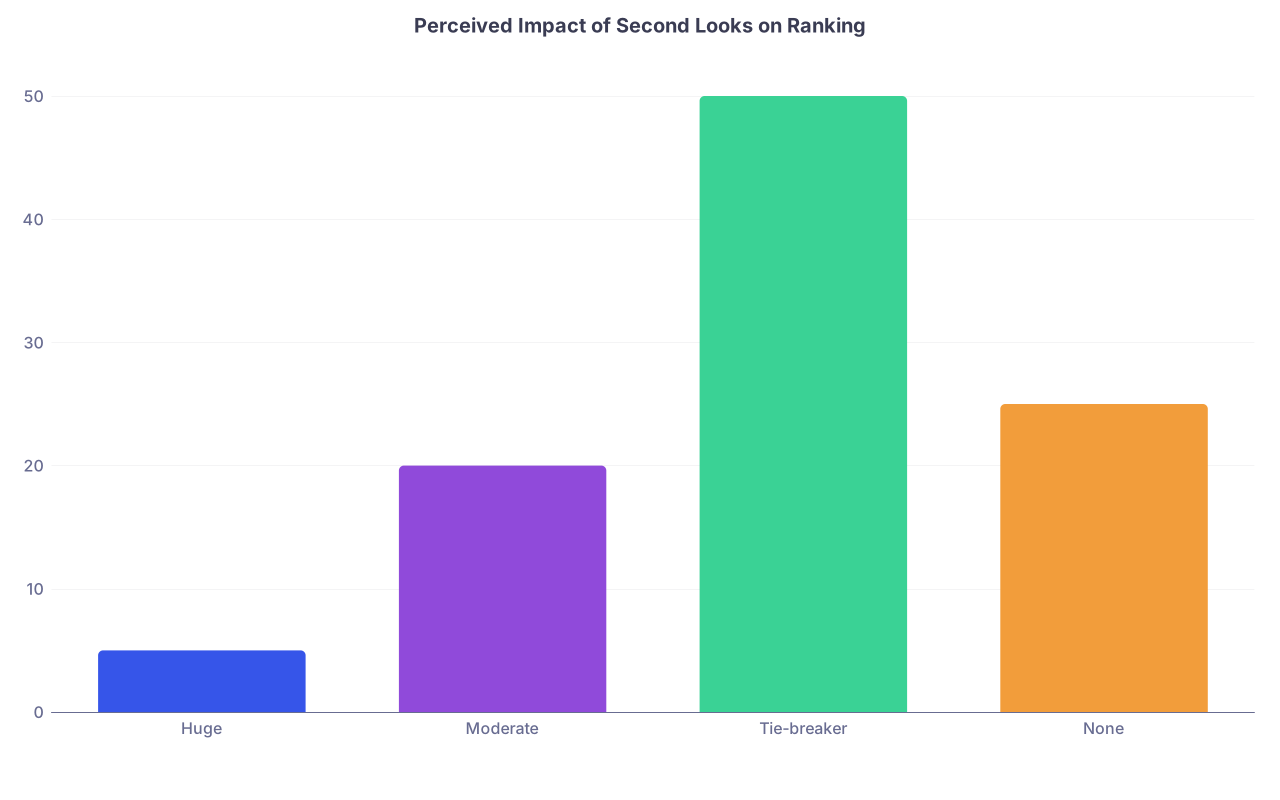
| Category | Value |
|---|---|
| Huge | 5 |
| Moderate | 20 |
| Tie-breaker | 50 |
| None | 25 |

| Step | Description |
|---|---|
| Step 1 | Considering Second Look |
| Step 2 | Do not ask again |
| Step 3 | Skip second look |
| Step 4 | Request visit politely |
| Step 5 | Attend and behave professionally |
| Step 6 | Send brief thank you |
| Step 7 | Build rank list |
| Step 8 | Program allows or neutral |
| Step 9 | Need more info to rank? |
FAQs: Second Looks and How PDs Read Them
1. If I love a program, do I need to do a second look to show that?
No. If you interviewed well, sent a thoughtful follow-up, and clearly articulated your interest, you’re fine. Not doing a second look almost never hurts you. Programs assume travel, money, and scheduling constraints are real. You do not fall on their rank list just because you stayed home.
2. Can a great second look move me significantly up a rank list?
Not from “probably not ranked” to “top 5.” That’s fantasy. Where a great second look helps is in close calls: being chosen over a similarly ranked applicant when the committee feels more confident you’d fit and actually want to be there. Think “micro-adjustment,” not “rocket boost.”
3. Can a bad second look really hurt that much?
Yes. Absolutely. I’ve been in rooms where applicants dropped sharply because the second look revealed entitlement, poor boundaries, or social weirdness that wasn’t obvious on interview day. You don’t get extra points for merely showing up. You can, however, lose points by how you act.
4. Should I tell a program during a second look that they’re my number one?
Only if (1) it’s actually true, and (2) you can say it without pressuring them. Even then, say it once, calmly, and without asking for reassurance in return. Something like: “I wanted you to know I plan to rank your program first.” Then stop. No begging. No follow-up bargaining emails.
5. If a program says second looks won’t affect ranking, can I safely ignore them?
You can safely not do one, yes. You won’t be penalized. But if you choose to do one anyway against their stated culture, that can reflect poorly on you. Take them at their word: if they say second looks are irrelevant or not offered, either skip them or keep any visit extremely low-key and resident-focused, ideally only if explicitly allowed.
Key points to take with you:
- Second looks are tie-breakers and red-flag filters, not magic rank boosters.
- Not doing one is almost never harmful; doing one poorly absolutely can be.
- Programs pay far more attention to your professionalism, questions, and vibe than to the mere fact that you showed up a second time.