
The worst mistake on second looks is trusting your memory. You won’t remember. You need a system.
You are not just collecting vibes; you’re collecting data for a high‑stakes decision. So yes, you should absolutely be taking notes during (and right after) second looks. But not random diary entries. Structured, comparable notes that actually help you rank programs.
Here’s exactly what to write down and how to do it so you can compare programs side‑by‑side without losing your mind.
The Core Principle: Make Programs Comparable
Let me be blunt: “I liked the people” and “felt good vibes” are useless when you’re staring at a rank list with 14 programs that all had “good people.”
Your notes need to do three things:
- Capture specific, factual details (call schedule, case volume, curriculum).
- Capture your gut reaction in the moment (before it gets contaminated by time, prestige, or what your classmates say).
- Use the same categories for every program so you can compare horizontally.
So the right question isn’t “what should I write?”
It’s: “what questions am I going to want answered when I’m sitting down to rank?”
Let’s build that.
A Simple, Reusable Note Template for Every Second Look
You want a one‑page template you can reuse for each program. That way, you’re not reinventing the wheel in the middle of a pre‑rounds coffee.
Use these sections. Same order every time:
- Snapshot & Vibe
- People & Culture
- Education & Support
- Schedule, Workload, and Call
- Clinical Exposure & Cases
- Logistics & Life Outside the Hospital
- Red Flags / Green Flags
- Overall Fit Score
1. Snapshot & Vibe (Top of the Page)
This is your quick‑and‑dirty impression.
Write down, in the first 5 minutes after you leave (not at midnight):
A one‑sentence summary:
“Feels like a high‑octane, academic‑heavy program with intense workload but great teaching.”Your immediate gut rating (0–10) on:
- “Could I be happy here?”
- “Would I be proud to train here?”
That’s it. Do not overthink.
2. People & Culture: What You Actually Notice, Not What They Say
Everyone says “we’re a family.” Ignore that. Watch behavior.
During the second look, take notes on:
How residents talk about each other and leadership
- “Intern said: ‘Our PD actually knows us by name and will text us after a rough call.’”
- “Senior mentioned: ‘We lost another co‑resident to transfer last year.’”
How residents seem in real time
- Look for: tired vs dead, sarcastic vs bitter, supportive vs sniping.
- Note specific moments: “Senior jumped in to help intern with a note without being asked.”
Diversity and inclusion
- Rough sense: “Class looks diverse / very homogeneous.”
- Any explicit examples: affinity groups, parental leave stories, support for non‑traditional residents.
Write down quotes. Short ones. You’ll forget exact wording later.

3. Education & Support: How You’ll Actually Learn
Prestige is noisy; structure is signal.
Focus your notes on:
Formal teaching structure
- “Protected didactics? How often, and are pages held?”
- “Morning report quality? Real case discussion vs checkbox session?”
- “Simulation, ultrasound, procedural labs?”
Feedback and mentorship
- “Do you get regular, structured feedback or just end‑of‑rotation evals?”
- “Is there a clear advisor/mentor system?”
- Any specific programs: teaching tracks, research mentorship, leadership development.
Exam / boards / fellowship outcomes (if relevant to your field)
- “Board pass rates mentioned? Typical fellowship placements?”
Don’t write paragraphs. Jot bullet phrases like you’re collecting evidence.
4. Schedule, Workload, and Call: The Stuff People Hide
This is where a lot of programs get vague. Your job is to write down actual numbers and concrete patterns.
Ask and note:
Hours and call
- Typical weekday hours: “Most days 6:30–6:00, pre‑rounds expected.”
- Weekend frequency: “q3–4 weekends as intern, improves PGY2.”
- Call type: “24‑hr in‑house vs night float vs home call.”
Service intensity
- “Average patient census per intern?”
- “Do you cap? What is the cap?”
- “Are you regularly over cap in reality?”
Ancillary support
- “Who does blood draws, transport, prior auths, paperwork?”
- “Is there a reliable night phlebotomy / transport team?”
This is where programs that look similar on paper start to separate.
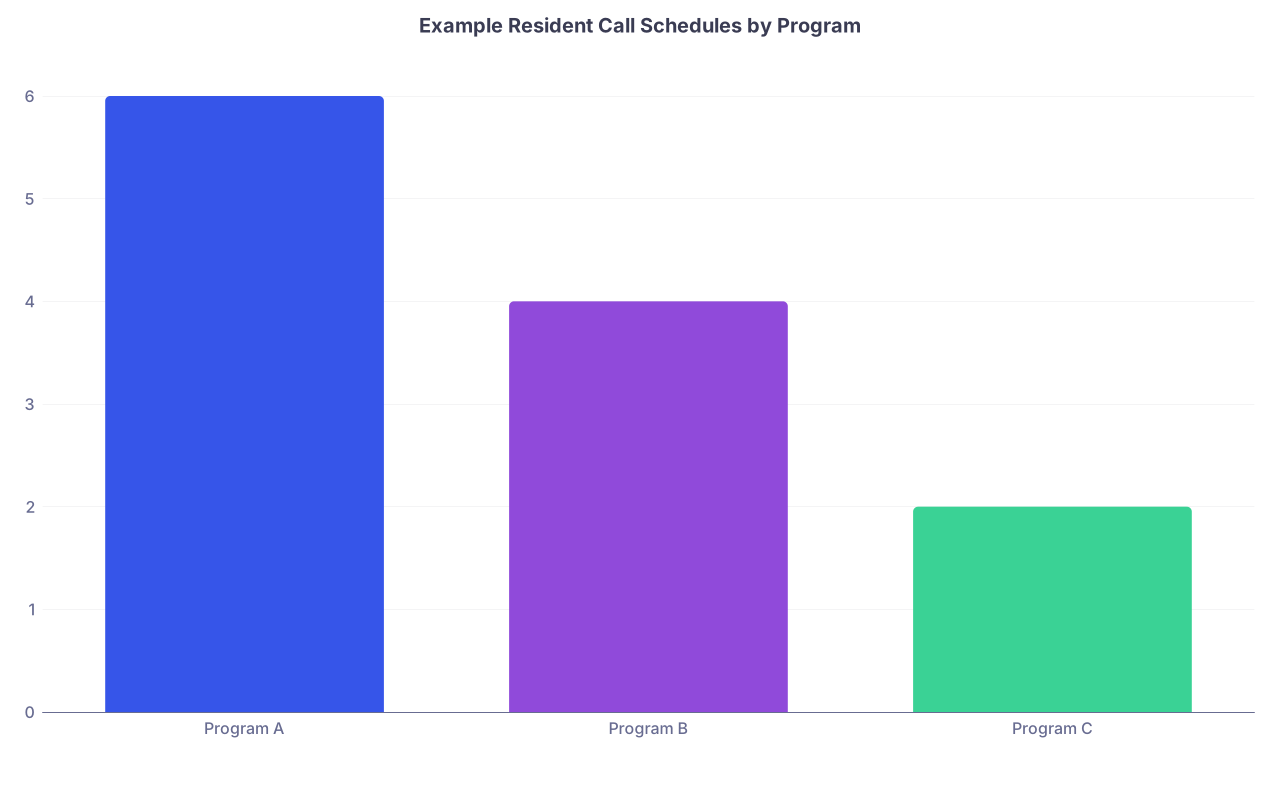
| Category | Value |
|---|---|
| Program A | 6 |
| Program B | 4 |
| Program C | 2 |
(Example: average 24‑hour calls per month for interns.)
5. Clinical Exposure & Cases: What You’ll Actually See
You are training for a career, not a brochure.
Write down:
Bread‑and‑butter volume
- “Tons of X (MI, COPD, trauma, OB, peds bronchiolitis), saw multiple cases during half‑day visit.”
- “Residents say they feel independently comfortable with Y procedure by mid‑PGY2.”
Tertiary/quaternary exposure
- “LVADs, ECMO, transplant, complex onc, high‑risk OB?”
- Too much zebras and no basics can also be a problem; note that balance.
Autonomy vs supervision
- Specific comments: “Attendings let us run the list and then give feedback,” vs “We mostly shadow on subspecialty services.”
You don’t need a case log on your notes page. Just enough to capture “average day” and “peak complexity.”
6. Logistics & Life Outside the Hospital
This part gets ignored until it’s too late.
Write down concrete things you’ll care about on a Thursday night after a brutal shift:
Commute and parking
- “Parking cost? Included or $$$?”
- “Resident lot close or 15‑minute walk?”
- “Realistic commute from where residents actually live?”
Housing and cost of living
- “Where do most residents live (neighborhoods names)?”
- “Is housing reasonably affordable on salary?”
- Any housing subsidies, meal cards, or benefits people actually use.
Hospital layout and workflow
- “Multiple campuses? How often do you shuttle between them?”
- “EMR smooth or universally hated? CPOE speed?”
City fit
- Quick personal notes: “I could see myself here / this feels too isolated / I’d be far from family support.”
| Factor | Example Note Style |
|---|---|
| Commute | 15 min drive, free parking |
| Housing | Most live 10–20 min away |
| Cost of Living | High, no housing stipend |
| EMR | Epic, residents like it |
| Campus Layout | 2 sites, shuttle q30 minutes |
7. Red Flags and Green Flags: Don’t Soften These Later
Your future self will try to rationalize things. Fight that by writing them down now in plain language.
Have two short sections in your notes for every program:
Green Flags (specific, behavior‑based)
- “Senior stayed late to help an intern with sign‑out.”
- “Residents openly praised PD without looking scared.”
- “Residents with kids seemed supported (talked about flexibility, childcare).”
Red Flags (one line each, no sugar‑coating)
- “Multiple residents independently said ‘We survive’ or ‘You just get through it.’”
- “No one could clearly explain how duty hour violations are handled.”
- “High PGY2 attrition mentioned casually.”
If you leave a program and feel uneasy but can’t name why, sit in your car and force yourself to write 2–3 sentences. That feeling usually has data behind it.
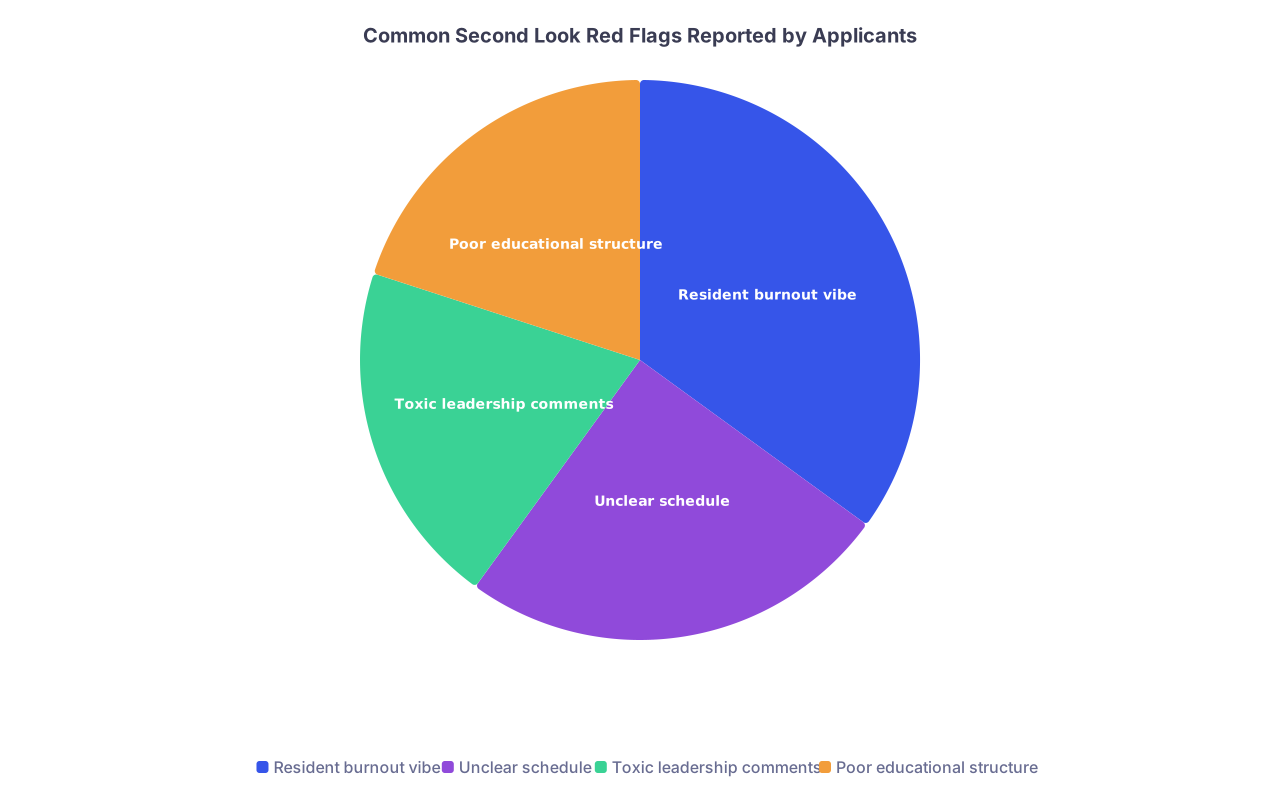
| Category | Value |
|---|---|
| Resident burnout vibe | 35 |
| Unclear schedule | 25 |
| Toxic leadership comments | 20 |
| Poor educational structure | 20 |
8. Overall Fit Score & Rank‑List Notes
End each note page with:
- A numerical “fit score” (0–10) based on your gut after the visit. Not prestige. Not fellowship match list. Fit.
- A brief “Rank List Note to Future Me”
- Example: “If I rank this above Program X, it should be because I value high‑volume, intense training and am willing to tolerate worse schedule and commute. Culture seemed slightly more stressed than X, but better education.”
That last line is gold when you’re comparing two places you mostly liked.
When and How to Take Notes Without Being Weird
You do not need to be that applicant scribbling furiously during rounds. There’s a smarter way.
Here’s what works:
During the visit
- Use your phone sparingly to jot a one‑word anchor: “parking,” “night float,” “OB volume,” “PD story.”
- Or star specific emailed info (sample schedules, didactics calendar) for later.
Immediately after each block (post‑rounds, post‑lunch, after resident tour)
- Step into a bathroom / hallway, take 2 minutes, and expand those anchors into short phrases.
In your car or on the train home
- Fill out your full template while the day is fresh. 15–20 minutes max.
If you wait “until tonight,” you’ll blend details from different programs and lose the small stuff that actually matters.
How to Turn Your Notes Into an Actual Comparison
Once you’ve done a couple of second looks, you’ll have several one‑page note sheets. Now you need a bird’s‑eye view.
Make a simple comparison tool. Could be a spreadsheet, could be paper.
Core idea: same rows (domains), different columns (programs), with your scores or short notes filled in.
| Domain | Program A | Program B | Program C |
|---|---|---|---|
| Culture Fit | 8/10 | 6/10 | 9/10 |
| Education | Strong | Moderate | Strong |
| Workload | Heavy | Moderate | Heavy |
| Lifestyle | OK | Excellent | Poor |
| Red Flags | 1 minor | 2 major | 0 |
You can weight things mentally. If you’re older, partnered, or have kids, “Lifestyle” might basically count double. If you’re gunning for a hyper‑competitive fellowship, “Education + Clinical Exposure” may trump most of the rest.
One More Thing: Capture Your “Non‑Negotiables”
Your notes will help a lot more if you decide in advance what matters most.
Before second looks, write down your top 3 non‑negotiables. Examples:
- “Supportive, non‑toxic culture.”
- “No 24‑hour in‑house call after PGY1.”
- “Strong preparation for X fellowship / high‑acuity clinical experience.”
- “Within X hours of family.”
Then, on each note sheet, literally add a tiny box:
- Non‑Negotiable 1: Met? Y/N + 1 line.
- Non‑Negotiable 2: Met? Y/N + 1 line.
- Non‑Negotiable 3: Met? Y/N + 1 line.
If a program fails 2 of 3, be honest with yourself. No amount of fancy pathology fixes that.

| Step | Description |
|---|---|
| Step 1 | Second Look Visit |
| Step 2 | Take quick anchors on phone |
| Step 3 | Write structured notes same day |
| Step 4 | Score key domains and fit |
| Step 5 | Compare across programs |
| Step 6 | Apply non negotiables |
| Step 7 | Finalize rank order |
FAQs
1. Is it OK to take notes on my phone during the second look, or will that look unprofessional?
It’s fine in small doses. If you’re constantly tapping while a resident is talking, it reads as distracted. The better move is to use your phone to quickly jot 1–2 word prompts right after a session (in the hallway, bathroom, or between events), then expand those notes later. If you want to take notes live during an info session, a small notebook actually looks more engaged and less like you’re scrolling Instagram.
2. Should I ask residents direct questions about red flags (burnout, toxic attendings, etc.) and write down their responses?
Yes, but with tact. Ask open questions: “What’s something you’d change about the program if you could?” or “How has the program responded when residents raised concerns?” Then paraphrase the gist in your notes, not every word. Watch their body language and how quickly they answer—that often tells you more than what they say. If three residents independently hint at the same issue, highlight it in your red flags section.
3. How detailed should my notes be? I don’t want to turn this into a part‑time job.
If your note template takes more than 15–20 minutes to fill out, it’s too much. Aim for short, high‑yield fragments, not essays. Think “evidence log,” not personal journal: 2–3 bullets per domain, 1–2 direct quotes max, clear red/green flags, and a fit score. Your future self is not going to read three pages per program the night before the rank list is due.
4. What if multiple programs feel very similar, even after taking notes?
That happens a lot. When everything looks similar on paper, use your notes to run tiebreakers: Which program had fewer red flags? Which one met more of your non‑negotiables? Which place gave you the strongest “I can see my future self here” reaction immediately after you left? If you truly cannot tell the difference, you can lean on geography, family proximity, or subtle culture cues you captured in quotes.
5. Should I include objective data (case logs, board pass rates) in my second look notes or just impressions?
Include both, but keep objective data light. If they give you hard numbers—board pass rates, fellowship match lists, average case volumes—note them in a simple phrase: “99% pass past 5 yrs” or “Strong match to GI, cards, pulm.” But remember: second looks are better at clarifying how it feels to train there than replicating what’s already in the brochure. Do not waste your time rewriting their website into your notebook.
6. How do I handle it if a program looks great on paper, but my second look notes are lukewarm or negative?
Trust your notes more than the brochure. If your real‑time impressions—culture, resident mood, red flags—don’t match the website or reputation, believe what you saw. You are signing up for 3–7 years of daily reality, not an abstract brand. In those cases, keep the program on your list if it still has big advantages (location, opportunities), but don’t be afraid to rank a “less flashy” program higher if your notes scream better fit and healthier training environment.
Key points: use the same structured template for every second look, capture both hard facts and real‑time gut reactions, and write down red flags immediately before you talk yourself out of them. Your notes exist to protect your future self from fuzzy memory and prestige bias. Use them.