
The second-look debrief is where the polite façade drops and the real opinions come out.
Everyone tells you second looks “don’t really matter,” that the rank list is already done, that it’s “just for you to see if it’s a good fit.” That’s not the whole story. Not in most programs, and definitely not in the competitive ones.
Let me walk you into that room and tell you what actually gets said once you’ve left the building.
When And Where These Meetings Actually Happen
Most applicants imagine some big formal committee right after second look, with PowerPoints and formal votes. That’s rarely how it goes.
Here’s the reality I’ve seen over and over:
At some places, the official rank list is “final” before second look.
Then they have an unofficial second-look debrief and quietly adjust anyway.At others, they deliberately delay finalizing the list until after second look, even if they tell applicants, “This won’t change your rank.”
At a few very rigid programs (certain big-name medicine or surgery places), the list truly is locked. Even there, second look still affects how people feel about you, and that sometimes leaks into late tweaks.
Mechanically, it usually happens in one of three ways:
- A scheduled meeting with PD, APDs, coordinator, chiefs, maybe a few core faculty.
- A “quick debrief” tacked onto a standing meeting: CCC, faculty meeting, or interview-season wrap-up.
- The most common and most honest version: informal conversations in the days after, then a short formal meeting where those impressions become changes.
Nobody advertises that third version. But it’s how most mid- to large-size programs work.

| Step | Description |
|---|---|
| Step 1 | Second look day |
| Step 2 | Residents talk |
| Step 3 | Chiefs gather opinions |
| Step 4 | Faculty share impressions |
| Step 5 | Program director debrief |
| Step 6 | Rank list tweaked or confirmed |
If you think your presence, your questions, your behavior at second look do not flow into that chain, you’re wrong. They absolutely do.
Who Is Actually In The Room (And Who Really Has Power)
On paper, it’s “the selection committee.” In practice, influence is very uneven.
This is roughly who’s there at many programs:
- Program Director (PD) – final word
- One or more Associate Program Directors (APDs)
- Chief residents (sometimes all, sometimes just one or two)
- Program coordinator (often quiet in the room, very powerful outside of it)
- A few key faculty who were heavily involved in interviews or second look
- Occasionally a resident rep who’s “on the committee”
But power is not distributed equally.
Here’s the uncomfortable truth: a strong statement from the right person outweighs three lukewarm comments from others. The PD will pay more attention to:
- Chiefs they trust
- Faculty they consider “good judges of character”
- The coordinator, if they say, “I have a concern” or “They were really respectful”
A PGY-2 who met you at lunch cannot override the chief resident’s, “That person felt off.” And a quiet APD who loves you won’t beat the PD’s gut if the PD is strongly negative.
This is why you need to understand something programs rarely admit: residents are not all equal in influence.
The senior resident who’s basically an unofficial chief? Their word carries weight. The intern who barely remembers your name? Not so much.
How They Talk About You: The Categories You’re Really In
Forget the vague “strong applicant,” “seems nice,” “good fit.” During the second-look debrief, your name will usually land in one of a few mental buckets.

The language varies, but the categories are surprisingly consistent across specialties:
Confirmed rock star
You came in highly ranked from interviews. Second look just cemented it.
Comments sound like:- “They fit right in with the residents.”
- “Asked smart questions. Zero red flags.”
- “Residents really liked them.”
Result: You stay high, sometimes nudged up a little.
Quiet climber
Not a slam dunk on interview day, but second look changed people’s minds.- “I actually liked them more this time.”
- “They seemed more relaxed and genuine.”
- “Residents who talked to them had a good vibe.”
Result: You move up. Not usually from bottom to top, but from “mid” to “safe” or from “borderline” to “solid.”
Paper star, in-person doubt
Great scores, glowing letters. But in real life?- “Bit arrogant.”
- “Talked more than they listened.”
- “Didn’t seem that interested in us.”
Result: You slide down, sometimes sharply. Programs will not phrase it this bluntly, but the subtext is: “We can fill with someone else who won’t be a headache.”
Enthusiastic but clingy
You showed up, clearly loved the place, but came off a bit intense.- “They really, really want to come here.”
- “A lot of emails. A lot.”
- “Very eager… maybe too much.”
Result: Mixed. Some PDs love this and move you up slightly. Others get wary and keep you where you are or drop you a few spots. Depends on whether they read it as commitment or desperation.
Soft red flag
Nothing explosive, but enough discomfort to stick.- “Something was off.”
- “Resident said they were dismissive during the tour.”
- “Kept asking about moonlighting and time off in kind of a weird way.”
Result: You don’t usually get removed. You get quietly pushed lower, sometimes into “only if we really need to go this far down.”
Hard red flag
This is rare but it happens.- Rude to staff.
- Inappropriate comment.
- Disrespectful about other programs, specialties, or patients. Result: You can drop dozens of spots or be taken off the list altogether. Yes, even if you had killer scores.
This isn’t theory. I’ve watched it happen in real time. People walk in thinking they’re untouchable because of their metrics, then a PD says, “I’m not sure they’re a fit,” and suddenly they’re not.
What They Actually Say: The Phrases You Never Hear
Program directors love sanitized language in public. In the debrief room, it’s more blunt.
You’ll hear things like:
“Are they going to be happy here?”
Often code for: they seemed too prestige-oriented, too research-heavy, or too lifestyle-focused for the program’s culture.“Do we think they’ll work hard?”
This is not about whether you said you’d work hard. It’s about how you carried yourself, asked questions, behaved with residents.“Will they get along with the nurses and staff?”
That story the coordinator tells about how you treated them at check-in? That matters more than your polished pitch to the PD.“Would I want to be on a night shift with this person?”
That’s probably the most honest screening question residents and chiefs use. A lot of final rank decisions boil down to that one.“Are they actually interested in us or just using us as a backup?”
Second look is often seen as commitment. If you show up disengaged, it can hurt you more than not coming at all.
No one is tallying your exact words like a debate judge. They’re walking away with an emotional summary. That summary gets translated into one of those categories above, then onto the rank list.
How Much Second Look Really Moves Your Rank
Let’s be blunt: you’re not leaping from #60 to #5 because of a nice lunch conversation. But these meetings are not symbolic either.
At many programs, typical movement after second look looks like this:
| Scenario | Approximate Movement |
|---|---|
| Strong second look, no red flags | Up 3–10 spots |
| Second look confirms top impression | Up 0–3 spots |
| Neutral/forgettable visit | No change |
| Mild concern raised | Down 5–15 spots |
| Clear red flag | Down 20+ or removed |
This is not rigid math; it’s the pattern. Big jumps are rare and usually tied to major new information:
- You reveal a legitimate geographic tie they didn’t know about.
- You make a strong connection with a key faculty member who becomes your advocate.
- A resident who’s highly trusted says, “We need this person; they’re exactly our kind of human.”
The bigger downward moves? Those are almost always from attitude, disrespect, or mismatch that becomes undeniable.
The Unseen Influence of Staff and Coordinators
Here’s a piece hardly anyone tells you: the coordinator and admin staff have more power than you think.
They’re usually not “voting” members on some formal sheet. But in the room, if the coordinator says:
- “They were late and didn’t really apologize.”
- “They were really kind and appreciative.”
- “They made me uncomfortable.”
The PD listens. Every time.
Why? Because staff see how you behave when you’re not performing. They see if you’re polite when no one “important” is watching. They see if you read your emails, follow instructions, and treat people decently.
An example I watched play out:
Applicant A: strong on paper. Showed up to second look, didn’t read the schedule email, repeatedly asked the coordinator questions that were already answered, was short and slightly annoyed when told where to go.
Outcome? Dropped a tier. Comments: “High maintenance,” “Not sure how they’ll be as an intern.”Applicant B: not as strong numerically. Quiet during formal sessions, but thanked the coordinator by name, helped move chairs after a talk without being asked, wrote a short thank-you email referencing specific things from the day.
Outcome? Moved up several spots. Comment from PD: “Everyone likes them. I’d be happy if they matched here.”
Programs will deny that “helping move chairs” matters. Then they’ll move you up because of the impression that you’re a team player.
How Residents Actually Shape The Conversation
You’ve heard “resident input is really important.” That’s partially true and partially marketing. Residents don’t control the list. But they absolutely steer it.
After second look, this is what really happens:
- Group chats light up: “Did you guys meet [Name]?”
- Informal consensus forms: good vibe, weird vibe, zero impression.
Chiefs and PDs then ask a couple of simple questions to residents who interacted with you:
- “What did you think of them?”
- “Could you see them fitting in with your class?”
If multiple residents independently say, “Loved them,” that pushes you up. If they all say some version of “I don’t remember them,” you stay where you were. If several say, “Eh… something felt off,” you’re going down, even if nobody can fully articulate why.
And yes, residents do bring up things you thought were small talk:
- How you talked about other programs.
- How obsessed you were with call schedule or vacation early in the day.
- Whether you showed basic curiosity about them as people, not just as informational objects.
No one expects you to be “on” like an OSCE. But the vibe you give off at lunch and during tours absolutely shows up in the debrief.
The “Does This Person Actually Want Us?” Question
Second look is a signal. Programs know you’re applying everywhere, but they’re trying to guess:
- Are we top 3?
- Are we top 5?
- Or are we just one of 30?
They’re reading between the lines:
- Did you come at all, given your geography and schedule?
- If you came, did you stay engaged the whole time or look like you were just checking a box?
- Did you follow up after, in a way that felt thoughtful rather than spammy?
Some PDs pretend not to care about this. Others care a lot. Quietly.
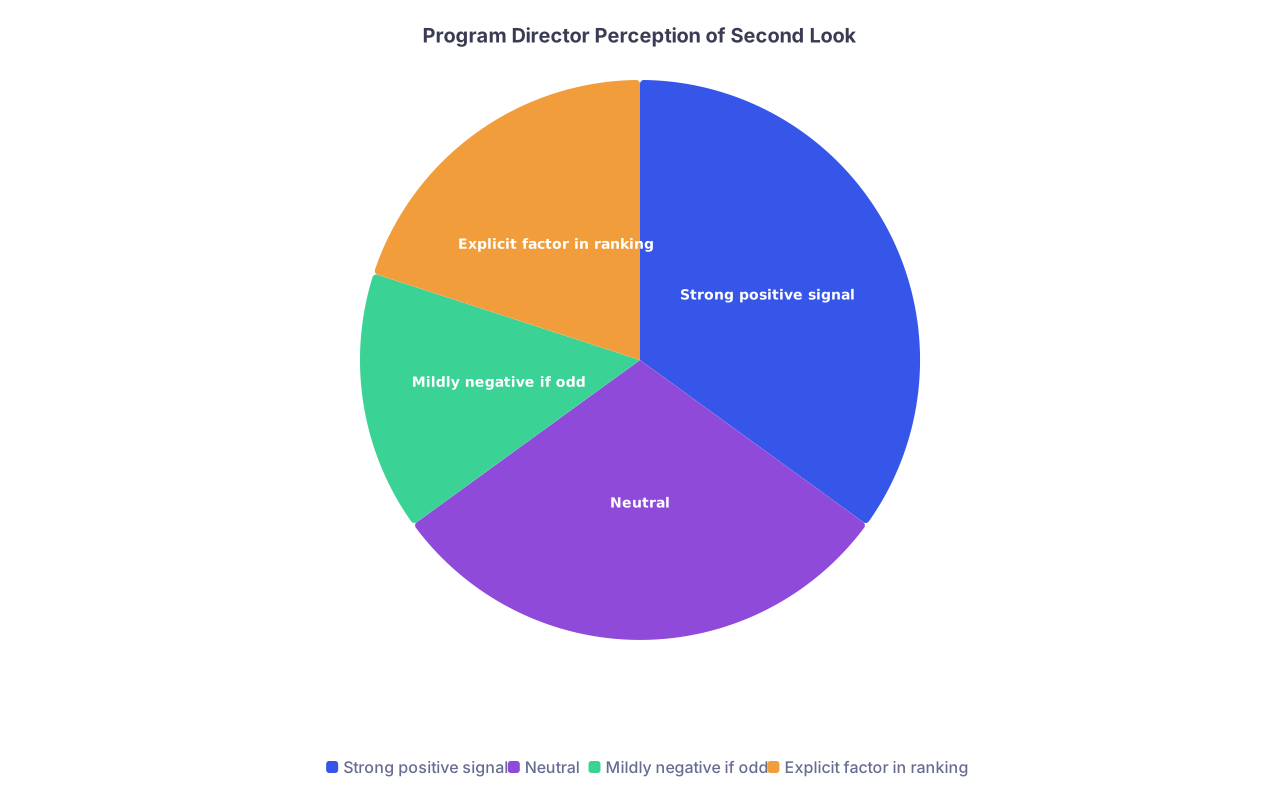
| Category | Value |
|---|---|
| Strong positive signal | 35 |
| Neutral | 30 |
| Mildly negative if odd | 15 |
| Explicit factor in ranking | 20 |
What that pie chart translates to behind closed doors:
- A good second look doesn’t usually catapult you to the top.
- A bad or weird second look can get you moved down or mentally labeled as “less likely to come.”
- No second look at all, if explained (far away, scheduling conflict), is often genuinely neutral.
But when they’re between two similar applicants, that “this person clearly likes us and we like them” feeling breaks the tie.
The Scripts Versus The Truth
On the record, you’ll hear lines like:
- “Our list is already set by the time of second look.”
- “Second look is for you, not for us.”
- “Coming or not coming won’t impact your rank.”
Here’s what I’ve actually seen happening:
PD announces to applicants: “List is done.”
PD in the debrief: “Let’s just sanity-check the top and bottom 20 after second look.”Faculty tell you: “Don’t feel obligated to come.”
Then in private: “It does show interest, though.”Residents say: “We don’t have much say.”
Then their group consensus quietly influences 10–20 spots.
I’m not saying everyone is lying maliciously. A lot of them genuinely wish second look didn’t matter, because it complicates everything and can introduce bias. But they’re human. They remember you. And those memories end up on the board.
What All This Means For You
Let me distill the insider reality into a few blunt truths:
Second look is not a magic bullet.
It won’t rescue a weak application or turn you into a superstar if you weren’t already competitive.It can hurt you more than it helps if you:
- Act entitled or disinterested.
- Treat staff or residents poorly.
- Overstep with PDs or come off as pushy about ranking.
It can help you at the margins if you:
- Show genuine interest without being obsessive.
- Treat everyone—from PD to administrative assistant—with the same respect.
- Ask questions that show you understand their program and could see yourself there.
The debrief is mostly about confirming or slightly adjusting existing impressions.
The extremes—huge boosts, catastrophic drops—are triggered by behavior that’s very obviously out of line one way or the other.
Second look debrief meetings are not about your away rotation performance, your Step score, or the eloquence of your personal statement. Those were already baked into your rank. The debrief is about this:
“Now that we’ve seen who they are when the pressure is a little lower… Do we still want them on our team?”
Years from now, you won’t remember the exact words spoken in that room—because you’ll never hear them. But how you carry yourself while people aren’t “formally” judging you will quietly echo there, long after you’ve gone home and refreshed your email for the hundredth time.