
The way most applicants do second looks is broken. They treat them like bonus interviews instead of what they really are: high-yield reconnaissance missions that will drain you if you do not control them.
You want to see multiple programs again. You also want to stay sane, pass rotations, not destroy your budget, and still make a clear rank list. All of that is possible—but only if you stop “saying yes to everything” and start running a system.
Here is that system.
Step 1: Decide Whether You Even Need Multiple Second Looks
First problem: people doing five second looks when they only needed one. Or zero.
You do not need a second look for:
- Programs where your gut is already a hard no
- Places where you would rank them low no matter what you see
- Institutions that told you explicitly they do not track or care about second looks
- Programs that gave you a thorough interview day with strong resident candor and transparent vibe
You might need a second look when:
- You are choosing between 2–4 programs you would be genuinely happy to rank #1–4
- You felt the interview day was heavily scripted or “too polished” and you want the real story
- You did not see critical aspects the first time (call rooms, clinic sites, resident workroom, night float, child-care options, etc.)
- You need to verify deal-breakers: partner job prospects, schools for kids, commute realities, cost of living, or specific niche training (complex spine, advanced heart failure, etc.)
Create a fast triage list.
| Program Type | Second Look Needed? | Reason |
|---|---|---|
| Obvious low rank | No | Time and energy not worth it |
| Clear #1 after interview | Usually no | Only if major life factors unclear |
| Cluster of 2–4 top choices | Yes / Consider | Clarify fit and lifestyle |
| Red flag you want to verify | Yes | Confirm if concern is real |
| City or region you barely know | Yes / Consider | Evaluate life outside hospital |
Be ruthless. Most applicants should land on:
- 1–3 second looks total
- Spread across their true top tier only
If you are already hovering at 6–8 planned visits, you are not “thorough.” You are setting yourself up for exhaustion and decision paralysis.
Step 2: Plan the Calendar Like a Mini-Block Schedule
You cannot bolt second looks onto your life randomly. You build around:
- Rotation schedule
- Peak fatigue weeks
- Hard deadlines (rank list certification, exams, family commitments)
Build a simple master calendar
Use Google Calendar, Notion, whatever. Block:
Non-negotiables
- Exam dates, important presentations, OSCEs
- Family events you actually care about
- Hard work days (call, 24s, clinic-heavy days)
Energy map
- Weeks where you know you will be wrecked (ICU, nights, EM)
- Weeks that are relatively light (elective, research, outpatient blocks)
Then place second looks only into:
- Lighter weeks
- Days immediately before or after an off day
- Thursdays / Fridays with a buffer into the weekend when possible
Do not be the person flying back Sunday night, rounding exhausted Monday, and pretending that is sustainable for three weeks.
To see how quickly this stacks up:
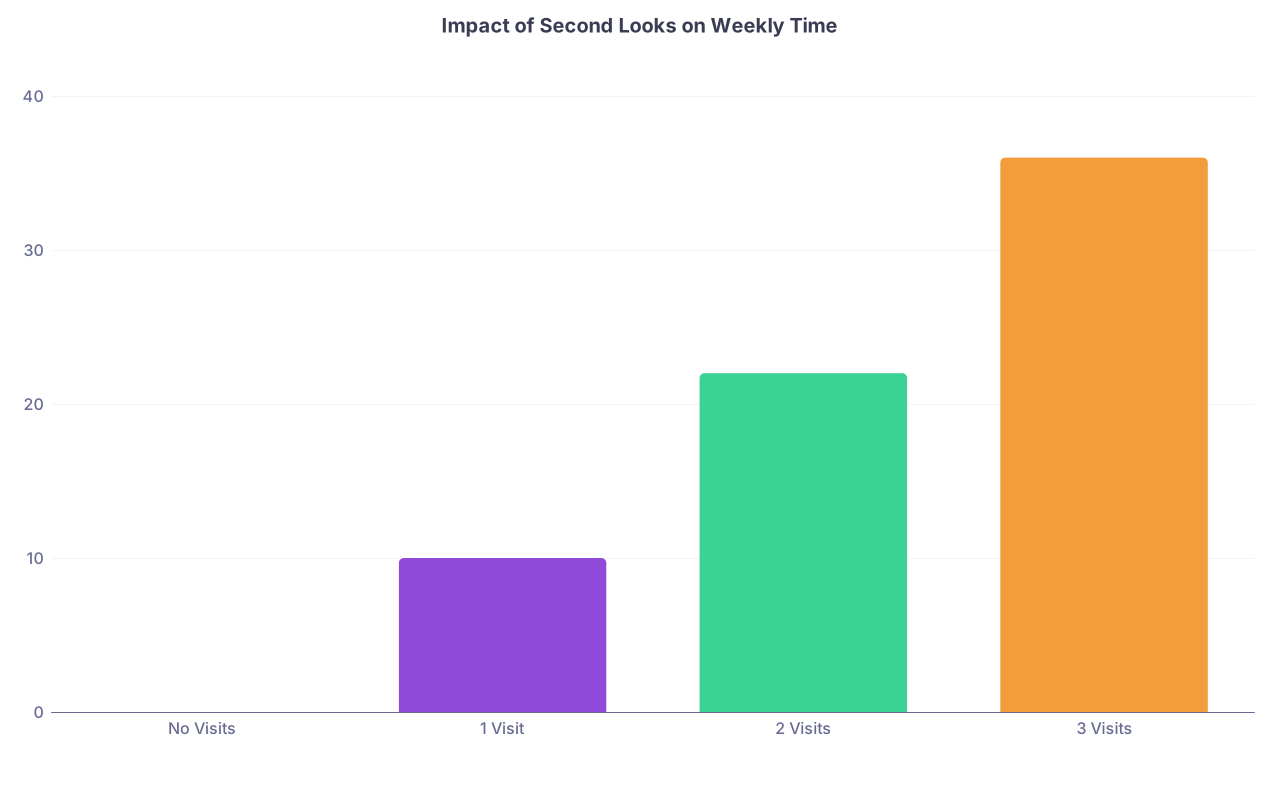
| Category | Value |
|---|---|
| No Visits | 0 |
| 1 Visit | 10 |
| 2 Visits | 22 |
| 3 Visits | 36 |
(That is travel + visit + recovery hours per week, conservative estimate.)
If you are considering more than 2 visits in a 3-week window, you need to justify it like you are presenting on rounds. Clear benefit. Otherwise, cut.
Step 3: Choose Visit Formats That Cost Less Energy
The biggest mistake I see: people assuming “second look” means full-day, in-person, orchestrated event.
You actually have options:
Full in-person second look
- High yield for: checking city fit, housing, commute, partner opportunities, physical facilities, resident vibe
- High cost: travel, time off, fatigue
Half-day focused visit
- Morning rounds + noon conference
- Afternoon clinic + short tour
- Much gentler on your system
Virtual mini-second look
- 30–60 minute Zoom with 2–3 residents
- Quick chat with PD or APD if specifically invited
- Lower emotional and time cost; still useful for targeted questions
Asynchronous “second look lite”
- Email questions to residents you clicked with
- Ask for a day-in-the-life outline
- Request photos or short video walkthrough of call rooms, workroom, etc.
If you are doing multiple second looks, you almost never need all of them to be full in-person visits. Pick 1–2 to be “anchor” in-person visits. Make the rest:
- Half-day in-person
- Or virtual / resident-only conversations
Use in-person when:
- City choice is a major part of your rank decision
- You had limited face time with residents previously
- Your partner or family needs to see this location
Use virtual when:
- You are clarifying culture, schedule specifics, or niche training questions
- Travel is a budget or rotation problem
- The main issue is “I just want to hear how they really talk off-script”
Step 4: Script How You Request Second Looks (Without Sounding Desperate)
You do not need to over-think the email. But you also should not send a four-paragraph life story.
Basic rules:
- Keep it short
- Be clear about what you want to see or learn
- Avoid hinting at ranking games (“I am ranking you #1 if…”)
Sample template you can actually use:
Subject: Second Look Visit Inquiry
Dear Dr. [PD Last Name],
Thank you again for the opportunity to interview with [Program Name] on [date]. I enjoyed meeting the residents and learning more about your program.
As I work on finalizing my rank list, I am hoping to arrange a brief second look to better understand the day-to-day resident experience and see more of the hospital environment. Would there be an appropriate time for me to visit for a half day in [time window—e.g., late February], focusing on [rounds/clinic/ED/resident workroom/etc.]?
I understand the importance of not interfering with patient care or the ranking process, and I am happy to follow whatever structure or limitations your program prefers for second looks.
Thank you for your time and consideration.
Sincerely,
[Your Name], MS4
[School]
Key moves here:
- “Half day” is intentional—it signals you are respectful of their and your own time
- You state your purpose clearly
- You acknowledge ranking-process boundaries so you do not trigger any anxiety about policy violations
If they do not offer structured second looks, pivot quickly:
- Ask for a Zoom with a chief or a couple of residents
- Or ask if there is a specific open house / Q&A you should attend instead
Do not chase. One follow-up after a week is fine. After that, let it go.
Step 5: Build a Ruthless Prioritization Grid
If you are still staring at 5+ possible visits, you need a sorting tool. Use a simple 3-factor grid:
- Likelihood to Rank in Top 3–4 (0–3)
- Uncertainty About Fit (0–3)
- Life Impact Unknowns (0–3)
- Cost of living, partner job market, commute, safety, schools, etc.
Score each program from 0–3 on each dimension, then rank by total. Example:
| Program | Rank Likelihood (0–3) | Fit Uncertainty (0–3) | Life Unknowns (0–3) | Total Score |
|---|---|---|---|---|
| Urban Academic A | 3 | 2 | 1 | 6 |
| Suburban B | 2 | 3 | 3 | 8 |
| Home Program C | 3 | 1 | 0 | 4 |
| Far Away D | 1 | 2 | 2 | 5 |
In that example:
- Suburban B probably deserves an in-person look
- Urban Academic A might get a shorter or virtual second look
- Home Program C probably needs no visit—you already know it
- Far Away D may be a virtual-only candidate
This is how you avoid wasting a plane trip on a “cool-sounding” program you are unlikely to rank high.
Step 6: Time-Box the Visit and Control the Schedule
Once the program says yes, you do not let the day sprawl into chaos. You propose a tight window:
Ideal structure for a half-day in-person:
- 07:00–09:00: Round with a team (floor or ICU)
- 09:00–09:30: Quick tour of resident spaces and call rooms
- 09:30–10:30: Sit in on sign-out, conference, or clinic
- 10:30–11:15: Resident-only debrief (no attendings, no PDs)
- Depart by late morning or early afternoon
You do not need:
- To meet every attending again
- Another formal PD interview
- Dinner with half the department
Say this explicitly when you schedule:
- “I am hoping for a focused 3–4 hour visit with time to see rounds, conference, and talk with residents. I want to be respectful of your schedules and keep this as low-impact as possible.”
This protects your energy and signals professionalism. Programs like applicants who are not high-maintenance.
Step 7: Run a Simple Question Script So Every Visit Is Comparable
Without structure, second looks turn into noise. You walk away with random impressions like, “People seemed nice.” Not helpful.
You want to ask mostly the same questions at each program so you can compare.
Core sets:
Resident culture and support
- “What has surprised you most about the program—good or bad?”
- “What do residents complain about when they feel safe to vent?”
- “When someone struggles here (personal or academic), what actually happens?”
Workload and schedule reality
- “On a typical ward month, when do you get out most days?”
- “How often do you leave late on ‘non-call’ days?”
- “Which rotations feel the most brutal, and why?”
Career and fellowship outcomes
- “Did people feel supported in getting the fellowships or jobs they wanted?”
- “How many residents in your class changed their career plans after starting here?”
- “Does anyone feel pressured into certain fellowships or staying on as faculty?”
Life outside the hospital
- “Where do most interns live, and how is the commute really?”
- “If you had kids / partner / pets, would this setup still work?”
- “Do you actually use your days off, or are they mostly recovery days?”
Two rules:
- Ask for concrete examples: “When that happened, what did leadership actually do?”
- Watch for hesitation, group-think, or weird glances between residents
You want patterns, not one-off stories. If three different people mention the same problem in different ways, believe it.
To organize the data, use a quick score sheet immediately afterward. Otherwise your brain scrambles everything by week two.

| Step | Description |
|---|---|
| Step 1 | Finish Visit |
| Step 2 | 10 min Solo Notes |
| Step 3 | Rate Culture 1-5 |
| Step 4 | Rate Workload 1-5 |
| Step 5 | Rate Life Fit 1-5 |
| Step 6 | Update Rank Draft |
Step 8: Guardrails Against Burnout While You Are Doing All This
Multiple second looks will burn you out if you treat them like vacations or “bonus interviews.” They are neither. They are work.
Set these guardrails:
1. Hard weekly cap
- Max travel days per week: 2
- Max nights away in a 10-day stretch: 4
- Max second looks total: usually 1–3
2. Mandatory buffer days
- No back-to-back second looks in different cities
- Always give yourself at least one low-demand day after travel before heavy clinical work
3. A simple travel rule
- No 6 AM outbound flights after a call or late shift
- No red-eye flights during this season unless there is absolutely no alternative
- If a flight leaves you non-functional for 24 hours, it was the wrong flight
4. Sleep and nutrition basics (actually enforced)
- Protect 7 hours minimum the night before each visit
- Pack real food, not just granola bars and caffeine
- Do not overload on coffee to fake being “on”—you will crash and your impression of the program will be biased by your own jittery state
And watch your own metrics:
- If you start getting sick, short-tempered, or chronically behind on rotation duties, you have already over-scheduled. Cancel the lowest-yield visit first. No hesitation.
I have watched more than one student tank an attending’s impression of them on a sub-I because they were exhausted from “just one more visit.” Not worth it.
Step 9: Keep Programs Out of Your Ranking Brain Until You Are Done
This is subtle but important for mental health.
During the visit phase:
- You are gathering data. That is it.
- You are not finalizing your rank list in real time after each visit.
- You are not emailing programs “You are my top choice” after every mildly positive experience.
Keep a rank draft list, private:
- After each visit, you can slide programs up or down one position based on what you learned
- Do not obsess over 3 vs 4 vs 5 yet. Look for emerging tiers:
- Definitely top tier
- Middle tier
- Lower tier but on the list
You only finalize ranking after:
- All second looks are done
- You sleep on it at least one night
This prevents you from over-weighting the most recent shiny experience and under-valuing the more stable, reliable options.
Step 10: Financial Sanity—Do Not Light Your Money on Fire
Travel costs accumulate faster than people expect. Flights, Uber, food, parking, maybe hotel. That is how you end up with a $1,500 “just for second looks” bill you did not plan.
Build a quick budget:
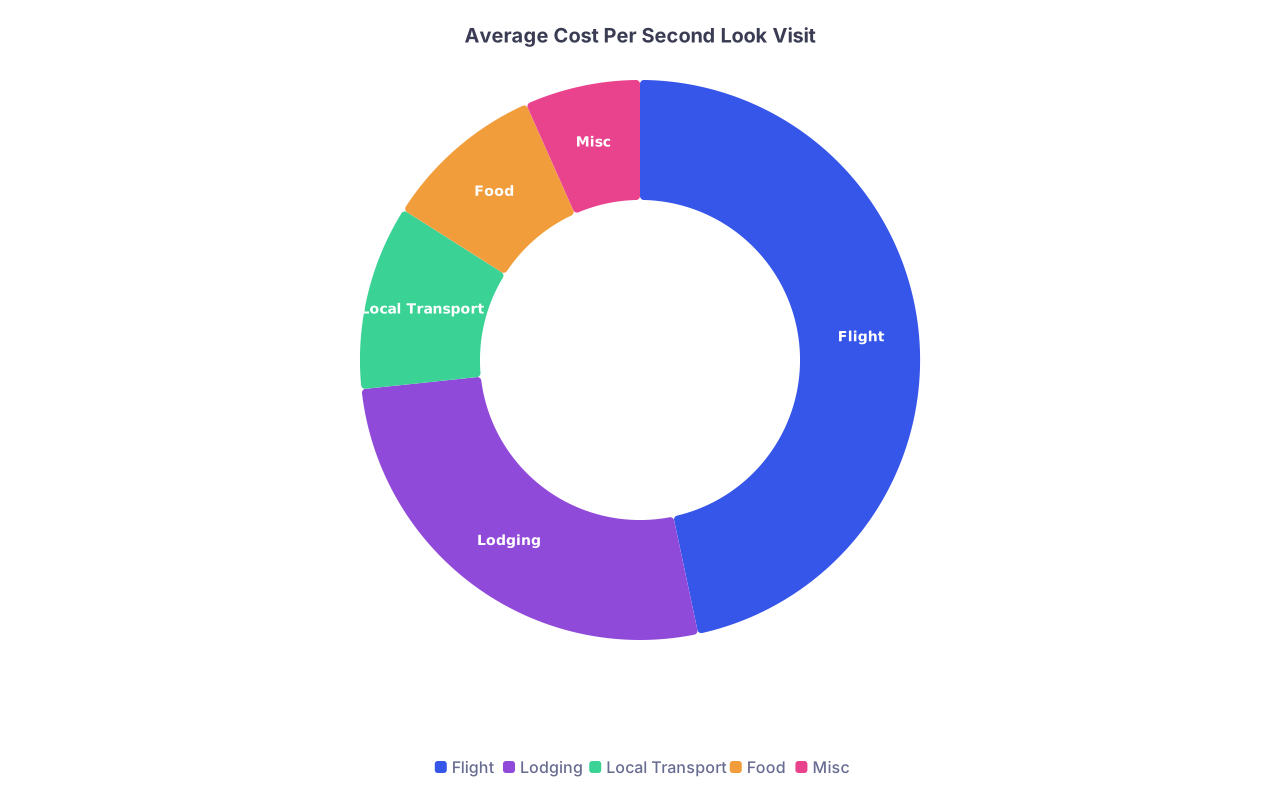
| Category | Value |
|---|---|
| Flight | 350 |
| Lodging | 200 |
| Local Transport | 80 |
| Food | 70 |
| Misc | 50 |
Rough typical total: $700–$800 per full in-person visit. That number should make you selective.
Tactics to reduce cost (without being reckless):
- Cluster visits by region—hit two programs in one trip if they are geographically close and you can keep each visit short
- Stay with friends, alumni, or residents if offered and you feel comfortable
- Use public transit when it is safe and reasonable
- Cap restaurant spending; second looks are not culinary tourism
And yes, sometimes the answer is:
- “I am not flying across the country again for a program that is realistically #4 on my list. I will do a Zoom second look and live with a small amount of uncertainty.”
That is not “settling.” That is adult prioritization.
Step 11: Decide When To Cancel or Scale Back
You should expect that at least one planned second look will turn into a “this no longer makes sense” situation.
Reasons to cancel:
- Another program clearly moves into a dominant #1 position
- Travel logistics implode (weather, rotation, family issues)
- Your own health or performance is suffering
Do not over-apologize. You can send a simple note:
Dear Dr. [PD Last Name],
Thank you again for arranging the opportunity for me to visit [Program Name]. Due to unexpected schedule constraints, I will unfortunately not be able to make the planned second look.
I remain very appreciative of the chance to have interviewed with your program and to learn about [specific aspect].
Sincerely,
[Your Name]
You do not owe them your life story. You do not need to re-schedule if it genuinely no longer makes sense.
Step 12: Convert Data to a Final Rank List Without Overthinking Yourself Into Misery
Once second looks are done, give yourself one structured decision session. Not a week of ruminating.
Framework:
Life first
- Where can you reasonably see yourself living 4–7 years without resenting your life?
- Which cities or regions are a hard no for your partner, kids, or mental health?
Program culture second
- Where did you feel you could actually show up as yourself?
- Where did residents look tired but not broken? That is your sweet spot.
Career needs third
- Will this place reliably get you to your likely career path? Not dream scenario. Likely scenario.
- Do not overweight prestige if your day-to-day will be miserable.
If you want to put numbers to it, fine. Create three columns:
- Life fit (1–5)
- Culture and support (1–5)
- Career/training (1–5)
Then give each program a quick score. But do not let the math override your gut if the numbers conflict wildly with how you actually feel.
A Quick Visual on the Whole Process
Just to be clear how this all flows:

| Step | Description |
|---|---|
| Step 1 | Identify Top Programs |
| Step 2 | Triage Need for Second Look |
| Step 3 | Skip Visit |
| Step 4 | Score Priority |
| Step 5 | Choose Visit Type |
| Step 6 | Schedule Within Guardrails |
| Step 7 | Conduct Focused Visit |
| Step 8 | Immediate Debrief and Scores |
| Step 9 | Update Rank Draft |
| Step 10 | Finalize Rank List After All Visits |
You are not just randomly accepting invitations. You are running a controlled process.
The Bottom Line
Three things you should leave with:
Second looks are tools, not trophies. Use them only for programs that are realistic top choices and where your uncertainty is real, not manufactured.
Control the structure and volume. Half-day visits, virtual options, clear guardrails on time, money, and energy—that is how you avoid burnout while still getting the information you need.
Decide like an adult, not an applicant chasing validation. Protect your rotations, your health, and your budget. A slightly imperfect data set with a clear head beats “I saw everything” while exhausted and confused.