How Overplanning Your Second Look Can Backfire With Residents
How many Google Sheets are you going to make for a “casual” second look before you accidentally creep out the very residents you’re trying to impress?
Let me be blunt: second looks are where strong fits quietly confirm themselves—and where overplanners quietly sabotage themselves. Not because they’re bad applicants. Because they try too hard, in all the wrong ways, in front of the wrong audience.
Residents can smell that from across the workroom.
You think you’re showing commitment and “serious interest.” They see someone who might be exhausting to work with at 2 a.m.
Let’s walk through the major ways overplanning your second look backfires—and how to avoid looking like a walking red flag.
Mistake #1: Treating a Second Look Like a Second Interview
The first big mistake: you show up like it’s Step 3 of the interview gauntlet instead of what it really is—a vibe check.
Second looks exist so you can answer: “Can I live and work here with these people?” Programs use them, informally, to answer the same about you. This isn’t another OSCE. It’s an authenticity test.
Overplanners miss that.
They come in with:
- A memorized elevator pitch… again
- A mental list of “key points to re-emphasize”
- Pre-scripted questions that sound like they came from Reddit instead of their actual brain
Residents are not fooled. They already saw Interview Day You. If second-look-you feels like a rebooted character with additional DLC content, it’s weird.
Here’s what happens when you treat it like another interview:
You talk too much and listen too little.
Instead of asking residents how they actually feel about the call schedule, you’re busy squeezing in, “I just really value strong clinical training and longitudinal relationships with patients.”You project stress.
When you’re stuck in “performance mode,” your anxiety bleeds out in your tone, your posture, your interruptions. Residents don’t think “this person is so dedicated.” They think, “I do not want this nervous energy next to me for 28 hours.”You miss the real data.
Because you’re so focused on “making a good impression,” you don’t notice that the PGY-3 barely knows the med students’ names. Or that everyone flinched when someone mentioned nights. You leave with a carefully curated narrative instead of reality.
Don’t make this mistake. You already did the polished applicant routine. Second look is where you act like the person who’ll actually show up on July 1st. Not the over-rehearsed beta version.
Mistake #2: Over-Structuring Your Day Like a Military Operation
I’ve seen applicants walk into a second look with printed itineraries they built themselves. “9:00–9:20: prerounds with senior. 9:20–9:40: see ICU. 9:40–10:10: talk with interns about work-life balance.” That kind of thing.
Residents are juggling real work. Consults, admits, cross-cover pages. Your hyper-detailed plan does not care about that. And that’s the problem.
You overplan your day, it sends a bunch of the wrong messages:
- You don’t understand that the hospital is not a controlled environment
- You might be rigid and demanding as a trainee
- You struggle with uncertainty and improvisation

| Step | Description |
|---|---|
| Step 1 | Decide to Do Second Look |
| Step 2 | Plan Detailed Schedule |
| Step 3 | Hospital Day Goes Off Script |
| Step 4 | Applicant Looks Stressed and Rigid |
| Step 5 | Residents Question Fit |
You want structure, sure. But here’s the line you don’t cross: when your plan becomes more important than the people in front of you.
Bad signs you’ve crossed it:
- You keep checking your phone to “make sure you’re on schedule”
- You cut off a good conversation with an intern because “you really wanted to see the ICU”
- You seem visibly thrown off when a clinic is running late or a resident gets called away
You think it shows “initiative” that you pre-arranged 6 conversations via email. Residents read it as, “This person will constantly need things to go a certain way.”
Better approach: Anchor your day around 1–2 priorities (watch morning sign-out, talk to interns without attendings, see where people actually hang out) and let the rest stay fluid. You’re entering their system; you do not get to control the flow.
Mistake #3: Turning Every Resident Interaction Into a Formal Q&A
Another overplanning disaster: you come in with a huge list of written questions and you’re determined to get through all of them.
So every interaction becomes a structured interview:
“So, I have a few questions. First, how would you describe the autonomy on night float? Second, how supportive are attendings when you ask for help? Third, on a scale from 1 to 10, how approachable is leadership?”
I’ve watched residents quietly recoil during these. They’ll answer, but the vibe flips from “future coworker” to “survey instrument.”
Here’s what residents actually want those interactions to feel like:
- A normal conversation
- Back-and-forth, not interrogation
- Some sense that you’re reacting to what they say, not reading from a mental checklist
The irony: you often get better information when you’re not burning through a list.
If you ask, “What surprised you most about intern year?” and then actually shut up and listen, residents will give you the good stuff—unfiltered. But if you keep firing question after question, they default to polite, generic answers just to get through them.
Don’t be the applicant who treats each resident as a box to check:
- “Talked to intern – check”
- “Talked to chief – check”
- “Asked about research – check”
You’re not data gathering for a trial. You’re trying to figure out who you’ll suffer hallway medicine and broken printers with.
Mistake #4: Overscheduling Meetings With The Wrong People
This is where overplanning goes from annoying to actively damaging: stacking your day with meetings that signal you’re not really here to see what matters.
I’ve seen applicants do second looks like this:
- 30 minutes with the PD (again)
- 30 minutes with the APD (again)
- 45 minutes with the research director
- 30 minutes with a fellowship director
- 15 minutes, maybe, with an intern “if time allows”
That’s backwards.
Residents notice who you choose to spend your limited time with. If your second look is basically “extra administration time,” they assume you care more about optics than reality.
Here’s the thing programs rarely say out loud: if your rank hinges heavily on what you see on a second look, you’d better be spending the bulk of that time with residents.
| Person Type | Priority Level | Why It Matters Most |
|---|---|---|
| Interns/PGY-2 | Highest | Real day-to-day reality |
| Senior residents | High | Culture, expectations, teaching style |
| Chief residents | Medium | Systems, advocacy, big-picture view |
| PD/APD | Low on 2nd look | You already met them |
| Fellowship directors | Lowest | Not who you work with daily |
If your schedule is 80% faculty and 20% residents, the story you’re telling—whether you mean to or not—is that you’re more interested in networking and career leverage than actually seeing if you fit the team.
Residents are protective of their culture. Subconsciously, they’re thinking, “Is this person going to be a black hole of careerism who never helps with scut but somehow always has time to ‘touch base with leadership’?”
Meet leadership if it’s easy, sure. But don’t overplan there and starve the resident time.
Mistake #5: Doing a Performance of “Enthusiasm” That Feels Fake
Overplanners love to prove interest. They overcorrect. You can feel the try-hard energy from the door.
Some classic moves that backfire:
- Saying “this is my top choice” on loop like it’s a magic spell
- Overpraising everything: “Wow, that’s amazing,” “That’s incredible,” “That’s so supportive” after every mildly normal thing
- Excessive name-dropping from the website: “Yeah, I was just on Dr. X’s publications page last week looking at their work on Y”
Residents are not admissions committees. They’re your future coworkers. Their barometer is, “Do you seem normal? Will you be a good hang on a rough day? Will you pull your weight?”
Overplanning your persona—your talking points, your “specific reasons for loving the program”—makes you sound like a brochure.
One resident once told me after a second look: “If they say ‘I just really love the collegial culture here’ one more time, I’m going to lose it. You were here for four hours, calm down.”
You want to show enthusiasm? Fine. But do it like a real person:
- “I like that you all actually eat lunch together. I’ve been places where everyone scatters and it felt… off.”
- “The fact that you can text the PD about schedule issues without it being a big deal—that’s huge for me.”
Specific, but grounded. Not breathless. Not rehearsed.
Fake enthusiasm is a symptom of overplanning: you walked in deciding what you were going to say about the program, instead of letting your reaction be based on what you actually saw.
Mistake #6: Micromanaging Follow-Up and “Thank You” Outreach
The overplanning doesn’t stop when you walk out of the hospital. It spills into what comes next: the thank-you campaign.
Let me be very clear: an obsessive, mass “thank you” operation can hurt you more than help you.
Red-flag behaviors:
- Emailing every single person you encountered—even if you spoke for 2 minutes in the hallway
- Sending long, emotionally intense messages about how “life-changing” the second look was
- CC’ing multiple faculty on your “thank you” email to signal your interest
- Sending follow-up emails within a day asking for updates, “any additional information I can provide,” or “how I compare to other applicants”
This screams anxiety and poor boundaries. Residents especially hate getting obviously copy-pasted “thanks for your time” notes that they know you also sent to 12 others.
Second look is not a Kickstarter campaign where you have to hit a certain communication quota to unlock an acceptance.
A better rule: one short, sincere thank-you to the coordinator or main contact, maybe one or two targeted notes if you had a genuinely helpful longer conversation. That’s it.
And then stop.
Do not overplan your way into a weird, clingy email trail that ends with a PD thinking, “This person might be a lot to manage.”
Mistake #7: Using Second Look to Try to “Game” Your Rank Position
Here’s a quiet ugly truth: a lot of overplanning comes from panic about rank lists.
You think, “If I just nail this second look, show my face, say the right magic words, they’ll rank me higher.”
So you design the perfect day. Target the right people. Drop the right hints about “being excited to train here.” Maybe even try to fish for intel: “Based on my application, do you think I’d be a good fit here?” (Don’t do that.)
This mindset is dangerous for two reasons:
It makes you weird and transparent.
Residents can tell when you’re using them as conduits to PDs. They’re not flattered. They feel used.It makes the day about them choosing you, not you choosing them.
You stop observing. You start performing. You ignore your own doubts because you’re so busy trying to “convert” the visit into rank-list juice.
Let me be harsh for your own good: your second look is unlikely to radically move your rank at most places unless you do something catastrophically bad. Or unbelievably concerning.
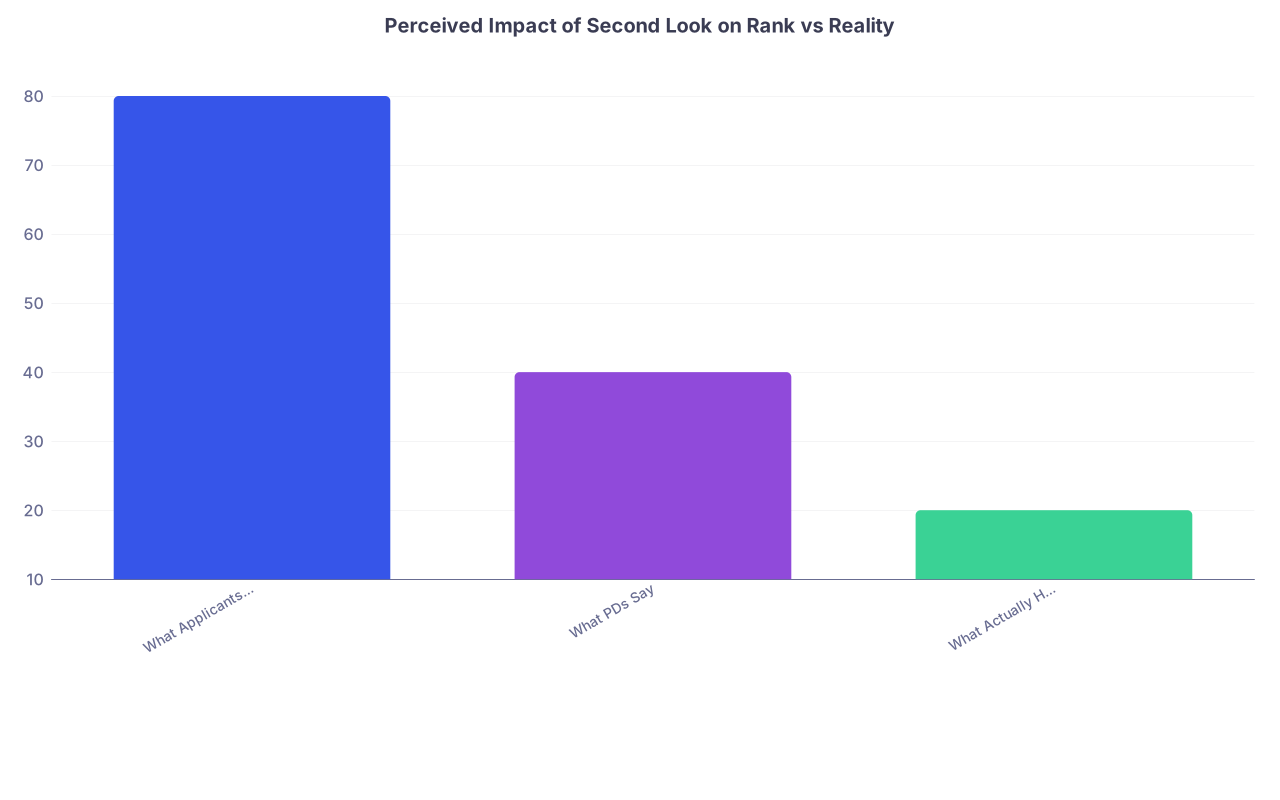
| Category | Value |
|---|---|
| What Applicants Think | 80 |
| What PDs Say | 40 |
| What Actually Happens | 20 |
Programs mostly use second looks to:
- Confirm you’re not a jerk
- Confirm you’re not weirdly disinterested
- Get a feel from residents about your interpersonal style
They are not secretly re-running their whole list based on who said “this is my number one” the most convincingly.
If you overplan as if this single day is make-or-break, you’ll radiate desperation. That’s rarely attractive in any selection process.
Use the second look for what it’s for: protecting yourself from a bad fit. Not staging a final audition.
Mistake #8: Ignoring The Natural Flow of Resident Life
The subtler way overplanning hurts you? It stops you from seeing the residency for what it is on a normal day.
You arrive with so much agenda—so many people to meet, places to see, questions to ask—that you basically create an artificial day around yourself.
Residents are pulled off their usual tasks to walk you around. You bounce between “curated experiences.” You see their best faces, their best rooms, their best explanations.
And you leave without seeing:
- The 20-minute wait for a CT
- The intern drowning in admits while no one seems to step in
- The broken vitals machine that “biomed has been coming to fix” for six months
- The side comments between residents that tell you more than their direct answers ever will
Overplanning makes the day about your script instead of their reality.
A smarter play is to leave intentional space in your schedule where you literally just shadow. Watch the team in the workroom. See how people page each other. Notice who actually gets asked for help and how they respond.
If you come in with every minute packed and prearranged, none of that can happen. You’ll leave with a glossy version of the program. That’s how you match somewhere and say in October, “Oh… this is not what I thought it would be.”
I’ve seen that too many times.
So How Do You Plan Just Enough—Without Overplanning?
Let’s be concrete. You do need some structure. The goal is to plan enough to avoid chaos, not so much that you suffocate the visit.
Here’s a simple guardrail: your plan should fit comfortably in 2–3 clean sentences in your head.
Something like:
“I want to see a normal workroom, sit in on sign-out if possible, and spend real time with interns without faculty around. If I can, I’d also like to see where people live or hang out after work.”
If your “plan” sounds like a multi-point strategic initiative, it’s already too much.
A healthy second-look structure:
- One or two flexible anchors (e.g., sign-out, a case conference, or short shadow block)
- Unstructured time with residents (lunch, downtime, post-conference hanging out)
- Space for conversations to go off-script
And always: room for the hospital to be a hospital. If someone gets called away, you adapt. That’s not a failed plan. That’s real life.
The Bottom Line
Second looks don’t reward the most detailed spreadsheet. They reward the most accurate instincts.
Key points to remember:
- Overplanning turns you into a performer instead of a future coworker—and residents pick up on that fast.
- The more you try to control the day, the less real information you’ll actually see about the program and its people.
- Your job isn’t to “win” the second look; it’s to avoid talking yourself into a bad fit by drowning reality in your own carefully scripted plan.