What do you lose when you post that “innocent” second-look selfie before you’ve even left the hospital parking lot?
You’d be surprised how often that answer is: respect, ranking position, and sometimes a program altogether.
Second-look visits are weirdly fragile. You’ve already interviewed, you’ve mostly sold yourself, and this visit should be the easy part: just confirm fit, meet more people, get a better feel. But social media has turned second looks into a minefield. The number of otherwise stellar applicants who sabotage themselves with a single story, tweet, or DM is higher than you think.
Let me walk you through the mistakes I’ve actually seen — and how to not be the cautionary tale people whisper about on next year’s interview trail.
The Most Dangerous Assumption: “They Don’t See My Social Media”
The biggest myth: “My Instagram is private; programs can’t see anything.”
Do not bet your career on that.
Here’s what you keep forgetting:
- Residents follow each other across schools and cities.
- Med students screenshot everything.
- People show each other posts in person on their phones.
It takes exactly one co-rotator or an M4 at another school to screenshot your second-look story and text it to “a friend” in that program. I’ve watched this happen in real time:
Applicant posts: “XYZ second-look today… vibes are mid but food is 🔥😂”
Screenshot → shared in a group chat with that program’s residents → shown in the workroom to the PD two days later.
That applicant’s file went from “strong fit, likely rank high” to “do not rank.” Not because they were honest. Because they were careless, public, and disrespectful.
Do not confuse “private” with “controlled.” Once it’s on a screen, it’s shareable. You have zero control beyond your own thumb.
Slip-Up #1: Posting Anything Identifiable About Patients or Clinical Areas
This one should be obvious. It still happens every season.
You go on your second look. You’re on a tour, on rounds, maybe you sit in on a conference. You snap a hallway selfie, a quick boomerang of the team rounding, a view of the ED with monitors in the background. You post it with “Future home?? 🩺✨”
You think: “There are no faces. I’m fine.”
You’re not.
HIPAA isn’t just faces and names. It’s any potentially identifiable info. Screens with partial MRNs. Distinctive tattoos. A family sitting in the background. A door with a room number and name plate. The ED board behind the charge nurse’s head.
Programs are paranoid about this for a reason. One applicant’s careless post can turn into:
- Angry patient complaint
- Screenshot sent to hospital compliance
- Program director getting a “handle your people” email
- Faculty thinking, “If they’re this reckless before they’re even here…”
One PD put it bluntly: “If I see a patient-care-area photo on your social media, I don’t care how high your Step score is. You’re done.”
Avoid this entirely by following one rule:
During the visit, your phone is for logistics only. No photos in any clinical space. None. Not the hall, not the elevator, not the nurses’ station.
If you want a picture to remember the day, wait until you’re outside the hospital, off clinical floors, and away from anything that looks like care is happening.
Slip-Up #2: Real-Time Posting During the Visit
Real-time posting screams one thing to faculty and residents: you’re not present.
I’ve watched applicants sit at a resident lunch, nodding along to a senior’s story about burnout and wellness, while crafting a perfect “second look day!!” reel under the table. Everyone noticed. Nobody said anything. Everyone remembered.
And here’s the pattern I’ve seen:
- Real-time posters are often the same people who miss subtle red flags about the program.
- They ask fewer thoughtful questions.
- They come off more performative and less genuinely curious.
Programs do not want influencers. They want physicians who can focus.
Another problem: real-time posts make it incredibly easy to identify other attendees and faculty. Someone sees your story, recognizes a co-applicant or a current resident, and suddenly other people’s privacy is collateral damage.
Worst version I’ve seen: applicant live-tweeting their impressions of different residents and attendings during the second look. No names, but lots of descriptions. It still got back to the program. The PD called them and withdrew their informal “we’re very interested” email. Quietly.
Here’s the safer approach:
- During the visit: phone stays in bag or pocket unless you need directions, a schedule, or you’re checking the time.
- After you leave campus, if you insist on posting, do it then — but make it vague, neutral, and scrubbed of all identifiers.
You do not get bonus points for being the most online version of yourself that day.
Slip-Up #3: “Honest” Hot Takes About Programs
You’re tired. You’ve done four second looks in ten days. You’re in a group chat or your close friends’ story, venting:
“Program A: residents seemed dead inside.”
“Program B: 100% malignant vibes, yikes.”
“Program C: PD is lowkey terrifying but fellowship match is 🔥 so…”
You think it’s private. You trust those 10–20 people. Right?
No. Someone you trust will forward something out of context to someone you don’t know as well. Or they’ll be doing their own second look at that program and decide to “warn” a resident by showing them your message.
People love being the one “in the know.” They cannot resist sharing spicy takes. Your anonymous rant is social currency in their world.
And programs are small universes. The world of IM programs in the Midwest? Tiny. Everyone knows everyone. Same for surgery in the Northeast. Or EM on the West Coast.
Here’s the hard line: do not put rank-list-level opinions in writing anywhere digital. Not GroupMe, not Signal, not Slack, not “close friends” stories, not an anonymous forum.
Say it out loud to one or two people you truly trust. That’s it.
If you MUST write thoughts down, do it in:
- A private notes app with no sharing.
- A physical notebook. Old-school, but impossible to screenshot.
I’ve seen applicants get quietly down-ranked at multiple programs because their “private” criticisms traveled through one too many people.
Slip-Up #4: Tagging Programs, Hospitals, or Individual Residents
This one is subtler but just as dangerous.
You get excited. You genuinely like the program. You want them to know it. So you post:
“Loved my second look at @CityMedIM today — amazing residents, great teaching!”
Then you tag:
- The hospital
- The department
- The official residency account
- The chief resident who led your tour
You think it shows enthusiasm. You think it’s professional. It isn’t.
Here’s what actually happens:
- Residents now feel like they’re part of your public brand without consent.
- The program gets dragged into your social media presence (which they have zero control over).
- If any minor HIPAA or professionalism issue exists in the post, now it’s directly attached to them.
Also, some PDs and coordinators keep their own quiet boundaries: they don’t want to be tagged by applicants. They don’t want any appearance of favoritism or special access. Your tag puts them in an awkward spot.
And if your account contains anything even slightly questionable (party pics, drunk captions, edgy jokes), tagging a professional entity forces them to see all of that next to their institutional brand.
Simplest rule: do not tag programs or individuals in any second-look content.
If you absolutely must say something publicly, keep it generic:
“Grateful for the chance to visit another great program this week.”
No location, no tags, no names.
Slip-Up #5: Posting Group Photos Without Permission
You take a group photo with other applicants and residents. Nice memory. Good moment. Fine.
Then one person posts it. Suddenly:
- Another applicant who’s very private is now on your public Instagram.
- A resident who keeps a strict boundary between work and personal life is on your TikTok.
- Someone’s religious symbol, body type, or gender expression becomes content for strangers.
Yes, technically it’s “just a photo.” Professionally, it’s messed up.
The more specific problem: residents and other applicants can be recognized by name and affiliation, especially in small specialties. Now their faces are floating around with whatever caption or content style you used — which may not match the image they’re trying to maintain.
Programs are hypersensitive about photos when recruiting next classes. They’ve seen images get pulled into unrelated controversies or threads they never wanted to be part of.
Best practice:
- If your photo includes anyone else: ask before posting.
- If they hesitate even a little, don’t post it.
- If you post, avoid naming the program in the caption.
Also, never assume that because someone posted something to a private group chat, they’re fine with it being on your public story. That’s how drama starts.
Slip-Up #6: Cryptic or Snarky Posts That Everyone Can Decode
You think you’re being clever:
“Some programs talk wellness but schedule 28-hour call q3, interesting 👀”
“Wild how ‘we are a family’ sometimes sounds exactly like ‘we will own your life.’”
“Today: saw what malignant really looks like lol”
No names, right? Totally fine?
Not really.
If you just did a second look at one program in a certain city, on a specific date, it’s not hard to connect the dots. Other applicants will. Residents will. Your home advisors might. All it takes is one person who knows your schedule.
Now the program isn’t just “not your vibe,” they’re publicly dragged in a way that makes you look impulsive and unprofessional. Even programs you like will see that and think, “So when they don’t like something about us, are we the next subtweet?”
Don’t be the mysterious “tea spiller.” It’s not cute. It makes you look immature and reckless at exactly the time you most need to show judgment.
If you’re burned out and need to unload, do it offline with one or two friends, or talk to an advisor. Not to your 400 followers, half of whom are med-adjacent.
Slip-Up #7: Broadcasting Your Rank List Around Your Second Looks
The timeline problem: programs are extremely sensitive to anything that smells like “gamesmanship” or “I’m using you as leverage.”
Applicants post things like:
“Final rank list almost done! So grateful for the love from [City A, City B, City C].”
“Pretty sure my #1 locked in after today.”
“Decided to move X program down after the second look, wasn’t what I hoped.”
Nobody wants to feel like your backup or your bargaining chip. Programs tend to over-interpret any public signal you send because they’ve been burned too — by applicants who ghost, lie, or use fake “you’re my #1” messages to get attention.
I’ve seen a PD get shown a screenshot where an applicant called their program “solid #3” in a friend’s story. That PD shrugged and said, “We’ll move them down. They clearly want to be somewhere else more.” No confrontation. Just a quiet shift on the rank list.
You do not control how people interpret your posts. Do not hand them ammo.
Golden rule: never talk about your rank order online. Not even in code. Not even “def top tier for me.” Keep that conversation between you, your mentors, and maybe one truly trusted friend.
Slip-Up #8: Letting Social Media Distract You From the Actual Point
Even if you never post a single thing, social media can still wreck your second look by pulling your head out of the room.
I’ve seen this subtle version too many times:
- Applicant is constantly checking their phone between sessions.
- They’re monitoring group chats about other programs while walking with residents.
- They’re refreshing SDN/Reddit for “impressions of XYZ program” instead of just being there and forming their own judgment.
The cost is huge:
- You miss the offhand comments between residents that tell you whether they actually like each other.
- You miss tone and body language.
- You miss the resident who quietly offers, “If you want the real story, I can tell you later,” and then stops because you’re staring at your phone.
Programs notice who is present, who asks follow-up questions, who seems genuinely engaged. Residents compare notes. “Yeah, they were solid but seemed kinda distracted the whole time” is not the review you want.
For one day, unlink yourself from the hive mind. The internet will still be complaining about call schedules tomorrow. Today you should be collecting your own data.
Slip-Up #9: Treating Second Look Content as “Brand-Building”
Some of you are starting to think like this: “I’m building a professional presence; posting about second looks is part of my story.”
Fine. But don’t confuse “professional presence” with “constant documentation.”
The biggest branding fail is trying to optimize everything for content:
- Filming empty hallways “for later B-roll”
- Asking residents to repeat something “for the camera”
- Turning earnest conversations about burnout, diversity, or patient care into soundbites
You’re not a documentary team. You’re a guest.
Faculty and residents are already on edge about social media. They barely trust their own trainees with online behavior. Showing up as the applicant who’s clearly thinking about “content strategy” more than fit or patient care is a fast way to get mentally downgraded.
If you’re running a public professional account:
- Post general reflections on the process, not program-specific details.
- Use composite stories (“Over several second looks, I’ve noticed…”) instead of “At Program X, they said…”
- Wait days or weeks before posting, not hours.
Long story short: if your “brand” requires you to constantly push the professionalism line, it’s a bad brand for medicine.
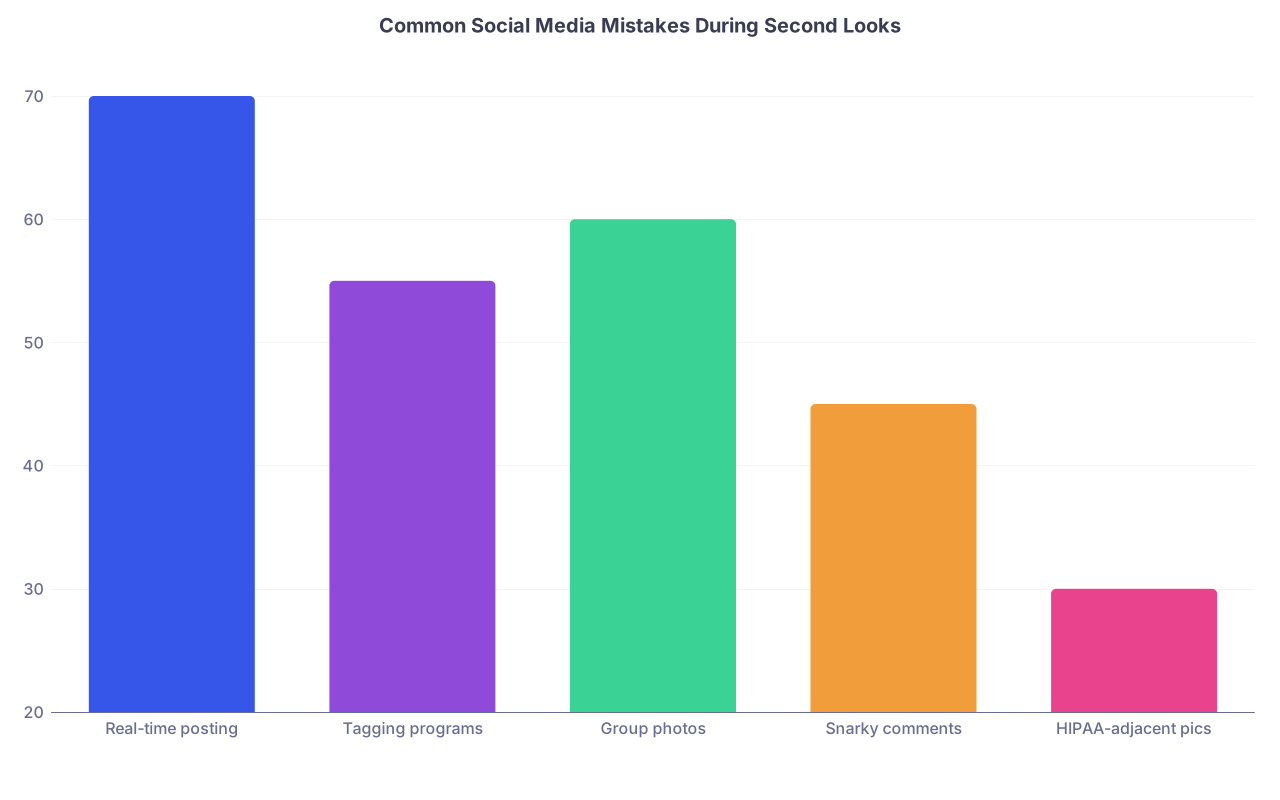
A Quick Visual: Where Applicants Slip Most
| Category | Value |
|---|---|
| Real-time posting | 70 |
| Tagging programs | 55 |
| Group photos | 60 |
| Snarky comments | 45 |
| HIPAA-adjacent pics | 30 |
These are rough, but they match what I hear over and over from coordinators and residents.
Safer Habits That Protect You (Without Going Off-Grid)
You don’t have to delete every account and vanish until Match Day. But you do need a different mode when you’re in interview/second-look season.
Think of it as “professional lockdown mode”:

| Step | Description |
|---|---|
| Step 1 | Before Second Look |
| Step 2 | Audit posts and stories |
| Step 3 | Limit who can see content |
| Step 4 | Remove questionable posts |
| Step 5 | Day of Visit - No real time posts |
| Step 6 | After Visit - Wait 24 hours |
| Step 7 | No content |
| Step 8 | Generic, nonidentifiable reflection |
| Step 9 | Public or private account |
| Step 10 | Still want to post? |
A few specific guardrails:
- During the visit: no photos in clinical areas, no real-time posting, phone mostly away.
- After the visit: wait at least 24 hours. Anything that still feels edgy or overly specific after a day? Don’t post it.
- Never: tag programs or individuals, rant about specific places, or share rank-order-level opinions online.
Notice none of this says “never touch social media.” It just says “don’t let your phone cost you a rank spot you’ve worked years to earn.”
A Quick Comparison: Safe vs Risky Behaviors
| Situation | Safer Choice | Risky Choice |
|---|---|---|
| During hospital tour | No photos | Hallway selfies / shots with monitors visible |
| Group lunch with residents | Phone away, engaged | Filming stories, posting real time |
| Liking the program | Thank-you email to PD/coordinator | Tagging program on Instagram or Twitter |
| Processing your impressions | Private notes or in-person conversations | Vents in group chats or “close friends” stories |
| Wanting to post something | Vague, non-identifiable reflection | Specific comments about culture or workload |
If you’re wondering which side to pick, it’s the left column. Every time.
The Short Version: What Not to Screw Up
If you remember nothing else, keep these in your head as you walk into any second look:
- Once it’s on a screen, it’s sharable. “Private” posts still travel.
- Don’t document the day; live it. Real-time posting, tagging, and hot takes make you look distracted and unprofessional.
- Never put something online that you’d be embarrassed to see read aloud in front of the PD, the residents, and a hospital lawyer.
You worked too hard to match where you belong. Don’t hand that away to a 15-second story.