
The way top programs use second looks to break rank list ties would make a lot of applicants furious—if they saw the back room where the real decisions get made.
You’ve been told “second looks don’t matter,” “the rank list is already done,” and “it’s just for you to decide.” That’s not how it actually works at most competitive programs. Especially the ones that match at the top of applicants’ lists year after year.
Let me walk you into the conference room one week before rank list certification and show you what really happens.
The Official Line vs. The Real Use
Publicly, programs say: the rank list is essentially finalized before any second looks. Technically, there’s a kernel of truth. The first pass of the list—built after interviews—is usually complete before second looks.
But that first pass isn’t the list that gets certified.
Behind closed doors, what second looks really do is:
- Break ties between similarly ranked applicants
- Confirm or kill “borderline” candidates
- Recalibrate impressions when there’s disagreement about an applicant
- Give reluctant faculty an excuse to push you up. Or down.
I’ve sat in rank meetings where the PD opens a spreadsheet and says:
“We have six people in this cluster at 20–25. Honestly they’re almost interchangeable on paper. Who came back? How did they behave on second look?”
Second look data becomes the tiebreaker. Not the main meal. But definitely the dessert that tips the scale.
When Second Looks Actually Matter (And When They Truly Don’t)
Let’s be blunt: if you’re in the top 5–10 on their list, your second look almost never changes anything—unless you massively screw it up or disclose something alarming.
If you’re in the bottom third, a second look is usually window dressing. You were already too low to matter, barring a tiny program with crazy volatility.
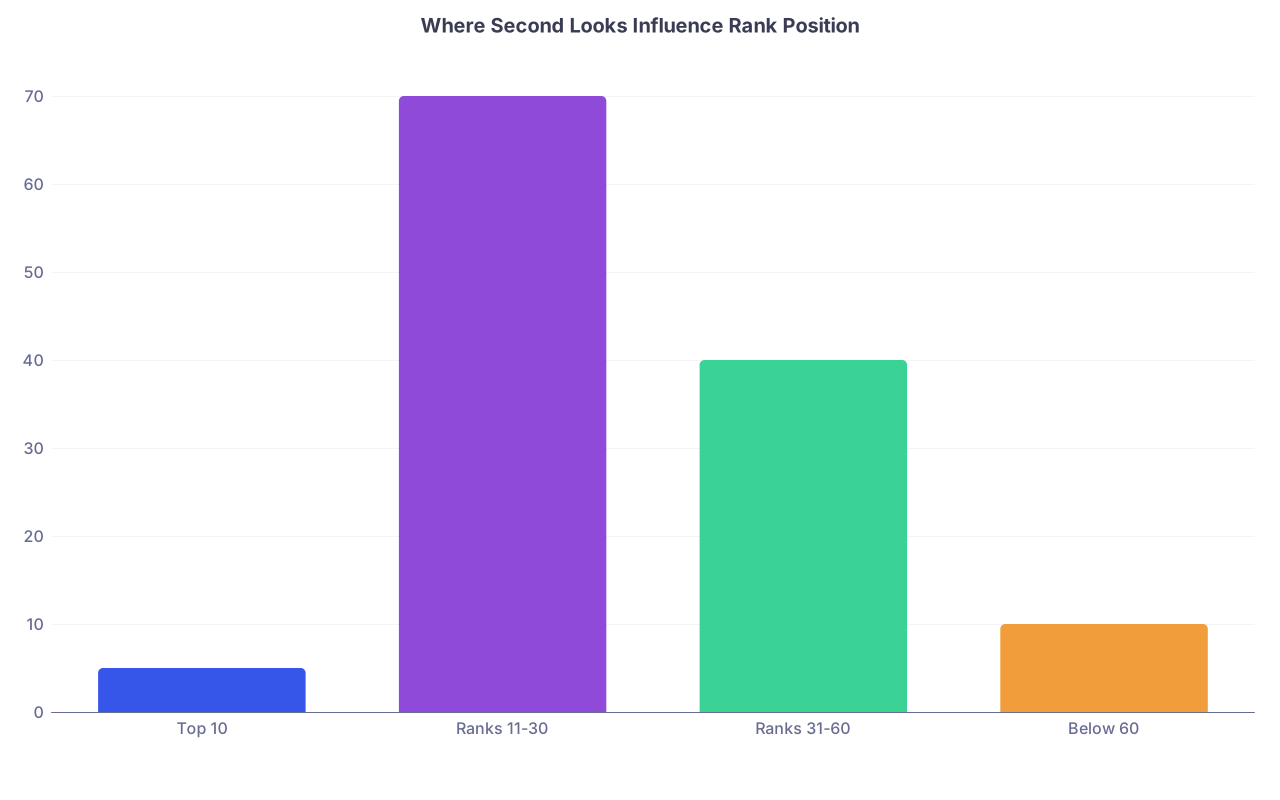
Where second looks carry real weight is that messy middle: the huge cluster of “good, not obvious-standout” applicants.
Think: solid scores, normal letters, good interview, reasonably strong fit. The group that could get ranked 8th or 38th depending on micro-signals.
To visualize where second looks might move you:
| Category | Value |
|---|---|
| Top 10 | 5 |
| Ranks 11-30 | 70 |
| Ranks 31-60 | 40 |
| Below 60 | 10 |
Those percentages are rough experience-based estimates of how often second look feedback is even discussed in those bands. The middle is where most of the movement happens.
So, if you’re:
- Clearly a superstar for that program: second look is optional, mostly for you.
- Clearly not competitive for them: second look won’t resurrect you.
- In that big gray zone: second look is absolutely part of how they break ties and refine positions.
How Programs Capture Second Look Data (The Stuff You Don’t See)
You think you’re just getting coffee, chatting with current residents, walking around the hospital again. Let me tell you what’s happening in the background.
At most serious programs, second looks are structured reconnaissance, even if they pretend it’s informal.
Here’s a very typical internal flow:

| Step | Description |
|---|---|
| Step 1 | Second Look RSVP |
| Step 2 | Resident Assignment |
| Step 3 | Second Look Day |
| Step 4 | Resident Feedback Form |
| Step 5 | Coordinator Summary |
| Step 6 | PD Review |
| Step 7 | Rank Meeting Discussion |
What you notice as “just hanging out” is often being captured with:
- Quick online forms residents fill out afterward
- Group texts between chief residents and the PD
- Coordinator notes about who emailed, how they behaved, and what they asked for
I’ve seen internal forms that literally have fields like:
- “Did the applicant express strong interest in ranking us highly?”
- “Any professionalism concerns?”
- “Would you be happy working with this person?” with a forced yes/no
The residents might say, “Don’t worry, this isn’t evaluative.” Then later they’re on a Zoom rank meeting saying:
“Honestly, she came to second look and just complained about other programs and asked about moonlighting money. I’d drop her 10 spots.”
You’re being evaluated even when they pretend you’re not.
The Tie-Break Scenarios They Never Explain to You
Let’s walk through real types of tie-breaks I’ve watched programs make using second look impressions.
1. The “Three People for Two Spots” Problem
Imagine Internal Medicine at a well-known university hospital. They’ve got three very similar applicants sitting around rank 15–20:
- All with Step 2 in the 245–255 range
- Solid letters, nothing crazy
- All interviewed well enough, no disasters
Now the faculty argue:
- Someone remembers one applicant’s research.
- Someone else liked another’s communication skills.
- Nobody feels strongly enough to win the argument.
Then someone asks: “Who came to second look? What did we hear?”
If:
- Applicant A didn’t come,
- Applicant B came and seemed engaged,
- Applicant C came and was lukewarm and odd with the residents,
You’ll see something like:
- B moves up a few spots
- C slides down
- A stays where they are or drops slightly, depending on how neurotic the group is about “commitment signals”
No one says “We changed the rank list based solely on second look.” But that’s functionally what just happened.
2. The “Is This Person Actually Interested?” Question
Some high-powered programs are paranoid about getting “used” on rank lists. They don’t want to be your throwaway interview you rank #8 when you’re chasing three bigger-name places.
So they use second look—and post-interview contact—to sniff out how likely you are to rank them highly.
They’ll never explicitly tell you, but informal rules show up, especially in programs that routinely go far down their list.
You can think of it like an internal model:
| Applicant Type | Second Look? | Perceived Interest | Likely Rank Movement |
|---|---|---|---|
| Borderline but strong fit | Yes | High | Up a tier |
| Strong on paper, low signals | No | Low | Slight downshift |
| Middle-of-pack, enthusiastic | Yes | Moderate-High | Used as tiebreak up |
| Weak fit, high interest | Yes | High | Little to no change |
| Strong fit, unresponsive | No | Very low | Risk of small drop |
Interest isn’t everything; it’s rarely enough to rescue a weak applicant. But among similar people, it matters more than they officially admit.
3. The “Resident Veto” Situation
Here’s one most applicants don’t realize: at quite a few top programs, residents effectively have soft veto power.
Not formal. Not written down. But very real.
If multiple residents come to the PD and say, “We really did not get a good feeling about this person at second look,” that applicant is not going to stay where they were on the list. They’ll drop. A lot.
Second look is the one time residents get prolonged, unstructured contact with you after the interview. If they see:
- Arrogance
- Disrespectful comments about other programs, specialties, or patient populations
- Obnoxious questions about money, time off, call swaps, before you show any interest in learning/teaching/culture
They’re going to share that. Not politely. I’ve heard exactly this:
“Honestly, if he matches here, I’m going to be pissed. He was trashing other residents at his school during second look.”
That comment killed that applicant’s chances. Full stop.
What Programs Actually Look For At Second Look
Here’s what PDs and residents are implicitly screening when they watch you on second look—not what they put in brochures.
Consistency of personality
Were you the same person they saw on interview day, or did you show a different side once you thought the formal evaluation was mostly done?How you treat people with no power
Do you interact respectfully with junior residents, coordinators, administrative staff? Or are you all charm for the PD and short with everyone else?Signals of future headache
Programs are allergic to drama. If second look vibes are: needy, easily offended, entitled, constantly asking for exceptions, they see future remediation and GME headaches.True interest vs. “I’m shopping”
They can tell who’s there because they’re serious vs. who’s casually checking a box, running through the hospital, and leaving early.How residents react to you
Residents know who they’d be happy seeing as interns in July. They will say it bluntly when the faculty ask.
How Second Looks Change the Rank Meeting Conversation
Picture the actual rank meeting. Real scene.
PD shares the preliminary list. Faculty scan the names. Chief residents and a few senior residents are in the room or on Zoom.
Then comes the “adjustment” phase. This is where second look experiences enter.
You’ll hear things like:
- “She came back for a second look and spent a ton of time with the night float resident. They loved her.”
- “He emailed us repeatedly about doing a second look but then never followed through. Honestly seemed disorganized.”
- “She came to second look, but her questions were all about moonlighting and outside elective time. I didn’t get a sense she actually cared about our training culture.”
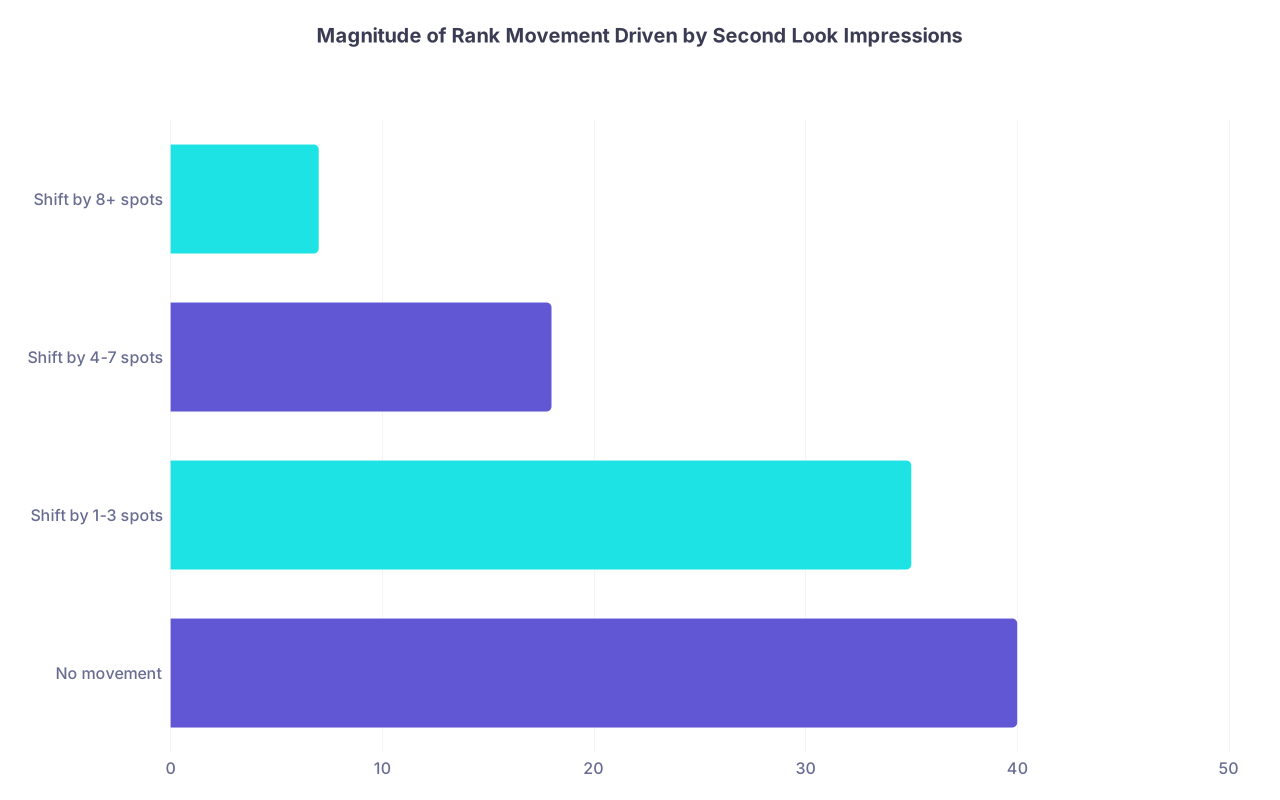
Those comments lead to micro-moves.
| Category | Value |
|---|---|
| No movement | 40 |
| Shift by 1-3 spots | 35 |
| Shift by 4-7 spots | 18 |
| Shift by 8+ spots | 7 |
Most movement is modest. But when second look confirms a bad gut feeling, I’ve seen 10+ spot drops. Not rare. Especially in smaller programs.
On the flip side, a stellar second look doesn’t usually rocket you from 35 to 5. But going from 22 to 16? That happens all the time. And that’s exactly the difference between matching and not matching in some years.
The Dirty Truth About “Mandatory” vs. “Optional” Second Looks
Here’s the phrase you’ll hear: “Second looks are completely optional and not required for ranking.”
And from a legal and NRMP standpoint, that’s what they have to say.
In practice, programs fall into a few categories:
Programs that truly don’t care much
Usually overwhelmed, big-name, or very high-demand places. They know they’ll match a full class from the top part of their list regardless. Second looks are mostly for you to evaluate them.Programs that use second looks as real data
A lot of mid-to-high tier university programs fall here. Not mandatory, but second looks are quietly counted as an interest/professionalism/fit signal.Programs that are quietly punitive
If they invite and strongly encourage second looks and you’re local or easily able to attend but don’t, they take that as a mild negative. They won’t admit it. They do it anyway.
What you need to understand: “optional” does not mean “irrelevant.”
It means: the program can’t require it and can’t say that attending affects your ranking. But human beings run the rank meeting, not compliance officers.
Strategic Use: When YOU Should Go, And How To Act
You shouldn’t go to every second look you’re offered. That’s just masochism and financial self-harm.
You go when:
- The program is realistically in the top 3–5 on your list
- You had a good feeling but still have questions
- It’s a place where “fit” and resident culture clearly matter a lot
- It’s a mid-range program where you’re not sure how competitive you are and where every tie-breaker might help
You skip when:
- It’s clearly lower than 6–7 on your final list
- Travel costs/time are brutal and your interest is lukewarm
- They’re explicitly telling you they don’t factor second looks into evaluation and you believe them (some highly structured places actually mean this)
Once you’re there, the rules are simple, but people blow them all the time:
- Be exactly the same person you were on interview day, just more relaxed. Not a new persona.
- Show curiosity about the program’s training, not just its perks.
- Treat staff like gold. Coordinators and admins carry soft power you don’t see.
- Avoid trash talking other programs, your classmates, or institutions. It gets back to faculty. Always.
- Don’t corner the PD to declare “I’ll rank you #1.” That’s uncomfortable and not as impressive as you think. Share strong interest, not desperation.
The Future: Where Second Looks Are Heading
Programs are slowly realizing second looks are both useful and dangerous.
Useful because:
- They reveal character and fit in a way a single interview cannot.
- Residents get a meaningful say.
- They help discriminate among a sea of similar applications in a pass/fail Step 1 world.
Dangerous because:
- They introduce inequity—students with money and flexible schedules can attend more.
- They flirt with NRMP rules about post-interview communication and coercion.
- They create perception problems when applicants compare notes.
Where is this likely going? A few trends are already emerging:
More virtual “second looks”
Especially in expensive cities or for applicants from far away, programs are starting to do structured virtual second looks. Breakout rooms with residents, PD Q&A, etc. Same concept, less travel.More explicit “non-evaluative” language, same quiet usage
Official stance: “This will not affect your ranking.”
Actual stance: residents’ impressions from that night absolutely influence the PD when there’s a tie.Centralized, standardized feedback forms
Chiefs and coordinators are sick of random texts. You’ll see more Google Forms/Qualtrics internally. The second look will be treated more like a “social interview.”Program self-protection
As more applicants complain online about pressure and cost, programs will lean into the “for your benefit” narrative. The savvy ones will also build structured resident-only spaces where honest feedback about you is collected.
Do I expect second looks to go away? No. If anything, in the era of bloated application numbers and blurred Step 1 signals, informal settings like this become more valuable to decision-makers, not less.
A Quick Mental Model For You
Use this to decide what to do about second looks and how to interpret them.
Second looks are:
- Not the main evaluation
- Not meaningless theater
- Not truly “optional” at many places
- A tie-breaker and character test in the eyes of faculty and residents
So you:
- Go where the tie-break could realistically matter for you
- Act as if you’re being observed—and recorded—because in a way, you are
- Use them to assess your fit, but don’t kid yourself that the evaluation is one-way
You don’t need to game them. You do need to take them seriously.