
The fastest way to ruin a great second-look visit is with a sloppy email subject line.
Programs do not reject people because of one awkward sentence. But they absolutely form an impression from it—and second-look emails are often read by the same people who sat in the ranking meeting.
You want to help them remember you. Not flag you as “pushy,” “unprofessional,” or “does not get boundaries.”
Let me walk you through the mistakes I keep seeing in second-look emails—especially subject lines and key phrases—that quietly sink otherwise strong applicants.
1. Subject Lines That Scream “Red Flag”
Subject lines are triage tools. Coordinators and PDs skim a packed inbox and make a snap decision: open now, later, or never.
Do not sabotage yourself in seven words.
A. The “Desperate or Clingy” Subject Line
These look like:
- “Please Rank Me Highly”
- “This Program Is My Dream”
- “I Will Come Here If You Rank Me”
- “My #1 Choice!!”
Here is the problem: by the time you send a second-look email, most programs have either finished or nearly finalized their rank list. Your begging does not move the needle. It just makes you look naive about the process and a bit desperate.
Worse: phrases like “I will come here if you rank me” put programs in uncomfortable territory. They know they cannot guarantee anything. They also know some applicants send that same promise to multiple places. It reads as manipulative or, at best, uninformed.
Avoid in subject lines:
- “Rank”
- “Promise”
- “Guarantee”
- “#1 choice” / “Top choice”
Instead of:
“Please rank me highly – I will come if you do”
Use something like:
“Thank you for the second look – [Your Name]”
or
“Second look follow-up – [Your Name], [Specialty] applicant”
Low drama. High professionalism.
B. The “Urgent When It Is Not” Subject Line
Common offenders:
- “Urgent: Question About Your Program”
- “Time-Sensitive: Please Respond ASAP”
- “Immediate Attention Needed”
Unless your email is literally about:
- A serious professionalism concern
- A required document that will prevent you from onboarding
- A time-critical visa/HR issue
…you are misusing “urgent.”
What actually happens when you do this?
- Coordinator opens expecting a crisis.
- Finds a generic “I just wanted to reiterate my interest” message.
- Mentally tags you as someone who exaggerates.
That is not the label you want.
If you truly need a quick answer (for example, about a required form), you can say that in the body, not the subject:
- Subject: “Second look logistics question – [Your Name]”
- Body: “I apologize for the time-sensitive question; I need to submit X by [date] and wanted to clarify…”
C. The Overly Casual / Sloppy Subject Line
Examples I have actually seen:
- “Hey again!”
- “Quick question :)”
- “Yo, about my visit”
- “Thank youuuu!!”
You are not emailing a classmate. You are writing to a Program Director, APD, or coordinator who has likely been awake since 5 a.m. dealing with actual emergencies.
Casual subject lines read as:
- Inexperienced
- Poor boundaries
- Risky to put in front of patients, staff, and faculty
Phrases to avoid in subject lines:
- “Hey”
- Emojis, exclamation points, or drawn-out words (“soooo,” “thank youuu”)
- Text-speak: “u,” “thx,” “idk,” “W/,” etc.
Safe, boring beats clever and risky:
- “Thank you for the second look – [Your Name]”
- “Follow-up after second look – [Your Name]”
- “Second look clarification – [Your Name]”
If your subject line could be a text to a friend, it is not appropriate for a program.
2. Subject Lines That Look Manipulative or Dishonest
This is where applicants really burn trust.
A. Fake Personalization / Clickbait
Do not do this:
- “Important information about your program”
- “Concern about resident experience”
- “Feedback after my visit”
…and then inside you write:
“My only concern is that I may not match there because I love it so much.”
Programs are not stupid. They see the bait. They resent the switch.
If you actually have constructive feedback, fine. But do not disguise a generic “I loved it here” email as “concern” to guarantee an open.
B. “Exclusive Commitment” Language When It Is Not True
Subject lines like:
- “My exclusive #1 ranking – [Your Name]”
- “I commit to your program if you rank me”
If you have truly decided to rank a program #1 and your specialty allows “love letters,” that message belongs in the body, and even then you use cautious, honest language. You never imply a two-way agreement. You never pressure them.
Subject line should still be neutral:
- “Post-interview update – [Your Name]”
- “Second look and continued interest – [Your Name]”
Save any “I will be ranking your program #1” (if your specialty/community accepts that practice) for the body. Do not turn it into a billboard.
3. Phrases in the Email Body That Backfire
The subject line gets you opened—or ignored. The body cements how they remember you.
There are phrases that sound flattering in your head but hit as manipulative, boundary-ignoring, or unprofessional on their end.
A. The Overcommitment Trap
Lines to avoid:
- “I will definitely match at your program.”
- “I know you will rank me highly.”
- “I am certain I am a perfect fit for your program.”
- “I am 100% sure I belong there.”
Why this is a problem:
- You do not control the Match.
- They do not control the Match in isolation.
- Declaring certainty about something you cannot know makes you look impulsive and overly self-assured.
Better: concrete interest without magical thinking.
Instead of:
“I am 100% sure I belong at your program and I will match there.”
Use:
“My second look reinforced that your program aligns with my goals, particularly in [specific aspect]. I will be ranking your program very highly.”
Calm. Respectful. No fake certainty.
B. The “I Know You Will…” Assumption
Examples:
- “I know you will rank me highly after meeting me.”
- “I know you saw that I was the best fit.”
- “I am sure you noticed my strong connection with your residents.”
This sounds arrogant. It also crosses a line—you are telling them what they think.
You can state your perception, not their internal state.
Bad:
“I know you realized I was the best fit for your program.”
Better:
“I felt a strong fit with your residents and curriculum, especially on the second look day.”
You are responsible for your side of the experience, not theirs.
C. The Excessively Emotional Confession
Second-look emails are not therapy sessions.
Avoid:
- “I cried after visiting because I knew this is my home.”
- “This program healed the trauma of my previous rotations.”
- “I have never felt this seen before.”
Does this mean you have to be robotic? No. But when you veer into intense emotional disclosure, you raise questions:
- Can this person regulate under stress?
- Will they overshare with patients, staff, or colleagues?
- Are boundaries going to be a problem?
Use emotion in measured, professional ways:
- “I felt genuinely supported by the residents and faculty I met.”
- “The sense of community I observed was deeply meaningful to me.”
Enough to show you are human. Not so much that it sounds unstable.
4. Tone Mistakes That Make You Hard to Rank
The words you choose are signals about how you will behave as a resident. Certain tones make people nervous.
A. Entitled or Transactional Tone
Phrases that raise eyebrows:
- “Given my Step scores and publications, I believe I should be ranked near the top.”
- “I expect that my strong performance will be recognized on your list.”
- “I believe I have earned a high rank from your program.”
Programs do not owe you a position, no matter how impressive you are on paper. That is the ugly truth of the Match.
A second-look email is not a place to:
- Negotiate your rank
- Compare yourself to other applicants
- Assert what you “deserve”
You can highlight fit and enthusiasm, not demand outcomes.
B. Aggressively Strategic Language
Avoid anything that sounds like a negotiation email from a consulting firm:
- “Strategically, your program aligns with my career leverage points.”
- “I am confident we can create a mutually beneficial outcome.”
- “I hope our priorities will align in the algorithm.”
They are not signing you to a contract. They are choosing someone to wake up at 3 a.m. and care for sick patients without imploding.
Do not sound like a corporate brochure.
Stick to:
- Specific program features you valued
- How your experiences match their strengths
- Sincere appreciation for time and access during the second look
5. Timing, Recency Bias, and the “Annoyance Threshold”
Another mistake: assuming “one more email” always helps.
Sometimes the biggest error is sending anything at all.
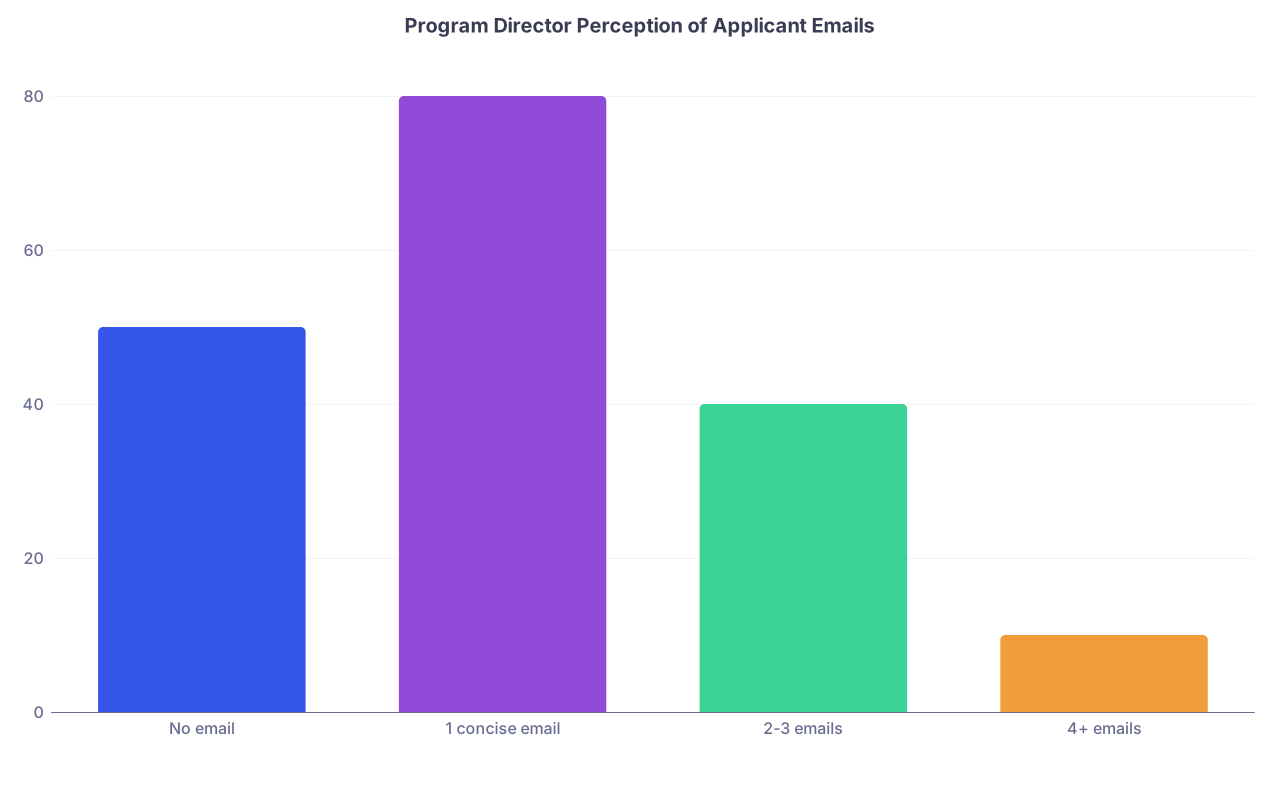
| Category | Value |
|---|---|
| No email | 50 |
| 1 concise email | 80 |
| 2-3 emails | 40 |
| 4+ emails | 10 |
This is simplified, but the general pattern holds:
- No email: Neutral.
- One concise, respectful email: Often slightly positive.
- Repeated emails: Quickly move from persistent → clingy → irritating.
If you already:
- Sent a thank-you after the interview, and
- Sent a clear, professional post-interview interest email, and
- Attended a second look and thanked them after
…a third message rehashing how much you love them is unlikely to do anything but clutter their inbox.
Programs remember applicants who:
- Respect time
- Communicate clearly and briefly
- Do not require extra emotional labor
If you are about to send “just one more note” saying nothing new, stop. You are moving from helpful to intrusive.
6. How to Phrase a Safe, Strong Second-Look Email
You came for the pitfalls, so I will keep the “how to do it right” section lean. But it helps to see the contrast.
A. Example of a Problematic Email
Subject:
“Please Rank Me Highly – This Is My Dream Program!!!”
Body:
Dear Dr. Smith,
Thank you SO much for the amazing second look. I cried afterwards because I just knew I BELONG at your program. I know you saw what a perfect fit I am and I am sure you will rank me very highly. Given my 257 Step score and 8 publications I believe I deserve a top position in your rank list. I will definitely match at your program if you rank me high enough and will tell everyone this is my number one program.
Please let me know where I stand on your list or if there is anything else I can do to improve my position. This is very urgent for me as I have to make my rank list soon.
Sincerely,
[Name]
Count the landmines:
- “Please Rank Me Highly” + “!!!” – desperate.
- Emotional overshare (“I cried”).
- Assuming their thoughts (“I know you saw…”).
- Entitlement (“I deserve a top position”).
- False certainty (“I will definitely match”).
- Inappropriate request (asking where they are on the list).
- Calling it “urgent” when it is not.
B. Example of a Clean, Low-Risk Email
Subject:
“Thank you for the second look – [Your Name]”
Body:
Dear Dr. Smith,
Thank you for the opportunity to attend the second look at [Program Name] on [date]. I especially appreciated speaking with Dr. Jones and the PGY-2 residents about the [clinic, curriculum, or specific rotation].
The visit strengthened my interest in your program, particularly the emphasis on [example: resident autonomy in the ICU] and the supportive culture I experienced during the day. I would be very glad to train at [Program Name] and will be ranking your program highly.
Thank you again for your time and for welcoming me back.
Sincerely,
[Name]
AAMC ID: [optional, helpful for them]
No drama. No manipulation. No boundary crossing. Exactly what a busy PD or coordinator can read in 20 seconds and file as “professional, positive, non-problematic.”
7. Subtle Things That Still Trip People Up
The big mistakes are obvious. The quieter ones are what usually catch strong applicants by surprise.
A. Writing to the Wrong Person or Using the Wrong Title
Second-look emails often go to:
- The program coordinator
- The APD who organized the day
- The PD
Sloppy errors:
- “Dear Mrs. John” (for a Dr. John)
- “Hi [first name]” when you have only met them in a formal context
- Copy-paste errors: “I enjoyed my visit to [Other Program Name]”
That last one? I have watched programs read those out loud as cautionary tales in the workroom.
Double-check:
- Name spelling
- Correct program name
- Correct specialty (yes, people mix that up too)
B. Over-personalizing Based on a Brief Interaction
Be careful with lines like:
- “I felt such a deep personal connection with you.”
- “You understood me better than anyone else in this process.”
- “Our conversation was life-changing.”
From the program side, you spoke for 20–30 minutes in a professional setting. Claiming some profound personal connection can feel…off.
You can absolutely compliment the interaction:
- “I appreciated your candid advice about [topic].”
- “Our discussion about [area of interest] was especially helpful.”
Praise their time and insight. Do not elevate it to “soulmate mentor” territory.
C. Trying to “Correct” a Past Impression
Some applicants try to use the second-look email to undo perceived interview mistakes, writing:
- “I know I seemed nervous, but I promise I would be a great resident.”
- “I think I did not fully express my interest before, but I really want to be there.”
- “I am worried I came across poorly; I hope you will give me another chance.”
Here is the harsh reality: if they had a major concern, this email is not going to erase it.
What your message can do is add one more data point of professionalism.
So avoid self-flagellation. You may be reminding them of concerns they had already forgotten. Focus on the positive aspects of your second look, not on apologizing for something they may not have even noticed.
8. Quick Comparison: Safe vs Risky Subject Lines
| Safe Options | Risky / Red-Flag Options |
|---|---|
| Thank you for the second look – [Your Name] | Please rank me highly – [Your Name] |
| Second look follow-up – [Your Name] | Urgent: I must talk about my rank |
| Continued interest after second look – [Name] | My #1 and only choice – please read!!! |
| Question about second look logistics – [Name] | Concern about your residents (not really) |
| Appreciation for second look visit – [Name] | I will come if you rank me high enough |
If your subject sounds like something you would be embarrassed to see on a projector in front of faculty, do not send it.
9. Simple Process for Not Screwing This Up
Here is a quick mental checklist before you hit send:

| Step | Description |
|---|---|
| Step 1 | Draft email |
| Step 2 | Check subject line |
| Step 3 | Rewrite to neutral, factual |
| Step 4 | Any emotional overshare or entitlement? |
| Step 5 | Remove or soften |
| Step 6 | Already emailed 2+ times? |
| Step 7 | Ask if this adds anything new |
| Step 8 | Proofread once |
| Step 9 | Do not send |
| Step 10 | Send |
| Step 11 | Any rank, promise, or urgency words? |
It looks fancier than it is. The core ideas:
- Neutral subject line.
- No begging or promising.
- Professional, measured tone.
- No unnecessary extra emails.

Final Takeaways
Keep these few points in your head when you write:
- Subject lines should be neutral, factual, and boring—anything desperate, manipulative, or cutesy hurts you.
- Avoid phrases that assume control over the Match, demand rank position, or overshare emotionally; they signal poor judgment.
- One concise, respectful email tied to your second look can help. Repeated, needy messages do not. Respect their time, and they are far more likely to respect you.