
Second-look visits are not “just a courtesy.” They’re a silent exam, and most applicants have no idea they’re being graded.
I’ve sat in the rooms where programs debate whether second looks should “count,” then watched the same people subconsciously bump applicants up or down because of something they did that day. They’ll swear it doesn’t matter. Then they’ll say, “You know, when she came back for the second look, she…” and suddenly the rank list shifts.
Let me walk you through what’s really happening behind the doors—and what faculty, PDs, and residents are quietly scoring you on, even when they insist they’re not.
What Second-Look Visits Actually Are (Not What You’ve Been Told)
Official line: “Second looks are optional, they don’t affect ranking, just come see if we’re a good fit.”
Reality: They’re a live-fire exercise in professionalism, judgment, and vibe. Programs do worry about equity and optics, so they’ll say the visit doesn’t influence rank. But all the humans in the system still have brains and impressions, and those impressions leak into discussions.
Here’s how most programs actually think about second looks:
- If you don’t come: No penalty at many places, especially in competitive urban programs. But at some mid-tier or smaller places, no second look is interpreted (rightly or wrongly) as, “They’re not that interested.”
- If you do come and you’re solid: You become easier to advocate for. “I met them again, they seemed really engaged, good fit.”
- If you do come and you’re weird, demanding, or unprofessional: You can absolutely sink yourself.
And this matters more at some places than others.
| Program Type | Impact of Second Look |
|---|---|
| Big-name academic in major city | Low–Moderate |
| Mid-tier academic | Moderate |
| Strong community program | Moderate–High |
| Small/regional, applicant-poor | High |
| Extremely competitive specialties | Moderate |
No one will give you that table publicly. But that’s the real hierarchy.
The Moments That Really Get Scored (Even When They Pretend They’re Not)
Faculty are not walking around with clipboards. But they are pattern-recognition machines. Certain moments during second looks trigger quiet evaluations.
1. How You Treat the “Non-Important” People
This is the big one. The part no one tells you about.
Programs have been burned by residents who look great on paper, charming with PDs, then turn toxic once they’re in. So PDs and chiefs are constantly scanning for humility versus entitlement.
Who notices you?
- The program coordinator who arranged your schedule.
- The chief resident who’s shepherding you around.
- The PGY-2 who sits with you at lunch.
- The nurse at the nurses’ station when you’re “just hanging out.”
I’ve seen rank-list discussions where a coordinator says, “I actually found them kind of rude—no hello, no thank you, just stared at their phone,” and that candidate’s name quietly slides down a few spots. Nobody says, “We dropped them because of that.” But it happens.
What they’re watching:
- Do you introduce yourself to staff, or just to attendings?
- Do you say thank you—specifically—to the coordinator, residents, and whoever hosts you?
- Are you on your phone while someone is talking to you?
- Do you look bored during resident-only time?
If you’re respectful and curious with everyone, the PD hears, “Good citizen.” If you’re selectively polite, they hear, “Possible problem.”
2. Your Story Consistency Test
Second look is where faculty and residents quietly cross-check your application story.
On interview day, you say: “I’m passionate about community health and longitudinal primary care.”
On second look, you say to residents: “Honestly I’m just trying to get as much procedures and ICU time as possible; I don’t really care where I end up long term.”
People compare notes. They always do.
Common inconsistencies that raise eyebrows:
- Claiming you’re “all about research” in your application, then showing zero interest in research people on second look.
- Saying you care about work-life balance, then gravitating only to the most hardcore services and bragging about how the grind doesn’t bother you.
- Telling PDs you love underserved populations, then making an offhand comment about the hospital’s patient mix that sounds dismissive or annoyed.
This doesn’t have to be malicious. But if your story feels constructed rather than authentic, faculty sense it. Second look is when that disconnect becomes obvious.
3. Who You Want to Talk To (And Who You Avoid)
Your requests during a second look tell them more about your real priorities than anything you say.
Typical patterns we see:
- The genuinely curious applicant: “If possible, I’d love to talk to a current intern and maybe someone in the research track. I’m also interested in how you support residents with families.”
- The transactional climber: “Can I meet the chair again? Any chance to meet the department leadership? Maybe the fellowship director too?”
PDs are not blind to this. When you only want to talk to high-status people, you’re sending a signal: You’re more interested in prestige than in the actual training environment.
Behind closed doors, someone will say, “Yeah, they seemed very focused on networking upwards.” And that is not a compliment.
Stronger signal: asking to talk to second-years on night float, a part-time resident with kids, or the chief about schedule realities. That says, “I care about the real life here, not just the brochure.”
4. How You Talk About Other Programs
Second look traps a lot of people here.
You’re relaxed, in “informal” mode, chatting with a resident. Someone asks you where else you’re looking. You want to sound competitive. So you flex a little.
Bad move.
Residents will absolutely report back if you:
- Trash-talk other programs.
- Brag competitively: “I’m sure I’ll match at [Top Program] but just wanted to check this out.”
- Talk like this place is your backup or safety.
Actual things I’ve heard repeated in ranking meetings:
- “She said, ‘Honestly this place seems chill, I’m not sure I’d work this hard if I end up at [top 5 program].’”
- “He said this place is his geographic backup if [prestige place] doesn’t work out.”
- “They said they don’t want a ‘malignant’ place but then told stories about how they ‘crushed’ a brutal rotation and loved it.”
Second look is not the time to show off how competitive you are. It’s the time to show that if you end up there, you’ll be glad you did and you’ll be a good colleague.
5. Your Situational Judgment – The “Are You High-Maintenance?” Filter
Second looks have a way of exposing whether an applicant is high-maintenance. Faculty and residents are watching how you respond to small frictions.
Here’s what sets off alarms:
- Complaining or pushing when the schedule’s not perfectly tailored to you.
- Being visibly annoyed if people are running behind.
- Asking for special arrangements that clearly burden staff: “Could you rearrange so I see X, Y, Z all in one morning? I’m trying to make a flight.”
- Acting like the program owes you a curated experience.
When residents describe someone as “a lot” after a second look, they don’t need to define it. The PD knows exactly what that means.
On the flip side, easy wins:
- Rolling with schedule hiccups without drama.
- Being appreciative when they squeeze someone in.
- Telling the coordinator, “I know you’re super busy—thank you for organizing all this.”
You’re not just being judged as a learner. You’re being judged as future co-worker. Nobody wants the person who melts down when small things go off-plan.
The Subtle Things PDs Track (That You Don’t Realize Matter)
Now we get into the truly hidden stuff. The things programs won’t put in writing, but I’ve watched influence discussion over and over.
Body Language and Energy
No, this isn’t some pseudo-psych nonsense. It’s simple:
Residents and faculty look for: Do we feel tired or energized after being around you?
People pick up on:
- Do you make decent eye contact with the person you’re actually talking to, or are your eyes constantly drifting?
- Do you interrupt a lot? Talk over residents? Monopolize resident-only time?
- Do you ask a question and then visibly check out halfway through the answer?
If two applicants are otherwise similar and one feels like someone you’d happily take sign-out from at 5:45 pm after a brutal day, that one wins.
Clinical Curiosity vs. Gunner Questions
Residents can smell “question-as-performance” a mile away.
You want to show interest. You should. But there’s a huge difference between:
- “How do you handle autonomy for interns on nights? Who backs you up if you’re stuck?”
versus
- “What’s your exposure to advanced hem-onc therapeutics and CAR-T protocols on the inpatient side?”
One screams, “I’m trying to sound impressive.” The other says, “I’m trying to understand what my life will actually look like.”
Faculty remember which one you asked.
Genuine Interest vs. Rank-List Fishing
Programs hate being used as bait. They can tell when you’re there mainly to extract match intel.
- “So where do your usual applicants end up ranking you compared to [prestige places]?”
- “Do you think I’d be competitive here? I have interviews at X, Y, Z.”
- “What Step 2 scores did your last class have?”
They won’t usually tank you for that alone. But you’re not helping yourself. They already know you’re applying broadly. You don’t have to prove it.
Much better line of questioning:
- “What kind of resident thrives here and what kind doesn’t do as well?”
- “If you could change one thing about this program, what would it be?”
That gives them a chance to be honest. Which they remember.
Risk vs. Reward: When a Second Look Helps You, Hurts You, or Does Nothing
Let’s be blunt: second looks are not always worth it.
Here’s how PDs effectively categorize them, whether they admit it or not:
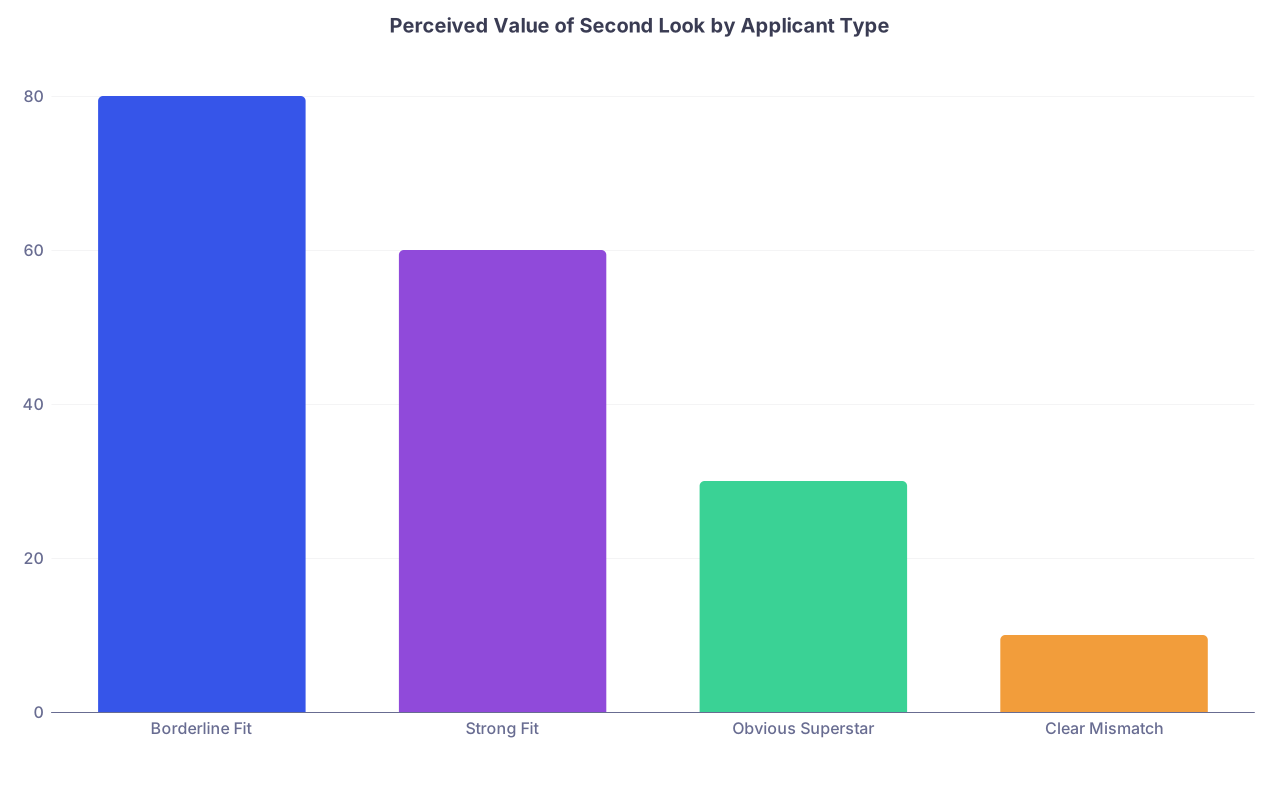
| Category | Value |
|---|---|
| Borderline Fit | 80 |
| Strong Fit | 60 |
| Obvious Superstar | 30 |
| Clear Mismatch | 10 |
That’s a rough picture of where a second look can shift perception.
High-Reward Situations
You’re applying to a program that:
- Is mid-tier or community with decent but not overwhelming applicant volume.
- Emphasizes “fit,” “culture,” or “family” heavily in their messaging.
- Serves a specific population you have a credible, demonstrated interest in.
- Is in a region where you have ties and they might doubt you’d actually come.
For you, a good second look can:
- Reassure them you’re serious about the location.
- Showcase that you actually mesh with their residents.
- Give faculty more data points beyond a standard interview day.
In those environments, I’ve seen second looks turn, “I like them but not sure it’s mutual” into, “They’re probably ranking us high; I feel good putting them higher too.”
High-Risk Situations
Second looks can hurt you when:
- You’re awkward or anxious in unstructured social settings.
- You have a tendency to overshare or say controversial things casually.
- You’re exhausted from the interview season and running on emotional fumes.
Second looks are much less controlled than formal interviews. There’s no scripted 20-minute block with standard questions. It’s casual hallway talk, lunch banter, unsupervised resident time. That’s where people accidentally say the thing that kills them.
If this is you, you’re often better off letting the polished interview day be your final impression.
When It Truly Doesn’t Move the Needle Much
There are programs so oversubscribed or so algorithm-driven that your second look barely matters. Example:
- Top-10 IM or surgery programs with 2000+ applications and hyper-competitive pools.
- Programs where the PD herself barely interacts with second-look visitors because she’s buried in service and admin.
There, your second look might bump you from spot 42 to 38. Maybe. But the real levers were your letters, reputation of your med school, research, and the vibe from your interview day.
So why go?
- For you, to compare gut feel.
- To avoid ranking a place highly that you’d actually hate.
Just be honest with yourself: in many of these places, the visit helps you more than it helps your application.
How to Use a Second Look Without Letting It Use You
Second looks can be smart, but they should be surgical, not reflexive.
Choose Your Targets
You don’t need five second looks. That’s how people burn out and start making sloppy mistakes.
Pick 1–3 programs where:
- You could realistically see yourself ranking them high.
- You still have unanswered substantive questions: resident culture, autonomy, ICU exposure, fellowship outcomes, support for families, etc.
- You don’t fully trust the curated interview-day version.
Craft a Second-Look Plan (That Doesn’t Look Like a Plan)
You don’t need some cheesy spreadsheet. But you should walk in with 3–4 quiet goals, such as:
- Talk to at least one intern and one senior resident away from faculty ears.
- Ask 2–3 concrete questions about day-to-day resident life.
- Get a feel for whether residents are actually happy or just “on stage.”
- Let at least one faculty member see you engaged, curious, and normal.
Then let the rest be natural.
What To Say About Your Rank List (And What Not To)
They’ll probe you subtly:
- “So where else are you looking?”
- “Do you think we’d be a good fit for you?”
- “How does our program compare to others you’ve seen?”
You do not need to lie or reveal your exact rank order. Programs know you can’t promise. But here’s what lands well:
- “You’re absolutely one of the places I’m seriously considering near the top of my list.”
- “I came back because I can see myself training here and I wanted to be sure the fit felt right.”
- “My rank list isn’t final, but if I match here I’ll be very happy.”
What kills you:
- “I can’t say much, my advisor said not to reveal my rank list.”
- “You’re in my top X” (sounds scripted and absurd).
- Overpromising: “You’re my number one” when that’s clearly not true.
Residents and faculty can smell canned lines. Just be honest within reasonable ambiguity.
Second Look Etiquette That Faculty Actually Care About
This is the low-hanging fruit that too many people still screw up.

| Step | Description |
|---|---|
| Step 1 | Arrive |
| Step 2 | Check in with coordinator |
| Step 3 | Meet residents |
| Step 4 | Attend rounds or tour |
| Step 5 | Meet faculty or PD |
| Step 6 | Casual lunch or debrief |
| Step 7 | Thank you follow up |
At each step, they’re reading you.
Key points:
- Arrive on time. Not “a few minutes late but it’s fine because this is casual.” It’s not fine.
- Dress like interview-lite: business casual, not scrubs, not jeans. You’re still being watched.
- Do not bring family or partners unless explicitly invited. This is not a campus tour day.
- Do not try to “shadow” and give unsolicited medical opinions. You’re a guest, not staff.
Follow-up matters more than you think:
- A brief, specific thank-you email to the coordinator and anyone who spent >20 minutes with you goes a long way.
- Overly effusive, copy-paste “you’re my dream program” messages sent to 10 places get laughed at. They talk to each other. Yes, across programs.
A short, grounded note like: “Thank you again for letting me visit on [date]. Speaking with [resident X] about your night float system and seeing the [clinic/ward] really helped me picture myself training there” reads as mature and sincere.
FAQ: Second-Look Visits, Unfiltered
1. Do programs track who comes for a second look?
Yes. Not always in some official spreadsheet, but coordinators and PDs generally know. Some literally have a column for “visited again.” It’s not a magic ticket, but it’s noted.
2. Can a bad second look actually drop me on the rank list?
Absolutely. If you’re rude to staff, say something inappropriate, or come off as arrogant or disinterested, that impression will surface in rank meetings. I’ve seen people slide from “probably top 10” to “middle of the list” over one bad day.
3. If they say second looks don’t affect ranking, should I believe them?
Believe they’re trying to be fair. Don’t believe that humans magically stop forming opinions. Official policy and informal influence are not the same thing. The visit might not be scored, but impressions still count.
4. What if I didn’t do any second looks—am I at a disadvantage?
Not automatically. Many applicants match at their top choices without a single second look. It matters more at certain programs (smaller, regional, or culture-heavy ones) than at big-name institutions drowning in applicants. If your interviews were strong and your file is solid, you’re fine.
5. How late is too late for a second look?
Once rank meetings are essentially done—usually late February for most specialties—the impact drops. You can still visit for your own clarity, but don’t expect it to move your position much. If you’re going mainly to influence them, aim earlier rather than “right before rank list deadline.”
The Bottom Line
Second looks are not a checkbox. They’re a micro-audition.
Three things to keep front and center:
- You’re being evaluated on how you are as a future coworker, not just as a “strong applicant.”
- The way you treat residents, staff, and coordinators matters more than your sparkling small talk with attendings.
- Only do second looks that are strategic and where you can show up as your best, grounded self—not the burnt-out, filter-off version of you at the end of a 12-interview month.
Play them right, and second looks quietly tip the scales in your favor. Play them wrong, and they undo months of hard work.