
The way most people do second-look visits is a complete waste of time and money.
You do not need another hospital tour. You do not need another generic lunch. You need targeted intel to make a correct rank list and avoid a miserable match. That requires a deliberate, structured second-look plan—not “I’ll just go see how the vibe feels.”
Here is the step-by-step blueprint I give students when they ask how to run a high-yield second look that actually changes decisions.
Step 1: Decide If You Even Need a Second Look
Most applicants should not be doing 8–10 second looks. That is financial and cognitive suicide.
Second looks are useful when:
- You are truly torn between 2–4 programs that feel very close.
- You have specific unanswered questions that will change your rank list.
- You could not fully assess the program on interview day (virtual interview, bad weather, shortened day).
- You have a major life constraint: partner job, kids’ schools, visa issues, commute concerns.
They are a bad idea when:
- You just want to “show interest” at a program that is already much lower on your list.
- You hope to “rescue” an application at a place that barely talked to you.
- You want reassurance about a program that is already clearly #1. You do not need more data. You need a rank list.
Use this simple filter:
| Situation | Second Look? |
|---|---|
| Torn between 2 top programs | Strongly consider |
| Program was all-virtual and far away | Consider |
| Program is clearly #1 or clearly low | Usually no |
| Hoping to impress for ranking | Low yield |
| No specific questions identified | Do not go |
If your reason is vague (“I just want to see it again”), stop. Clarify what you need to learn first.
Step 2: Define Your Decision Questions First
A second look is not a social visit. It is a targeted data collection mission.
Before you email anyone, write down:
- What are the 3–5 key variables that will decide your rank list?
- What information did you not get from the interview day?
- What would make you move Program A above Program B?
Common decision variables I see:
- Culture and resident happiness (real version, not brochure).
- Autonomy and case volume.
- Fellowship/job placement in your specific interests.
- Support for research, global health, or niche tracks.
- Schedule realism: call frequency, true work hours, vacation.
- How categorical years differ from prelim/transition years.
- Partner job market, childcare options, commute feasibility.
Turn each into a concrete question, not a fuzzy feeling. For example:
Bad: “Is the culture good?” Better:
- “What happens when a resident struggles—who helps them, and how?”
- “When is the last time a resident left or transferred, and why?”
- “Who actually covers when someone is sick?”
You want questions whose answers will change your behavior, not just satisfy curiosity.
Step 3: Choose Programs and Timing Strategically
Assuming you are applying in the NRMP era (or similar match system), timing matters.
How many second looks?
- 2–3 is reasonable for most people.
- 4 if you are truly stuck, have the money, and they are geographically manageable.
- More than that and your marginal return plummets.
When to go?
For most residency matches:
- Second looks are usually January–February (post-interview, pre-rank-list).
- Go after you have seen all interviews, before you finalize your list.
- Avoid last-minute dates when everyone is panicking and faculty are impossible to find.
You want enough time afterward to process:
- What you saw.
- How it compares.
- How it changes your rank list.
Do not jam a second look the week rank lists are due if you can avoid it.
Step 4: Request the Visit the Right Way
You are not asking for a second interview. You are asking for a brief, targeted visit to gather more information. Keep it professional and low-drama.
Who to email
- The program coordinator first. They run the logistics and know the rules.
- CC the program director only if that is normal in your specialty or region, or if you already had direct PD communication.
What to say
Keep it short, clear, and specific. Something like:
Subject: Second-Look Visit Request – [Your Name], [Specialty] Applicant
Dear [Coordinator Name],
Thank you again for organizing the interview day on [date]. After completing my interviews, [Program Name] remains one of the programs I am most strongly considering for my top rank positions.
I wondered whether the program offers an opportunity for a brief second-look visit. I am particularly hoping to:
- Spend a few hours informally observing the resident workflow.
- Speak with a few residents about schedules, elective structure, and life in [City].
- See the hospital and surrounding area in a bit more detail.
I am available on [two or three specific dates] but can be flexible within that week. I understand that this visit would not impact the program’s rank list and would be purely informational on my side.
Thank you for your time and for any guidance on whether and how a second look is possible.
Best regards,
[Your Name]
AAMC ID: [if applicable]
Two important points you just signaled:
- You understand it is informational, not a ranking tool. This reduces anxiety on their side and yours.
- You have specific goals, so this is not a vanity visit.
If they say they do not do official second looks: fine. You can still visit the city, walk the neighborhoods, and maybe meet residents off-site if appropriate and allowed.
Step 5: Build a Minute-by-Minute Game Plan
Here is where most people blow it. They show up, latch onto one resident, chat about brunch spots, leave, and then say, “The vibe seemed nice.”
Not good enough.
You want a rough structure like this for a half-day visit (3–4 hours):
Quick orientation (10–15 minutes).
- Meet coordinator or chief resident.
- Clarify what you are allowed to see/do.
Resident time (60–90 minutes).
- Ideally with multiple PGY levels.
- Mix of structured Q&A and casual “workroom” observation.
Clinic or ward observation (60–90 minutes).
- See how residents talk to staff, nurses, each other.
- Watch how pages / calls / consults are handled.
Optional short meeting with PD or APD (15–30 minutes).
- Only if offered and not prohibited by policy.
- Use it for program-structure questions, not flattery.
Physical environment check (30–45 minutes).
- Call rooms, resident workrooms, food, parking, nearby housing.
You will not get this exact agenda at every program, but having a target structure keeps you from drifting.
Step 6: Use a Question Script (and Stick to It)
You are not there to wing it. Show up with a written list and physically check things off. Old-fashioned, but it works.
High-yield resident questions
Aim for specifics. Examples that actually uncover reality:
Schedule and workload
- “On a typical inpatient month, what are your real work hours? Start to finish.”
- “How often do you leave by 7 pm vs after 9 pm?”
- “How strictly is duty hour compliance monitored?”
Autonomy and supervision
- “Can you tell me about the last really sick patient you managed? Who was actually making decisions?”
- “When you call an attending overnight, how responsive and helpful are they really?”
Culture and morale
- “If you had to choose again, would you still come here?”
- “What frustrates residents the most currently?”
- “When someone is burned out, who notices and what happens?”
Education quality
- “How often do conferences get canceled for clinical duties?”
- “Are people actually protected for didactics, or is that aspirational?”
Career outcomes
- “What did the last few classes match into or do after residency?”
- “How much real mentorship is there for fellowships or jobs?”
Life logistics
- “Realistically, where do most residents live and why?”
- “Anyone here with kids? What has that been like?”
Questions for leadership (PD/APD/Chiefs)
Different tone. Focus on structure and support:
- “What do you see as the program’s biggest area of growth in the next 3–5 years?”
- “How have you changed the program in the last couple of years based on resident feedback?”
- “How do you support residents who are struggling clinically or personally?”
- “How do you see the program adapting to changes in our specialty and the broader future of medicine (AI, telehealth, shifting care to outpatient, etc.)?”
Notice the last one. You are not just asking about today. You are checking whether this program is future-proofing your training.
Step 7: Observe the Nonverbal Data
The highest-yield information on a second look is what nobody officially tells you.
Watch for:
-
- Do they look exhausted, cynical, and checked out?
- Or tired but engaged, joking with each other, still curious?
Interactions with nurses and staff.
- Do nurses seem comfortable approaching residents?
- Is there a “we” or an “us vs them” dynamic?
How pages and crises are handled.
- Is there frantic chaos, or organized urgency?
- Do seniors step in and help, or leave interns floundering?
How leadership behaves on the wards.
- Do attendings know residents’ names?
- Is there tension when leadership appears?
Physical spaces.
- Resident workroom functional or a sad closet?
- Call rooms actually usable?
- Food access beyond a vending machine and a dream?
Here is what I have seen more than once: beautiful academic program, incredible CVs on paper, residents quietly warning applicants in side conversations, “If you have another option, take it.” That is not in any brochure or interview-day slide deck. You only catch it on second look.
Step 8: Factor in City, Commute, and Real Life
Second looks are not just about the hospital. They are your chance to reality-check your life outside work.
Use 2–4 extra hours (either before or after your hospital time) for:
- Walking the neighborhoods where residents live.
- Timing the commute during rush hour.
- Sitting in a coffee shop just watching who lives there.
- Driving past schools or daycare centers if that is relevant.
- Checking grocery stores, gyms, parks—whatever matters to you.
Do not romanticize. If you already hate the suburb you drive through, that will not get better after 60 consecutive 70-hour weeks.
For people with partners or families, I strongly prefer they visit with their partner at least once, even if not inside the hospital. Your partner’s buy-in will matter more than the name on the scrubs once you are actually living there.
Step 9: Document Immediately and Compare Objectively
You will forget the details by the next week. Everyone does. Fix that.
Right after the visit (same day)
Sit alone for 20–30 minutes and write:
- Fast gut rating (1–10): How much could you see yourself training here?
- 3 best things you saw or heard.
- 3 biggest concerns that surfaced.
- Any specific comments from residents that stuck with you—actual quotes.
Then, grade each program on your pre-defined decision variables.
Simple scoring system: 1 (terrible) to 5 (excellent) for each category you care about, like:
- Resident morale
- Autonomy and supervision balance
- Schedule realism
- Education
- Career outcomes
- Location / life fit
Do this consistently across programs and you get something useful:
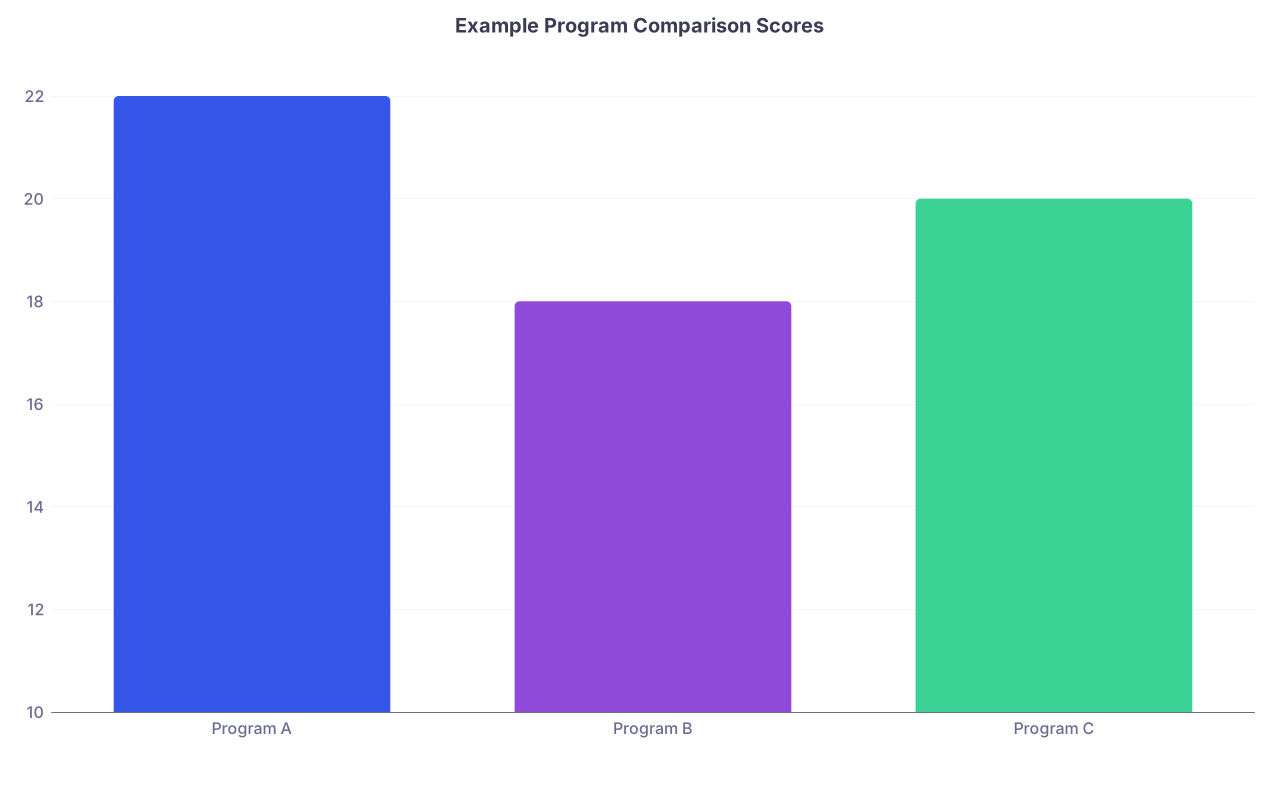
| Category | Value |
|---|---|
| Program A | 22 |
| Program B | 18 |
| Program C | 20 |
You are not pretending this is science. You are forcing yourself to be explicit about how each program actually performed on what matters to you.
Step 10: Use Second-Look Data to Adjust Your Rank List
Here is the discipline most applicants lack: if the second look did not change your data meaningfully, do not pretend it did.
Ask:
Did I learn something that materially changes my understanding of:
- Resident happiness?
- Training quality?
- Career outcomes?
- Life feasibility?
Did any program move from:
- “Top tier” to “absolutely not”?
- “Middle of the pack” to “secret gem”?
Common patterns I have seen:
- Applicant visits a prestige-heavy program and realizes, “Residents are miserable, everything is service, education is an afterthought.” Program drops from #1 to #4.
- Applicant visits a “safety” community program, sees phenomenal mentorship and happy residents, and moves it way up the list.
- Applicant sees their apparently “perfect” program but realizes their partner will hate the city. They decide the tradeoff is not worth it.
Use what you saw. Do not let sunk cost (“But it is [fancy name]!”) override actual evidence.
Step 11: Understand What Second Looks Do Not Do
Let me be blunt.
Second looks generally do not:
- Boost your rank position in any meaningful, policy-compliant way.
- Turn a program that was lukewarm on you into an enthusiastic match.
- Compensate for a weak application.
Many programs have strict rules (and sometimes institutional policies) that second looks must not influence rank decisions. Some specialties have made this explicit.
Second looks do:
- Help you avoid toxic or misaligned environments.
- Give you clarity between close options.
- Correct first impressions based on one polished interview day.
- Expose programs that are adapting well (or poorly) to the changing future of medicine.
If you go in thinking, “I will impress them into ranking me higher,” you will almost always be disappointed. Go in thinking, “I will get the truth I need to rank them correctly.” That is a realistic goal.
Step 12: Think About the Future of Medicine While You Are There
You mentioned “Miscellaneous and Future of Medicine” for a reason. Second looks are not just about next July. They are about your whole career trajectory in a shifting landscape.
During your visit, pay attention to how the program is dealing with:
Technology and AI integration
- Are they using decision support tools, AI-assisted imaging, or smart EHR workflows?
- Is there training on how to use these tools, or are residents just clicking through prompts?
Telemedicine and outpatient shift
- Are clinics incorporating telehealth meaningfully?
- Are residents being trained to manage care across in-person and remote settings?
Interdisciplinary teamwork
- Is this still a doctor-centered, top-down culture?
- Or are pharmacists, advanced practice providers, and nurses clearly respected collaborators?
Quality improvement and system redesign
- Are residents involved in QI projects that actually change practice?
- Or are QI “requirements” a box-checking formality?
Good programs are not just reacting to changes. They are experimenting, learning, and bringing residents into the conversation. That is the kind of place that will make you resilient in a messy healthcare future.
You do not need them to have everything perfect. You just need proof they are thinking ahead.
Step 13: Follow-Up Communication (If Any)
You do not need a long, dramatic thank-you email. Keep it simple, honest, and aligned with match rules.
To the coordinator or chief who arranged the visit:
Dear [Name],
Thank you again for organizing my second-look visit on [date]. I appreciated the opportunity to see the residents at work and to learn more about the program’s culture and training environment.
The visit confirmed for me that [Program Name] is a place where I could see myself training. Please extend my thanks to the residents and faculty who took time to speak with me.
Best regards,
[Your Name]
Do not:
- State your rank order.
- Fish for reassurance (“I hope I am still being considered highly”).
- Ask them to tell you where they will rank you.
Stay professional. Then focus back on your list.
Common Pitfalls to Avoid
Let me clean up the most frequent mistakes I see:
Using second looks as a flex. Posting “Second look #7 this month!” on social media. Totally missing that you are exhausting yourself to gain almost nothing.
Letting flattery override reality. A PD tells you, “We loved your application,” and suddenly you ignore the miserable residents you just talked to.
Overinterpreting small data. You meet one unhappy PGY-2 and panic. Could be a personality clash, could be a rough month. Weigh patterns, not anecdotes.
Ignoring your partner or family. “They will adjust” is how long-term resentment starts. If they are clearly uncomfortable with the city, take that seriously.
Failing to write anything down. Then deciding weeks later based on fuzzy impressions. You will rationalize whichever choice feels more prestigious unless you have concrete notes.
A Simple Second-Look Workflow (Visual)
Here is a clean snapshot of the process you should be following:

| Step | Description |
|---|---|
| Step 1 | Identify close-call programs |
| Step 2 | Define decision questions |
| Step 3 | Email coordinator to request visit |
| Step 4 | Plan 3-4 hour agenda |
| Step 5 | Visit - observe and ask targeted questions |
| Step 6 | Document ratings same day |
| Step 7 | Compare across programs |
| Step 8 | Update rank list |
Quick Time and Money Reality Check
Before you commit to multiple trips, be honest with yourself about cost and benefit.
| Category | Value |
|---|---|
| Program A | 22 |
| Program B | 18 |
| Program C | 20 |
That is 12 hours per program, plus travel costs. Two or three high-yield visits are smart. Eight shallow ones are self-sabotage.
Final Takeaways
- Second looks are decision tools, not performance stages. If you are not getting data that changes your rank list, you are doing them wrong.
- Plan them like a mission: clear questions, structured time with residents, focused observation of real work and real life.
- Judge programs not just on prestige or polished interview days, but on how they treat residents, adapt to the changing future of medicine, and fit your actual life.
Use that approach and your second looks stop being expensive tourism and become what they should be: the last, sharp filter before you commit years of your life.