
You are standing in the lobby on your second look day. White coat half on your arm, coffee in your hand, a few other applicants hovering nearby doing awkward small talk. Residents are friendly. Faculty says all the right things. The hospital looks… fine. Or good. Or maybe great. Hard to tell.
You go home, open your spreadsheet, and realize you have almost nothing objective to add. Just vague impressions like “good vibes,” “people seemed nice,” and “PD smiled a lot.”
This is the problem. Second looks feel important. But if you do not turn the day into concrete data, they just become emotional noise that wrecks a rational rank list.
Let’s fix that.
Step 1: Decide What Second Looks Are (And Are Not) For
Before you walk into a second look, you need to be very clear on the job description of this visit.
Second looks are for:
- Clarifying unknowns you could not answer from interview day, website, FREIDA, or word of mouth.
- Stress-testing how you fit the program’s day-to-day reality, not just their interview costume.
- Comparing “good” programs against each other on your priorities.
- Generating structured, comparable data for your rank list.
Second looks are not for:
- Trying to impress the program or “move up the list” (that ship mostly sailed after interview day).
- Fishing for some magical sign the program “loves you.”
- Letting guilt, flattery, or pressure push a program up your list.
Your mindset:
“I am here as an informed buyer doing a second inspection on a house. I am not here to perform. I am here to collect data.”
If you do not adopt that stance, you will default to vibes. And vibes are how people end up miserable PGY-2s in cities they never wanted to live in.
Step 2: Build a Scoring System Before You Go
If you walk in with no framework, you will walk out with no usable data.
You need a simple, standardized scoring system you can apply to every second look. Not perfect. Just consistent.
2.1 Define your categories
These are common buckets that actually matter once you start residency. You customize, but do not go overboard. 6–10 categories is enough.
Examples:
- Resident Culture and Support
- Clinical Volume and Autonomy
- Teaching Quality and Education Structure
- Program Leadership (PD/APD/Chair)
- Schedule, Call, and Workload
- Fellowship / Job Outcomes
- Location, Commute, and Lifestyle
- Support Services (ancillary staff, mental health, admin)
- Research and Career Development
- Program Stability and Reputation (for your goals)
Now weight them. Because not everything is equally important.
If you are going into EM, call schedule might be huge. If you are planning on academic cardiology, research and fellowships carry more weight. Be honest about what you actually care about, not what you are supposed to care about.
Here is a simple weighting model:
- 3 = Critical (deal-breaker territory)
- 2 = Important
- 1 = Nice to have
Assign one of those to each category before you step foot in the hospital.
| Category | Weight (1–3) | Notes Example |
|---|---|---|
| Resident Culture & Support | 3 | Want non-toxic, collaborative team |
| Clinical Volume & Autonomy | 3 | Need strong training |
| Teaching & Education | 2 | Care about didactics balance |
| Schedule & Workload | 3 | Want humane but rigorous schedule |
| Fellowship/Job Outcomes | 2 | Aim for competitive fellowship |
| Location & Lifestyle | 2 | Partner job + family nearby |
2.2 Create a 1–5 rating scale
For each category, you will score programs 1–5 based on what you see and hear on second look:
- 1 = Big red flags / unacceptable.
- 2 = Below average for you; clear concerns.
- 3 = Fine / acceptable; nothing special.
- 4 = Strong; above average.
- 5 = Excellent; clear strength.
Total score for each category = weight × rating. Sum all categories → program’s second look composite score.
This is not pretending to be science. It is structured subjectivity. Far better than “I liked the lunch.”
Step 3: Convert the Day Into Targeted Data, Not Tourism
Most second looks are poorly structured. That is fine. You will impose your own structure.
3.1 Go in with a battle plan
Show up with:
- Your score sheet (paper or on your phone).
- A short list of specific questions tailored to:
- Residents at different levels (intern, mid-level, senior).
- Faculty / PD or APD.
- Current fellows (if applicable).
- Any non-physician staff you can casually talk to (nurses, social work, etc.).
Do not ask every question to everyone. You will sound robotic. Use the list as a menu.
3.2 What to ask residents (and how to ask it)
You are not trying to catch them lying. You are trying to get past the script.
Skip vague questions like “Do you like the program?” Everyone will say yes.
Use specific, behavior-level questions:
Resident culture:
- “Who do you call at 2 a.m. when a patient is crashing and you feel over your head?”
- “Tell me about the last time something went wrong here. How did leadership handle it?”
- “If an intern is struggling, what actually happens? Who notices? What do they do?”
Schedule/workload:
- “On your worst rotation, what are real hours door-to-door?”
- “How many true days off do you get in a normal month?”
- “How often are you staying >2 hours late on ‘non-call’ days?”
Teaching:
- “Which attending is known for really teaching on busy days?”
- “How often do conferences get cancelled? For what reasons?”
- “Are you ever pulled from didactics to cover service?”
Clinical volume and autonomy:
- “On nights as a PGY-2, what are you allowed to do before calling an attending?”
- “Do you feel overworked and under-supervised, or underworked and babysat, or about right?”
- “Are there any rotations everyone dreads because you just do scut?”
Pay attention to inconsistencies. If every intern says “We get crushed all the time” and the senior says “The hours are pretty light,” that is a data point.
3.3 What to ask leadership (PD/APD)
You want to hear how they think, not just what they market.
Examples:
Program philosophy:
- “What problem in this residency are you actively trying to fix this year?”
- “If I talk to your interns, what will they say is the hardest part of this program right now?”
- “In the last 2–3 years, what major change have you made based on resident feedback?”
Schedule/workload:
- “What rotations are you trying to lighten or adjust?”
- “How do you monitor for burnout beyond just ‘our door is always open’?”
Outcomes:
- “Where did your last 3 graduating classes match for fellowship / take jobs?”
- “What do you do for residents who want academic careers? Industry? Community practice?”
Program stability:
- “Any anticipated leadership changes in the next 1–2 years?”
- “Have there been any recent GME or ACGME citations? How did you address them?”
A PD who dodges specifics or paints everything as perfect is not reassuring. Perfect programs do not exist. Honest ones admit their flaws and can tell you what they are doing about them.
3.4 What to observe silently
Some of the best data you collect is non-verbal.
Look for:
- How residents talk to each other when faculty are not hovering.
- How nurses speak about residents in hallways or break rooms.
- Resident body language at noon conference: engaged vs dead vs absent.
- How often someone’s phone is blowing up during “protected” didactics.
- Whether people joke with each other or just survive together.
You are not a secret shopper. But you are not blind either. Trust what you see.
Step 4: Capture Impressions Immediately and Rigorously
Your brain will lie to you within 24–48 hours. It will compress details into “good” or “bad.” That is useless.
You need a post-visit ritual.
4.1 Do a 20-minute debrief the same day
Before you go out to dinner, before you call your partner, sit down somewhere quiet (coffee shop, your car, hotel room) and:
- Fill in your 1–5 scores for each category.
- Write 3–5 bullet points under each category backing up the score.
Example for “Resident Culture & Support – 4/5”:
- Interns joked about chiefs and asked for help freely.
- Senior said “We all cover each other when people have life stuff.”
- One resident quietly said “We are tired, but we like each other.”
- Only mild eye-roll when asked about PD; no fear.
- Write a gut ranking sentence:
- “Right now, I would put this program above Midwest U and below City General.”
Do not overthink it. Capture the fresh, unedited reaction and the structured data.
4.2 Use a consistent comparison format
You want apples-to-apples. Here is a simple template you can reuse for every second look:
- Top 3 strengths of this program for me
- Top 3 concerns / weaknesses
- One thing that surprised me (good or bad)
- Would I be okay if I matched here? Why or why not?
Those few lines, multiplied across programs, give you far more clarity than 17 pages of freeform notes.
Step 5: Turn Multiple Second Looks Into a Comparable Dataset
One second look is interesting. Three or four second looks become a pattern.
Once you have done your visits, you need to pull everything into one place. This is where your scoring system pays off.
5.1 Build a simple comparison table
You do not need fancy software. Google Sheets, Excel, or even a hand-drawn table works.
Columns: Programs.
Rows: Categories.
Cells: weighted scores.
Example (simplified):
| Category | Weight | Program A | Program B | Program C |
|---|---|---|---|---|
| Resident Culture | 3 | 4 | 5 | 3 |
| Clinical Volume/Autonomy | 3 | 5 | 3 | 4 |
| Teaching/Education | 2 | 3 | 4 | 4 |
| Schedule/Workload | 3 | 2 | 4 | 3 |
| Location/Lifestyle | 2 | 5 | 3 | 2 |
Now multiply each score by the weight and sum for each program.
5.2 Visualize where programs really differ
If you are a visual person, chart the differences.
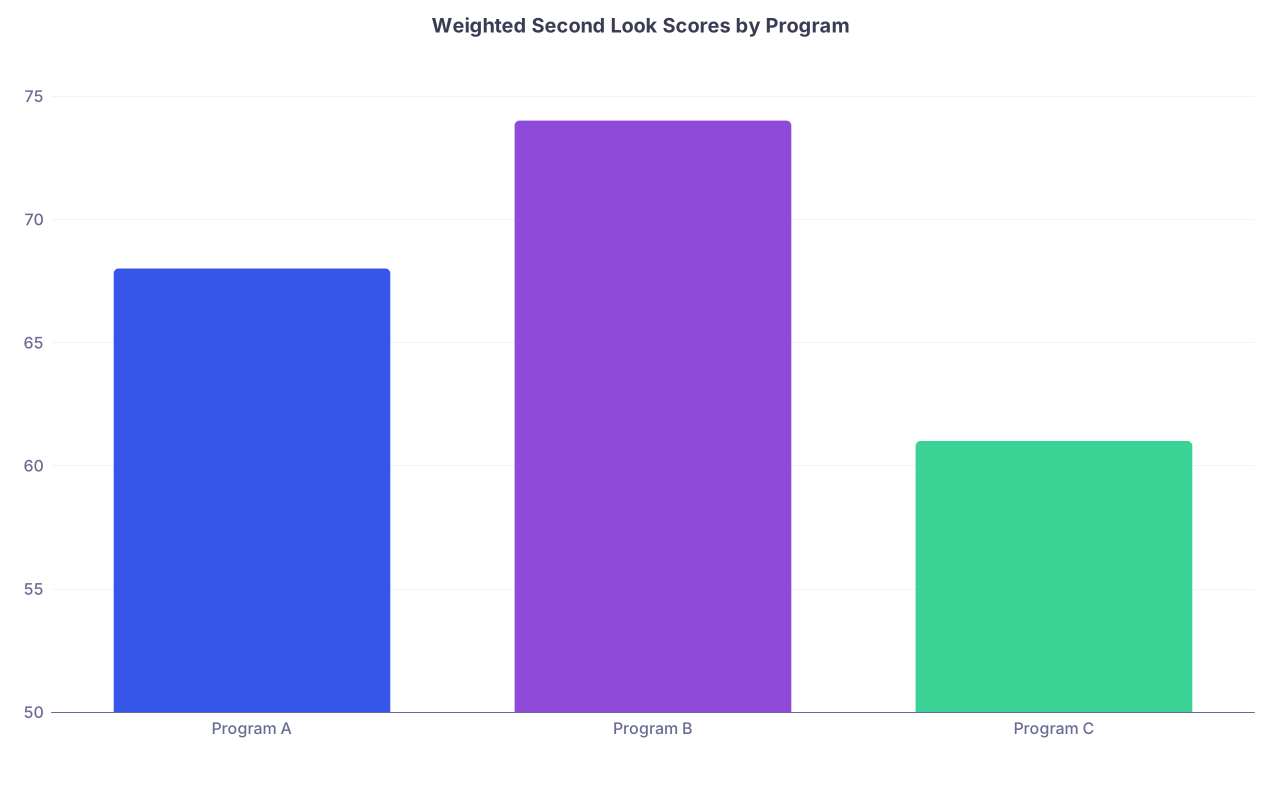
| Category | Value |
|---|---|
| Program A | 68 |
| Program B | 74 |
| Program C | 61 |
Now you are not just saying “Program B felt nicer.” You are saying:
- “Program B scored highest overall, mostly because resident culture and schedule were significantly better, and those are 3-weight categories for me.”
That is how adults make decisions.
5.3 Use scores to force hard conversations with yourself
Scores are not the final answer. They are a starting point to challenge your own bias.
If a program you thought was your dream comes out lower, ask:
- Did I weight categories honestly, or did I downplay something like location because I am chasing prestige?
- Are there any scores I inflated or deflated because of a single charismatic resident or PD?
You do not have to obey the numbers. But if you are going to override them, do it consciously, not by accident.
Step 6: Watch for Red Flags That Should Hit Your Rank List Hard
There are certain findings on a second look that deserve disproportionate weight. You ignore these at your own risk.
6.1 Resident misery + denial from leadership
Combination that should make you very cautious:
- Multiple residents say things like:
- “We are drowning.”
- “People are leaving.”
- “There is a lot of drama right now.”
- Leadership’s narrative:
- “We are like a family. We rarely lose residents. Everyone is thriving.”
Gap between those two? Major problem.
6.2 Schedule games and “creative” compliance
Examples I have seen:
- Residents openly talking about logging 80 hours when they are clearly working 90–100.
- Chief quietly says, “We all just make sure the numbers look right.”
- “Protected” didactics is routinely interrupted for pages or floor calls.
This is not just about comfort. It tells you how the program handles rules, resident well-being, and ACGME compliance. If they cut corners here, they will cut corners elsewhere.
6.3 Leadership instability and vague answers
Things that should drop a program on your list unless there is strong upside:
- Recent or upcoming PD turnover with no clear plan.
- Multiple APDs leaving in the same year.
- “We are in a transition phase” with zero specifics.
- Vague responses when you ask about past citations or major complaints.
You will be there 3–7 years. You are not signing up for a beta test.
Step 7: Integrate Second Look Data Into Your Rank List Rationally
Now the real work: merging second look data with the rest of what you know.
7.1 Build three rank inputs
Think of your final rank list as the product of three separate lists:
Baseline Program Quality / Career Fit List
- Based on case volume, fellowships, reputation, board pass rates, research.
Personal Life / Logistics List
- Cost of living, partner job, family proximity, city preference.
Second Look / Lived Experience List
- Your structured scores + fresh impressions from second looks.
Each of those generates its own “top to bottom” ranking. Then you look at how they line up.
Example:
- Career Fit List: A > B > C
- Personal Life List: C > B > A
- Second Look List: B > C > A
This is where adults get stuck. They stare at the conflict and freeze.
7.2 Force pairwise decisions
Stop thinking “What is my perfect list?” and start thinking one comparison at a time.
Ask:
- Between A and B, where do I honestly want to wake up July 1?
- Between B and C, same question.
Use your structured data to break ties and challenge your biases, but still answer with your whole self, not just the spreadsheet.
For borderline choices, look at:
- “If I matched at X, would I spend the next week feeling relieved or disappointed?”
- “If a friend I trust ranked Y above X, could I clearly explain why I disagree?”
If you cannot justify your choice against your own data, that is a sign you are rank-ordering based on ego, fear, or someone else’s priorities.
Step 8: Do Not Let Second Looks Hijack Your Emotions
A final warning: second looks are emotionally loud. Programs turn on the charm. Current residents sell hard. You will be flattered, fed, and told you would “fit in great here.”
Necessary reminder: almost every program will be fine. The question is not “Is this a good program?” but “Is this the best option for me out of the programs I interviewed at?”
To keep second looks from hijacking your decision:
Never reorder your entire list based on one great (or terrible) second look alone.
Require at least:- Clear, specific strengths or red flags.
- Alignment with your pre-defined priorities.
Do not chase perceived love.
Hearing “We are ranking you highly” feels good. It should not move them up your list unless:- You were already near the top.
- Your data and experience support that ranking.
Avoid proximity bias.
The last second look you do will feel most vivid. That does not mean it is best. That is just availability bias doing its job.
A Simple Second Look Workflow You Can Steal
If you want a turnkey process, here is one:

| Step | Description |
|---|---|
| Step 1 | Define priorities and weights |
| Step 2 | Create 1-5 scoring sheet |
| Step 3 | Prepare targeted questions |
| Step 4 | Attend second look |
| Step 5 | Observe and ask residents and faculty |
| Step 6 | Same day 20 minute debrief |
| Step 7 | Score categories and write bullets |
| Step 8 | Enter scores into comparison sheet |
| Step 9 | Compare programs and adjust rank list |
You do that for each program. No heroics. Just consistent, structured, repeatable behavior.
Key Takeaways
Second looks are only useful if you structure them.
Go in with weighted categories, a 1–5 scale, and specific questions. Walk out with scores and concrete bullets, not vibes.Compare programs using the same lens.
Put scores into one table, look for patterns, and let the data challenge your assumptions. You do not have to obey the numbers, but you should not ignore them.Use second looks to refine, not reinvent, your rank list.
Integrate them with career fit and personal life factors. Watch for real red flags. And rank where you actually want to train, not where you felt the most flattered.