
The way most applicants use a second look is a waste of leverage. You do not fly back to a program to check if the lounge snacks are good. You go back to answer one hard question: “Will I be primarily a learner here, or cheap labor that gets teaching when there is time?”
You are trying to separate real education from service exploitation. That is the entire game.
Below is a step‑by‑step playbook to use a second look visit to evaluate teaching vs service load with ruthless clarity—and to walk away with a decision that actually protects your future self.
Step 1: Go in with a scoring framework, not vague vibes
If you walk in thinking “I’ll just see how it feels,” you will get played by nice personalities and free food.
You need a simple, explicit mental model:
| Domain | Teaching Signal (Good) | Service Signal (Bad) |
|---|---|---|
| Time | Protected teaching time, lighter call | Constant pages, long work hours |
| Structure | Curricula and objectives | Ad hoc, “depends on attending” |
| Faculty engagement | Present, invested, available | Absent, rushed, transactional |
| Resident role | Supervised learner | Independent workhorse |
| Documentation burden | Streamlined, support staff | Residents do everything |
On second look, your job is to collect data in each domain. Not feelings. Data.
Before you go, make a one‑page checklist. Literally:
- Teaching:
- Weekly didactics: frequency, attendance, interruptions
- Bedside teaching: examples, frequency, who leads
- Feedback: how often, what format, who tracks it
- Service:
- Typical census per resident
- Average hours / week on main rotations
- Cross‑coverage at night, number of admits
- EMR / notes burden (who writes what, how much)
Bring it on your phone. Fill it throughout the day in bullets right after each conversation.
Step 2: Use second look to see the day, not the brochure
You do not care what the PD told you on interview day. You want to see what a Tuesday actually looks like.
Here is the basic flow you want your second look to roughly follow:

| Step | Description |
|---|---|
| Step 1 | Arrive at Program |
| Step 2 | Morning Handoff or Rounds |
| Step 3 | Workroom Time |
| Step 4 | Noon Conference |
| Step 5 | Afternoon Clinical Time |
| Step 6 | End of Day Debrief with Residents |
You will not always get this perfect structure, but push for it.
When you arrange the second look, ask specifically:
- “Can I:
- Sit in on morning sign‑out or table rounds?”
- Be in the resident workroom for at least an hour?”
- Attend a noon conference or equivalent teaching?”
- Shadow on a typical ward / clinic / ED shift for a few hours?”
Programs that are serious about education will say “Yes, absolutely, let’s build that in.”
Programs that mainly want scut labor often give vague answers:
- “We usually keep second looks more informal.”
- “You can chat with residents but we don’t really let you on the units that day.”
- “You’ve already seen a lot on interview day; this is more for questions.”
Translation: they do not want you to see the real workflow.
Step 3: Audit the schedule in real time
Every program claims to have “protected didactics,” “ample teaching,” and “reasonable service load.” Fine. You are not asking what exists on paper. You are asking what survives contact with reality.
During your second look, track three things like a scientist:
3.1. Didactics: Do they actually happen?
At noon conference or any formal teaching:
- Start time:
- Did it start on time or 15 minutes late because half the team was still admitting?
- Attendance:
- Are most residents there, or are 40–50% “stuck on the floors”?
- Interruptions:
- How many pages / phones go off?
- Do residents step out and never come back?
- Faculty presence:
- Are attendings there, engaged, asking questions?
- Or is this resident‑only, self‑run, and chaotic?
Red flags I have seen in real life:
- Program says: “We have protected didactics.”
Reality: Half the residents get texted to “come discharge your patient” mid‑lecture. - Noon conference is “optional because patient care comes first.”
Translation: Teaching is decorative here.
Write down exact observations. “Noon conference – 8/14 residents present. 4 pulled away by pages. Attending left after 15 minutes.”
3.2. Workflow: Who is drowning, who is teaching?
In the workroom / on rounds, notice:
- Resident body language:
- Are people relatively calm, or frantic and behind all day?
- Conversation content:
- Are interns asking clinical questions and getting real explanations?
- Or is every conversation “Did you place that PT order?” and “We need those notes done”?
- Attending behavior:
- Do they pause to teach, ask questions, and explain decisions?
- Or do they blow through 18 patients in 40 minutes, then disappear?
Ask a senior quietly:
- “On a typical ward day, when do you actually sit and read or learn something?”
- “If you fall behind, what gets cut first—teaching or tasks?”
If the honest answer is “Teaching always gets cut,” that program has chosen service over education by design.
3.3. Time accounting: Where do the hours really go?
You need rough numbers, not generalities.
Ask different residents independently (not in front of faculty):
- “On your main inpatient rotation:
- What is your typical arrival time?”
- What time do you usually leave?”
- What is your highest census you have personally held?”
- How many new admissions on a call day / night?”
Then push one step further:
- “On a heavy day, how many hours are direct patient interaction or teaching versus documentation / orders / logistics?”
Look for consistency. If one intern says, “I’m here 6:00–7:30 most days” and another says “7:00–5:30,” somebody is sugarcoating.
Step 4: Ask targeted, uncomfortable questions (the right way)
The worst question you can ask: “Is the program more service‑heavy or education‑focused?”
They will almost all say, “It’s a balance.” Useless.
You want specific, non‑leading questions that force concrete answers.
4.1. For interns
Ask these away from attendings and chiefs:
- “How many notes do you usually write in a day on wards?”
- “Who does discharge summaries? Do attendings ever help with them?”
- “On your hardest rotation so far, what did a typical day look like, hour by hour?”
- “How often does your attending sit down and actually teach for >10 minutes?”
- “If you told your attending you needed 15 minutes to see a cool procedure, would they help cover or say no?”
- “How many times in the past month did you leave after 8 p.m. on a ‘non‑call’ day?”
Listen for key phrases I have repeatedly heard in service programs:
- “You learn by doing.” (Often code for “no structured teaching.”)
- “You get efficient.” (Translation: EMR treadmill.)
- “It depends on the attending.” (Means there is no baseline standard.)
4.2. For seniors and chiefs
They see the system. Ask:
- “If you could remove one rotation because it is mostly scut, which would it be?”
- “On which rotations do people feel the most like workhorses?”
- “Do residents actually log their duty hours accurately, or is there pressure to adjust?”
- “How often do you call jeopardy or backup due to unsafe volumes?”
- “Who actually protects noon conference when the unit is slammed?”
A solid program will have chiefs who say things like:
- “We cap strictly; if we hit cap, we call the admitting team to stop.”
- “We will pull a floater or night resident early if days are drowning.”
- “If you miss conference for real reasons, we track it and try to adjust; missing daily is unacceptable.”
A service‑first shop often has seniors saying:
- “You just push through; it gets better as you get faster.”
- “We rarely call backup; we pride ourselves on handling our own.”
That “pride” is usually burnout in disguise.
4.3. For faculty and program leadership
This is where you separate marketing from reality. Ask directly:
- “Tell me about a recent specific change you made to reduce resident service burden.”
- “How do you measure whether residents are actually learning—not just surviving?”
- “What is one recent instance where clinical volume forced you to modify or protect teaching time?”
- “When a rotation is consistently overworking residents, what exactly happens and how fast?”
You want examples with dates and specifics:
- “In 2023 we cut the admit cap from 10 to 8 per intern and added an NP on weekdays.”
- “We moved half of the discharge summary workload to scribes on high‑volume services.”
If all you get is vague philosophy and no concrete system changes, assume service wins.
Step 5: Watch for structural signals that scream “service”
Forget the slogans. Look at the bones of the program. Certain features almost always correlate with service‑heavy training.
5.1. Caps, coverage, and backup
Ask specifically for numbers:
- Max census per:
- Intern on wards
- Senior on wards
- Night float resident
- Max new admits per:
- Call day (day team)
- Night
- Backup system:
- Formal jeopardy? How often used?
- Or “We rarely call jeopardy; people just manage.”
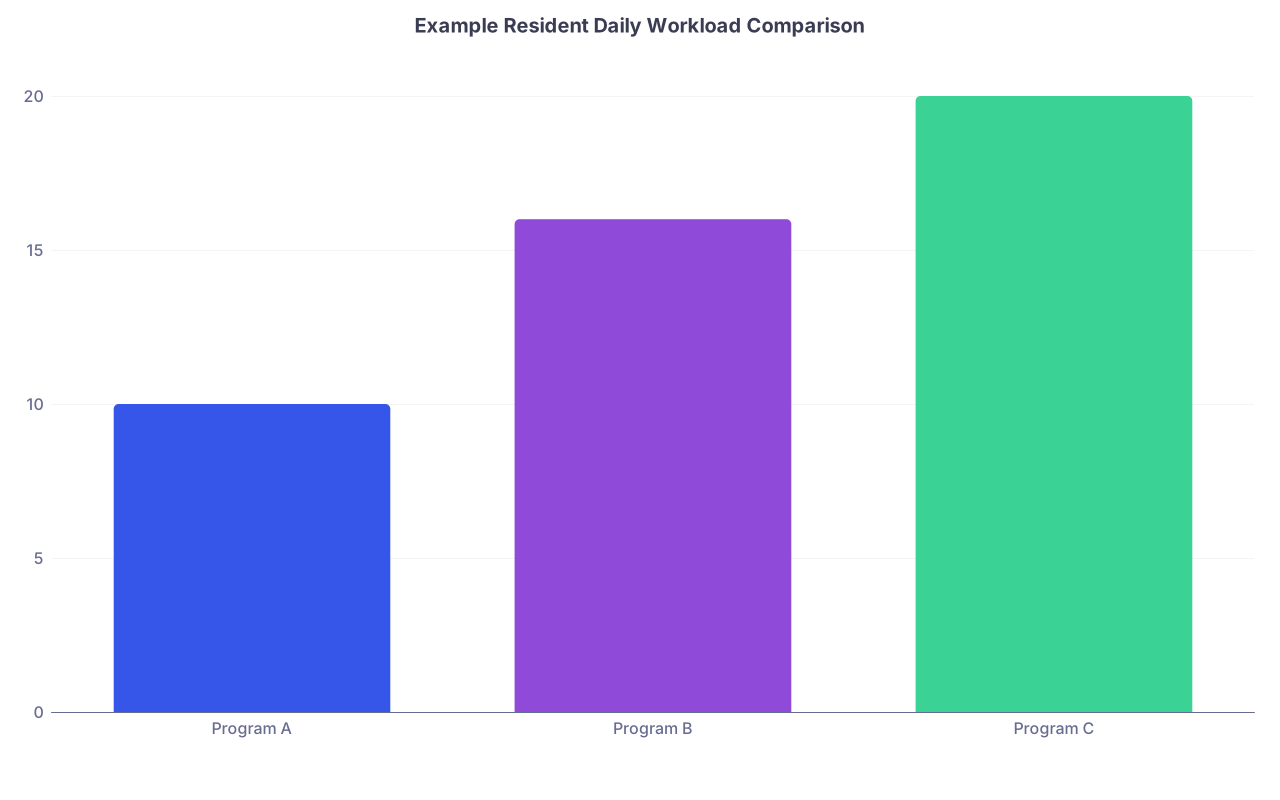
| Category | Value |
|---|---|
| Program A | 10 |
| Program B | 16 |
| Program C | 20 |
If multiple residents tell you they have personally carried:
- 18–24 patients as a senior regularly
- 12–16 as an intern consistently
You are looking at a service machine, not an educational program.
5.2. Who does the work that is not learning?
Run down this list for major rotations:
- Discharge summaries: resident vs NP/PA vs shared
- Social work coordination: resident vs dedicated coordinator
- Prior auths: resident vs pharmacy/services
- Bed management / calling consults: resident vs unit clerk / coordinator
- Transporting patients: does that ever fall to residents?
Residents should absolutely work hard. They should not run the hospital’s logistics.
If you hear “We do everything, but you get really efficient,” that is hospital leadership taking advantage of your license.
5.3. EMR and documentation burden
Ask:
- “Average note length expectations?”
- “Any smart phrases / templates shared by program?”
- “Are you expected to prechart all clinic patients at home?”
- “Any scribes or MAs who help with data entry?”
Then ask one blunt question:
- “How many hours per week would you say are purely documentation?”
If people start at “Hmm, maybe 15–20,” that is a serious load. Over three years, that is thousands of hours you are not using to read, think, or rest.
Step 6: Identify real teaching culture, not performative teaching
Now the flip side. You are not only hunting for red flags. You want hard evidence that the program has embedded education into its daily routines.
6.1. Rounds and teaching structure
On rounds, look for:
- Intentional teaching moments:
- Attending stops at a room: “OK, quick 3‑minute talk on hepatorenal.”
- Senior asks intern: “Walk me through your differential for this anemia.”
- Use of teaching tools:
- Whiteboard in workroom with “topic of the day.”
- Brief chalk talks between admissions.
Ask:
- “Do you have any required mini‑lectures or case conferences that residents give regularly?”
- “Do attendings ever assign pre‑round or post‑round reading and follow up on it?”
Programs with strong teaching culture almost always have:
- A core inpatient conference schedule beyond noon conference.
- Expectations that seniors teach interns (and get evaluated on it).
- Clear language like: “On this service, your primary job is to learn to think like a ___ doctor; tasks are secondary.”
6.2. Feedback and coaching
Ask every level:
- “How often do you get structured feedback?”
- “Is there a formal midpoint + end‑of‑rotation evaluation that you actually see?”
- “When you are struggling, does anyone sit with you and make a plan?”
Signs it is real:
- Residents can name specific faculty who gave them targeted feedback.
- Chiefs can describe a remediation or coaching system that is not purely punitive.
- There are teaching awards that residents actually care about because they reflect consistent behavior.
Signs it is fake:
- “We’re told we get feedback all the time, but it is mostly ‘you’re doing fine.’”
- “Evaluations get filled months late and nobody discusses them.”
6.3. Autonomy vs abandonment
You want autonomy. You do not want to be abandoned with 20 sick patients and an attending who only appears to sign charts.
Ask:
- “On nights, how easy is it to reach an attending, truly?”
- “Have you ever felt unsafe because you were alone with too much responsibility?”
- “On ICU rotations, how often does the attending round in person versus phone updates?”
Healthy programs strike a balance:
- Intern:
- Owns patients, presents plans.
- But can always escalate and get real help.
- Senior:
- Runs the team but has attending backup that is present when needed.
- Attendings:
- Expect independence but check in intentionally.
Service‑driven programs often confuse “They survived” with “They learned.”
Step 7: Cross‑check stories for internal consistency
People will spin. That is normal. Your protection is triangulation.
For each key domain (hours, census, teaching, culture), try to get:
- At least:
- 2 interns
- 2 seniors
- 1 fellow (if applicable)
- 1 attending or PD
Ask very similar questions and compare answers.
Example:
- Intern A:
- “We usually leave by 6 p.m. on wards.”
- Senior:
- “On average yes, but last month we had 3 nights everyone stayed till 9.”
- Fellow:
- “Night float is brutal—lots of cross‑cover but residents manage.”
Now you know:
- The “average day” story.
- The “real worst‑case” pattern.
- The “cultural spin” from someone more senior.
If everyone matches too perfectly with rehearsed lines, be suspicious. Residents at healthy programs usually have nuanced answers: “This rotation is rough, this one is fantastic, here is what changed recently.”
Step 8: Convert observations into a concrete decision
After the second look, do not rely on a fuzzy impression. Sit down that evening or the next day and do a crude but useful scorecard.
8.1. Build a quick rating table
Take your checklist and rate each area 1–5 (5 = excellent teaching / reasonable service, 1 = terrible).
| Domain | Score (1–5) | Notes Example |
|---|---|---|
| Protected didactics | 4 | Conference daily, ~80% attendance, minimal interruptions |
| Inpatient workload | 2 | Intern census 10–12, frequent 12+ hr days |
| Faculty engagement | 5 | Multiple attendings observed teaching actively |
| EMR / documentation | 3 | Heavy but some templates, no scribes |
| Feedback / coaching | 4 | Midpoint feedback consistent, residents cite real examples |
Two things matter:
- Pattern, not a single number.
- Comparison with other programs you have seen.
If you walked away from another program with:
- Lower census
- Better backup
- Equally strong teaching
You need a very good reason to rank the higher‑service program higher. “Prestige” is rarely a good enough reason to sign up for three or more years of chronic overload.
8.2. Apply one simple litmus test
Ask yourself this, brutally honestly:
“If a family member needed complex care, would I want to be their doctor trained primarily at this program, given what I saw of how residents learn here?”
If the answer is “No, I would rather be trained somewhere with more supervision / thinking / teaching,” that is your gut telling you the service load is eating the education alive.
Step 9: Know the non‑negotiable red flags
A few things should make you pause hard, no matter how nice people seemed.
Red flags that usually mean service dominates:
- Duty hours:
- Residents openly admit to consistent >80 hour weeks.
- Or quietly admit “we adjust hours to avoid triggering violations.”
- Systemic understaffing:
- Constant complaints about nursing, social work, or ancillary staff.
- Residents routinely transporting patients or doing clerical tasks.
- Culture of martyrdom:
- “We are super hardcore; it makes you tough.”
- Heavy pride in suffering, light focus on learning.
- Disregarded teaching:
- Noon conference regularly cancelled or poorly attended.
- Rounds are all logistics, no education.
You can survive that. Many do. But you will pay for it: in burnout, in weaker habits of clinical reasoning, in a narrower long‑term career.
Step 10: Use second look to plan your own survival if you do match there
Sometimes you will rank a program high even if service is heavier than you like—because of location, family, or specialty competitiveness.
If that happens, do not waste what you learned. Use your second look intel to build a survival plan:
- Identify:
- Which rotations are especially abusive.
- Which ones are gold for teaching.
- Write down:
- The 2–3 attendings residents universally praise as educators.
- The chiefs or seniors who clearly protect juniors.
- Plan:
- How you will protect at least 20–30 minutes a day for real learning.
- How you will push for teaching moments even in busy settings (“Can we spend 2 minutes on why you chose that anticoag?”).
Second look is not only about rank lists. It is recon on your future battlefield.
Your next step today
Open a blank document and draft your Second Look Question Set: 10–15 specific questions you will ask interns, seniors, fellows, and faculty about teaching and service load.
Then sort them by who you will ask first.
If you already have a second look scheduled, revise that agenda email now and explicitly request:
one morning in the workroom + one educational conference + time with residents without faculty present.
Do not trust the brochure. Engineer your second look to show you exactly how much of your residency will be spent learning medicine—and how much will be spent just keeping the hospital running.