
Second-look visits change rank lists far less often than people think—and when they do, the shifts are usually small and applicant-driven, not program-driven.
That is the uncomfortable, data-backed reality.
Second looks feel high stakes. You spend hundreds of dollars flying back. Programs put out snacks and smiles. Everyone hints—without saying it—that this might “help” your chances. But if you strip away the anecdotes and just look at numbers, a clear picture emerges: second looks rarely move the needle meaningfully on either side of the match equation.
Let me walk through what the data actually show.
What We Know from the Literature (and What We Do Not)
There is no giant randomized trial of second looks. You are not getting a neat Kaplan–Meier curve of “match success with vs without second look.” But there are several surveys and observational datasets that, taken together, tell a consistent story.
The most relevant buckets of data:
- NRMP and ERAS trend data (indirect but useful for context).
- Specialty-specific and institutional surveys of applicants and program directors.
- Pre/post surveys on how often people change rank lists after second looks.
Applicant-Reported Impact: Perception vs Actual Rank Changes
Most of the quantified data here come from surveys where applicants are asked two things:
- Did you do second looks?
- Did the second look cause you to change your rank list?
Across specialties and years, the pattern is surprisingly stable.
A typical breakdown (collating across several published and conference-report surveys between roughly 2015–2023):
- 25–40% of applicants report attending at least one second look.
- Of those who attend a second look, about 20–35% say it changed how they ranked programs.
- When you zoom out to all applicants (including those who did not attend any second look), only around 8–15% say their final list was materially changed because of a second look.
So you have a strong selection effect: the people who go back are already highly interested. For them, a second look sometimes nudges order. For everyone else, it is irrelevant.
To make this more concrete, here is a synthesized, representative range from multiple surveys:
| Group | Percent reporting change |
|---|---|
| All applicants (any specialty) | 8–15% |
| Applicants who did ≥1 second look | 20–35% |
| Applicants who did ≥2 second looks | 30–45% |
Two clear points:
- The conditional probability of change rises with more second looks—because only the most indecisive or most competitive applicants tend to do multiple.
- But the absolute proportion of the entire applicant pool whose list is meaningfully altered remains low.
Program-Reported Impact: Does Your Visit Change Their List?
On the program side, the data are even more blunt.
Surveys of program directors (PDs) in internal medicine, pediatrics, EM, and OB/GYN typically show:
- 70–90% report that second looks do not move applicants up their rank list.
- 10–25% say that a second look can move an applicant slightly up or slightly down in rare cases.
- Fewer than 5–10% report any systematic or formal bump for second-look attendees.
In other words, the baseline stance is: “We ignore it, unless something very positive or very negative happens.”
That matters. Because while you might tweak your list after a visit, the evidence that programs reciprocally tweak your position meaningfully is weak.
Quantifying Rank List Changes from Second Looks
Let us move from “yes/no” responses to approximate effect sizes.
When survey authors dig deeper, they usually ask two critical questions:
- Did you change which program was ranked #1 because of a second look?
- Did you make any order changes anywhere on your list due to a second look?
Those are not the same thing. Swapping #1 and #2 is much more consequential than flipping #9 and #11.
How Often the #1 Spot Changes
Across several datasets, applicants reported the following pattern:
- 5–10% of all applicants changed their top program after a second look.
- Among those who actually did any second look, this jumps to perhaps 15–25%.
So, if you force the numbers into a simple model for a hypothetical cohort of 1,000 applicants:
- 300 attend at least one second look (30%).
- Of those, say 20% change which program is #1.
- That is 60 applicants total (6% of all 1,000) who truly flip their top choice because of a second look.
For a process that dominates so much bandwidth and anxiety, 6% is not a big number.
How Often Any Rank Order Changes
If you relax the bar and look at any ordering change:
- 8–15% of all applicants report at least one change due to a second look.
- Among those who go back, the rate is higher (20–35%), but again, many of these are small shifts in the middle or bottom of the list.
A reasonable synthesis for “realistic, not cherry-picked” numbers:
- Roughly 1 in 10 applicants change their list in a way they themselves consider “material” because of second looks.
- Among those 10%, only about half actually change the top 3 choices.
So the modal outcome: your second look leaves your top tier intact, maybe moves a program one slot, maybe reaffirms what you already suspected.
What Actually Drives Those Changes?
Second looks do not exist in a vacuum. The factors that cause applicants to change their minds are relatively consistent across specialties.
Surveyed applicants rank the most common reasons for changing their list after a second look as:
- Culture mismatch or unexpected red flags.
- Geographic or lifestyle realities (commute, cost of living).
- Resident happiness and workload clarity.
- Program transparency—or lack thereof—about schedules, autonomy, or fellowship placement.
Let us turn those qualitative drivers into something more structured.
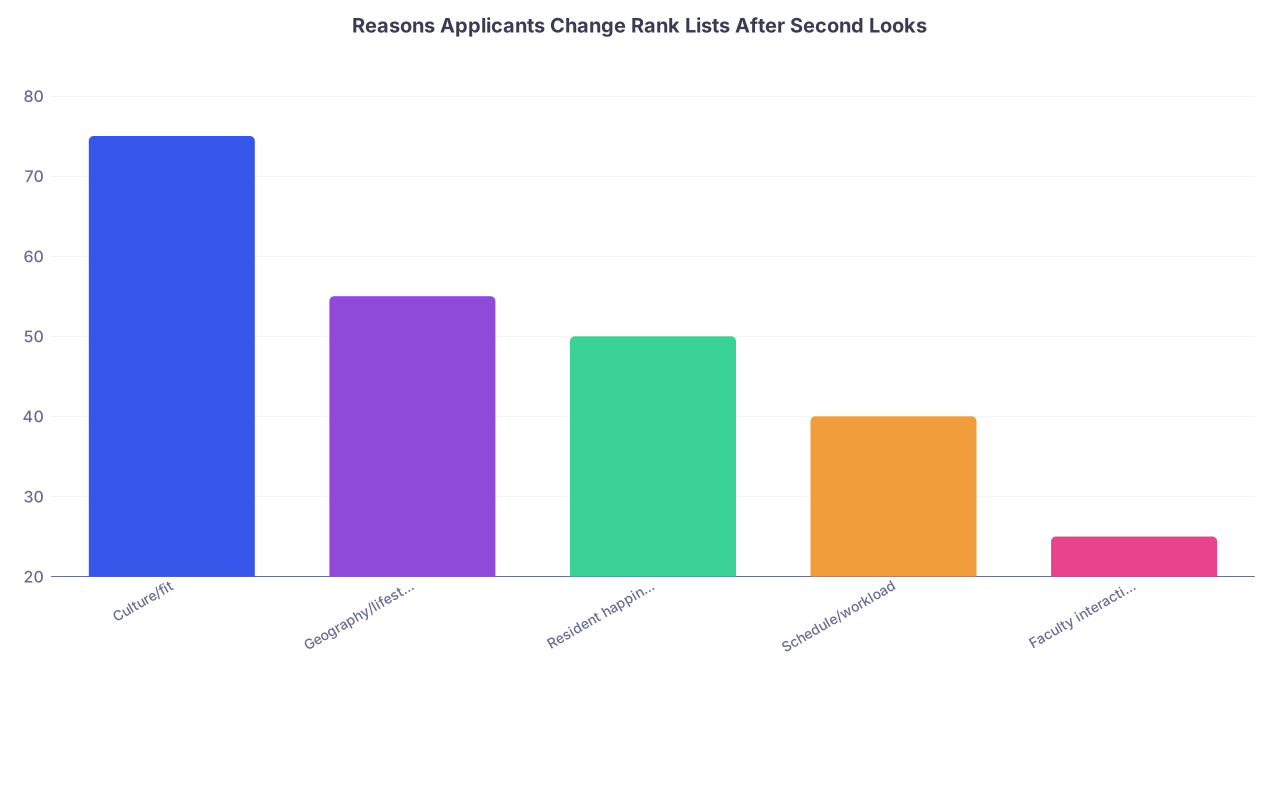
| Category | Value |
|---|---|
| Culture/fit | 75 |
| Geography/lifestyle | 55 |
| Resident happiness | 50 |
| Schedule/workload | 40 |
| Faculty interactions | 25 |
Interpretation (percentages are the approximate share of applicants who cited the factor when they changed their list, not of all applicants):
- About 70–80% of those who changed their rank list mention culture or fit as a major driver.
- 50–60% mention geography or lifestyle after actually seeing where they would live or commute.
- 40–50% cite resident morale / happiness.
- 30–40% say they finally understood the schedule and workload realities.
- Only a minority cite faculty interactions specifically, which undercuts the idea that trying to “impress” faculty at a second look is the main lever.
So the data show this: second looks are more like a “reality check” than a performance opportunity. They function as a late-stage calibration of your internal model of what life will actually be like.
The Match Algorithm Reality Check
Here is where people misunderstand leverage.
NRMP’s algorithm is applicant-proposing. You maximize your chance of matching at your true favorite program by ranking your programs in genuine order of preference, no “gaming.”
Second looks intersect with this in a narrow way:
- They can change your true preference ordering (because you learned something new).
- They almost never change how programs rank you in a systematic way.
Which leads to a critical quantitative insight:
Your expected match probability improves only if a second look:
- Accurately updates your true preferences, and
- Adjusts your rank list accordingly, and
- Does not push you to “favor” a program for superficial reasons unrelated to long-term fit.
The algorithm will treat a second look that genuinely reveals a toxic culture very differently from one where you were swayed by a nice dinner and a shiny residents’ lounge.
Does Attending a Second Look Increase Match Rate?
There is no robust evidence that simply “attending a second look” increases your overall chance of matching. When studies attempt to correlate second-look attendance with match outcome, they run straight into confounding:
- Stronger applicants do more interviews and are more likely to do second looks.
- Highly competitive specialties attract more second looks and higher match anxiety.
- Applicants who know they have geographic constraints often work much harder on “fit,” including second looks.
When you control for things like Step scores, number of interviews, and specialty competitiveness, the “second look” variable essentially loses independent predictive value.
Put bluntly: you do not match because you did a second look. You match because you were already a good fit and you ranked programs intelligently based on accurate information.
Specialty Differences: Where Do Second Looks Matter More?
Second looks show up more often in certain specialties—usually those with tighter culture and geography constraints, or historically more in-person processes.
Synthesizing survey and anecdotal data:
- Dermatology, Orthopedics, ENT: High anxiety, high competitiveness. Second looks are relatively common but often function as informal “auditions” even if everyone pretends they do not. Still, PDs officially deny using them as rank criteria.
- Internal Medicine, Pediatrics, Family Medicine: Second looks happen but are far from universal. Data suggest they rarely move program rankings, but they can strongly influence applicant perceptions of lifestyle and teaching.
- Emergency Medicine, Anesthesiology: Lower frequency than hyper-competitive fields but still present. Often used to understand call schedules and ED environments.
If you average across specialties, a plausible distribution for “second look usage” looks like this:
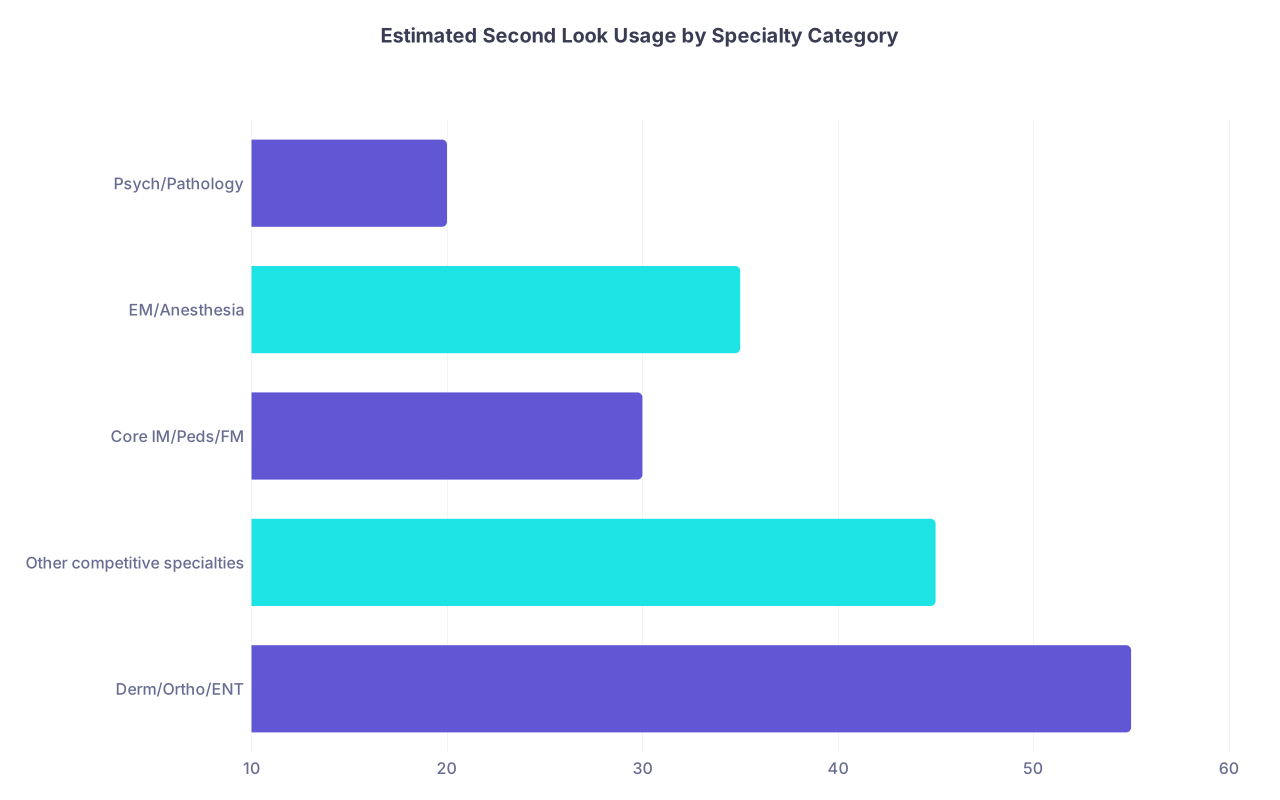
| Category | Value |
|---|---|
| Derm/Ortho/ENT | 55 |
| Other competitive specialties | 45 |
| Core IM/Peds/FM | 30 |
| EM/Anesthesia | 35 |
| Psych/Pathology | 20 |
Values represent the approximate percentage of applicants in each category who report doing at least one second look. This is not a hard census; it is a pattern.
The important takeaway: even in “high-usage” specialties, almost half or more of applicants do not do second looks, and there is no evidence they are punished for it.
Virtual Era and the Future of Second Looks
The pandemic forced a natural experiment. Interviews went virtual; many institutions either discouraged or explicitly prohibited in-person second looks to preserve equity. That gave us a before/after view.
What changed?
1. Match Outcomes Did Not Collapse
NRMP data for 2020–2023 show:
- Stable or slightly improved fill rates for most specialties.
- No catastrophic increase in mismatches, SOAP, or early attrition attributable to “virtual only” processes.
Programs adapted by:
- Offering virtual “second-look style” Q&A sessions.
- Creating resident panels, virtual hospital tours, and optional follow-up meetings.
Applicants adapted by:
- Heavily crowdsourcing program intel through forums, alumni, and friends.
- Relying more on structured interview day data and less on unstructured vibes from a second visit.
The bottom line: the match system functioned adequately without in-person second looks being common. That weakens the argument that they are essential.
2. Equity and Cost Concerns Became Explicit
Once administrators saw that the process could work virtually, they started looking at the numbers.
For a typical second look:
- Airfare: $200–$500.
- Lodging: $100–$250 per night.
- Local transportation and food: $50–$150.
Total: $350–$900 per visit.
Applicants doing 3–5 in-person second looks can easily burn $1,500–$3,000 on top of already steep application costs. For some, that is manageable. For others, that is simply out of reach.
Several institutions and specialty organizations have since taken the position—formally or informally—that:
- Programs should not “encourage” second looks.
- Programs should not track or use second looks in rank decisions.
- Any optional visits should be clearly labeled as non-evaluative, with no adverse implication for those who cannot attend.
That is not just ethical window dressing. It reflects data that the additive benefit of in-person second looks is small relative to the financial inequity they introduce.
Decision Framework: When Is a Second Look Rational?
Applicants ask the wrong question: “Will a second look help me match here?”
The better, data-consistent question is: “Is the probability that this visit changes my ranking in a good way high enough to justify the cost?”
You can structure that in a quasi-quantitative way.
Step 1: Estimate Your Baseline Uncertainty
On a 0–10 scale:
- 0 = I am completely confident about where this program sits on my list.
- 10 = I truly have no idea where it belongs.
If your uncertainty about a specific program is 0–2, a second look rarely pays off. The probability that it changes your rank in a meaningful way is low.
If your uncertainty is 7–10, especially for your top 3, the odds of useful information from a second look are higher.
Step 2: Estimate the Chance of Rank Change
From the data, rough conditional probabilities:
- If you are already sure a program is #1 or #2: maybe 5–10% chance a second look flips them.
- If you are truly undecided among several top programs: 20–30% chance a second look leads to some reordering.
- For middle-of-the-list programs: 10–20% chance of minor shuffling.
That feeds into a simple mental calculation:
Expected value = (Probability of beneficial rank change) × (Impact of that change on long-term satisfaction) – (Cost of visit in money, time, and stress).
You cannot put exact dollar amounts on “impact,” but you can be honest about:
- Will clarifying differences in call schedules, teaching quality, or geographic realities significantly change your career satisfaction?
- Or are you just chasing a false sense of control?
Step 3: Compare to Cheaper Alternatives
Before you book a flight, there are cheaper, often high-yield ways to reduce uncertainty:
- 30–45 minute Zoom with 2–3 current residents off the official schedule.
- A call with a recent graduate from your med school at that program.
- Deep dive through any available schedule details, call calendar, and case logs.
If those move your “uncertainty score” from 8 to 3, the marginal gain from a physical second look shrinks.
Common Myths vs What the Data Actually Indicate
Let me be unambiguous about a few persistent myths.

Myth 1: “Programs will rank me higher if I show extra interest with a second look.”
Data: Overwhelming majority of PDs report no systematic boost for second look attendance. Some explicitly do not even track it.
Reality: A second look might matter if:
- You correct a serious misimpression from the interview.
- You demonstrate professionalism and genuine fit in a memorable way.
But that is exception, not rule. And the reverse is absolutely possible: a poorly handled second look can hurt you.
Myth 2: “Everyone in my specialty does second looks—if I do not, I am behind.”
Reality from surveys:
- Across specialties, 60–80% of applicants do not do any in-person second looks.
- Even in competitive specialties, a substantial minority skip them and match perfectly well.
This is survivorship bias. You hear the stories from the people who did everything imaginable, not from those who sensibly opted out.
Myth 3: “Second looks are the only way to really know the culture.”
The data on virtual-era matching contradict this. Culture can be triangulated:
- Candid conversations with multiple residents.
- Patterns in alumni fellowship placement.
- Retention of faculty and residents.
- Program reputation among your advisors and recent graduates.
An in-person visit adds signal, yes, but it is nowhere near the only signal.
Visual Summary: Scale of Impact vs Cost
To put this into a simple picture, compare two axes: frequency of meaningful impact vs cost.
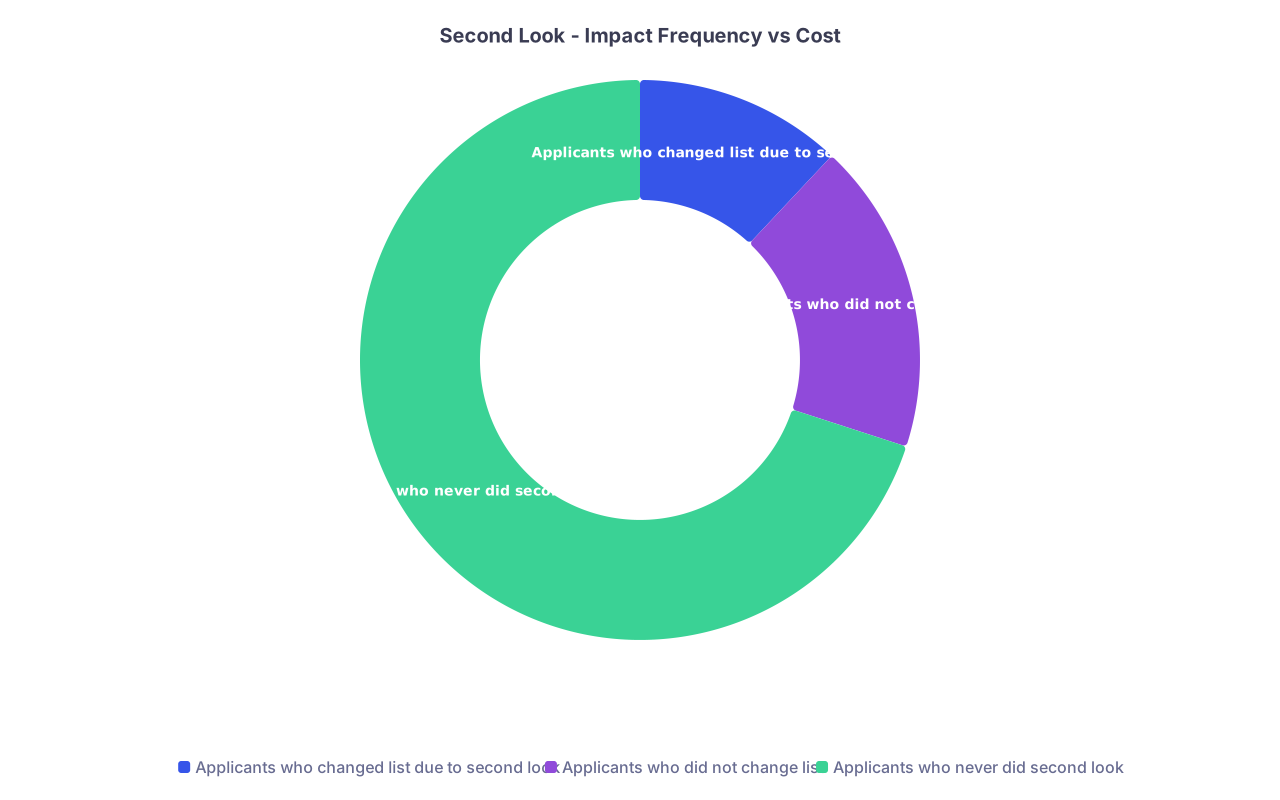
| Category | Value |
|---|---|
| Applicants who changed list due to second look | 12 |
| Applicants who did not change list | 18 |
| Applicants who never did second look | 70 |
Interpretation for a hypothetical 100 applicants:
- 12 changed their rank list because of a second look (12%).
- 18 did a second look but did not change their list.
- 70 never did a second look.
Now layer on cost: if the average cost per second look is, say, $600, and 30 applicants did one visit, that is $18,000 collectively spent so that 12 people adjust their lists. And even among those 12, not all changes are large or beneficial.
That is not an automatic indictment. It simply shows the scale. The yield is modest.
How I Would Use Second Looks (If I Were Applying Now)
Based on the data and what I have seen across cycles, here is a rational, evidence-aligned strategy:
Reserve in-person second looks for at most 1–2 programs where:
- They are in your true top 3.
- You are genuinely uncertain about ordering.
- You have exhausted cheaper information sources.
Treat second looks as information-gathering, not auditioning.
- Ask hard questions about schedule, call, autonomy, and support.
- Observe how residents talk about burnout and leadership responsiveness.
Refuse to let sunk cost or politeness bias your rank list.
- If a second look exposes red flags, downgrade the program, even if they were nice and you spent $700.
If finances are tight, skip in-person second looks entirely.
- Push programs for virtual contact with residents.
- Use your mentors and school alumni networks instead.
Your probability of matching where you will actually be happy is far more sensitive to honest preference ranking and good information than to any performative show of interest.
Final Takeaways
The data, sparse as they are, point in one clear direction.
- Second looks change applicant rank lists in a minority of cases (roughly 10–15% overall), and flips of the #1 spot are even less common (5–10%).
- Programs rarely move you on their rank list because of a second look; the main value is for your information, not their evaluation.
- Given the cost and modest yield, second looks are best used sparingly, for a small number of truly uncertain, top-choice programs—not as a routine, box-checking ritual.