
The way most applicants handle second-look visits is financially reckless. They treat each invite as a binary yes/no based on vibes, not numbers, and then act surprised when the season total quietly crosses $5,000.
You can do better. You can model it.
The Hard Reality: Second Looks Are a Marginal Investment Problem
Strip all the emotion away and second looks reduce to a single quantitative question:
For each potential second-look visit, is the expected change in match outcome worth the marginal dollar?
That sounds abstract. Let’s ground it.
Across recent cycles, here is what I have seen from real applicant budgets (MD and DO, mostly IM, EM, OB/GYN, psych, peds, with some surgical):
- Total interview-season spend (travel, housing, clothing, fees) often lands between $3,000 and $8,000.
- Second looks, for those who do them, usually add another $500 to $2,000.
- About half of applicants who do second looks attend 2–4 visits; a small but loud minority do 6+ and torch their cash.
The data reality: a small number of poorly chosen second looks can easily add 25–40% to your entire interview-season budget without a commensurate change in match probability.
So the first analytic step is not “Which programs should I revisit?” It is “What is my total season budget, and how much of that will I allocate to second looks?”
You model the season. Then carve out a second-look envelope from that.
Step 1: Quantify Your All-In Interview Season Budget
I do not start with line items. I start with a cap.
You need a hard ceiling for the entire season. Not an aspiration. A number that, if exceeded, has real negative consequences (credit card debt at 24% APR, borrowing from family, delaying moving costs).
Let’s say you set a total interview-season cap of $6,000. From there, you split it:
- Mandatory baseline (interviews you have already done or committed to): flights, lodging, local transit, clothes, lost work time if relevant.
- Optional layer: second looks, extra away rotations, late-added interviews in faraway cities.
Here is what that might look like for a fairly typical applicant who applies broadly and interviews at 12–15 programs.
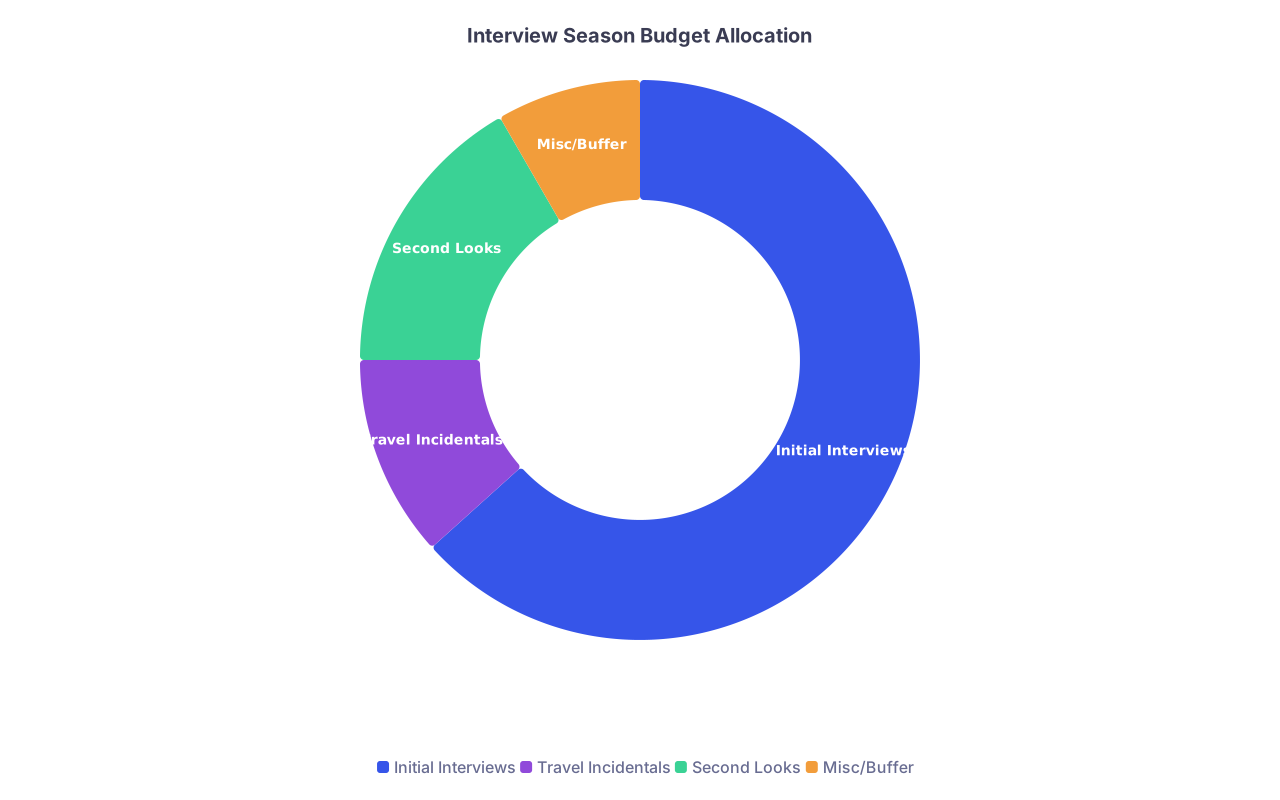
| Category | Value |
|---|---|
| Initial Interviews | 3800 |
| Travel Incidentals | 700 |
| Second Looks | 1000 |
| Misc/Buffer | 500 |
In this example:
- Total cap: $6,000
- Explicit second-look envelope: $1,000
- Misc/buffer: $500 that you really should not burn on impulse unless the opportunity is exceptionally high yield.
The key decision: you pre-commit to a second-look budget before the invites and FOMO show up.
If your total cap is lower (say $3,000–$4,000), the math is ruthless: your second-look envelope is either small ($200–$400) or zero. That is not “unfair.” It is arithmetic. Plenty of applicants match without any second looks.
Step 2: Build a Simple Cost Model Per Second Look
Now you zoom in on the unit cost: one second-look visit.
Second looks are structurally similar to interviews: fly in (or drive), stay a night, local transit, food. But they tend to be shorter and less structured, which ironically can make them more expensive per hour of face time.
You should model each visit with the same template. Something like:
- Transportation
- Lodging
- Local transit / parking
- Food
- Lost income (if you have a job and need time off)
- Hidden costs (baggage fees, airport parking, Ubers that always seem to be surge-priced)
The average numbers I see from people who actually track their spend:
| Cost Component | Conservative Range (USD) |
|---|---|
| Flight / Gas | $150–$400 |
| Lodging (1–2 nights) | $120–$300 |
| Local Transit | $30–$80 |
| Food | $40–$100 |
| Misc / Fees | $20–$50 |
So a single second-look visit realistically lands between $360 and $930, with a median around $550–$650 for domestic travel.
Now imagine you are holding a $1,000 second-look budget. That means:
- 1 “expensive” cross-country second look + 1 local driveable second look, or
- 2–3 regional / driveable second looks if you plan tightly, or
- 0–1 second looks if you book everything last minute at peak prices.
The important concept here is marginal cost versus total number of visits. You are not deciding “Do I like this program enough to revisit?” You are deciding “Is this program worth $X, where X is about 10–15% of my entire season budget?”
Step 3: Assign a Quantitative Score to Each Program
You cannot optimize second looks without a scoring system. “I felt good about it” is noise. You need numerical rankings that you can manipulate.
I use a 0–10 composite score across consistent dimensions. Example categories that have shown predictive value for final rank list position:
- Program fit / culture (your subjective but structured assessment)
- Career alignment (fellowship goals, patient population, case volume)
- Geography / support system proximity
- Training quality (board pass rates, reputation, operative or clinical volume)
- Risk of misranking due to information gaps (you left interview day with unresolved questions)
Assign weights. Do not pretend each category is equal if it is not. A sane weighting might look like:
- Program fit: 35%
- Career alignment: 25%
- Geography: 15%
- Training quality: 20%
- Information gap risk: 5%
Then you score each program from 0–10 per category.
Let’s say you have 5 high-interest programs out of your 12 interviews. You get something like:
| Program | Fit (0–10) | Career (0–10) | Geo (0–10) | Training (0–10) | Info Gap (0–10) | Weighted Composite |
|---|---|---|---|---|---|---|
| A | 9 | 9 | 6 | 9 | 3 | 8.4 |
| B | 8 | 7 | 8 | 8 | 5 | 7.8 |
| C | 7 | 8 | 5 | 8 | 6 | 7.3 |
| D | 6 | 6 | 9 | 7 | 4 | 6.8 |
| E | 8 | 6 | 4 | 8 | 7 | 7.0 |
The “Info Gap” column is critical. Programs with high info gap scores are the only ones for which a second look has a reasonable chance of shifting your composite ranking meaningfully. If you already know Program A is your locked #1, a second look may not move the needle enough to justify another $600.
Step 4: Estimate the Expected Impact of a Second Look
Here is the uncomfortable statistical truth: there is little rigorous published data quantifying how second looks affect the match. Programs openly differ—some discourage them, some are indifferent, a few quietly appreciate them.
So you should not model second looks as “increasing your chance of matching” in any precise probabilistic sense. What you can model, more honestly, is:
- Expected change in your rank order list due to better information and fit assessment.
- Very small, mostly speculative effect on the program’s perception of you (which varies wildly by specialty and program culture).
I treat the program’s perception effect as noise unless you have concrete intel (“PD told us second looks don’t matter” or “Residents said PD strongly values seeing interest on campus again”). Even then, I cap it.
The main quantifiable benefit is better self-sorting. Not “I will match here because I showed up again,” but “I will more accurately rank the programs, reducing the risk of regretting my rank list for 3+ years.”
So, for each program, ask:
- On a 0–10 scale, how likely is a second look to change my composite by ≥0.5 points?
- If it changes, what is the expected direction? Up, down, or truly uncertain?
- How does that expected change map to positions on my list? Could it realistically move a program from #5 to #2? Or from #2 to #1?
Then, attach a numeric expected impact. For a concrete example:
- Program B: Currently composite 7.8, likely #2–3 on your preliminary list. Large info gap (5/10). You suspect the culture might be off but are not sure. You estimate a 50% chance that a second look moves it down by 0.5–1.0 points, a 20% chance it moves up 0.5, and 30% no change.
Expected change (rough):
0.5 * (−0.75 average negative move) + 0.2 * (+0.5) + 0.3 * (0)
= −0.375 + 0.1
= −0.275
So the expected effect is slightly negative: you are more likely to discover reasons to drop it than to raise it. That might sound bad, but in decision-quality terms, that is good. You avoid over-ranking a bad fit.
Then you convert that into “rank positions adjusted”. Maybe that −0.275 is enough to push it from your tentative #2 to #3 or #4. That is a nontrivial impact.
Now you divide that by the dollar cost. You get something like:
- Cost of second look at B: $550
- Expected “value”: small but meaningful shift in rank accuracy on a program that might otherwise be your #2–3.
Compare that to second looks at lower-interest programs. The ROI is much worse there.
Step 5: Do a Marginal Benefit per Dollar Calculation
Once you have:
- A cost estimate per program, and
- An expected impact on your rank list (in positions or composite points),
you can run a very simple benefit-per-dollar ranking.
For a small set of 4 candidate second looks, you might get:
| Program | Est. Cost | Est. Expected Rank Impact* | Benefit per $100 |
|---|---|---|---|
| A | $700 | 0.5 position shift | 0.07 |
| B | $550 | 1.0 position shift | 0.18 |
| C | $400 | 0.5 position shift | 0.13 |
| D | $300 | 0.2 position shift | 0.07 |
Your “benefit per $ threshold” can be rough. For example: only do a second look if it affects your top 3 and could realistically shift at least one rank position at a marginal cost under $500.
Anything less is usually just expensive reassurance.
A Concrete Example: Putting It All Together
Let me walk through a plausible composite scenario. Fourth-year, mid-tier MD school, applying categorical IM, 13 interviews, 6 serious contenders.
- Total interview-season budget: $5,500
- Already spent / committed for interviews: $3,900
- Reserved for moving / transition: $1,000
- Remaining flexible budget: $600
You sketch a second-look envelope of $600 maximum. Anything above that would eat into moving funds, which you decide is not acceptable.
You identify 4 potential second-look programs:
- Program X – Your tentative #1. Cross-country. Airfare high. Info gap low (you loved it, residents were transparent). Cost est: $700 (immediately above envelope).
- Program Y – Close second. Regional flight. Info gap moderate (unsure about night float). Cost est: $450.
- Program Z – Local, 45-minute drive. Info gap high (never saw clinics, rushed interview day). Cost est: $120 (gas + 1 night parking, maybe no hotel if you day-trip).
- Program W – Tentative #5. Info gap high, but career alignment only moderate. Cost est: $400.
You assign expected rank-impact:
- X: 0.2 positions (already basically #1, at most it might lock it in emotionally).
- Y: 0.8 positions (could move #2 → #1 or #3).
- Z: 1.0–1.5 positions (could jump from #4–5 up to #2–3 if it is a hidden gem).
- W: 0.3 positions (unlikely to break top 3).
Now normalize:
- Benefit per $100:
- X: 0.2 / 7 ≈ 0.03
- Y: 0.8 / 4.5 ≈ 0.18
- Z: 1.25 / 1.2 ≈ 1.04
- W: 0.3 / 4 ≈ 0.08
The numbers scream: Z is insanely high value, Y is good, X and W are marginal to poor.
With $600 to spend, the rational play:
- Definite: Go to Z. Cost ~$120.
- Strongly consider: Y. Cost ~$450.
- Combined: ~$570—within your envelope.
- Skip X and W.
Emotionally, you might feel more drawn to seeing X again. Quantitatively, that is irrational. Your rank list is already stable at the top; your uncertainty is in the 2–4 spots. That is where second looks earn their keep.
Final Takeaways
Three points matter:
- Treat second looks as a marginal investment decision, not a badge of commitment. Model cost versus realistic impact on your rank order list, and cap your second-look envelope before the season’s chaos hits.
- Prioritize programs where you have both high stakes (likely top 3–5) and high information gaps. Do not waste money revisiting places where your ranking is already solid or where the trip cost outstrips any plausible benefit.
- Use clustering and simple quantitative rules to control costs: group regional visits, estimate benefit per dollar, and protect your future-self budget for moving and early residency life.
If you do that, your second-look strategy stops being “follow the vibes” and starts looking like what it should be: a cold, clear allocation of scarce resources to where they change your outcome the most.