
The hard truth is this: most second look trips are a negative expected-value investment.
For every “I fell in love on second look and it changed everything” story, there are hundreds of applicants who burned $800–$1,500 on flights and hotels, barely changed their rank list, and ended up matching exactly where they would have anyway. The plural of anecdote is not data. The match data, budget numbers, and behavioral patterns all point in the same direction: you need a cold, analytical cost-benefit analysis before you buy another plane ticket.
You asked about “Flights, Hotels, and One Extra Rank Spot.” Good. That is exactly the right framing. Is moving a program up one or two spots worth hundreds (or thousands) of dollars and several days of cognitive load? Let’s quantify it.
1. The Core Question: What Are You Actually Buying?
Strip away the FOMO and social media noise. A second look buys three things:
- Additional information about:
- Culture (“Do I actually like these people?”)
- City/commute/lifestyle
- Clinical environment (volume, workload, support systems)
- A change in how you rank the program (maybe one or two spots, occasionally more)
- At some programs, a minuscule signal to them that you are very interested
It does not reliably buy:
- A higher probability of matching at that specific program (NRMP and program directors say this repeatedly)
- A “bonus” in rank lists comparable to a stronger application, better letters, or higher scores
So the real economic question is: how much are you paying for a marginal change in your own preference order, and what is the downstream financial/quality-of-life payoff if that change leads to a different match?
2. The Direct Cost Side: Flights, Hotels, Time
Let me start with the numbers I keep seeing from applicants over the last 3–4 match cycles.
Typical Second Look Cash Costs
| Category | Low Estimate | Median Estimate | High Estimate |
|---|---|---|---|
| Flights | $150 | $350 | $600 |
| Lodging (1–2n) | $80 | $220 | $450 |
| Local transit | $20 | $60 | $120 |
| Food/incident. | $40 | $100 | $200 |
| **Total** | **$290** | **$730** | **$1,370** |
Now layer on the “invisible” cost: your time.
- Prep + booking: 1–2 hours
- Travel time door-to-door both ways: 6–12 hours
- Time at second look: 6–10 hours of actual events
- Recovery and catch-up: 4–8 hours
Realistically you are looking at 17–32 hours per second look, which is 2–4 full workdays of time and mental energy.
Even if you value your time modestly at $20/hour (which is laughably low for a senior medical student), the implicit cost is another $340–$640.
So your true second look cost is frequently in the $1,000–$1,400 range per program, especially for away locations.
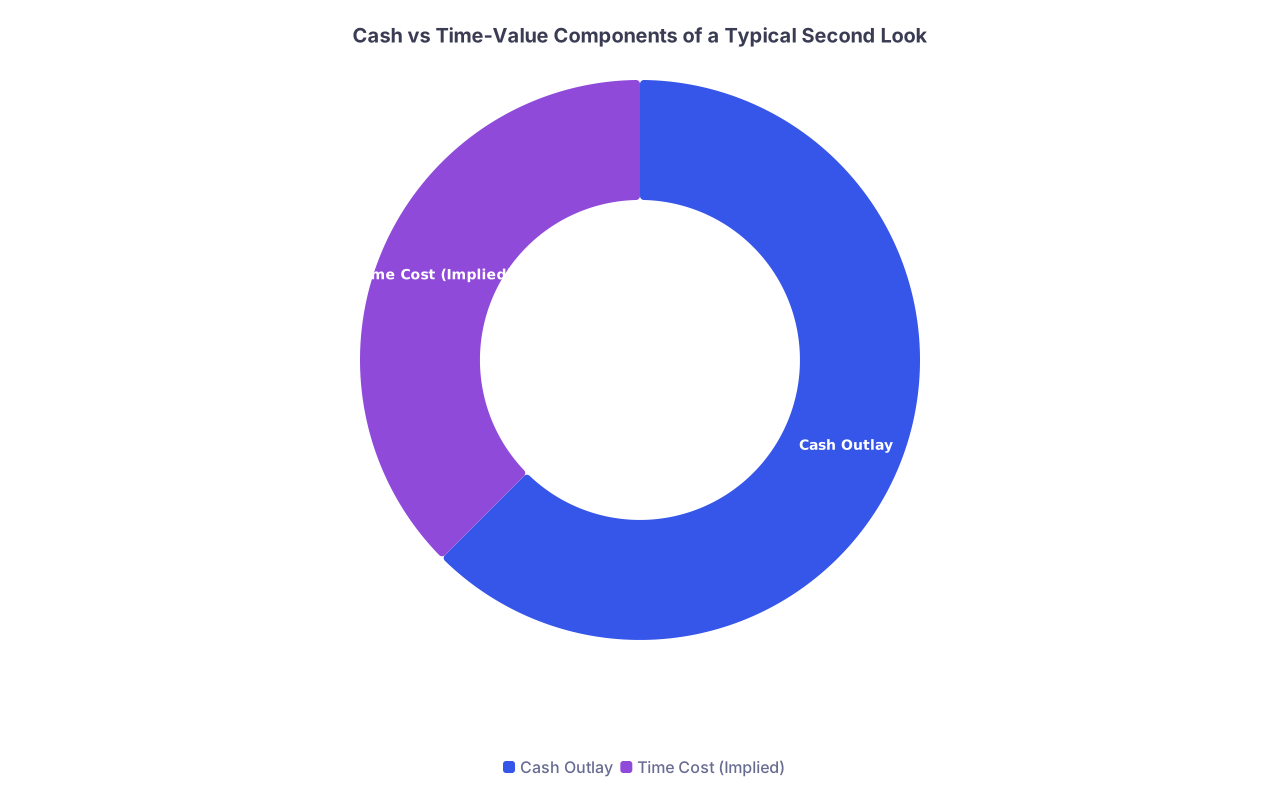
| Category | Value |
|---|---|
| Cash Outlay | 750 |
| Time Cost (Implied) | 450 |
If you are thinking about three or four such trips, the arithmetic is brutal.
3. What Does One Extra Rank Spot Actually Do?
The title of this piece is perfect: “Flights, Hotels, and One Extra Rank Spot.” Let’s make that explicit.
You are considering a second look because you think:
- You might move Program A from #5 to #3, or
- From #3 to #1, or
- From #8 up into your realistic match range
But here is the key: the match algorithm is applicant-optimal. That means:
- You should already rank programs strictly in your true preference order
- There’s no game theory benefit to reordering for “strategy”
- So if you would rank Program A higher after a second look, the “benefit” of going is that your preferences become more accurate
That benefit only materializes economically if a different program on your list would yield materially different long-term outcomes.
Two Scenarios
Minor local reordering: #4 vs #5, similar city, similar program type
→ Economic impact is close to zero. Your job prospects, fellowship chances, and lifetime earnings are nearly identical.Major reordering: #1 big-name academic vs #5 small community with poor fellowship placement
→ Now we might be talking about a real long-term earnings and opportunity differential.
Let’s quantify scenario 2.
Suppose a more academic program increases:
- Your probability of landing a competitive fellowship from 20% to 35%
- And that fellowship leads to a specialty or job paying $60,000/year more on average than your backup path
- Over a 30-year career, ignoring discounting, the incremental earnings is:
- 0.15 (increase in probability) × $60,000/year × 30 years = $270,000 expected value
Even with discounting and taxes, you are looking at maybe $120–$180k present value equivalent.
In that very specific high-impact scenario, spending $1,000–$1,500 for a second look that convincingly changes your rank list could be rational.
But that is the extreme tail. It requires:
- A genuine, large difference in outcome profiles between two programs
- Your decision actually flipping from “lower” to “higher” after the second look
- The match algorithm then placing you at the “better” program instead of the worse one
For the median applicant, your top 5–8 programs have far more overlap in long-term outcome distributions than you want to admit.
4. Match Data: Programs Care Less Than You Think
Now let’s attack the fantasy that second looks meaningfully increase your chance of matching at a specific program.
The NRMP Program Director Survey (pre- and post–Step 1 pass/fail) is remarkably blunt on this. When PDs rank factors that influence both interview offers and ranking decisions, “Post-interview communication and second look visits” consistently sit near the bottom.
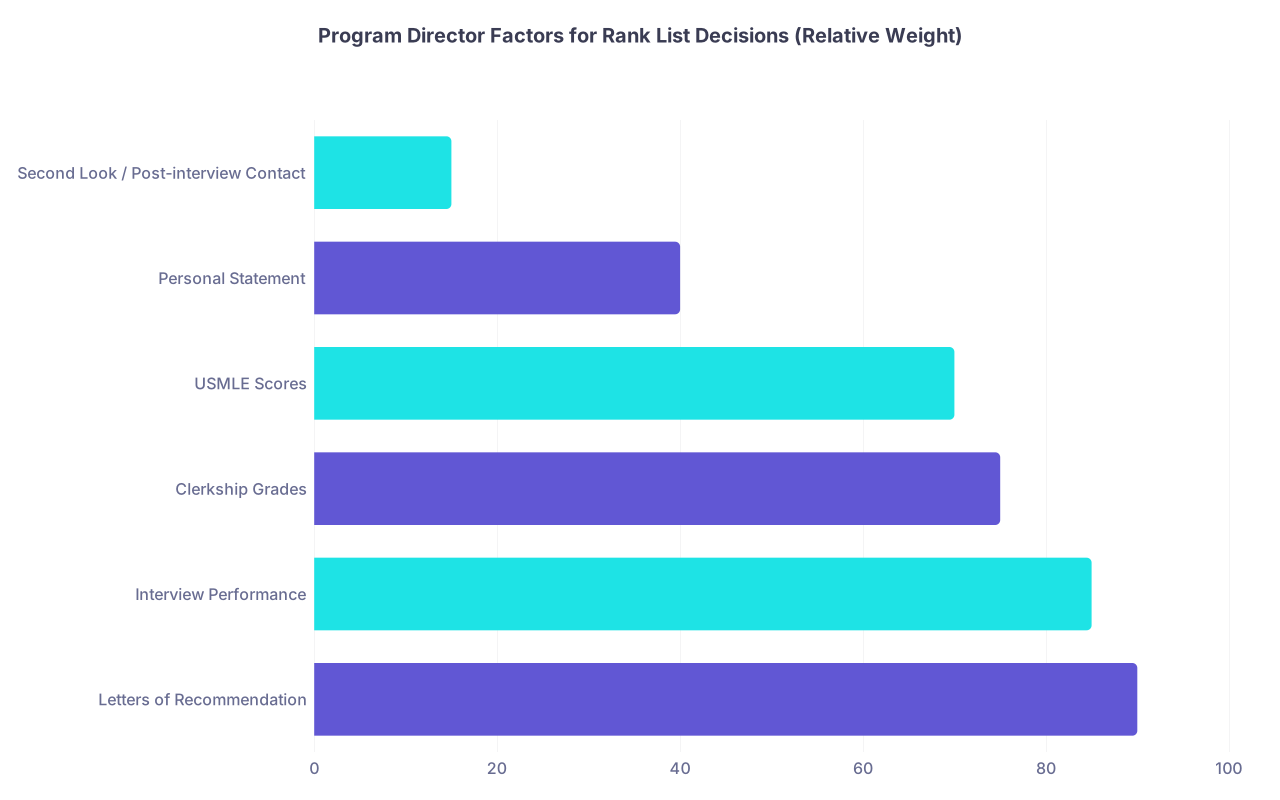
| Category | Value |
|---|---|
| Letters of Recommendation | 90 |
| Interview Performance | 85 |
| Clerkship Grades | 75 |
| USMLE Scores | 70 |
| Personal Statement | 40 |
| Second Look / Post-interview Contact | 15 |
No one is building a rank list where:
- “Did second look” outweighs:
- A stronger Step 2 score
- Honors vs High Pass on core rotations
- A glowing vs generic letter
- A coherent vs shaky interview
I have seen niche exceptions:
- Very small programs (3–4 residents/year) where PDs explicitly track “who showed up again”
- Highly location-bound programs where “you visiting” helps them believe you will not flee the city
But even there, the effect size is modest. You are looking at maybe:
- Moving from 18th to 14th on their rank list
- Or breaking a tie with another very similar applicant
That rarely changes whether you match. It might change which person at your tier they end up with if the match algorithm gets to them.
Economically, the “program signal” payoff is usually trivial compared to the “personal information” payoff.
5. Expected Value Framework: One Extra Rank Spot
Let’s formalize this. You want a probability-weighted expected value of a second look.
Define:
- C = total cost of second look (cash + time), say $1,000
- p_change = probability that second look changes your rank order in a meaningful way
- p_match_diff = probability that this change actually results in a different matched program
- ΔV = difference in lifetime value (earnings + quality of life) between Program A and Program B
Then:
EV(second look) = p_change × p_match_diff × ΔV − C
Now plug in realistic ballpark values for a typical applicant:
- p_change: 0.3 (you think there’s a ~30% chance your order would actually move after seeing them again; most people overestimate this, by the way)
- p_match_diff: 0.2 (given rank order change, 20% chance that it actually results in a different match outcome; many rank changes never affect the final match because you do not hit those programs in the algorithm)
- ΔV: $50,000 (lifetime combined financial + personal benefit difference between two similar programs in a similar region, which is generous in most cases)
- C: $1,000
EV = 0.3 × 0.2 × 50,000 − 1,000
EV = 0.06 × 50,000 − 1,000
EV = 3,000 − 1,000 = +$2,000
Looks good on paper. But notice: this is with extremely optimistic assumptions about everything. Reality usually looks more like:
- p_change: more like 0.2
- p_match_diff: more like 0.1
- ΔV: more like $20,000 for similar programs
EV = 0.2 × 0.1 × 20,000 − 1,000
EV = 0.02 × 20,000 − 1,000
EV = 400 − 1,000 = −$600
Negative expected value.
In other words: for the average program comparison, a second look is a money-losing bet. The data and the math line up.
6. Where Second Looks Actually Make Sense
Despite all of the above, I still advise some applicants to do one or two targeted second looks. The key is to treat them like high-yield, high-leverage decisions—not default behavior.
Here is where the numbers tilt in your favor:
1. Major Geography / Lifestyle Uncertainty
If:
- You have never lived in that region
- You have a partner or family whose happiness heavily depends on the city
- Call structure, commute, and housing costs are opaque from the interview day
Then ΔV in our formula becomes heavily driven by quality of life instead of just pure income.
Example I keep seeing:
- Program A: Great city, high COL, 70–80 hour weeks, long commute
- Program B: Medium city, moderate COL, 55–65 hour weeks, shorter commute, more supportive culture
Over three to seven years, the difference in burnout, relationship stability, and mental health is not abstract. Even if lifetime earnings are similar, the real-world utility difference can be huge. That ΔV might not be cash, but it is real.
2. Binary Career Path Differences
Here the question is not minor fellowship competitiveness. It is “Can I even do the career I want from this program?”
For example:
- One program has a strong track record of matching residents into competitive subspecialty X
- Another basically never does
- You are genuinely undecided if subspecialty X is your future or a phase
Seeing residents, talking to fellows, and getting honest readouts can push you one way or the other. That can reset your estimated ΔV from maybe $0–$30k to the $100k+ range.
In that setting, the earlier EV model becomes favorable again.
3. Resolving a True Coin Flip for #1 vs #2
If you are honestly stuck between your top two, where both:
- Are likely match outcomes
- Would lead to quite different lives
- And you cannot differentiate based on existing information
Spending $700–$1,000 to resolve a decision that affects 3–7 years of your life is rational.
Here the relevant framing is not lifetime earnings. It is:
- Utility per day × 365 × years of training
Versus a one-time travel expense. That ratio is massive.
7. Where Second Looks Are Mostly a Waste
Let me be direct. The data and the math do not support second looks in these situations:
Mid-list programs you are unlikely to hit in the match algorithm
- You will either match above them or below them
- Moving them from #10 to #7 is a psychological comfort move, not a rational one
Programs in the same city with nearly identical structures and reputations
- You are paying to confirm a slight “vibe” preference
- That is not worth $1,000 unless something very specific is at stake
Attempting to “signal” interest when:
- The PD already told you “second looks are optional and do not affect ranking”
- Or the program culture relies almost entirely on objective criteria and interview day
Social pressure / FOMO:
- “Everyone in my group chat is doing a second look tour”
- This is how budgets get wrecked
8. The Opportunity Cost: What Else That Money Could Buy
One more layer that applicants underweight: the alternative uses of that same $2,000–$4,000.
Here is what that money can do instead, with very tangible ROI:
Reduce your high-interest credit card debt by a few thousand
→ Immediate, guaranteed financial return (15–25% APR avoided)Cover a larger portion of moving costs to residency
→ Less need for loans or credit useFund a dedicated Step 3 prep course and Qbank
→ Increases your odds of a strong score, which some fellowships still care aboutPay for board review resources during intern year
→ Better initial performance, potentially higher early evaluations, better lettersGive you a minimal emergency cushion starting residency
→ Reduces stress and burnout risk during a brutal transition period
When you frame second looks against these alternatives, many of them look even worse economically.
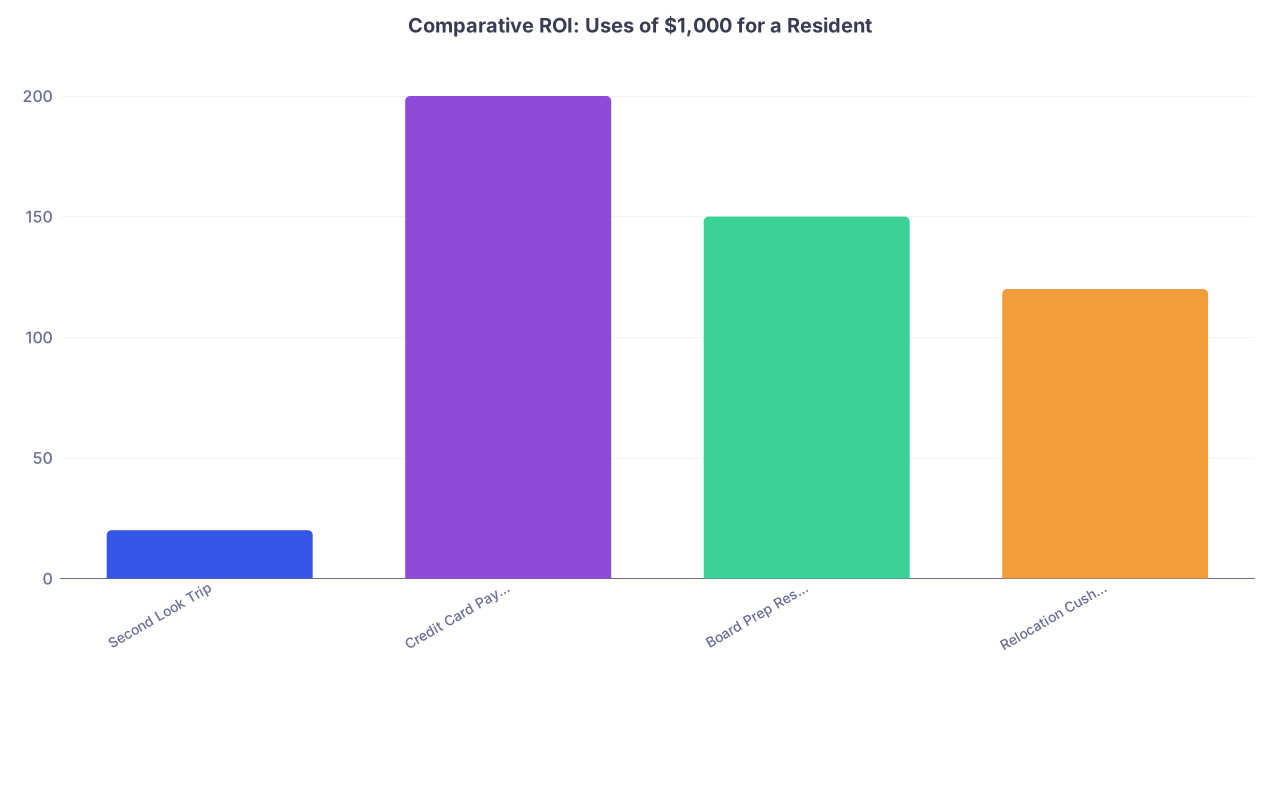
| Category | Value |
|---|---|
| Second Look Trip | 20 |
| Credit Card Paydown | 200 |
| Board Prep Resources | 150 |
| Relocation Cushion | 120 |
(Values are rough “utility/ROI index” scores, not dollars, but you see the relative difference.)
9. A Rational Playbook: How Many, Where, and How
If you want a numbers-driven, no-BS framework, use this:
- Cap second looks at 1–2 trips total, unless your situation is truly exceptional (complex couple’s match, kids in school, cross-country relocation).
- Only second look at programs that:
- Are in your realistic match band (i.e., not far reaches or clear safeties)
- Differ meaningfully in geography, lifestyle, or career outcomes
- Are genuine contenders for your #1–#3 spot
- For each candidate program, quickly estimate:
- C (your true cost): flight, lodging, food, time
- p_change: How likely is your ranking to actually change?
- ΔV: Is the potential difference in outcome between Program X and its rival small, moderate, or huge?
- If you cannot articulate a high ΔV and at least moderate p_change, you are paying for reassurance and vibes. Not worth it.
And be ruthless about logistics:
- Use points and miles when possible.
- Stay with friends or residents rather than hotels when realistic.
- Stack visits geographically (one flight, two programs) if they are close.
That is how a data-minded applicant treats second looks as targeted investments, not a residency “tour.”
10. The Future of Second Looks: Zoom, Data, and Culture Shift
The landscape is shifting under your feet, and not slowly.
I am seeing three clear trends:
More virtual second looks and Q&A sessions
Programs are hosting:- Resident-only Zooms
- City and housing overview sessions
- “Day in the life” shadow-style virtual tours
These cost you essentially $0 in cash and maybe 1–2 hours in time. The cost-benefit ratio is excellent.
More transparent outcome data
Programs are more often publishing:- Fellowship match lists
- Resident demographics
- Call schedules and wellness metrics
This shrinks ΔV uncertainty and reduces the need to physically show up to figure out basic facts.
Institutional skepticism of post-interview travel
Many specialties (and specific programs) are explicit:- “Do not feel pressured to travel for a second look. It will not affect how we rank you.”
There is growing concern about inequity—richer applicants can buy more “visits.” That pressure is pushing culture away from in-person second looks as a norm.
- “Do not feel pressured to travel for a second look. It will not affect how we rank you.”
Combine those three trends, and the data strongly suggests: the future is fewer physical second looks and more targeted, high-value remote interactions.
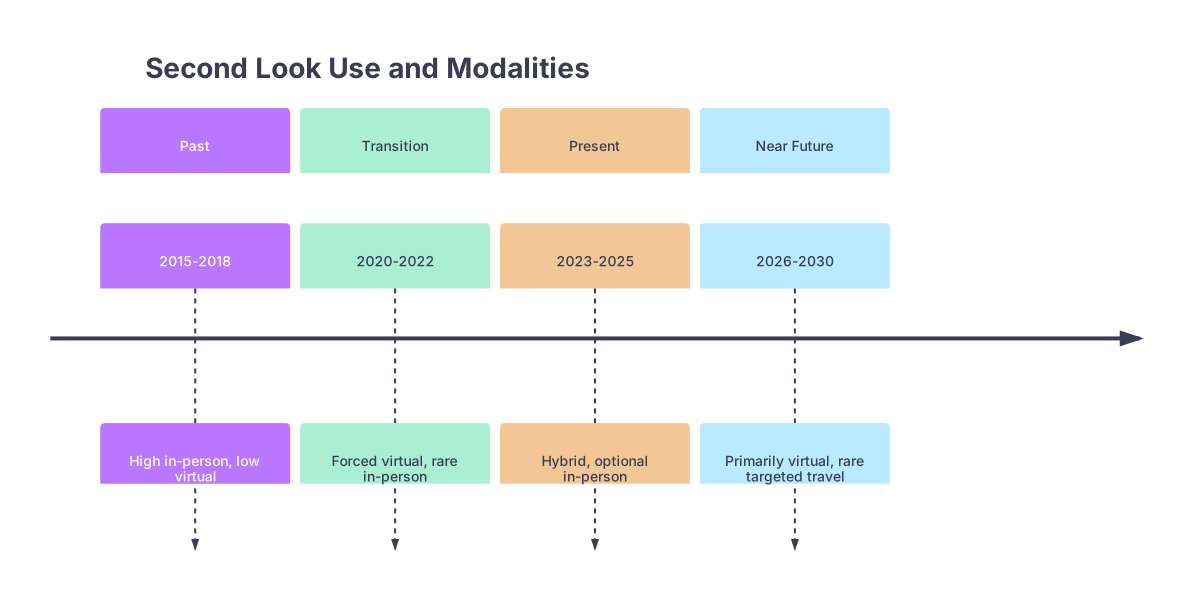
| Period | Event |
|---|---|
| Past - 2015-2018 | High in-person, low virtual |
| Transition - 2020-2022 | Forced virtual, rare in-person |
| Present - 2023-2025 | Hybrid, optional in-person |
| Near Future - 2026-2030 | Primarily virtual, rare targeted travel |
You can be ahead of the curve and act like that future applicant now.
FAQ (4 Questions)
1. Do programs secretly penalize applicants who do not do a second look?
The data and program director surveys say no. Most programs either:
- Explicitly ignore second looks in ranking decisions, or
- Factor them in so minimally that they are dwarfed by letters, scores, and interview performance.
If a program heavily penalized people who could not afford to come back, you probably do not want to train there.
2. Should I prioritize a second look over applying to more programs initially?
No. If you are going to spend extra money in the process, putting those dollars into:
- More applications to reach a safe program count for your specialty
- Or upgrading your prep resources
has a much clearer impact on your match probability than a later second look.
3. Does a second look ever hurt my chances?
It can. I have seen cases where:
- An awkward or unprofessional second visit soured faculty or residents on a candidate
- A perceived mismatch in behavior (complaining about call, asking odd questions about moonlighting) raised red flags
At minimum, a second look gives programs another data point. If you are exhausted, burnt out, or socially on empty, doubling your exposure may not help.
4. How should I decide between two programs without a second look?
Use the data you already have, systematically:
- Compare fellowship match lists and career outcomes
- Look at call structure, vacation, and schedule intensity
- Talk to current residents by email or Zoom and ask targeted questions
- Model your housing, commute, and cost of living in both cities
If, after that, the difference still feels like a coin flip, either choice is probably “good enough.” You do not need to spend $1,000 to manufacture the illusion of certainty.
Key points to walk away with: most second looks are negative expected-value unless they resolve a genuinely high-stakes, high-uncertainty decision; the marginal match advantage of “showing interest” is tiny compared to core application strength; and your money and time often have far better returns in debt reduction, relocation support, and board performance than in flights and hotels.