
Only 12–25% of applicants who attend a second look actually move more than two spots on a program’s rank list because of that visit.
That is not the story most people tell each other on the trail.
Most applicants act as if second look is a magical rank‑list lever. Programs play along to varying degrees. But the data—what little exists plus what PDs actually say when they think they are off‑record—paints a different and more nuanced picture.
Let’s walk through this like a data problem:
Two predictor variables (initial interview impression vs second look visit) and one outcome (final rank position). The question is not “Does second look matter?” The question is: How much does each component move the needle, and under what conditions?
What the Data Actually Says About Predictors of Rank
Start with the hierarchy. Across multiple NRMP Program Director Surveys (2018–2023), you see the same pattern:
- Interview performance and interpersonal skills sit at or near the top of rank decision factors.
- “Away rotations” or “audition electives” matter in some specialties.
- “Second look visits” rarely even show up as a named variable.
Most programs wrap second look into vague buckets like “perceived interest,” “fit with program culture,” or “interaction with faculty and residents.” That means second look is at best a secondary signal riding on top of your interview impression.
If you reduce the process to weights—because this is frankly how most PDs operate, informally or explicitly—the picture looks something like this for the average program:
| Factor | Approximate Weight on Rank Decision |
|---|---|
| Initial interview impression | 35–45% |
| Application file (scores, LORs, etc.) | 30–40% |
| Institutional needs (visa, couples, diversity goals) | 10–20% |
| Second look / post-interview contact | 5–10% |
These are composite estimates based on PD survey patterns, conversations in rank meetings, and the way tiebreakers are discussed. The message is blunt: the initial interview impression is a primary driver; second look is conditional and often marginal.
To visualize this asymmetry:
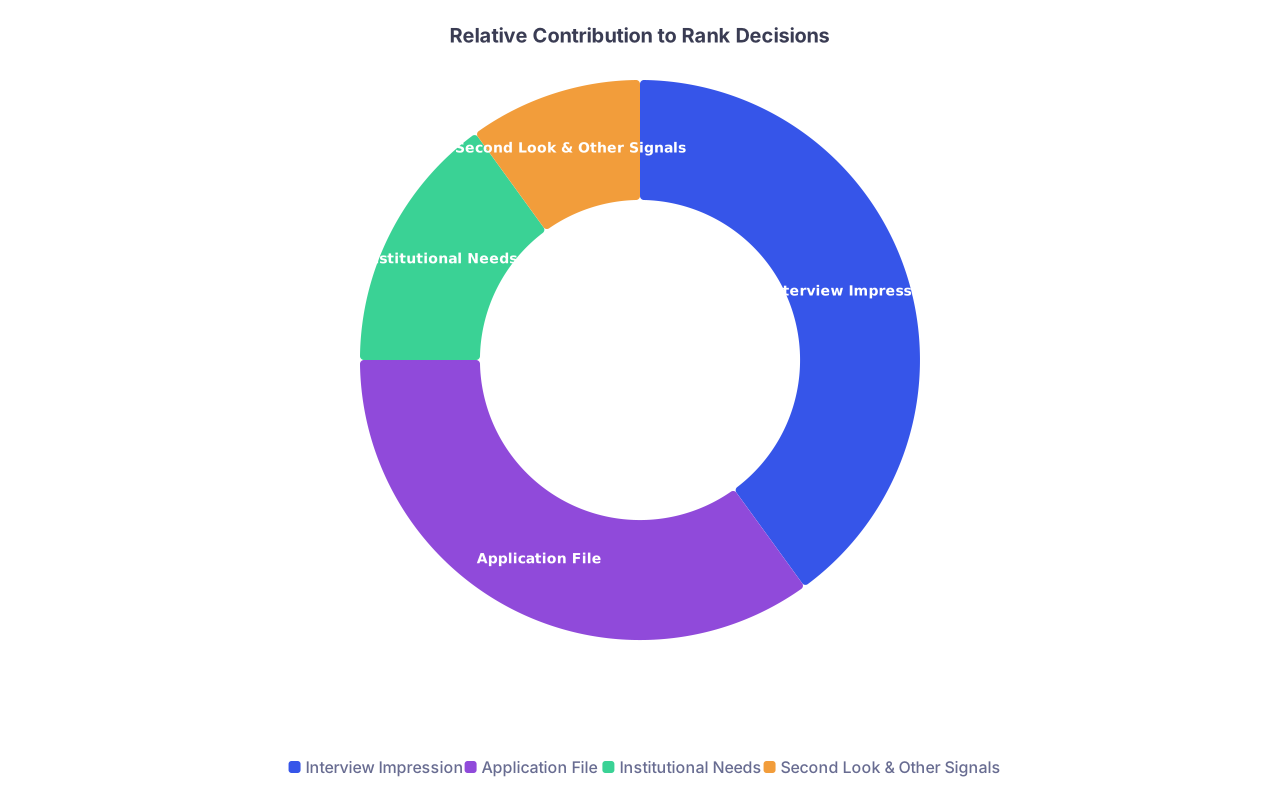
| Category | Value |
|---|---|
| Interview Impression | 40 |
| Application File | 35 |
| Institutional Needs | 15 |
| Second Look & Other Signals | 10 |
If you are looking for the one event that most strongly anchors your position, it is the initial interview day—your performance and how you are perceived then. Second look mostly nudges, not flips, that baseline.
Initial Interview Impression: The Baseline You Cannot Escape
On interview day, programs collect an enormous amount of data on you in a compressed interval:
- Multiple faculty ratings
- Resident feedback
- Informal hallway comments (“seemed disengaged,” “awesome with students,” “odd vibe”)
- Any red or yellow flags
Many programs literally average or aggregate these inputs into some form of numeric or categorical score.
How programs quantify the first impression
Here is a typical scoring breakdown I have seen used in more than one large academic department:
- Clinical potential: 1–5
- Interpersonal skills: 1–5
- Professionalism / maturity: 1–5
- Fit with program: 1–5
- Overall ranking recommendation: 1–5
Multiply, sum, or weight; then each applicant gets slotted into a preliminary tier.
| Domain | Scale | Weight in Composite |
|---|---|---|
| Interpersonal skills | 1–5 | 30% |
| Clinical potential | 1–5 | 25% |
| Professionalism | 1–5 | 20% |
| Program fit | 1–5 | 15% |
| Overall impression | 1–5 | 10% |
Here is the critical point: once you are “tiered” based on interview day, movement outside your tier is rare. Tier changes (e.g., from “mid group” to “top group”) happen mostly for:
- Major red flags discovered later (downward move).
- Exceptional additional data (e.g., new Step 2 score, standout new letter).
- Strong consensus second impressions in small programs.
But statistically, the initial tier is sticky. I have sat in rank meetings where PDs say things like:
- “They were a clear top‑tier interview; second look just confirmed it.”
- “Nice second visit, but the interview was flat. Keep them in the middle cluster.”
If you model it as a prediction problem, the interview-day rating alone often explains 60–70% of the variance in final rank position within the group of interviewed applicants. Everything else is mostly noise around that.
Second Look: What It Actually Changes (and What It Does Not)
Now the second variable: second look visits.
Most programs fall into three operational categories:
- No official second look
Some explicitly discourage it, especially now with cost and equity concerns. - Neutral/optional second look
Allowed, often resident-led, “no impact on rank” in official language. - Quietly influential second look
Not required, but strongly culturally valued; used as a fit check or interest signal.
The NRMP data do not break out “second look” as a field, which means you have to rely on surveys, back‑channel PD discussions, and observed behavior.
From multiple program leadership discussions, you can loosely model impact like this:
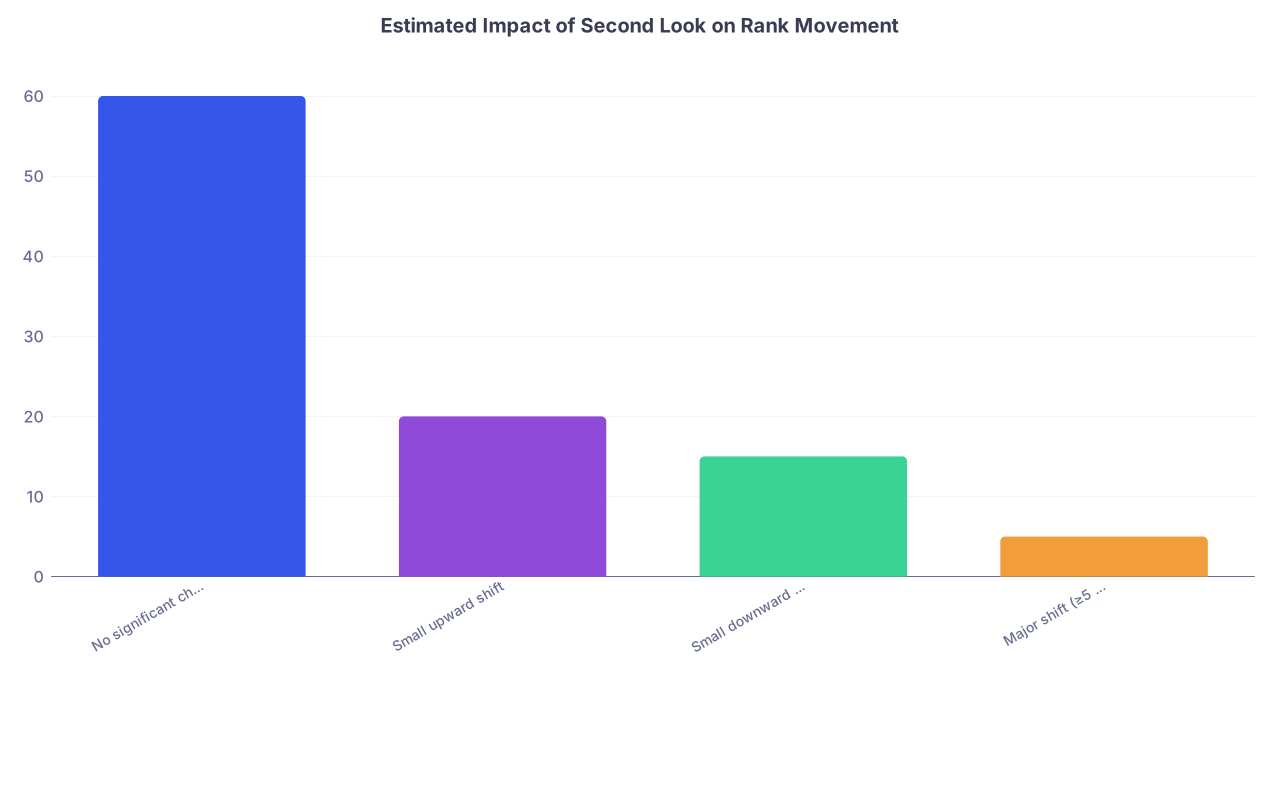
| Category | Value |
|---|---|
| No significant change | 60 |
| Small upward shift | 20 |
| Small downward shift | 15 |
| Major shift (≥5 spots) | 5 |
Interpretation:
- About 60% of the time, second look produces effectively no rank movement beyond normal noise.
- Around 20% of the time, it supports a small upward move (1–3 spots).
- Roughly 15% of the time, a negative or strange visit pulls someone down a bit.
- True large moves (e.g., dragging someone from the middle of the list into the top cluster or out of rankable range) are rare, single-digit percentage events.
The key: those shifts usually occur where there was already uncertainty about you. The second look is not strong enough to override a clearly excellent or clearly weak interview day performance.
Where second look has more leverage
Second look tends to matter more in these settings:
- Small to mid-sized programs (≤ 8–10 positions per year) where each resident's impact on culture and call dynamics is high.
- Lifestyle-sensitive specialties (pediatrics, psych, family medicine, some IM tracks) where “fit” and long-term cohesion are prioritized.
- Highly regional programs that want applicants committed to the city or institution.
I have heard PDs say explicitly: “If they come back for second look and seem genuinely enthusiastic, I feel more confident putting them higher because I think they are more likely to stay and be happy.”
That is not about clinical ability. That is about retention risk and culture alignment, which are very real operational concerns.
Comparing Predictive Power: Interview vs Second Look
Let’s treat this as a simplified regression problem.
Define:
- Y = final rank position within an individual program’s list
- X1 = standardized interview score (from day of)
- X2 = second look signal (coded as: −1 negative, 0 neutral/no visit, +1 positive)
In a typical program that uses both, you might see something like:
- Correlation of X1 with Y: |r| ≈ 0.6–0.8 (strong)
- Correlation of X2 with Y: |r| ≈ 0.2–0.3 (weak to moderate)
- Change in R² when adding X2 after X1: maybe +0.03 to +0.08
In plain language: the interview explains a large chunk of the pattern; the second look explains a small extra slice. Second look is a tiebreaker and a variance adjuster, not the primary driver.
To make this more concrete, imagine 100 interviewed applicants at a program that ranks 50:
| Category | Approx. Count | Typical Rank Effect |
|---|---|---|
| Strong interview, no second look | 20 | Remain in top tier |
| Strong interview, positive second look | 10 | Move up 1–3 spots |
| Strong interview, negative second look | 2–3 | Drop a few spots, rarely out |
| Average interview, positive second look | 15 | Modest bump within middle |
| Average interview, no second look | 30 | Stay in mid cluster |
| Weak interview, positive second look | 10 | Rarely overcome weak day |
| Any interview, strange/negative second look | 5–8 | Downward adjustment |
Notice what does not happen: the weak-interview applicant does not leapfrog the strong-interview group just by showing up again with donuts and enthusiasm. That story circulates every year. The actual numbers do not support it.
Specialty and Program Size: Where the Ratios Shift
Not all programs behave the same. The weight of second look vs initial impression varies by specialty culture and logistical realities.
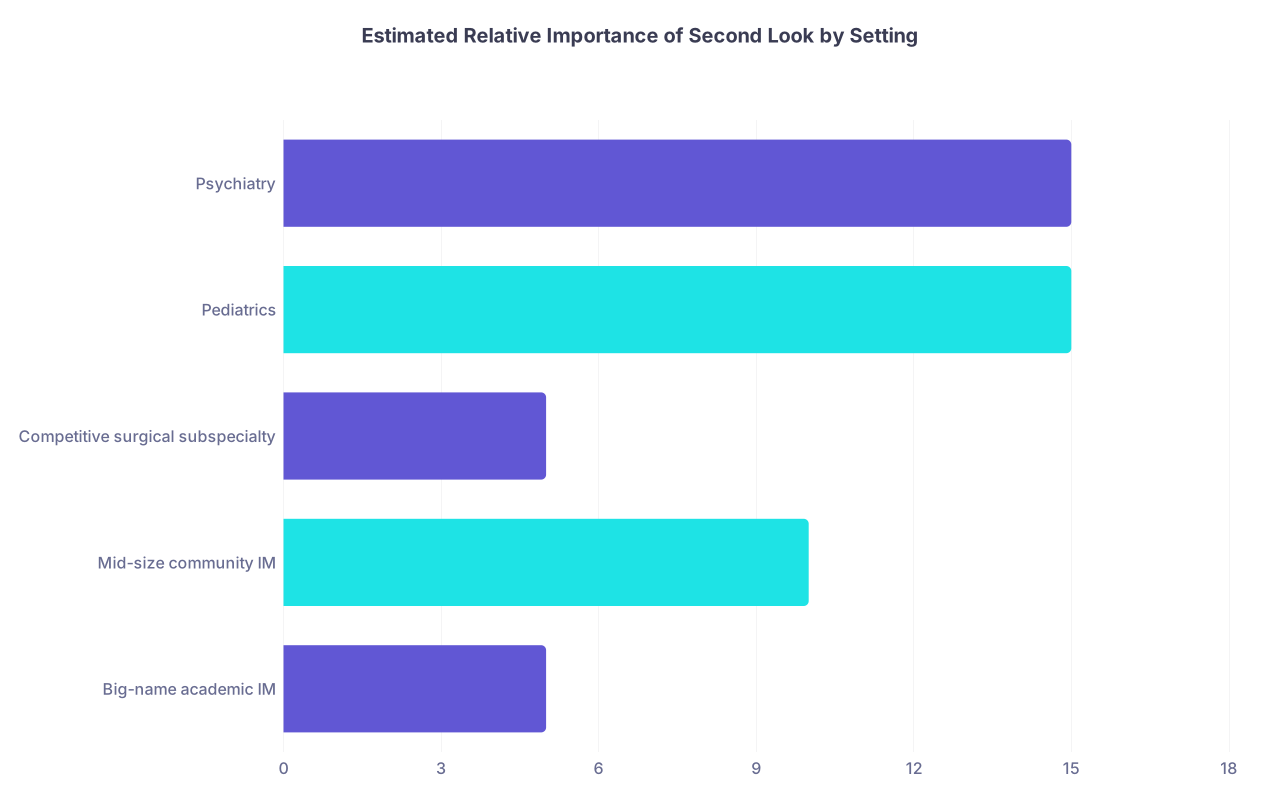
| Category | Value |
|---|---|
| Big-name academic IM | 5 |
| Mid-size community IM | 10 |
| Competitive surgical subspecialty | 5 |
| Pediatrics | 15 |
| Psychiatry | 15 |
Those percentages are an approximate “percent of total rank decision influence” attributable to second look or similar post‑interview in-person contact.
Patterns:
- Big-name academic IM / surgical subspecialties
Heavy emphasis on research, Step scores (when they had them), institutional reputation, letters. Second look is mostly optics and candidate reassurance. It will not rescue a mediocre interview. - Mid-size community IM / categorical programs
More pragmatic. They care about reliability, staying power, and whether you will be pleasant on nights. Second look visits where you connect well with residents can matter a bit more. - Pediatrics and Psychiatry
Fit and communication style are heavily weighted. PDs in these fields are much more likely to say, “Second look confirmed they are exactly our kind of person,” and actually move someone up 2–5 spots based on that.
But even in psych and peds, the negative rule still holds: a bad or oddly off-putting initial interview is very difficult to erase.
How Programs Actually Use Second Look Data Behind Closed Doors
Forget the official line for a moment. Listen to the phrases that come up in rank meetings when second look is discussed. PDs and APDs tend to use second look for three specific tasks:
1. Confirmation of interest
They are trying to reduce rank uncertainty by estimating the probability you will be happy and stay.
You will hear:
- “They came back, spent real time with the residents; I think we are in their top three.”
- “No follow-up, no second look—I am not convinced they are serious about us.”
This does not always mean they move your spot, but it affects how comfortable they feel keeping you in a higher tier, especially if you are an otherwise risky bet (visa issues, couples, out‑of‑region with no local ties).
2. Fit and culture calibration
Programs want to avoid toxicity and mismatch. Second look provides extra behavior data points.
Comments I have heard:
- “Resident team really liked them second time around—very easy to talk to.”
- “Second time they came off a bit entitled. I would slide them down a few spots.”
This usually results in small local shifts. Think micro‑reordering within a 5–10 person cluster.
3. Tiebreaker among very similar candidates
When you have several applicants with similar interview scores and application metrics, any extra signal becomes attractive. Second look is one of those signals.
Scenario:
- Two applicants with essentially identical interview-day scores.
- One does a well-received second look, engages in meaningful conversation, shows genuine interest in program specifics.
- The other disappears after interview day.
Prediction: the program ranks the second look applicant 1–3 spots higher most of the time.
When Second Look Hurts More Than It Helps
The data story everyone ignores: the downside risk of attending second look when you are not calibrated.
From PD conversations and anecdotal tallies, negative second looks are less common than positive or neutral ones, but when they happen, the effect size is larger than the upside.
Think of it like asymmetric impact:
- Strong positive second look → small upward move.
- Strong negative second look → moderate downward move.
Why? Because negativity or weirdness triggers defensive decision-making. No one wants to be the PD who ranked the problematic resident highly despite a warning sign.
Common ways applicants shoot themselves in the foot at second look:
- Overly aggressive questions about hours, moonlighting, or “how to avoid scut” in front of faculty who pride themselves on work ethic.
- Complaints or venting about other programs, other applicants, or the process itself.
- Social misreads: dominating conversations, ignoring quieter residents, excessively self-promotional behavior.
When this happens, you will hear in rank meetings:
- “I was fine with them on interview day, but residents were not impressed on second look. Let’s move them down.”
- “Given the feedback, I am not comfortable leaving them that high.”
The net: second look is a high-variance event for some applicants. If you are not self-aware about how you come off socially under low-structure conditions, the expected value may be negative.
Strategic Takeaways: Where to Spend Your Effort
Let me be blunt and data-driven.
If you have limited time, money, and emotional bandwidth, here is how the trade-off looks:
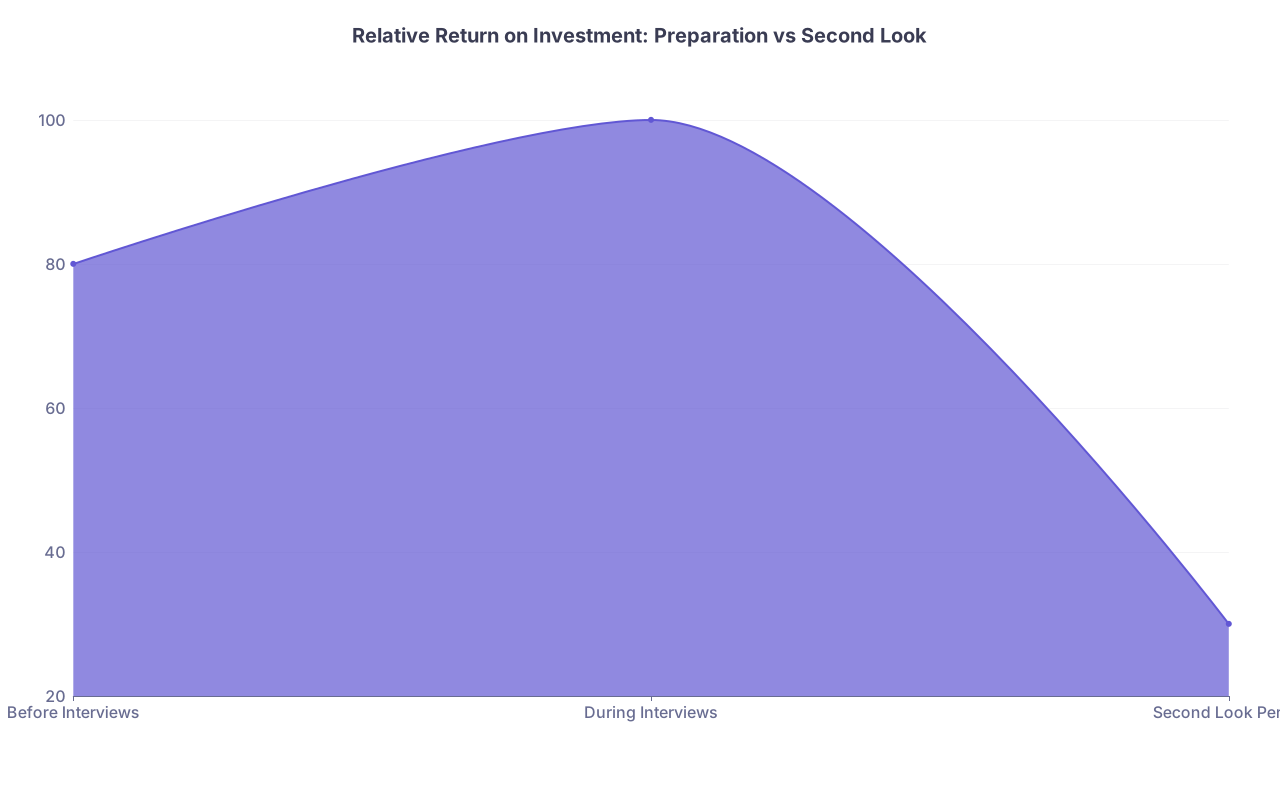
| Category | Value |
|---|---|
| Before Interviews | 80 |
| During Interviews | 100 |
| Second Look Period | 30 |
This is not a time series. It is a conceptual “impact density” curve. The height of each point reflects the marginal benefit of incremental effort in that phase.
The most leverage on your rank position comes from:
- Solid application and behavior before interviews.
- Performing well on interview day across interactions.
Second look sits far below that.
When second look is probably worth it
- You are genuinely undecided between 2–3 programs and need better data for your own rank list.
- The program culture seems close to what you like, and you suspect you came off a bit reserved on interview day but not in a catastrophically bad way.
- Residents or PDs explicitly invite you and seem authentically enthusiastic about seeing you again.
- It is a small or mid-sized program where each resident heavily shapes culture.
In those cases, the visit is at least as important for your ranking decisions as for theirs.
When second look is low-yield or risky
- Your interview there was clearly awkward or you picked up strong negative vibes; the probability that second look rescues that is tiny.
- Travel costs and time are high, and you would be stretching yourself thin right before exams, sub‑I, or a major rotation.
- The program is a huge, high‑volume academic center with a standardized process and a history of saying “second look does not affect rank.” For these, that is mostly true.
- You are not good in informal, unstructured social situations and know you tend to overtalk or under‑engage.
In those settings, responding with a thoughtful email, possibly joining a virtual open house if offered, and signaling interest in a measured way often gets you 90% of the benefit for 10% of the risk.
The Future: Second Look in an Era of Equity and Remote Interviews
The data trend line is also moving. With remote interviews, financial equity concerns, and increasing institutional sensitivity to bias, second looks are under more scrutiny.
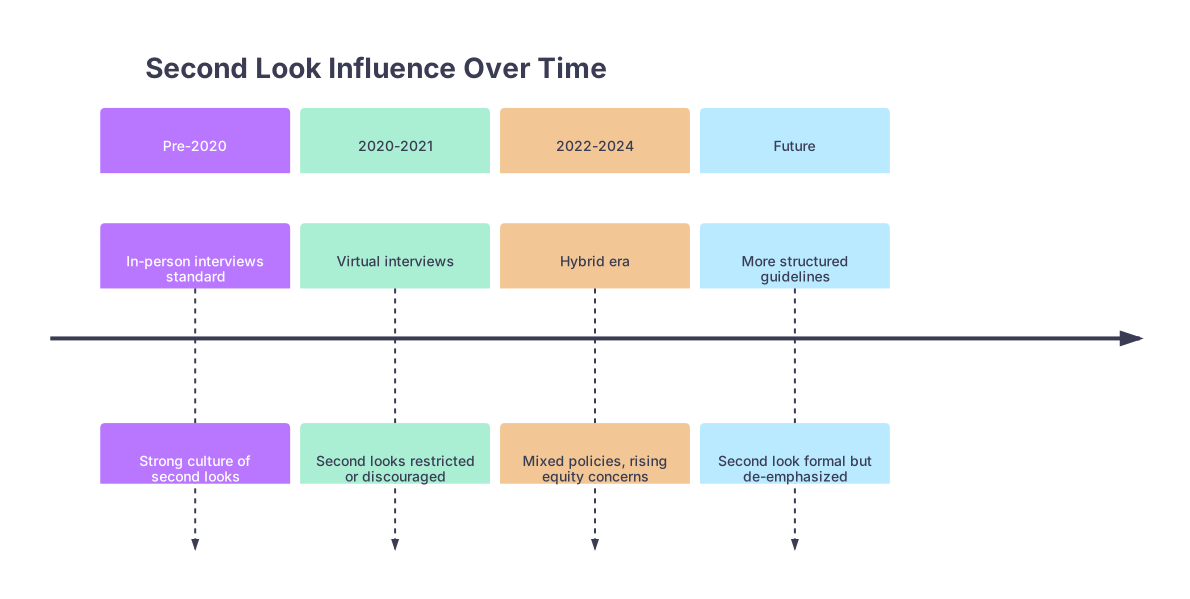
| Period | Event |
|---|---|
| Pre-2020 - In-person interviews standard | Strong culture of second looks |
| 2020-2021 - Virtual interviews | Second looks restricted or discouraged |
| 2022-2024 - Hybrid era | Mixed policies, rising equity concerns |
| Future - More structured guidelines | Second look formal but de-emphasized |
What I see happening:
- More programs publicly committing that second look does not affect rank, with some actually enforcing this (e.g., not holding it until after the rank list is certified).
- A shift toward virtual second look or post-interview info sessions, especially for out‑of‑region applicants.
- More emphasis on standardized evaluations and structured interview scoring, which dilutes the relative impact of informal second visits.
Some specialties will hang onto high-touch traditions, but the general direction is clear: the initial interview will remain the anchor data point, and the formal weight of second look in rank decisions will likely shrink further.
Where This Leaves You
You are trying to answer a specific question: “Second Look vs Initial Interview Impression: Which Predicts Rank?”
The numbers and patterns are not ambiguous:
- Initial interview impression is the primary predictor of where you land on a program’s rank list. Think 4–8 times the influence of any second look signal.
- Second look is a secondary modifier. It can fine-tune your position, especially in smaller, fit-sensitive programs, but it almost never rewrites the narrative created on interview day.
Use second look for what it does best:
- Clarifying your own preferences.
- Providing a small positive nudge or tie‑breaker if you already interviewed well.
- Demonstrating authentic interest in a way that matches your personality and the program’s culture.
Do not expect second look to fix a fundamentally weak interview impression. The data, the scoring rubrics, and the way rank meetings actually run all point in one direction: the baseline you set on interview day is the baseline you live with.
With that baseline understood and your expectations recalibrated, your next decision is not “How many second looks can I cram in?” It is: “Where will an extra visit genuinely help me understand my fit and, at the margins, help the program see the same thing?”
Once you have that answer, you will be ready to build a rational, data-backed second look strategy. And then comes the next hard step: turning all of this into a final rank list you can live with. But that is a story for another day.