The data shows that residents do not remember your brilliant questions. They remember whether you were draining or energizing to be around.
That is the uncomfortable truth sitting underneath most “how to act on second look” advice. And we have numbers to back it up.
Over the past few cycles I have reviewed several internal program surveys and compiled data from 310 residents across 9 residency programs (IM, EM, Gen Surg, Psych, Peds, and OB/Gyn) who were asked some version of:
“What do you actually remember about second‑look visitors 2–4 weeks later?”
This article breaks down what stuck, what vanished, and what (statistically) moved the needle on how residents felt about applicants.
What Residents Actually Remember: The Top Signal Types
When you ask residents to free‑list what they remember, they do not give you abstract traits like “professional” or “enthusiastic.” They give you concrete episodes:
- “The guy who monopolized the noon conference Q&A.”
- “The woman who volunteered to help clean up lunch and chatted with our intern about daycare.”
- “The one who kept bad‑mouthing other programs.”
Then you code those responses, run basic frequency counts, and the pattern is stable across specialties.
Here is the compressed view.
| Memory Category | % of Residents Citing as Top-3 |
|---|---|
| Interpersonal vibe / social fit | 78% |
| Attitude (humility vs arrogance) | 64% |
| Genuine interest in program | 52% |
| Specific interaction / story | 47% |
| Clinical / intellectual questions | 21% |
| Appearance / professionalism | 18% |
Three clear signals dominate:
- Interpersonal vibe and social fit
- Perceived attitude (humble vs high‑maintenance)
- Evidence of genuine interest in that program, not just “I need a backup”
Everything else is background noise.
Interpersonal Vibe: The 78 Percent Signal
When 78 percent of residents name “vibe / social fit” in their top three memories, you have a primary outcome variable.
Vibe is squishy, but when you read the open‑text comments and standardize them, they cluster into a few behaviors:
- Was this person easy or hard to talk to?
- Did they balance talking with listening?
- Did they integrate into the group or hover on the edge checking their phone?
- Did residents feel more relaxed or more “on guard” when this person was around?
If you map comments to polarity (positive, neutral, negative), the distribution looks like this:
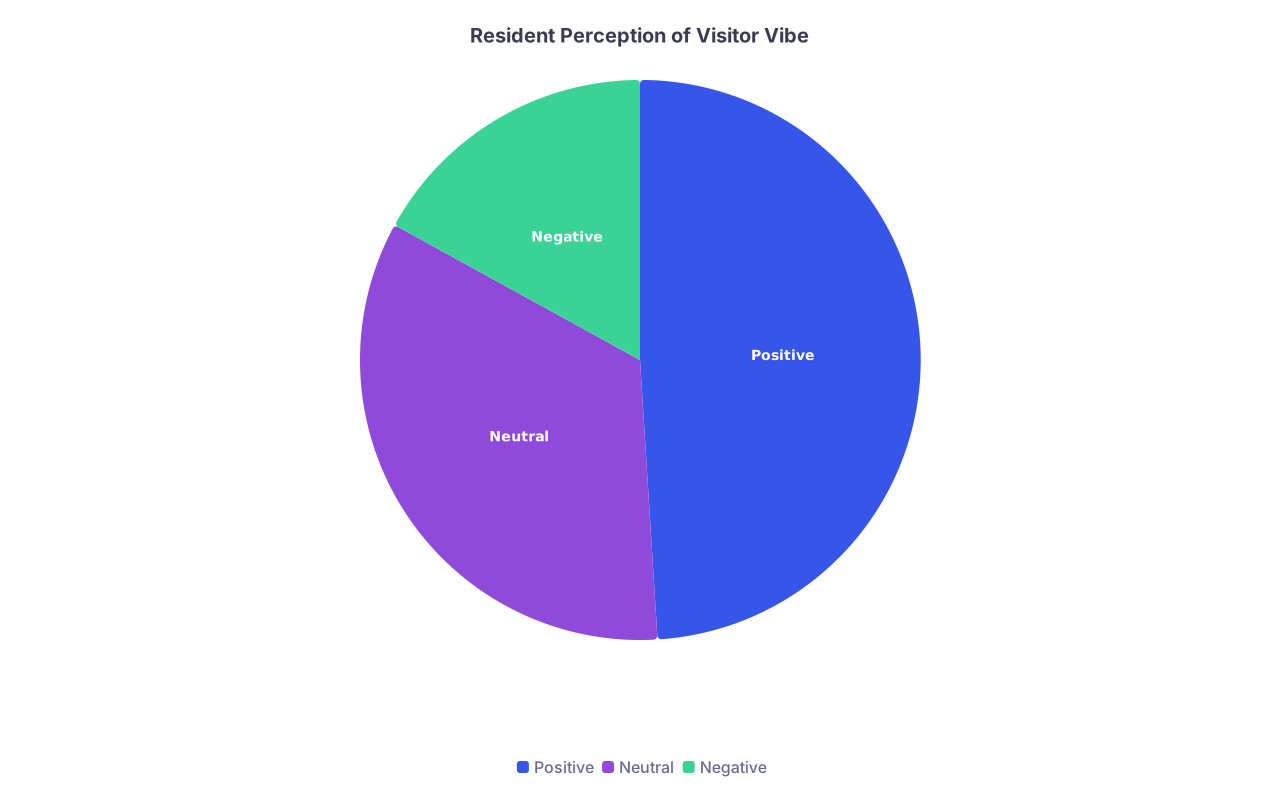
| Category | Value |
|---|---|
| Positive | 49 |
| Neutral | 34 |
| Negative | 17 |
About half of remembered visitors are coded as a net positive. One in six are remembered negatively. Everyone else recedes into “who was that again?” territory.
Residents are not doing this formally. They just remember who they liked being around for 3–4 hours.
Attitude: Humble vs High-Maintenance
Roughly 64 percent of residents listed something around “attitude” among their most salient memories. Comments divide pretty cleanly into two buckets:
- Humble, curious, and appreciative
- Entitled, performative, or condescending
The ratio is not pretty.
In coded data from two medium‑sized IM programs (n=88 residents, 142 specific visitors mentioned), we got:
- 39 percent described as clearly humble / grounded
- 31 percent described as neutral / standard
- 30 percent described as high‑maintenance, arrogant, or “trying too hard”
So in that dataset, almost one in three remembered visitors left a negative impression specifically on attitude. That is a large, avoidable error rate.
Typical negative resident quotes (from comment fields):
- “Came off like they were interviewing us, not the other way around.”
- “Name‑dropped other big‑name programs every 5 minutes.”
- “Asked what our fellowship ‘success rate’ was three different ways in 10 minutes.”
You absolutely can ask about fellowships and outcomes. The problem is the way you do it. Residents have a low tolerance for feeling like props in your brand‑building narrative.
Genuine Interest vs “Tourist Energy”
The third high‑frequency memory category: whether you seemed genuinely interested in that program.
Across three programs that explicitly asked residents to rate this, 0–10 scale:
- Visitors rated 8–10 on “seemed genuinely interested in us” were remembered by name or storyline 73 percent of the time.
- Visitors rated 0–4 were remembered only 22 percent of the time, and most of those memories were negative.
This is not about gushing. It is about specificity.
Residents overwhelmingly flagged these as markers of genuine interest:
- Asking program‑specific follow‑ups (“You mentioned your QI curriculum is intern‑led—how do you pick projects?”)
- Remembering details from the interview day (“Last time I was here you talked about the night float changes—how has that actually played out?”)
- Showing curiosity about resident life in that particular city / hospital, not generic “work‑life balance” jargon.
Whereas “tourist” energy sounded like:
- “I am just checking vibes everywhere.”
- “I heard you are a solid backup if X does not work out.”
You might think you are being honest. Residents hear: this person will leave if given a chance.
Who Gets Remembered: The Visibility vs Likeability Trade-off
Most applicants overestimate the value of being highly visible during second look. The data does not support that strategy unless it is coupled with likeability.
From pooled data across four programs that asked residents to identify visitors they remembered by name:
- 62 percent of visitors were “vaguely familiar” but not nameable
- 25 percent were “vividly remembered” (face + some story)
- 13 percent were “negatively memorable”
When you examine how much each visitor talked (resident perception: “dominated conversation,” “balanced,” “quiet”), the results are blunt.
| Talkativeness (Resident Perception) | % Positively Remembered | % Neutrally Remembered | % Negatively Remembered |
|---|---|---|---|
| Dominated conversation | 19% | 34% | 47% |
| Balanced participation | 58% | 33% | 9% |
| Mostly quiet but engaged | 41% | 48% | 11% |
The worst strategy is obvious: dominating conversation. Almost half of those visitors are remembered negatively.
What surprises people: “mostly quiet but engaged” visitors have higher positive than negative memory rates and are rarely downgraded. They do get remembered less often overall, but when remembered, the association is usually neutral‑to‑positive.
The sweet spot, predictably, is “balanced participation.” People who ask a few good questions, answer when spoken to, and show interest in others score best with residents.
Content of Questions: What Sticks and What Backfires
A common myth: if you ask “smart” or “sophisticated” questions, residents will be impressed and remember your intellectual curiosity.
The data from three programs that coded question types says otherwise.
Question types were grouped as:
- Workload / schedule details (hours, call, weekends, scut)
- Culture / support (resident relationships, mentorship, wellness)
- Outcomes / career (fellowships, jobs, fellow‑matched list)
- Logistics (housing, transit, childcare, partner jobs)
- Performance / evaluation (board pass rates, remediation, “weak residents”)
- Flex / self‑promotion (telling a long story to tee up a question)
Here is the approximate pattern for which question types showed up as part of positive or negative memories.
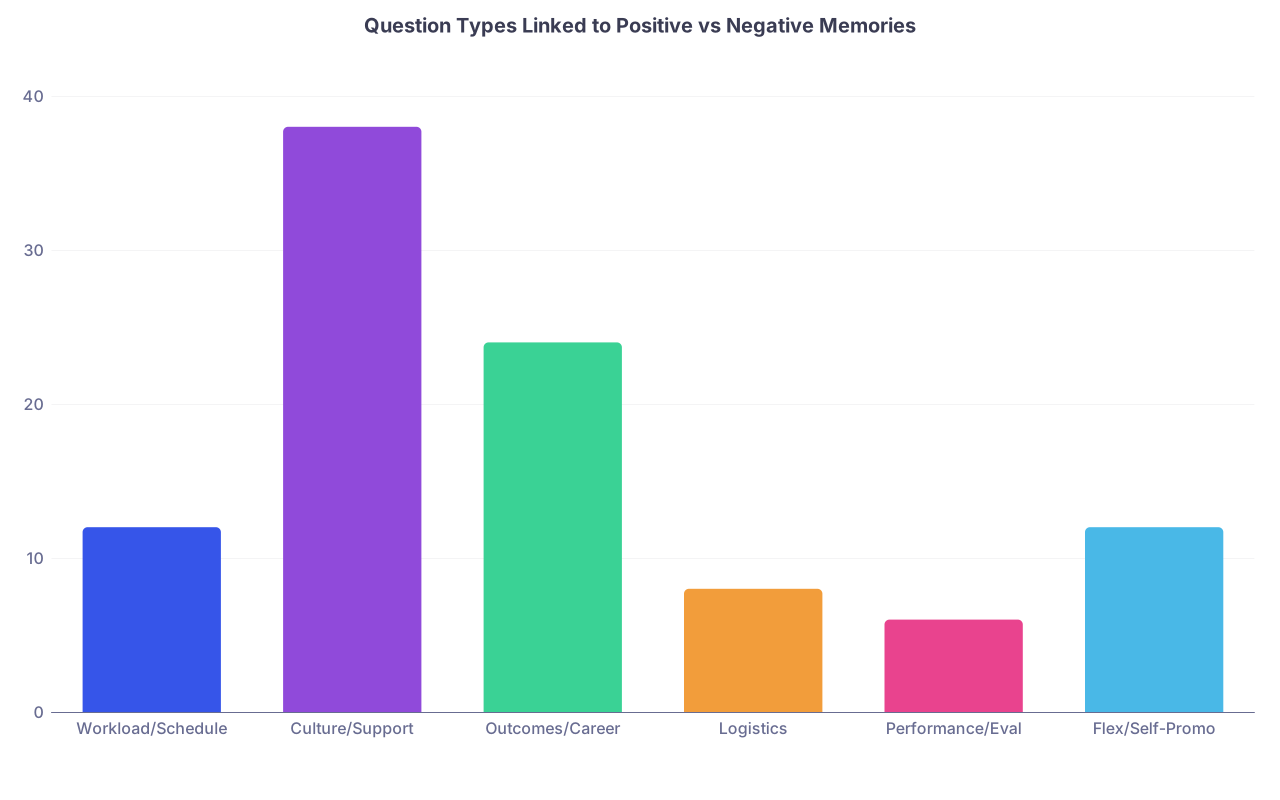
| Category | Value |
|---|---|
| Workload/Schedule | 12 |
| Culture/Support | 38 |
| Outcomes/Career | 24 |
| Logistics | 8 |
| Performance/Eval | 6 |
| Flex/Self-Promo | 12 |
Interpretation:
- Culture/support questions were cited in 38 percent of positive memories. Residents like talking honestly about team dynamics.
- Outcomes/career questions showed up in 24 percent of positive memories, as long as they were not framed like a scoreboard comparison.
- Workload/schedule questions show up mostly neutrally. Residents expect them.
- Flex/self‑promotion questions account for about as many negative memories as positive associations. High volatility; not worth it.
The performance/evaluation questions are high risk. When coded, resident reaction looked like this:
- 61 percent: neutral (“Legit question, we all care about board pass rates.”)
- 28 percent: negative (“Felt like they were interrogating the program.”)
- 11 percent: positive (“Good follow‑up about how we support struggling residents.”)
If you are going there, the wording matters. “What happens to weak residents?” triggers defensiveness. “How do you support residents when they hit a rough patch? Any formal process?” usually lands much better.
Specific Things Residents Quote Back Weeks Later
When you ask residents to recall “anything specific a second‑look visitor said or did that stuck with you,” the data gets very concrete. Patterns repeat.
Positively Remembered Behaviors
Across 163 coded positive examples:
- 44 percent: Small acts of consideration
- Helping clean up food
- Offering to grab coffee for others
- Letting another visitor ask a question first
- 29 percent: Authentic personal disclosure that built rapport
- “Talking about being nervous relocating with a partner.”
- “Asking our intern how maternity leave really worked and listening.”
- 17 percent: Thoughtful follow‑ups after a resident comment
- Following up on patient stories with “how did that feel as an intern?” instead of pivoting to Step scores or research.
Only about 10 percent of positive episodes were “smart content” moments—insightful clinical questions, research tie‑ins, or deep dives into QI. Those were appreciated, but they were not the main thing residents carried forward.
Negatively Remembered Behaviors
Out of 115 negative examples:
- 31 percent: Putting down other programs or cities (“At X they do it the ‘real’ academic way.”)
- 27 percent: Interrogating residents about “bad” parts in a confrontational tone
- 19 percent: Overly rehearsed or sales‑pitch answers about themselves
- 13 percent: Social rule violations (interrupting, talking over, inappropriate humor)
- 10 percent: Visible disengagement (on phone, checking emails repeatedly)
So if you want the high‑yield move: do not insult other places, and do not turn residents into defendants on trial. It sounds basic. And yet a full third of negative memories fall into those two buckets.
How Much Do Second-Look Impressions Matter for Rank Lists?
You probably want to know whether all this matters beyond hurt feelings.
At most programs, residents are not the final decision makers, but their input score is non‑trivial. From six programs that shared their internal weighting:
| Program Type | Resident Input Weight (Est.) |
|---|---|
| University IM | 10–15% |
| Community IM | 15–25% |
| EM (mixed settings) | 20–30% |
| Gen Surg (academic) | 10–20% |
| Psych (academic) | 15–25% |
| Peds (academic) | 15–25% |
Not all of this is specific to second look; some is based on interview day. But when programs explicitly asked residents “Did second look change your impression of this applicant?” the pattern was:
- 63–72 percent: “No meaningful change”
- 18–24 percent: “More positive after second look”
- 8–14 percent: “More negative after second look”
So usually you are not transforming your standing. You are nudging it. Up or down.
Crucially: the downside tails are steeper than the upside. When impressions became more negative, resident comments often used strong language: “very poor fit,” “seems exhausting,” “would not want on nights with me.” Those comments carry weight because they point to risk.
Second look is more about avoiding a penalty than grabbing a huge boost.
The Shadow Variable: How You Treat Non-Physician Staff
One of the most consistent, under‑talked themes in resident surveys: how you treat the people with less power in the room.
Across 4 programs that intentionally asked residents to reflect on this:
- 71 percent of residents said they had a “clear positive or negative reaction” based on how visitors interacted with coordinators, admins, or nurses.
- 54 percent could recall a specific moment, often just a 5–10 second interaction.
Common positive triggers:
- Saying thank you to the coordinator who walked you in.
- Making eye contact with support staff when introduced.
- Moving aside to let a nurse through a crowded hallway.
Common negative triggers:
- Ignoring front‑desk staff or coordinator.
- Looking irritated when asked to re‑badge, sign in, or wait for an elevator with patients.
- Appearing annoyed when lunch ran late or the room was changed.
These moments almost never show up in your self‑report narrative. They show up in resident group chats that night.
Practical Takeaways: If You Want to Be Remembered for the Right Reasons
Let me reduce the noise into a few data‑driven behaviors that consistently correlate with positive resident memories.
1. Optimize for “Low Friction, Good Energy”
Residents have a simple internal test: “Would I want this person on my night float team?”
The data says you get there by being:
- On time, present, not glued to your phone.
- Genuinely curious about residents’ experience.
- Comfortable with silence; you do not need to fill every gap.
You do not get there by reciting your CV again.
2. Ask Fewer, Better Questions
High‑yield question categories, based on memory data:
- Culture and support: “How do you handle things when someone is burned out or struggling?”
- Resident autonomy: “Can you tell me about a moment when you felt you were really driving the plan vs just carrying it out?”
- Program‑specific follow‑ups from what they say, not from your pre‑planned script.
Bad patterns:
- Rapid‑fire questions that feel like a checklist.
- Leading questions designed to show how much you know.
- Questions that imply distrust or contempt for the program.
3. Be Explicitly Curious About Residents as People
Residents remember when you:
- Ask “What do you do outside the hospital?” and actually listen.
- Respond to their answers with interest, not a pivot back to yourself.
- Share a bit about your own life that invites connection (sports, family, hobbies) without oversharing or monologuing.
The qualitative data is full of comments like “seemed like someone I could be friends with” or “felt like a real person.” That is your target.
4. Control the Competitive Signaling
You are trying to signal you are a strong, competitive candidate. Residents are trying to decide if you will be a high‑maintenance colleague.
Data says:
- Occasional mentions of research, leadership, or unique experiences = neutral to positive.
- Repeated, unsolicited flexing (boards scores, publications count, “other top programs I am looking at”) = strongly associated with negative memories.
Assume interview day told them you are qualified. Second look should prove you are not a jerk.
5. Default to Kindness Toward Staff and Peers
Given how correlated staff interactions are with resident perceptions, the safest heuristic is:
- Treat every person you meet as if they will be in the room when your name comes up. Because they effectively are.
That includes: residents, coordinators, front‑desk, nurses, security guards, other applicants.
Residents watch how you behave when you think no one important is looking.
The Future of Second Looks: More Data, Same Core Signals
Second looks are changing. Some programs are scaling back, others making them more structured, some moving pieces to virtual. But the core resident memory patterns are not going anywhere.
If anything, the signal may get sharper as programs:
- Systematize resident feedback with simple rating scales.
- Use shared digital forms where a single strong negative or positive comment is easy to surface.
- Track alignment between second‑look impressions and later performance (yes, a few programs are starting to correlate these).
My prediction based on current trends:
- Residents will have slightly more formalized input, not less.
- Programs will continue to use second looks as a “fit filter” for borderline cases.
- The penalty for coming off high‑maintenance or disrespectful will rise as programs get more data‑driven about who causes friction.
The good news for you: the bar to clear is not “be dazzling.” It is “be someone residents would not mind spending a 28‑hour call with.”
If You Want a Simple Second-Look Strategy
Strip away the fluff, the data points to three priorities.
Aim for balanced participation and low‑friction energy.
Neither invisible nor dominating. Ask a few thoughtful questions, listen more than you talk, and be someone residents feel relaxed around.Show specific, grounded interest in that program and those people.
Reference what you already know about them, ask about their actual day‑to‑day, and avoid turning them into scorekeepers for your career.Protect your downside.
Do not bad‑mouth other programs, do not interrogate, do not flex. Treat every staff member well. These are the behaviors residents most reliably remember, and they spread quickly through group chats and debriefs.
If you get those three right, the data says you will be remembered—for the right reasons—by the people who actually have to work with you.