
The worst second-look mistake is simple: most applicants schedule by emotion instead of timeline. That’s how you waste days off, burn money, and still end up guessing on your rank list.
Here’s the truth: second-look visits only matter if they’re timed against the Match calendar. Not just “when you’re free,” but week-by-week from interview season to list certification.
You’re not asking, “Should I do a second look?”
You’re asking, “When, exactly, should I go—and what should I do that week?”
Let’s walk it chronologically.
Big Picture: Match Calendar and Second-Look “Window”
You have a narrow, functional second-look window. Outside of it, you’re either too early (no perspective) or too late (no impact on your list).
Here’s the typical structure for a categorical residency (IM, peds, gen surg, etc.):
| Phase | Typical Timing (US) |
|---|---|
| Peak interview season | Mid-Dec to late Jan |
| Interviews taper off | Late Jan to early Feb |
| ERAS rank list opens | Early Feb |
| Second-look sweet spot | Early–late Feb |
| Rank list certification | Late Feb–early Mar |
| Match Week | Mid-March |
Overlay second looks:
- Before January: usually premature and logistically awkward.
- Early–mid February: prime time.
- Late February: only if tightly planned; no more “exploratory” visits.
- March: don’t do it. Your rank list is locked. It becomes pure tourism.
Now let’s go week-by-week.
Late Interview Season: Weeks -6 to -4 Before Rank List Deadline
Assume the NRMP rank list deadline is late February or early March. I’ll call that Week 0. We’ll count backward.
Week -6: Still Interviewing, Brain Is Mush
At this point you should… focus on interviews and light planning, not visiting again.
Typical time: early to mid-January.
What you do this week:
- Finish or nearly finish interviews.
- Keep a simple running list in your notes:
- “Maybe second look: Program X (loved residents, unclear about call).”
- “No second look: Program Y (clear ‘yes’ or ‘no’).”
- Start a rough filter:
- Only consider second looks at programs that:
- Are realistically in your top 5–7.
- You feel uncertain about for specific reasons (not just vibes).
- Are driving a major choice (city vs city, academic vs community).
- Only consider second looks at programs that:
What you do not do this week:
- Do not email coordinators about second looks while you’re still interviewing heavily. You’ll write sloppy emails and overcommit.
- Do not schedule anything before you have a tentative rank “shape” in your head.
Week -5: Initial Shortlist and Logistics Reality Check
At this point you should… decide WHERE second looks are even possible.
Typical time: late January.
Action steps:
Create a hard shortlist (max 3–4 programs).
For each program, write:- Current gut ranking (“Probably #1–2”, “Maybe mid-list”).
- What you still need to know:
- “How malignant is call really?”
- “Are fellows overshadowing residents?”
- “Can my partner realistically find work here?”
Check your calendar and hospital schedule.
- Look at your rotations: can you get one day off per week for 2–3 weeks?
- Decide maximum number of second looks you can reasonably do (most people: 1–3).
Check travel and cost.
- Can you batch visits? Example: two programs in the same city over 2 days.
- If you’re already broke from interview season, you probably get 1 meaningful second look. Use it strategically.
At this point, still no emails to coordinators. You’re making a plan, not asking favors yet.
Second-Look “Go Time”: Weeks -4 to -2
This is where timing actually matters.
Week -4: Contact Programs and Reserve Dates
At this point you should… send all your second-look inquiries and lock dates.
Typical time: very late January to early February.
What you do this week:
Decide which programs get a second look.
- “Top choice and I want to confirm.”
- “Two programs I’m genuinely torn between.”
- Skip everything else.
Email the program coordinator (never the PD first) to ask about second looks.
Keep it short and clearly state you’re not fishing for favoritism, just clarity. Example:Dear [Coordinator Name],
Thank you again for organizing the [specialty] interview day on [date]. I’m very interested in [Program Name] and am seriously considering it near the top of my rank list. I was hoping to schedule a second-look visit to better understand resident life, call structure, and the city.
Does your program allow informal second looks, and if so, are there recommended dates or days of the week to visit?
Best,
[Your Name], [AAMC ID]If a program explicitly says, “We do not offer or expect second looks,” drop it. Respect that boundary.
Aim for visit dates in Weeks -3 and -2.
Why not Week -1? Because:- Weather.
- Flight delays.
- Last-minute rotation issues.
- You still need time after the visit to let your brain settle and adjust your rank list.
Arrange time off properly.
- Tell your clerkship/resident scheduler what you’re doing.
- Frame it as “residency-related travel.” They’ve heard this a hundred times.
This is your scheduling week. Do not waste it.
Week -3: First Second-Look Visit(s)
At this point you should… do your most consequential second look.
Typical time: early to mid-February.
I’d put the highest-stakes program here—either your tentative #1 or the program you’re truly torn about.
What you do before the visit (2–3 days before):
- Re-read your interview notes.
- Write 5–7 targeted questions, not fluff:
- “How often do you actually leave on time post-call?”
- “How is feedback delivered here—formal forms or constant hallway feedback?”
- “What do residents do in their free time in this city, realistically?”
- Treat it like recon, not another audition.
- Focus on three domains:
- Resident culture.
- Do they laugh with each other?
- Do seniors protect interns?
- Work reality.
- Ask interns privately: “What surprised you most after starting?”
- Ask seniors: “If your best friend matched here, what would you warn them about?”
- Life outside the hospital.
- Commute.
- Housing.
- Where people actually live, not the brochure version.
- Resident culture.
You do not:
- Corner the PD to announce they’re your #1. That belongs in a clean, separate email if you choose to send one.
- Fish for hints on how high they’ll rank you. It’s awkward and useless.
After the visit (same day or next):
- Write down:
- 3 reasons this program moved up or down.
- A single sentence: “Right now, would I put this #1?” Yes or no. No “maybe.”
Week -2: Final Second Looks and Rank List Draft
At this point you should… complete any remaining second looks and build a working rank list.
Typical time: mid to late February.
What happens this week:
Finish any remaining second-look visits.
- These should be:
- Tiebreakers between similar programs.
- Visits to make sure your tentative #1 is actually livable.
- These should be:
Start building your actual draft rank list.
- Open ERAS/NRMP and put in a rough order based on:
- Where you can see yourself happy at 2 a.m. on call.
- Training quality and fellowship goals.
- Support system and personal life.
- Open ERAS/NRMP and put in a rough order based on:
Use second looks as a data point, not a last-minute crush.
I’ve seen people overreact to:- One charismatic chief.
- One bad day in clinic. That’s not a program. That’s noise.
If you’re going to send a genuine “I will rank you #1” message, this is the week.
Separate from second look. One clear email. To one program.
Second looks do not obligate you to send this kind of message and do not require you to declare a #1 on the spot.
This is your synthesis week. New information in, actual decisions out.
Week -1: Lock-In and No-New-Data Rule
At this point you should… stop collecting new in-person data and let your decision settle.
Typical time: the week leading up to rank list certification.
This is where people get into trouble. They panic and think, “Maybe a quick last-second trip will clarify everything.”
Bad idea.
Why you generally avoid Week -1 second looks:
- Travel risk: a storm delays your return and you’re scrambling on service.
- Cognitive risk: you over-weight the most recent visit and ignore months of data.
- Logistical: coordinators are busy prepping their rank lists and Match admin. You’re an extra task they don’t need.
Exceptions (rare, but real):
- You never got to see the city (truly) and you’re choosing between two cities you’ve never visited.
- Massive life change (partner got a job offer in that city, family emergency shifted your geography priorities).
If you absolutely must:
- Keep it single-day.
- No PD meeting.
- No new promises.
- Treat it strictly as “city and vibe reconnaissance.”
Otherwise, Week -1 is for:
- Finalizing your list.
- Talking decisions through with a mentor who doesn’t have a dog in the fight.
- Sleeping.
Match Week and After: Second Looks Are Dead
At this point you should… accept that second looks are over.
Once the rank list is certified and the deadline hits, second looks:
- Do not change your rank list.
- Do not change how programs rank you.
- Do not change the Match algorithm.
If you wander back for a “visit” in March, it’s either:
- Because you matched there (orientation or early housing trips)
- Or you’re just curious. Which is fine, but call it what it is: a visit, not a second look.
What To Do Each Week: Condensed Checklist
Here’s the week-by-week practical version.
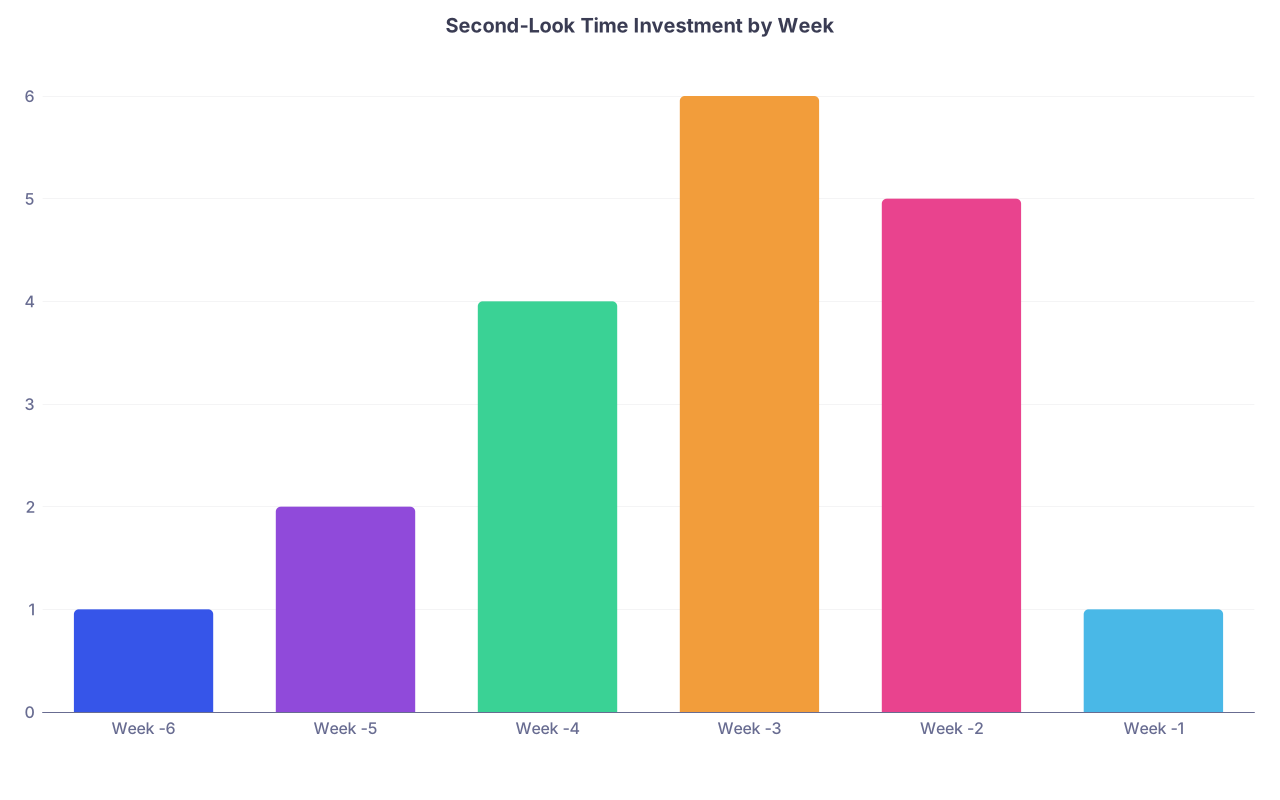
| Category | Value |
|---|---|
| Week -6 | 1 |
| Week -5 | 2 |
| Week -4 | 4 |
| Week -3 | 6 |
| Week -2 | 5 |
| Week -1 | 1 |
Hours per week roughly spent on second-look planning/visits.
Week -6
- Finish interviews.
- Start rough list of “maybe second look” programs.
- No emails yet.
Week -5
- Hard shortlist (1–4 programs).
- Calendar check: available days off.
- Budget check.
Week -4
- Email coordinators about second-look policies and possible dates.
- Book travel and lodging for Weeks -3 and -2.
- Coordinate days off with rotation.
Week -3
- Do your highest-priority second look.
- Focus on residents, workload, and city reality.
- Debrief in writing that night.
Week -2
- Do any remaining second looks.
- Build and refine your draft rank list.
- If sending a true “#1” email, this is the week.
Week -1
- No new second looks unless absolutely unavoidable.
- Finalize and certify your rank list.
- Step away from Reddit and group chats.
What Second Looks Are Not (Timeline-Independent Truths)
Does not matter which week you go—these things remain true:
- They are not required.
- They are not an audition 2.0. You are not re-interviewing.
- They usually do not move you significantly on the program’s rank list.
(Most PDs already decided their tiering based on interviews, letters, and file.)
Where they do have power:
- Clarifying your own ranking.
- Making sure there are no deal-breaking surprises.
- Giving you real-world, non-curated resident contact.

Quick Comparison: When to Schedule Your First vs Second Second Look
| Scenario | Best Week Window | Comment |
|---|---|---|
| Your clear tentative #1 | Week -3 | Confirm, not discover |
| Two programs you’re torn between | Weeks -3 and -2 | Space them apart |
| Need to see a city for the first time | Week -3 or -2 | Avoid last-minute Week -1 trip |
| Tight schedule, one day off only | Week -3 | Use it on the highest-stakes |
| Program discourages second looks | None | Respect and rely on interview |
FAQ (Exactly 2 Questions)
1. Do programs expect me to do a second look, and will it hurt me if I do not?
No, they do not expect it. The vast majority of applicants, even at competitive programs, do not do formal second looks. What programs actually expect is that you:
- Behaved professionally on interview day.
- Asked sane questions.
- Submit a realistic rank list.
Use second looks for your clarity, not to impress them. If a program heavily pushes second looks or makes it sound mandatory, I raise an eyebrow—good programs know not everyone has time or money for extra visits.
2. How many second-look visits is too many?
For most people, more than 3 is overkill and starts to blur your impressions. One well-timed visit to your likely #1 and maybe one more to a true “toss-up” program is plenty. If you’re filling every free day with a visit, you’re not clarifying—you’re chasing certainty that doesn’t exist. Decide which 1–3 programs could realistically land in your top tier, visit within Weeks -3 to -2, then commit to ranking based on that information, not endless new data.
Key takeaways:
- The real second-look window is roughly Weeks -4 to -2 before the rank list deadline; outside that, returns drop fast.
- Use Week -4 to schedule, Weeks -3 and -2 to visit, and Week -1 to stop, think, and certify your list.
- Second looks serve you more than they serve programs—schedule them where they’ll change your clarity, not where they just feed your anxiety.