
Late-Season Second Looks: How Close to Rank Deadline Is Too Late?
It’s February 10th. You’ve done your interviews. You’ve got a messy draft of a rank list in a notes app that changes every 48 hours. One program in particular keeps nagging at you—maybe a place you interviewed early and barely remember, maybe a “reach” that surprised you, maybe a solid mid-tier that suddenly seems more realistic than the shiny brand names.
You’re staring at the calendar. Rank list certification is in about three weeks. And you’re wondering:
“Is it insane to ask for a second look now? Is it too late? Do programs hate this? Will it even matter?”
Here’s the timeline reality: there is a window where second looks can help you make a better decision and not annoy programs. There’s also a point where you’re just in the way—logistically and politically.
Let’s walk it, chronologically.
Big Picture Timeline: When Second Looks Make Sense
At this point you should think in phases, not individual days. Second looks live in three broad windows:

Phase 1: Post-Interview, Pre-Crunch (Late January – Early February)
This is the ideal window.
- Interviews are mostly done.
- Programs haven’t locked rank lists yet.
- Schedules have a little breathing room.
- You still have time to process what you see on a second look.
If you’re going to do more than one second look, they should almost all live here.
Phase 2: Rank List Construction Window (Mid–Late February)
Programs are actively arguing over you in conference rooms.
- Faculty are ranking.
- PDs are tweaking.
- Chiefs are whispering “I really liked that one from X school.”
Second looks now are high-yield for your own clarity, but low-yield for “boosting” your rank. You’re not changing many minds at this point. You’re just gathering intel.
Phase 3: Last-Minute / Too Late (Final 3–5 Days Before Deadline)
This is where people start annoying coordinators.
- Some programs have already submitted internal drafts.
- Admin is drowning in rank list meetings and emails.
- Residents are tired and do not want extra bodies on rounds.
At this point you should assume:
- A second look is for you only, not for them.
- Your visit is very unlikely to move your position on their list.
Program Timeline: What They’re Actually Doing While You’re Debating
You will think your application is the center of their universe. It’s not. Let’s line up what programs are doing when you’re thinking about second looks.
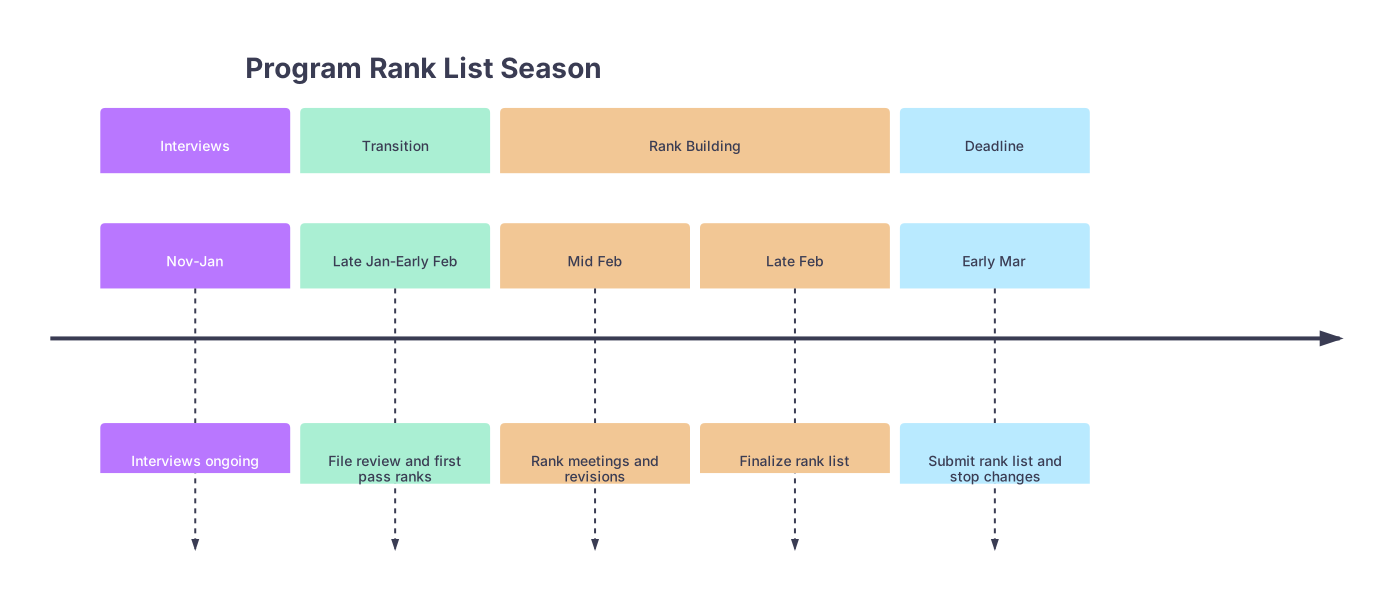
| Period | Event |
|---|---|
| Interviews - Nov-Jan | Interviews ongoing |
| Transition - Late Jan-Early Feb | File review and first pass ranks |
| Rank Building - Mid Feb | Rank meetings and revisions |
| Rank Building - Late Feb | Finalize rank list |
| Deadline - Early Mar | Submit rank list and stop changes |
At this point you should recognize where your second look request will land:
- Early February email → hits during early rank discussions = easiest yes.
- Mid–late February email → lands in the middle of rank meetings = harder yes, but possible.
- Last 3 days pre-deadline → likely “Sorry, we can’t accommodate,” or a token Zoom chat at best.
Month-By-Month: From Interviews to Deadline
Let’s zoom out, then zoom in.
December – Early January: Do Not Worry About Second Looks Yet
At this point you should:
- Focus on interviews.
- Keep notes immediately after each interview:
- Resident vibe
- Education structure
- Red flags
- Your gut feeling leaving the day (write one line: “felt like home,” “meh,” “everyone exhausted”)
Second look planning now is premature unless:
- You strongly suspect you’ll rank a program in your top 1–3 and your interview day was unusually limited (e.g., virtual-only, bad weather, half-day truncated schedule).
- You’re switching specialties and need to “prove” interest (rare, but this happens most in EM, anesthesia, radiology converts from prelim spots).
Mid–Late January: Early Shortlist, Early Second Looks
At this point you should:
Draft a soft rank list based on interviews alone.
Don’t overthink. Just write:- Top 3 “I could be happy here”
- Middle “fine but not exciting”
- Bottom “only if forced”
Identify programs where:
- You still feel blind.
- You interviewed very early and remember almost nothing.
- You had a virtual-only day and the city or hospital environment matters.
Those are your second look candidates.
Best timing for a first wave of second looks:
Last week of January to first week of February.
You email coordinators and PDs then → you’re reasonable, early enough, and more likely to get a meaningful day (sit in on conference, join residents for lunch, see the hospital).
February: Week-by-Week Breakdown
This is where most people mess up. Let’s go week by week.
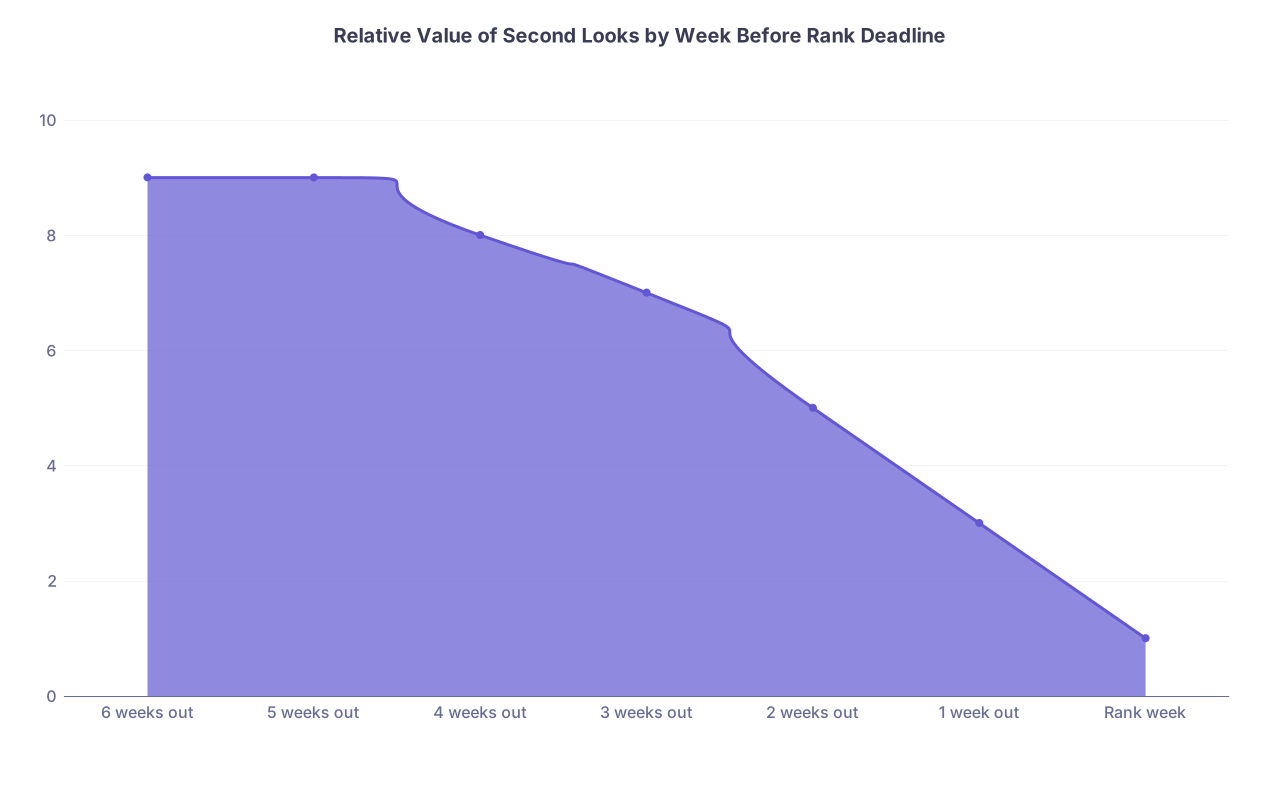
| Category | Value |
|---|---|
| 6 weeks out | 9 |
| 5 weeks out | 9 |
| 4 weeks out | 8 |
| 3 weeks out | 7 |
| 2 weeks out | 5 |
| 1 week out | 3 |
| Rank week | 1 |
4–6 Weeks Before Rank Deadline (Late Jan – Early Feb)
At this point you should:
- Request up to 2–3 second looks total. Beyond that, you’re either neurotic or trying to impress people who don’t care.
- Prioritize programs you’re actually considering ranking in your top 5–7.
How to word the ask (email to coordinator, CC PD if culture allows):
Subject: Second Look Visit Inquiry – [Your Name], [Specialty] Applicant
Dear [Coordinator Name],
I interviewed at [Program Name] on [date] and remain very interested in the program.
As I finalize my rank list, I would appreciate the chance to spend a few more hours at the hospital to better understand the resident experience and day-to-day workflow.
If your policy permits second look visits this season, would there be a half-day or morning in the next few weeks when I could:
– Attend morning report or conference
– Briefly shadow the resident team
– Speak informally with current residentsI understand everyone is busy and will gladly work around your schedule and any guidelines you have about these visits.
Thank you very much for your time and help,
[Name]
[AAMC ID]
[Med School]
If they say no because of policy? Accept it. Do not push. Do not beg. It will not help you.
3–4 Weeks Before Rank Deadline (Early–Mid Feb)
At this point you should:
- Use this window for targeted second looks:
- Your true top 1–3 where you’re stuck on order.
- Programs where you have conflicting impressions (amazing faculty, but residents looked burned out; great training, questionable city fit).
Program-side reality now:
- Many places have a draft rank list but it’s not frozen.
- A well-timed, professional second look might remind them you exist.
- But they’re not moving you from rank #70 to #5 because you showed up for three hours.
Your priority in this phase: decide if you’d actually be happy training there. Not trying to manipulate your spot.
2 Weeks Before Rank Deadline (Mid–Late Feb)
This is the line where second looks start to feel… late.
At this point you should:
Only request a second look if:
- You’re genuinely torn between two programs for your #1 or #2 spot, and
- You haven’t seen daily life there properly (virtual interview, limited exposure, etc.).
Be upfront in your email:
- That you know this is late in the season.
- That your goal is clarity for your own ranking, not to influence theirs.
The right mental frame:
You’re going there to answer three questions:
- Can I see myself on this team at 3 a.m. on a terrible call night?
- Do the residents look like the future version of me I’d be okay becoming?
- Does the workload/acuity vibe feel sustainable, not just “prestigious”?
If the answer to all three is “yes,” you bump them up. If not, you don’t.
Final Week Before Rank Deadline (Last 7 Days)
This is where “How close is too late?” becomes very real.
At this point you should assume:
- Many programs have already finalized or effectively locked their rank lists.
- A second look now almost never influences your position.
- Coordinators are slammed. Residents are exhausted. PDs are in meetings.
If you still want a second look now:
Expect the answer to be:
- “We’re not offering second looks this late,” or
- “You can briefly meet with a resident or faculty on Zoom.”
That’s not a snub. It’s logistics.
If you somehow get an in-person second look in the final week:
- Don’t bring gifts.
- Don’t say “You’re my number one” unless you mean it and are willing to back it up.
- Don’t fish for rank info (“Where do you think I’ll be on your list?” is amateur hour).
Use it as data only. Rank based on fit, not flattery.
How Late Is Too Late? Hard Lines
Let’s put numbers on it.
| Timing Before Rank Deadline | For Your Clarity | For Influencing Program Rank | Coordinator Happiness |
|---|---|---|---|
| 6–4 weeks out | Very high | Low–Moderate | High |
| 4–2 weeks out | High | Very low–Low | Moderate |
| 2–1 weeks out | Moderate | Near zero | Low |
| < 1 week out | Low | Essentially zero | Very low |
If you want an oversimplified rule:
- > 3 weeks before deadline → Reasonable and often useful.
- 2–3 weeks before deadline → Fine but don’t overdo it.
- < 2 weeks before deadline → Do it only if you’re deciding between top choices and you accept that this is for you, not for them.
- Last 3–5 days → Functionally too late; you’re almost certainly not changing anything on their side.
Day-By-Day: How to Run a Late-Season Second Look Well
Let’s say you land a second look 2–3 weeks before deadline. Here’s how to not waste it.
3–5 Days Before the Visit
At this point you should:
Re-read your interview notes.
Remember what you liked and didn’t.Make a focused question list (not 40 questions, more like 8–10):
- How often are residents staying late after sign-out?
- When are seniors truly comfortable running the unit/ED/OR alone?
- How many graduates last year did fellowship vs general practice?
Decide your rank list hypothesis before you go:
“If this second look doesn’t blow up any red flags, I’ll keep them at #1.” Or “I currently have them #3; they move up only if I see X, Y, Z.”
Day Of the Second Look
At this point you should:
- Show up on time. Business casual or interview-level depending on culture (if unsure, dress one notch down from full suit but not in scrubs unless told).
- Treat it like a site visit, not a re-interview.
Pay attention to:
- Residents’ body language when attendings aren’t around.
- How the intern talks about their worst rotation.
- Whether seniors seem protective of juniors or resigned and bitter.
Do not:
- Launch into a monologue about how interested you are every 10 minutes.
- Hover. If residents invite you to join pre-rounds, do it. If they’re clearly getting slammed, step back.
- Ask about your rank position. Ever.
Within 24 Hours After the Visit
At this point you should:
Write two things down immediately:
- “What surprised me?”
- “What worried me?”
Then answer:
- “Did this visit move them up, down, or keep them the same?”
If you plan to send a follow-up thank you:
- Keep it short.
- One email to the coordinator and PD is enough.
- If—and only if—it’s true, and only if you’re 100% sure, you can say:
After my second look, I’m confident that [Program] will be ranked highly on my list.
If they’re your true #1 and you’re not playing games, you can explicitly say that. But don’t say it to more than one place.
Virtual-Only Second Looks: Late-Season Reality
A lot of programs are moving to “no in-person second looks at all, ever” for equity optics. Late in the season, this is even more common.

If all they offer you in late February is a brief Zoom with residents:
At this point you should:
- Treat it as Q&A with unguarded sources. Residents are more candid when PDs are not on the call.
- Have 5–6 high-yield questions ready:
- “What’s the last thing that made you question staying here?”
- “What’s one change you’d make if you were PD tomorrow?”
- “Which rotations consistently run over hours expectations?”
Is this as good as an in-person second look? No. But late in the game, it may be the only realistic version—and it’s still useful.
When You Should Not Do a Late Second Look
This part matters more than people think.
Skip the second look—especially late—if:
- You’re clearly going to rank the program in your bottom half.
- You’re trying to do 5+ second looks “just to see what’s out there.”
- You’re hoping to fix a bad interview impression (you won’t).
- You’re anxious and think more data will fix what’s actually indecision about your own priorities.
Second looks are tools, not therapy. If you’re trying to calm raw anxiety, a last-minute visit usually does the opposite.
Quick Reality Check Summary
- Second looks more than ~3 weeks before the rank deadline are reasonable and can genuinely clarify your own list. After that, they’re mostly for you, not to move you up on their list.
- The true “too late” zone is the last week (and especially last 3–5 days) before rank certification; assume any visit then has essentially zero impact on how they rank you.
- Use late-season second looks surgically: only for programs you’re seriously considering near the top of your list, and only to answer specific fit questions—not to chase imaginary bonus points.