
The biggest mistake after a second look is thinking, “I’ll remember this later.” You won’t. Not in March. Not when rank lists are due. You have a 72‑hour window where your memory is sharp and your impressions are honest. Use it or lose it.
This is your hour‑by‑hour, day‑by‑day guide for what to do from the moment you walk out of a second look visit until 72 hours later. At each point, I’ll tell you exactly what you should be doing, writing, and sending.
The Last Hour On Site (Hour 0): As You’re Leaving the Second Look
At this point you should still be in the parking lot, lobby, or on the train home. You are not done yet.
Right now (within 15–30 minutes of leaving):
- Open your phone Notes app (or whatever you actually use) and create a note with:
- Program name
- Date of second look
- “Immediate gut score” out of 10
- Then, while the day is fresh, bullet out:
- One thing that surprised you (good or bad)
- One resident you clicked with (name + PGY level if you remember)
- One concrete negative you noticed (not vibes, something real)
- One concrete positive that matters to you
Do not try to write a novel in the Uber. You’re just catching the raw emotion before your brain sanitizes it.
On the way home (next 60–90 minutes):
You should be asking yourself 3 questions and jotting fast answers:
- “Could I see myself here on my worst call day?”
- “Did the residents look like the kind of people I want to become?”
- “Does this program fix any fear I have about residency?” (e.g., lack of operative numbers, weak fellowship match, bad schedule)
Write short, blunt answers. You’re not submitting this to anyone. This is for Future You who’ll be staring at 10 nearly identical programs on a spreadsheet.
Hour 0–12: Same Day, Controlled Brain Dump
This is still “day of” the second look. Your impressions are vivid. At this point you should be organizing, not editing.
Within 4 hours of leaving
Once you’re home or in your hotel:
Start a structured program log.
Use a single document for all programs. For each second look, add a section like this:- Program:
- Date of second look:
- Overall gut rank at this moment:
- Would I be disappointed to match here? (Yes/No/Unsure)
- Top 3 pros (specific, not generic)
- Top 3 cons
- Residents:
- Vibe (1–10)
- Names I connected with:
- Faculty:
- Anyone I’d want as a mentor:
- Training:
- Cases/procedures I saw or heard about:
- Anything that reassures me about their numbers:
- Lifestyle:
- Call schedule impressions:
- City/commute thoughts:
- Red flags:
- Open questions to clarify:
Transfer from your phone notes into this structure.
Don’t worry about exact wording. You’re just building a consistent format so you can compare programs later.
Hours 4–12: Capture details before you forget
Later that evening, when things are quieter:
At this point you should turn vague impressions into specific, searchable notes. Focus on:
- Actual quotes you remember:
- “Our PD really goes to bat for people interested in cards.”
- “We try not to break 70 hours but some rotations get close.”
- Any numbers they mentioned:
- “Average 300–350 cases as primary by PGY3.”
- “3–4 fellows a year into GI; most at academic centers.”
- Environmental details that matter:
- Residents congregated in a workroom vs. scattered and isolated
- People laughed together at lunch vs. dead silent table
- How they talked about nursing or ancillary staff (subtle but huge)
You do not need to be objective. Your bias is the point. Future You needs to know why you loved or hated something, not just that you “liked the vibe.”
Hour 12–24: Sorting Impressions & Planning Follow-Up
Now you’ve slept on it—or at least laid awake thinking about it. This is the “first pass” ranking and outreach planning window.
Morning after the second look (Hours 12–18)
At this point you should:
Re-rate the program.
Go back to your structured log and add:- 12–24 hour rating (1–10)
- Did my opinion improve, worsen, or stay the same after sleeping on it?
Place it in your provisional rank order list.
You don’t need a perfect list, just relative placement. Add this program into whatever draft list you have, with a note like:- “Currently between Program A and Program B.”
- “Jumped from #5 to #2 after second look.”
- “Dropped below all urban programs due to location.”
Flag follow-up questions.
Look at your “Open questions to clarify” and decide:- Which matter for ranking?
- Which are curiosity but not decision-critical?
Only plan to email about the first group.
Late morning to midday: Drafting your follow-up email plan
This is planning, not sending. At this point you should decide:
- Who deserves an email:
- Program director (PD)?
- APD?
- Residents you spent meaningful time with?
- Coordinator?
- What the purpose is:
- Clarify a detail that affects ranking
- Express genuine enthusiasm with specifics
- Maintain a connection with someone who might be a future mentor
| Role | Email Purpose |
|---|---|
| Program Director | Big-picture fit, enthusiasm |
| APD | Specific track/interests |
| Coordinator | Logistics, schedule, thanks |
| Resident | Candid follow-up questions |
| Fellow/Chief | Fellowship/match questions |
Do not send five separate gushing emails to everyone with a badge. Pick 1–3 people max. Quality over volume.
Hour 24–36: Writing Follow-Up Emails That Don’t Sound Desperate
This is your prime writing window. Enough distance to be coherent, close enough that your memory and emotional tone are still accurate.
When to hit send
- Best: End of Day 1 or sometime on Day 2 (i.e., 24–48 hours after the second look)
- Worst: 10 minutes after you leave (“Thank you so much, I LOVED IT SO MUCH!!!” reads… unseasoned)
- Still fine: By the 72‑hour mark
Structure of a strong follow-up email (PD or APD)
At this point you should write something like:
Subject line – short and clear:
- “Thank you – Second Look visit [Your Name]”
- “Appreciation for Second Look day – [Your Name]”
Opening line (1–2 sentences):
- Thank them for the opportunity
- Anchor it to the specific date
1–2 specific details that stuck with you:
- A case you observed
- A conversation with a resident
- A policy or philosophy that matched your goals
Brief statement of fit:
- Link 1–2 aspects of the program to your goals (not generic “great training” fluff)
Optional: 1 clarification question that matters:
- About mentorship, research structure, or schedule—not stuff you could Google
Close succinctly:
- Express appreciation again
- No premature “I will rank you #1” promises. Save that for a genuine post‑rank communication if you choose to do it.
Example skeleton (you should customize the actual content):
Dear Dr. [PD],
Thank you again for the opportunity to attend the second look at [Program] on [date]. I appreciated the chance to see a more typical resident conference day and to meet several of the current residents.
I was particularly struck by [specific thing: e.g., “the way the chiefs described balancing autonomy with backup in the ICU”] and by [second specific detail]. These align very closely with what I’m looking for in residency, especially given my interest in [your interest].
After this visit, I feel that [Program] would be an excellent fit for me in terms of [2–3 things: e.g., clinical volume, mentorship, and resident culture].
Thank you again for the opportunity to learn more about your program.
Best regards,
[Name], [Med School], AAMC ID [optional]
Resident follow-up email
For residents, keep it lighter and more human:
- Subject: “Thank you – second look at [Program]”
- Reference something specific you talked about
- Ask 1–2 real questions you didn’t feel comfortable asking in a big group (e.g., “What does a tough week actually look like?”)
Hour 36–48: Comparing Second Looks Across Programs
Now you’ve done the courtesy follow-up. At this point you should shift from “polite applicant” to “cold analyst.”
Build a rapid comparison snapshot
Create a simple comparison snapshot for every program where you did a second look. If you like grids, use a table like this:
| Program | Resident Vibe (1–10) | Autonomy (1–10) | Location Fit (1–10) | Overall Rank Now |
|---|---|---|---|---|
| A | 9 | 8 | 7 | 1 |
| B | 7 | 9 | 5 | 3 |
| C | 6 | 7 | 9 | 2 |
Then underneath each, write 2–3 lines:
- “If I match here, I will be excited because…”
- “If I match here, I might worry about…”
Those two sentences cut through a lot of noise.
Lock in “dealbreaker” notes
You’re still within 48 hours, meaning the weird stuff is fresh:
- PD made a comment that felt off
- Residents avoided eye contact when someone mentioned work hours
- Nurses looked miserable, or the ED felt chaotic in a bad way
At this point you should decide:
- Are any of these true dealbreakers?
- Or are they minor “watch and note” items?
Write it explicitly:
- “This is a yellow flag, not red. Will not rank below X because of this.”
- Or: “This moves the program below any equivalent alternative.”
Hour 48–72: Final Integration and Future-Proofing Your Notes
By now the emotional high (or low) from the second look is wearing off. This is the last part of the 72‑hour window where you still have reliable recall.
Hour 48–60: Final pass on notes and rank placement
At this point you should:
Re-read your own log out loud.
It sounds silly, but hearing your own words will tell you if you’re forcing enthusiasm or minimizing concerns.Confirm or adjust final provisional rank position.
Ask yourself:- “If Match Day were tomorrow, would I still put them here?”
- “Would I feel regret if I ranked them lower than [Program X]?”
Mark your confidence level.
Next to the provisional position, add:- High confidence
- Medium
- Low (need more reflection)
This lets you know later which parts of your rank list are flexible vs. locked in.
Hour 60–72: Archive for Future You
Future You, two weeks from now, will not remember which program had the chilled-out chiefs and which had the checked-out interns. At this point you should package your impressions so you can trust them later.
Do three things:
Create a one-slide “program summary” (yes, literally one slide per program).
Format doesn’t matter: PowerPoint, Google Slides, Notion, whatever. Each slide:- Program name, city
- Photo or logo (if you’re that person)
- 3 bullet “Why I should rank them higher”
- 3 bullet “Why I might rank them lower”
- Final 1–2 sentence impression:
- “Feels like a place where I’d work hard but be happy.”
- “Training is strong but culture feels guarded.”
Tag your notes with keywords.
You’ll forget nuances. So tag each program with 3–5 words like:- “Very academic, heavy ICU, happy residents, cold city”
- “Community feel, huge autonomy, weaker research, affordable”
Decide if any further contact is needed later.
Within this 72‑hour window, make a yes/no note:- “If I end up ranking this program top 3, send a final note before rank submission.”
- Or: “No further contact needed beyond thank-you emails.”
This prevents panic moves two days before rank lists are due.
Visual Timeline: Your 72-Hour Post-Second Look Plan
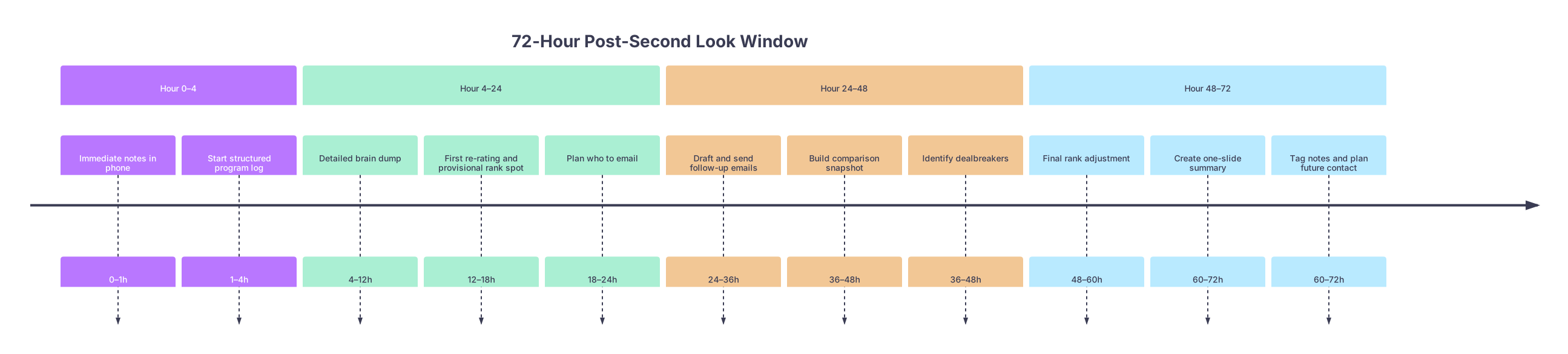
| Period | Event |
|---|---|
| Hour 0–4 - Immediate notes in phone | 0–1h |
| Hour 0–4 - Start structured program log | 1–4h |
| Hour 4–24 - Detailed brain dump | 4–12h |
| Hour 4–24 - First re-rating and provisional rank spot | 12–18h |
| Hour 4–24 - Plan who to email | 18–24h |
| Hour 24–48 - Draft and send follow-up emails | 24–36h |
| Hour 24–48 - Build comparison snapshot | 36–48h |
| Hour 24–48 - Identify dealbreakers | 36–48h |
| Hour 48–72 - Final rank adjustment | 48–60h |
| Hour 48–72 - Create one-slide summary | 60–72h |
| Hour 48–72 - Tag notes and plan future contact | 60–72h |
How This Fits Into Your Overall Interview Season
Second looks are optional. Overused. Sometimes performative. But when you do go, they give you data that interviews don’t.
At this point in the season, your priorities:
- You’re no longer trying to “impress” anyone. Impression has mostly been made.
- You are trying to get clarity for your rank list.
- Every second look should either move a program clearly up, clearly down, or confirm its position.
Use the 72‑hour window to decide which of those three happened. If a second look didn’t change anything, write that down too. “No meaningful change after second look” is a data point.
Two Concrete Examples

Example 1: Second Look that moves a program up
- Pre-second look: Program B is your tentative #4.
- During second look: You see residents genuinely happy on a brutal rotation, PD knows their stories, chiefs talk transparently about weaknesses and fixes.
Your 72‑hour outcome:
- Immediate note: “Way better culture than interview day suggested.”
- 24‑hr: You re-rank Program B up to #2.
- 48‑hr: After comparing with Program C, you realize you’d be more excited to match at B.
- 72‑hr: You lock Program B at #2 with “High confidence” tag.
Example 2: Second Look that reveals a red flag
- Pre-second look: Program C is your tentative #1.
- Second look: Residents repeatedly mention “we survive” and “it’s just three years” with nervous laughter; several look exhausted; offhand remark about “80 hours…ish.”
Your 72‑hour outcome:
- Immediate note: “Vibe worse than expected, subtle burnout.”
- 24‑hr: Move Program C below Program A pending more reflection.
- 48‑hr: Mark “Workload and support are real concerns; red flag.”
- 72‑hr: Decide you’re not willing to risk it; Program C drops to #4 permanently.
Without that structured 72‑hour window, you’d remember “it felt a little off” and still rank it #1. That’s how people regret their match.
Quick Chart: Time Allocation in the 72-Hour Window
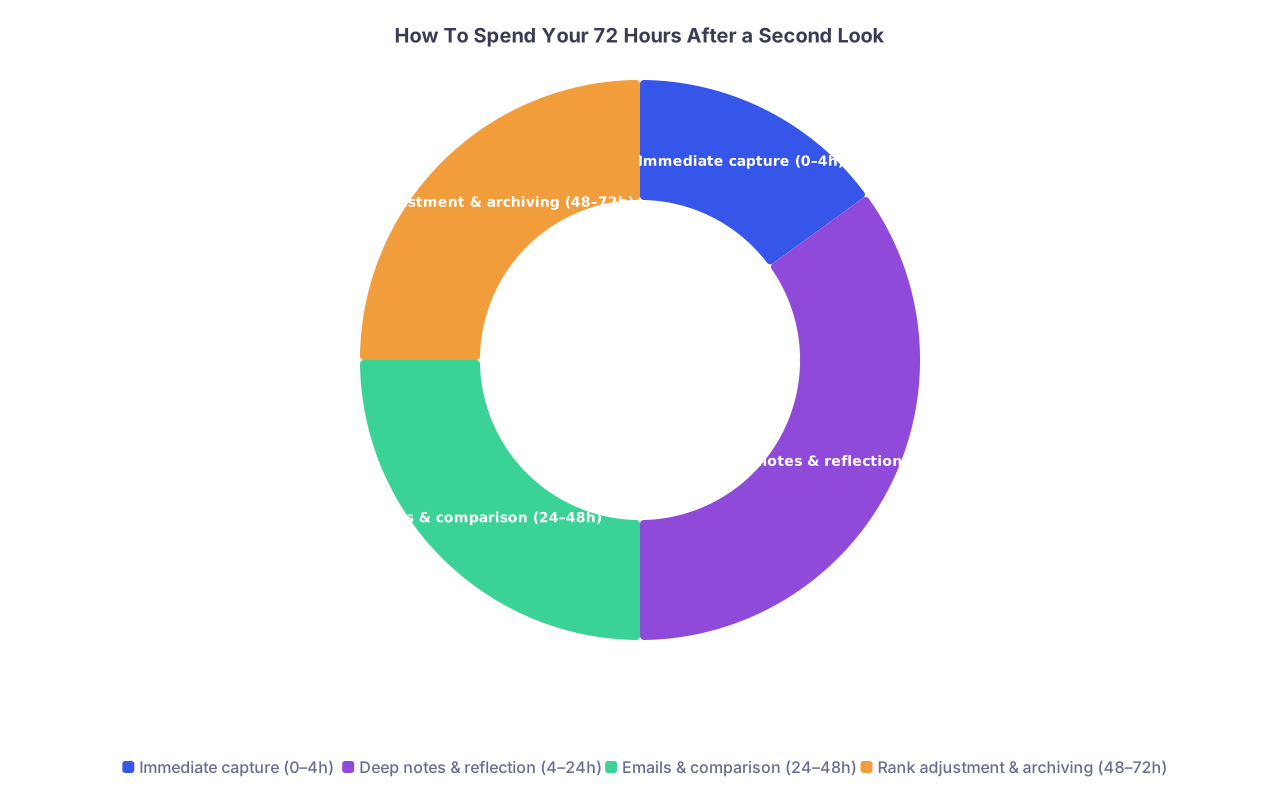
| Category | Value |
|---|---|
| Immediate capture (0–4h) | 15 |
| Deep notes & reflection (4–24h) | 35 |
| Emails & comparison (24–48h) | 25 |
| Rank adjustment & archiving (48–72h) | 25 |
FAQ (Exactly 3 Questions)
1. Do I have to email the program director after every second look?
No. You should email when you have something genuine and specific to say. A forced, generic “thank you so much for your time, I loved your program” that reads like a template doesn’t help you. If you spent meaningful time with the PD or APD, or if the visit changed how you see the program, then a short, specific thank-you email within 24–72 hours is appropriate.
2. What if I realize after 72 hours that I forgot to write something down?
You’ll still remember something, but the details and emotional tone fade quickly. If you recall a critical point later, absolutely add it. The reason I push a 72‑hour window is because it captures your most accurate snapshot. After that, your brain starts averaging programs together. So push yourself to do the bulk of the documentation and ranking shifts before that mark.
3. Can a strong follow-up email actually change how a program ranks me?
Occasionally, but you should not count on it. By the time second looks happen, most programs have a pretty solid impression of you from the interview. A thoughtful, professional email can reinforce your interest and keep you memorable, especially at smaller programs where PDs really do remember names. But the real value of the 72‑hour window is for you—to avoid self-gaslighting your own impressions when it’s time to certify your rank list.
Bottom line: Within 72 hours after a second look, you should (1) capture honest, detailed notes, (2) send any necessary, specific follow-up emails, and (3) lock in where that program truly belongs on your draft rank list. Everything else is noise.