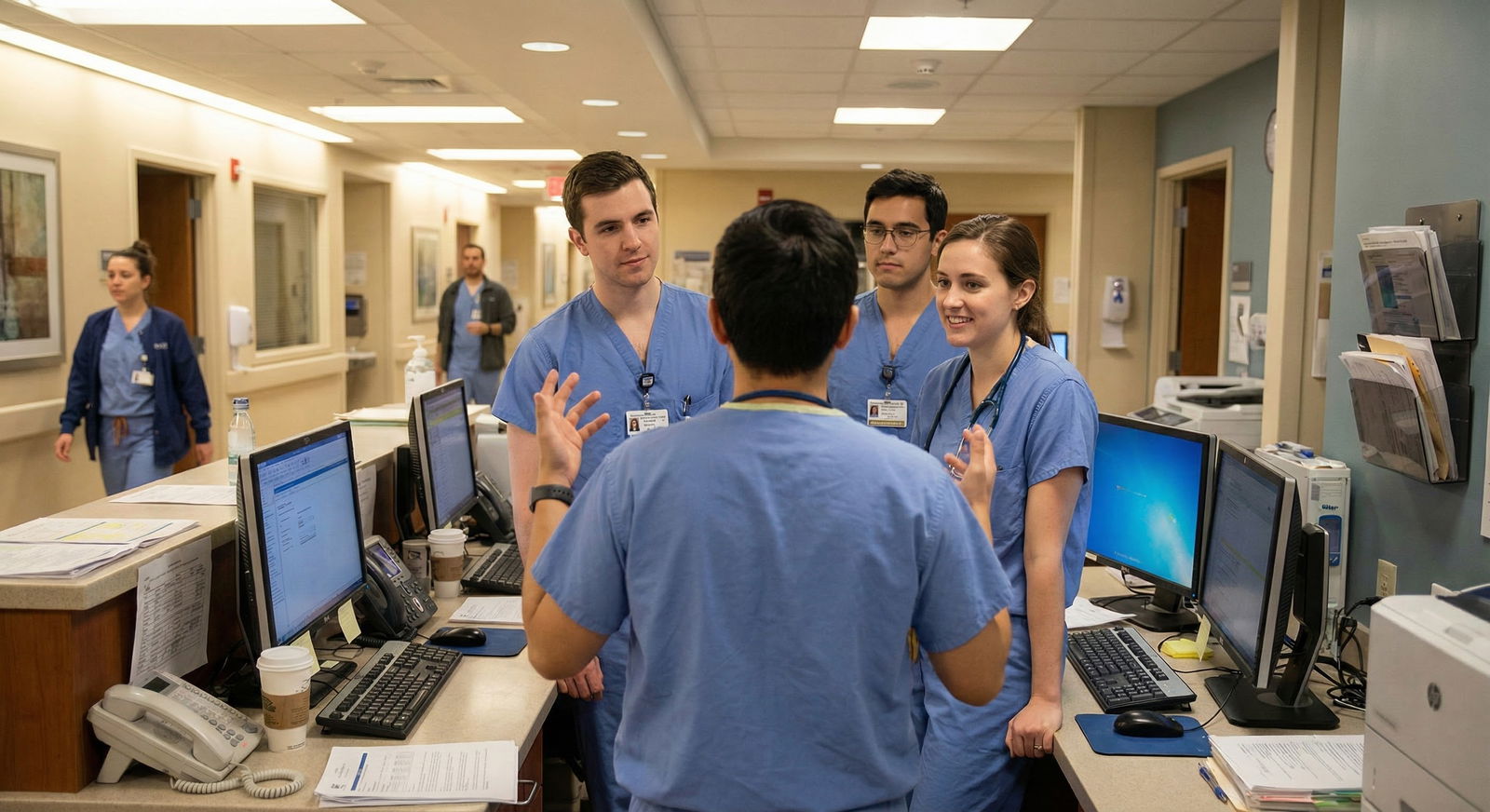
Second looks are dangerous when done badly—and a weapon when done well.
Most residents and fellows drift through them with vague small talk and zero strategy. Program leadership does the same. Then everyone complains the visit “did not change anything.” Of course it did not. No one said what they actually needed. No one asked for what mattered.
This is your playbook so you do not waste the most fixable part of recruitment season: the second look.
I am going to give you concrete scripts—for residents, program directors (PDs), and fellows—plus a simple structure so you stop improvising under pressure. Use them as written or tweak them to match your style, but do not show up empty-handed.
1. What Second Looks Are (And Are Not)
Let us cut through the mythology first.
Second looks are:
- A controlled chance to clarify fit
- A way to correct misperceptions from interview day
- A pipeline tool for niche interests (research, global health, subspecialty focus)
- A soft branding opportunity for programs to show culture and transparency
They are not:
- A secret extra interview for favored applicants
- A backdoor way to secure promises about rank
- A required hoop every applicant must jump through
- A place to pressure applicants into signaling commitment
If your program treats second looks as covert rank meetings, stop. It is unprofessional and risky in the NRMP era, and it backfires. Applicants talk.

| Step | Description |
|---|---|
| Step 1 | Applicant After Interview |
| Step 2 | Skip Second Look |
| Step 3 | Resident-led Visit |
| Step 4 | PD/APD Meeting |
| Step 5 | Fellow/Faculty Meeting |
| Step 6 | Clarified Fit |
| Step 7 | Finalize Rank List |
| Step 8 | Needs More Info? |
| Step 9 | Info Type |
The scripts below assume you are staying on the right side of match rules: no rank disclosures, no pressure language, no quid pro quo. You can still be direct and helpful.
2. Scripts for Residents Hosting Second Looks
Residents drive the emotional “fit” question. Applicants read you constantly: tone, burnout level, how you talk about your PD when they are not in the room.
You need scripts for:
- Initial outreach / invitation
- Starting the day
- Handling hard questions about culture, workload, and support
- Closing the loop after the visit
2.1 Resident Outreach: Email / Message Template
Goal: Make the visit feel optional, low-pressure, and specific.
Subject: Optional second look at [Program Name]
“Hi [Applicant First Name],
I am [Your Name], a [PGY-1/2/3] in [Program Name]. I met you on interview day / saw you on our interview list and wanted to reach out.
Some applicants like to do an optional second visit to:
- See a standard workday (rounds, conferences, etc.)
- Talk more with residents without a formal interview structure
- Ask detailed questions about schedules, benefits, or living in [City]
If that would be helpful, I am happy to host you for a half-day visit on [possible dates] and connect you with residents who share your interests (e.g., [research area], [subspecialty], [global health], [medical education]).
This is completely optional and is not part of our formal interview. It will not affect how our rank list is made. It is just a chance for you to get more information.
If you are interested, reply with a couple of dates that work and any specific things you want to see or people you would like to meet.
Best,
[Your Full Name], MD
[PGY-X, Program Name]
[Contact info]”
That “will not affect how our rank list is made” line lowers anxiety and protects you and the program.
2.2 Resident Script: Kicking Off the Visit
You get five minutes at the start to set the tone. Do not waste it with awkward weather chat.
“Hey [Name], glad you could make it. Just to restate: this is informal and not part of your evaluation. My job today is to help you answer, ‘Can I actually see myself here, day to day?’
Here is the rough plan:
- Quick walk-through of [wards/ICU/clinic areas]
- Join [morning report / noon conference] so you see real teaching
- Hang out with residents over [coffee/lunch] for unfiltered questions
If there is anything specific you are trying to decide—like support for [partner/family], [subspecialty interest], or [research time]—tell me now so I can make sure you talk to the right people.”
Then stop. Let them talk. Take notes or type a quick list in your phone so you do not forget who to connect them with.
2.3 Resident Script: Answering Hard Questions Honestly (Without Burning Your Program)
Here are common applicant questions and tight, honest ways to answer them.
Question: “How bad are the hours really?”
“On [ward/ICU] months, it is intense. Typical is [X am – Y pm], with [number] of calls / nights. On [clinic/elective], it is closer to [lighter schedule].
I do not feel unsafe or routinely over the 80‑hour rule, but I do go home tired on heavy months. The trade-off is you graduate very comfortable managing sick [medicine/surgery/etc.] patients. If you want a lighter schedule overall, you might prefer a smaller / community program. If you want high volume and acuity, this fits.”
Question: “Do people feel supported when they struggle?”
“Short answer: yes, though it sometimes starts with you being honest first.
I have seen: residents who failed Step 3, people needing schedule changes for family stuff, and someone who took a leave for burnout. In each case, the PD and chiefs sat down, made a concrete plan, adjusted schedules as needed. What you will not see is someone magically fixing things if you never tell anyone.
If support for [mental health / childcare / health issue] is big for you, I can connect you with someone who has actually gone through that here so you get a firsthand view.”
Question: “Are attendings approachable?”
“I can give you the unvarnished version.
Most are very approachable and like teaching. A minority are old-school and blunt. We try not to pair new interns with attendings who are known to be rough on feedback. Chiefs are good about moving people if a pairing is clearly toxic.
If you want a name-level research mentor or someone in [niche field], I can tell you who is responsive and who tends to ghost emails.”
You are allowed to be specific without gossiping. Frame things as patterns and processes, not drama.
2.4 Resident Script: Ending the Visit
Do not end on “Well… that is it, I guess.” Close with clarity.
“Anything we did not cover that is still making your decision hard?”
[Let them ask.]
“If you think of questions after you leave, email me or text me. I am happy to give you a reality check on anything you are wondering about programs in general, not just this one.
Also, regardless of how you rank us, use second looks like this: ask to see a typical day, ask residents about the worst parts of their week and how leadership responds. That will tell you more than slogans on the website.”
Then send a short follow-up that night or the next day:
“Good to see you today, [Name]. If you want to talk more about [X topic they raised], I am happy to hop on a quick call. Either way, good luck with the rest of interview season.”
Applicant remembers: you were helpful, honest, and not pushy. That sticks.
3. Scripts for Program Directors and Leadership
Most PDs either over-control second looks or ignore them completely. Both are mistakes.
Your job is to:
- Clearly define what second looks are and are not
- Give residents structure and guardrails
- Use second looks to show program strengths and address legitimate concerns
Here is how.
3.1 PD Email to Applicants: Second Look Policy
Send this to all interviewed applicants so there is no whisper network.
Subject: Optional second look visits – [Program Name]
“Dear [First Name],
Thank you again for interviewing with [Program Name]. Some applicants ask about visiting again before submitting rank lists.
At [Program Name], second look visits are:
- Completely optional
- Not used in creating our rank list
- Focused on helping you decide whether our training environment fits your goals and needs
If you would find it helpful, we can offer:
- A half-day resident-led visit, including rounds and conference
- Optional brief meetings with faculty in specific areas (e.g., [research area], [subspecialty])
These visits are informational only, in full compliance with Match policies. They will not affect your position on our rank list.
If you are interested, please email [coordinator] with:
- Preferred date(s)
- Specific interests or questions you would like to explore
- Whether you would like to meet with any particular type of faculty or fellow
Best regards,
[PD Name], MD
Program Director, [Program Name]”
Straight, clean, leaves little room for misinterpretation.
3.2 PD Script: Brief Group Intro (If You Meet Applicants)
Keep it short and firm.
“Welcome back to [Institution]. I want to be very clear about why we do second looks.
These visits are for you, not for us. Our rank list is built from your application and interview. Your being here—or not being here—does not change that.
You should use today to answer two questions:
- Could I see myself thriving here day to day?
- Does this program line up with the career I want in 5–10 years?
We have deliberately structured today’s schedule around resident contact, real clinical experiences, and targeted meetings with faculty in your areas of interest. Ask direct questions. You will get direct answers.
We cannot discuss rank lists or make promises. We can show you what training here actually looks like.”
Then leave. Let residents and fellows do most of the talking.
3.3 PD Script: One-on-One With Applicant (When They Ask “Tough” Questions)
Question: “How do you handle residents who are struggling or burned out?”
“At any given time, some residents are thriving, some are simply coping, and a couple are struggling. That is reality.
We use a very structured approach:
- Early identification through CCC reviews, advisor meetings, and self-referrals
- A concrete plan—schedule changes, coaching, wellness and mental health resources
- Regular follow-up and documentation, so residents know where they stand
I do not ignore problems, and I do not punish people for seeking help. My red lines are patient safety and professionalism. Everything else we work on.”
Question: “What do graduates actually do after this program?”
If you cannot answer this off the top of your head, that is the problem.
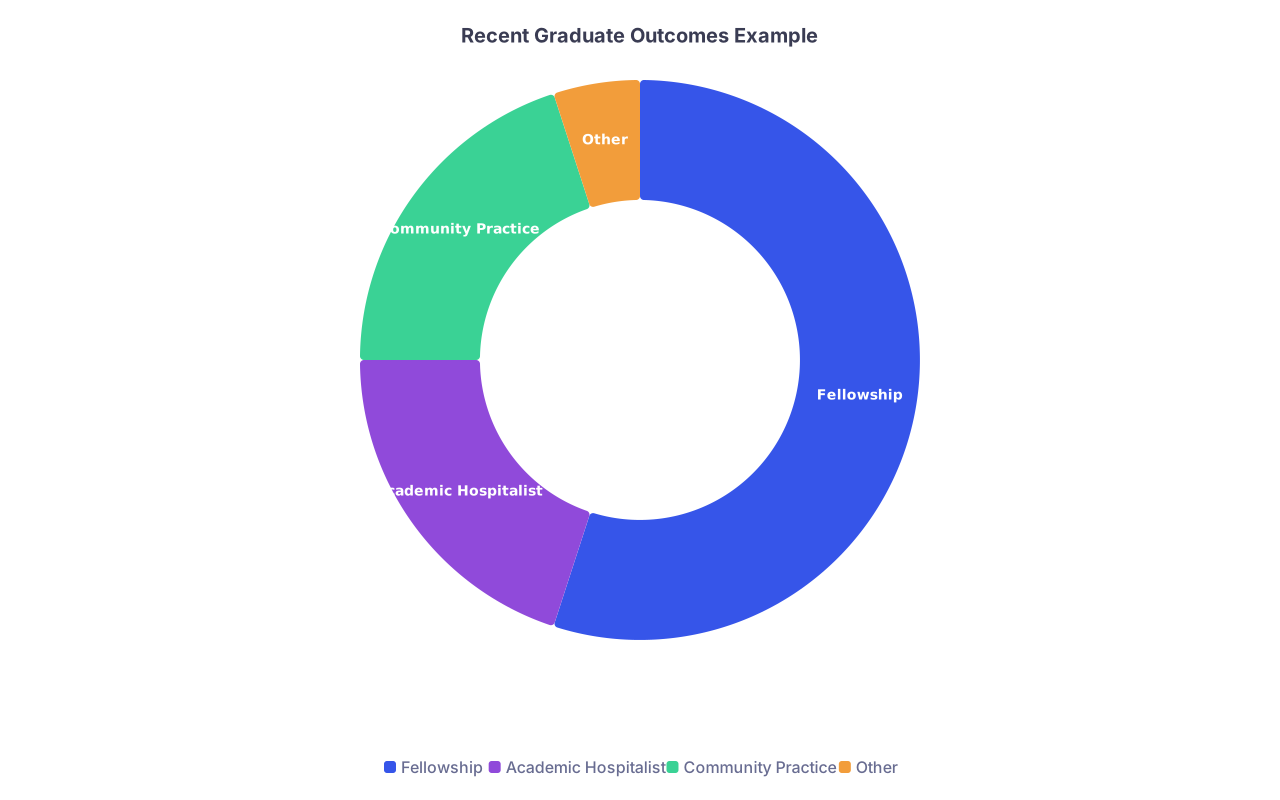
“The last 3 classes: roughly [X]% went into fellowship, [Y]% into hospitalist roles, [Z]% into community practice. We have placed residents into [specific fellowships / institutions]. Graduates going straight into practice usually feel overprepared for bread-and-butter [field].
If you tell me your likely path—academic subspecialty vs community generalist—I can show you real alumni paths that match.”
Use clear numbers. Do not hand-wave.
| Category | Value |
|---|---|
| Fellowship | 55 |
| Academic Hospitalist | 20 |
| Community Practice | 20 |
| Other | 5 |
3.4 PD Script: Ending The Conversation Without NRMP Violations
Applicants will fish for reassurance. Your job is to steady the frame.
Applicant: “You are one of my top programs.”
“I am glad the program resonates with you. We have been very impressed with you as a candidate.
Our policy, to comply with Match rules and to keep the process fair, is that we do not discuss rank positions or make comparative statements. What I can tell you is that we would be fortunate to have you here, and I think you would do very well in this environment.
My advice: build your rank list by honest preference, not by guessing what programs will do.”
That is how you signal respect and interest without stepping into gray zones.
4. Scripts for Fellows and Subspecialty Faculty
Second looks are gold for applicants with defined niche interests: interventional, global health, health policy, education, physician-scientist tracks. This is where fellows and subspecialty faculty matter.
Your job is to help answer: “Can I get where I want to go from here?”
4.1 Fellow Script: Email Before Meeting
“Hi [Name],
I am [Your Name], a [Year]-year fellow in [Subspecialty] here at [Institution]. I heard you have an interest in [subspecialty/academic path].
During your visit, we can talk through:
- How residents here build [research / procedural / teaching] experience
- What our fellowship and job placement looks like in your area
- What concrete steps I would start in PGY-1 if I were you
If you can send me 2–3 sentences about your long-term career picture, I can tailor our conversation so it is actually useful.
Best,
[Your Name]”
Do that, and your 20 minutes feels like a coaching session, not small talk.
4.2 Fellow Script: Focused 20-Minute Second Look Conversation
Structure it like this:
- 3 minutes: Applicant explains their “version” of the future
- 5–7 minutes: You translate that into training milestones
- 5–7 minutes: You show how this program can (or cannot) support that
- 2–3 minutes: You give a concrete plan for PGY-1 and PGY-2
Example opening:
“Ok, give me your current best guess at your 5–10 year picture. Where are you living, what is your week like, what percent clinical vs research vs teaching?”
Then you translate:
“Given that, during residency you need:
- Strong foundation in [X clinical areas]
- At least [Y] first-author projects or equivalent scholarly output
- Sustained mentorship with someone well connected in [desired fellowship region or niche]
Here is how residents here usually do it:
- PGY-1: show reliability clinically, start meeting potential mentors
- PGY-2: block out research time, 1–2 projects launching
- PGY-3: abstract submissions, networking for fellowship
On our end, resources look like:
- [Specific research pathway or protected time if it exists]
- [Names of 2–3 go-to mentors who actually answer emails]
- A track record of placing residents into [examples that match applicant’s goals]”
If the fit is not great, say it gently but clearly:
“Honestly, if you are dead set on a career that is 80–90% research at an R01-heavy institution, the programs that guarantee more built-in protected time might serve you better. Here, people absolutely match into strong fellowships and do research, but it is not a hardcore physician-scientist track.”
You earn trust by not overselling.
5. Concrete Structures Programs Should Use
You cannot rely on scripts alone. You need a simple, repeatable structure so second looks do not depend on which resident happens to be on days.
Here is a basic second look half-day template that works.
| Time | Activity |
|---|---|
| 08:00-08:15 | Resident welcome and agenda |
| 08:15-09:15 | Rounds or clinic shadowing |
| 09:15-10:00 | Meet with residents (workroom time) |
| 10:00-11:00 | Conference (morning report / noon) |
| 11:00-11:30 | Optional PD/APD brief meeting |
| 11:30-12:00 | Fellow/faculty meeting by interest |
You can mirror this in the afternoon. The point is: real clinical exposure + honest resident time + targeted faculty/fellow time.
Quick Guardrails To Give Your Team
No rank talk on either side. Train residents in one sentence: “Our rank list is decided based on your application and initial interview; second looks are for your information only.”
Document invites. Have all invitations and confirmations routed through the coordinator so no one is “secretly” brought back.
Standard talking points. Give residents a 1-page reference:
- What is the actual 80-hour monitoring process?
- What is the backup system when someone calls out?
- How are vacations scheduled?
- Where do graduates go? (Recent examples.)
This is not spin. It is consistency.
6. For Applicants: How To Ask For What You Need
You might be on the applicant side reading all this. Here is how you keep your own second look from dissolving into fluff.
6.1 How To Request A High-Yield Second Look
“Dear Dr. [PD Last Name]/[Coordinator Name],
Thank you again for the opportunity to interview with [Program Name]. As I work on my rank list, I am considering a brief second visit to better understand [specific focus: e.g., ICU training, research infrastructure in cardiology, support for residents with families].
If possible, I would appreciate:
- Observing a typical [ward/ICU/clinic] morning
- Speaking informally with 1–2 residents at my level of interest (e.g., those with [research/teaching/family] commitments)
- A brief conversation with a faculty member involved in [your noted interest]
I want to be respectful of everyone’s time, so a half-day or even a focused couple of hours would be more than enough.
Thank you for considering this.
Best,
[Your Name]”
You just told them exactly how to make this worthwhile.
6.2 Scripts For You During The Visit
Ask these questions, almost verbatim:
To residents:
- “What is the hardest week of the year for you here—what does it actually look like?”
- “If you had to pick one thing this program does better than your friends’ programs, what would it be? One thing worse?”
- “When a resident is struggling here, what actually happens?”
To PD/faculty:
- “If I want to be competitive for [fellowship/role], what would you expect me to have done by the start of PGY-3?”
- “In the last few years, have you made any concrete changes based on resident feedback? What were they?”
You are not being difficult. You are being a serious professional making a 3–7 year decision.
7. The Future Of Second Looks: Where This Is Going
Second looks are evolving whether programs like it or not.
- Hybrid models will dominate. Half virtual (targeted Zoom with fellows/faculty), half in-person for those who can travel.
- Transparency will be forced. Anonymous resident review platforms and social media already undercut scripted tour nonsense.
- Data will matter more. Applicants will start asking for actual attrition rates, board pass data, and graduate outcomes. Programs that hide this will lose the best people.
- Equity must be addressed. Flying in for a second look costs real money. Expect more funded visit programs, regional hubs, or virtual “day-in-the-life” shadows.
Build your scripts and structures now so you are ahead of that curve, not reacting to yet another PR problem on Reddit.
Key Takeaways
- Second looks are for clarity and fit, not secret ranking; say that out loud to everyone.
- Residents, PDs, and fellows all need simple, honest scripts so they stop improvising and start answering the questions applicants actually have.
- A structured half-day with real clinical time, unfiltered resident contact, and targeted faculty/fellow meetings turns second looks from a vague tradition into a sharp recruitment tool.