
The way most applicants handle second look visits is financially reckless. You do not need to bleed thousands of dollars to get useful information from programs.
You need a plan. Not vibes.
This is that plan.
Step 1: Decide If a Second Look Is Actually Worth It
Before you touch Google Flights, you need brutal clarity: does this visit change your rank list or is it ego tourism?
Use this simple filter. If you cannot answer yes to at least one of these, skip the trip:
- “I have two (or more) programs I genuinely cannot rank without seeing one in person.”
- “My only visit was virtual and I lack any on-the-ground sense of the city or hospital.”
- “There is a serious lifestyle variable I must verify: call rooms, partner job, childcare, commute, neighborhood safety.”
- “I have a specific red flag I need to clarify directly with residents or leadership.”
Red flags that do NOT justify travel on a tight budget:
- “Everyone else on Reddit is going.”
- “I want the PD to remember my face.”
- “I just want to feel excited about my top choice.”
You can get excitement from Match Day. You cannot get money back from your credit card.
Make a short list:
- Rank-ambiguous programs (hard decisions only).
- Only those where an in-person visit could realistically move them up or down by at least 2–3 spots.
If that leaves you with more than 3–4 programs on a tight budget, be honest: you are going to have to cut.
Step 2: Build a Hard Budget Ceiling (Then Reverse-Engineer)
Do not “just see how much it costs.” That is how you end up $1,200 in the hole for marginal benefit.
Set a non-negotiable ceiling for total second look spending.
For example:
- “I will not spend more than $500 total on second looks.”
- “I can afford exactly one flight + one night in a hotel. Everything else must be drivable or skipped.”
Then allocate. Think like this:
- Transportation: ~60–70% of budget
- Lodging: ~20–30%
- Food and incidental: ~10–20%
Now reverse-engineer what is even plausible.
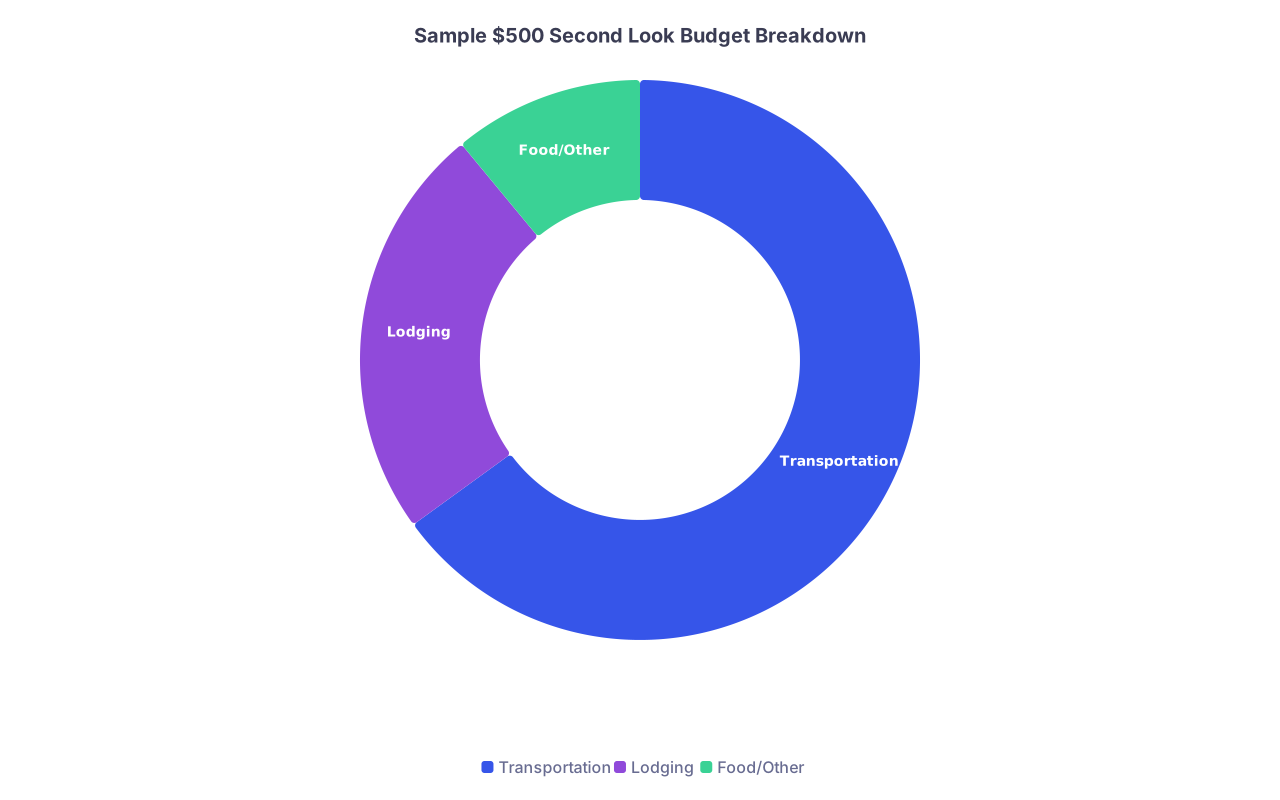
| Category | Value |
|---|---|
| Transportation | 325 |
| Lodging | 120 |
| Food/Other | 55 |
On $500, that might look like:
- 1 flight to a high-priority program with free housing (friend or host).
- 1–2 regional drivable programs in the same direction (same road trip) with one cheap motel night.
- Food kept brutally simple: groceries, hospital cafeteria, one modest dinner out.
If you cannot sketch something like this on paper, you are not “doing second looks on a budget.” You are hoping. Different thing.
Step 3: Ruthlessly Prioritize Which Programs Get a Visit
You cannot see everyone. You should not try.
Create a quick scoring system. Nothing fancy, just enough to force decisions.
Rate each potentially visit-worthy program 1–5 on:
- Rank Uncertainty – 5 = I truly cannot place this on my list yet.
- Cost to Visit – 5 = cheap to get there and stay.
- Impact Potential – 5 = info from visit could move it ≥3 spots.
- Existing Data Quality – 5 = I already know a lot; 1 = I know almost nothing beyond interview day.
Then focus on programs where:
- Rank Uncertainty is high (4–5)
- Cost to Visit is low to moderate (3–5)
- Impact Potential is high (4–5)
- Existing Data Quality is low to moderate (1–3)
Now apply a hard rule:
- No more than 1–2 flight-based second looks on a tight budget.
- Everything else must be drivable or skipped.
If your list still looks crazy, force rank them and cut the bottom half. If a program is ranked #10 and you are strained for money, you do not burn a plane ticket on it. Period.
Step 4: Design a Multi-Program Itinerary, Not One-Off Trips
The biggest waste of money I see: single-program flights with terrible timing. Fly out, sleep, quick half-day visit, fly back. Hundreds gone for maybe 4–6 useful hours.
You can do better.
Strategy: Second Look “Clusters”
Look at your list and map:
- Programs in the same state or region
- Programs along a single highway corridor
- Programs near major flight hubs (think Chicago, Atlanta, Dallas, NYC)
Then design clusters:
- One flight in → visit 2–3 programs in 2–3 days.
- One road trip → hit 2 hospitals in 1–2 days.
- Use trains / buses in dense regions (Northeast corridor, for example).

| Step | Description |
|---|---|
| Step 1 | List all interested programs |
| Step 2 | Mark by region |
| Step 3 | Plan single trip for cluster |
| Step 4 | Limit to 1 high-yield trip |
| Step 5 | Book transport once |
| Step 6 | Schedule back to back visits |
| Step 7 | Any tight clusters |
Example: 3 Programs, 1 Flight, 2 Nights
Say you are considering:
- Program A – City 1 (major hub)
- Program B – City 2 (1.5 h train)
- Program C – City 3 (2 h bus)
Max-efficiency itinerary:
Day 1
- Early AM flight into City 1
- Afternoon second look at Program A (2–6 pm)
- Evening train to City 2, stay with a friend or cheap motel
Day 2
- AM shadow / second look at Program B
- Afternoon bus to City 3
- Evening crash with a host or another cheap stay
Day 3
- AM at Program C
- Late afternoon / evening flight home from closest major airport
One flight. Two nights. Three programs.
Is it exhausting? Yes. Is it cheaper than three separate flights and 4–5 nights of hotels? Absolutely.
Step 5: Concrete Cost-Cutting Tactics That Actually Work
Here is where you claw money back. Line by line.
1. Transportation
You are not a business traveler. Stop acting like one.
Flights
- Use Google Flights or Skyscanner with:
- “Nearby airports” toggled on.
- Flexible dates by ±1–2 days if your schedule allows.
- Prioritize:
- Early morning or late-night flights (often cheaper).
- Direct options from budget carriers even if times are ugly.
Book:
- 3–4 weeks ahead for domestic economy tends to be the sweet spot.
- Avoid last-minute unless there is no alternative.
Ground Transportation
When regional:
- Drive if you already have a car and parking is not insane.
- Trains and intercity buses (Megabus, Greyhound, FlixBus, regional lines) can be dramatically cheaper than renting a car + gas + parking.
- If you rent a car:
- Use non-airport locations if possible (lower fees).
- Avoid “full size SUV because it feels nicer.” You are broke, remember.
2. Lodging
This is where people bleed money for no good reason.
Hierarchy of options from cheapest to priciest:
Friends / Alumni / Med school classmates in that city.
- Put out a targeted message: “I will be in [City] for second looks March 5–7. Anyone have a couch / floor I can borrow one night?”
- You only need a safe, clean place and a shower.
Program-sponsored housing or resident hosts
- Some programs quietly help if you ask politely and early.
- Email the coordinator:
- Brief, respectful, concrete schedule.
- One line about being on a tight budget as a student / applicant.
- Ask if there are resident host programs or negotiated hotel rates.
Hostels / Budget inns
- Check hostelworld.com, but vet reviews for safety and cleanliness.
- Shared dorms are fine for one night if you bring:
- Earplugs
- Small lock for your bag
Hotels only with a discount strategy
- Use:
- Credit card points if you have them.
- Program-negotiated rates (“We have a $99 resident rate at X Hotel”).
- Last-minute / opaque sites if your dates are flexible.
- Use:
3. Food
This one is simple. You are not on vacation.
- Pack snacks (protein bars, nuts, instant oatmeal).
- One grocery run on arrival: yogurt, fruit, cheap ready meals.
- Lunch:
- Hospital cafeteria
- Nearby cheap options (fast casual, not sit-down restaurants)
- One “nice” dinner per trip. Not per night.
Give yourself a daily food cap: $20–30. Enforce it.
Step 6: Script Your High-Yield Second Look Day
Second looks become expensive wastes of time when you wander, chat superficially, and leave with the same questions you started with.
You want a scripted, efficient, information-dense visit. Aim for 4–6 hours on site, targeted.
Core Objectives
In person, you focus on what is hard to get from Zoom or brochures:
- Culture: how residents talk to each other and to staff.
- Reality of workload: hours, scut, documentation burden.
- Support: how PD/APD responds to hard questions.
- City / neighborhood feel: commute, safety, housing options.
Email Ahead: What to Ask For
Email the program coordinator at least 2 weeks in advance with:
- Your available dates (specific).
- Clear request for:
- Half-day or full-day shadow with residents.
- Time to speak with the PD or APD, if appropriate.
- Time with a couple of residents without faculty present.
- If possible, a quick unit/hospital tour.
If they cannot organize a full shadow, even a 2–3 hour visit with residents + a tour can be sufficient.
On-Site Schedule Example (Half-Day)
- 8:00–8:30 – Meet chief resident / senior for quick overview.
- 8:30–11:00 – Shadow on wards / clinic (watch dynamics, not just pathology).
- 11:00–12:00 – Sit with residents over lunch, ask real questions.
- 12:00–12:30 – Quick PD/APD check-in or goodbye with coordinator.
Then you leave. Do not hang around “just because.” You have a train to catch and a budget to protect.
Step 7: Use This Question List So You Don’t Waste the Trip
You do not want generic “So what do you like about the program?” conversations. That is what interview day was.
You want decision-grade data that justifies the money you spent.
Ask residents:
- “What surprised you most (good or bad) after starting here?”
- “On a typical ward month, what time do you leave? What are the worst days actually like?”
- “Who does the scut work here? How much falls on interns?”
- “If you had to choose again today, would you still rank this program first?”
- “How does the program respond when a resident is struggling or burned out?”
- “Where do most of you live and what is your commute time like?”
- “How flexible are they with life stuff – illness, pregnancy, family emergencies?”
Ask leadership (PD/APD) if you get time:
- “How has the program changed in the last 3–5 years? What is still in progress?”
- “Where do you want this program to be in 5 years?”
- “What feedback have residents given you recently that you are acting on?”
Then after you leave, you write it down. Immediately. While the details are sharp.
Step 8: Sample 3-Day, 3-Program Budget Itinerary (Tight Budget)
Let me give you an actual concrete template.
Assumptions:
- You have $500–600 max.
- You want to visit 3 programs: two in Region X, one in Region Y (cheap hub).
- You have one friend in Region X.
| Item | Cost (USD) |
|---|---|
| Roundtrip flight (home–Y) | 220 |
| Train Y–X–Y | 70 |
| 1 night hostel in Y | 55 |
| 1 night with friend in X | 0 |
| Local transit (buses/metro) | 35 |
| Food for 3 days | 90 |
| Misc / buffer | 30 |
Total: $500
Day 1 – Program Y
- Early cheap flight into City Y.
- Drop bag at hostel (or at front desk).
- 10:00–3:00 – Second look at Program Y:
- Tour, shadow, lunch with residents.
- Evening – Budget dinner, lights out early.
Day 2 – Programs X1 and X2 (Region X)
- Early train to City X.
- 9:00–1:00 – Second look at Program X1 (half day, focused).
- Grab quick lunch.
- 2:00–5:00 – Short visit at Program X2, or coffee with residents if they cannot host you on campus.
- Stay with your friend.
Day 3 – Return
- Morning train back to City Y.
- Cheap lunch from grocery store.
- Afternoon flight home.
Is this luxurious? No. Does it preserve your budget while giving you enough real-time exposure to rank intelligently? Yes.
Step 9: When You Should Not Do a Physical Second Look
On a tight budget, you need to be willing to say “nope.”
Skip in-person second looks when:
- It is an away rotation site you already know well.
- Your interview day was in-person with a full tour and significant resident time.
- The program is lower on your list and unlikely to move to your top 3 even with a stellar visit.
- You are carrying high-interest credit card debt already. You should not be financing second looks at 20% APR.
In those cases, you do a virtual second look instead.
Step 10: Run a Virtual Second Look When Money Is Too Tight
Zoom is not perfect, but it is far better than nothing when you structure it correctly.
How to Ask
Email the program coordinator:
- Thank them again for the interview.
- Say something simple and honest:
- “I would like to learn a bit more to finalize my rank list, but I am limited financially and cannot travel for a second look.”
- Ask if there is:
- A virtual meet with residents.
- A brief follow-up with PD/APD.
- Any resident you can email or call informally.
Then treat that call like an in-person visit:
- Camera on, professional but less formal than interview day.
- Same targeted questions as above.
- Ask for a quick “walkthrough” via photos or short videos of:
- Call rooms
- Resident lounge
- Nearby housing examples (if they have them)
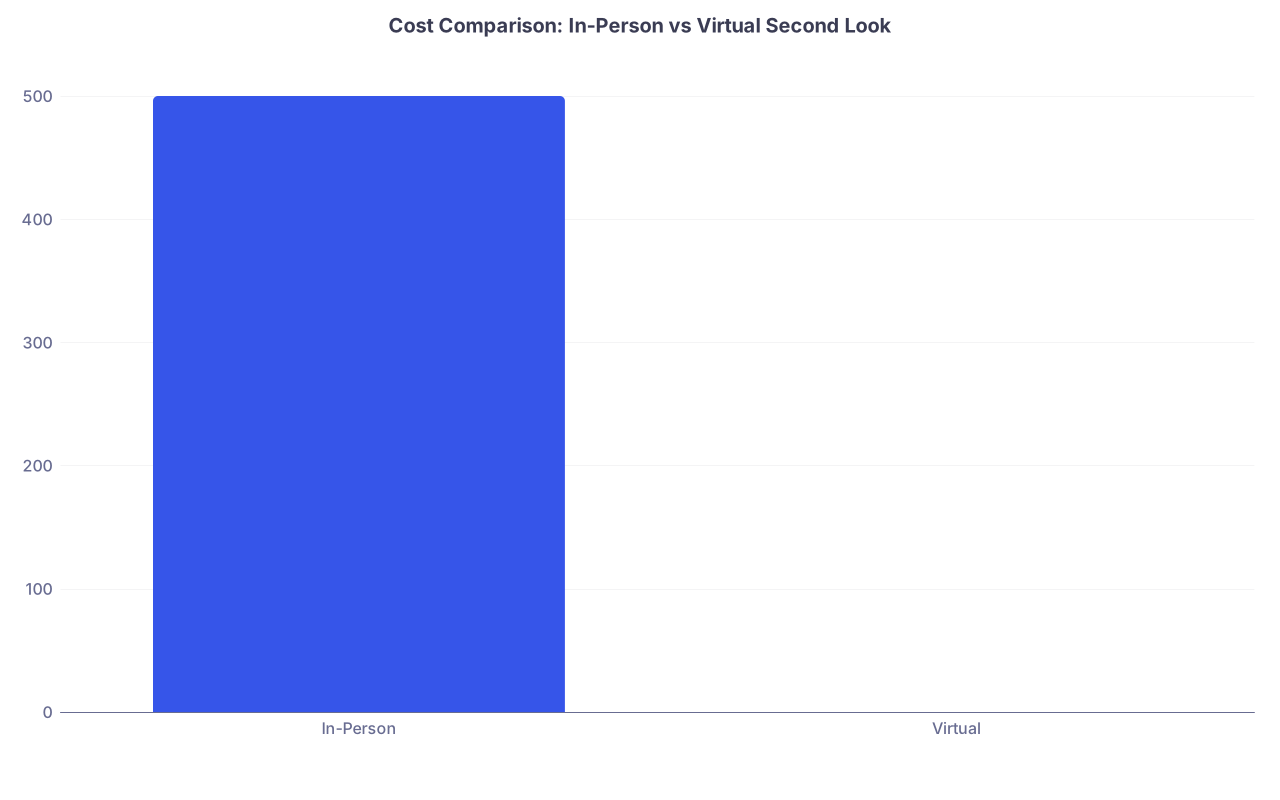
| Category | Value |
|---|---|
| In-Person | 500 |
| Virtual | 0 |
If you do 2–3 of these instead of flights, you just saved over $1,000. That matters.
Step 11: Capture and Compare Immediately After Each Visit
Most applicants rely on “gut feel” weeks later and forget the details that actually matter.
You should have a simple, repeatable template that you fill out the day of each visit, before your memory softens.
Use a quick 1-page note (paper or digital):
- Date, Program Name.
- Residents:
- How did they talk about leadership?
- Did they seem tired vs toxic vs “appropriately stretched”?
- Work:
- Realistic hours and worst rotation stories.
- Scut distribution.
- City / Life:
- Could you see yourself living here?
- Commuting realistically every day?
- Support:
- How they handle leave, mental health, emergencies.
- Overall snap ranking:
- “Right now, I would rank this #___.”
Do this for each program as soon as you get back to your room, train, or plane seat. 10–15 minutes max.
Later, when you finalize your rank list, you are not guessing. You have your own data.
Step 12: The Reality Check About “Showing Interest”
A lot of applicants secretly think:
“If I show up for a second look, they will rank me higher.”
No. Or at least, not reliably enough to justify debt.
Some programs have strict policies:
- Second looks do not affect their rank list.
- They are billed as informational only.
- PDs may even avoid seeing you specifically for that reason.
You should assume:
- Second looks are for you, not for them.
- Any benefit to your position is a side effect at best, not the primary purpose.
If a program explicitly tells you it cannot change your rank based on second looks, believe them. Do not try to game a system that is not built for your games.
Step 13: Quick Checklist Before You Spend a Dollar
Before you hit “purchase” on that ticket or hotel, run this rapid-fire checklist:
- Have I limited my second looks to programs that could realistically move ≥2–3 places on my list?
- Have I grouped programs into clusters to minimize flights?
- Do I have at least one free or very cheap housing option lined up?
- Did I contact the coordinator to see if they can offer:
- Host housing
- Discounted hotel
- Consolidated visit schedule to minimize nights needed?
- Do I have a written list of questions for residents and leadership?
- Will this total trip cost stay under my pre-set budget ceiling?
- Is there a virtual or local alternative I have not yet explored?
If you fail more than two of these, pause. Rework the plan.
Final Reality: Second Looks Are Optional. Your Financial Health Is Not.
Second looks can be useful. Sometimes pivotal. But they are not mandatory for success, and they are absolutely not worth blowing through high-interest debt and panicking about rent.
You are about to enter a profession with delayed earning and high baseline loan burdens. That does not magically excuse unforced financial errors right now.
So here is your next step:
Today, write down the exact dollar amount you are willing to spend on second looks, and make a list of all programs you are even considering visiting. Then cut that list in half.
Only after you do that should you open a travel site. Not before.