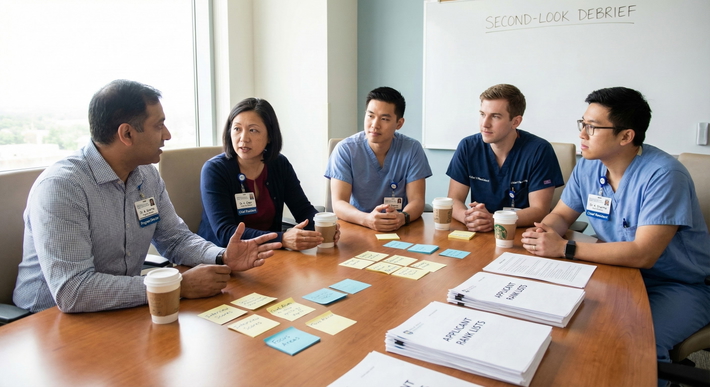
The usual second-look follow-up email is useless. That is the problem.
“I just wanted to thank you for the opportunity…”
Everyone writes that. Programs ignore it. You did not spend another unpaid day at a hospital just to disappear into a folder called “Generic Thank You.”
If you are going to send a second-look follow-up, it needs to do two things:
- Add signal (clarify real interest, fit, and updates).
- Be easy for a busy PD or coordinator to skim and remember.
Let me walk you through exactly how to do that, with templates you can drop in and use tonight.
1. The Real Point Of A Second-Look Follow-Up
The follow-up email is not about being polite. It is a strategic communication.
You are trying to:
- Lock in a clear impression of you as a good fit.
- Reinforce specific things you learned on the second look.
- Update them on anything meaningful that changed since your interview.
- Make it easy for them to reference you at the rank meeting.
What you are not trying to do:
- Game the match with promises you cannot or should not make.
- Write an essay. No one has time.
- Send 10 different emails to 10 different people on the same day saying the same vague platitudes.
Here is the mindset:
“Can someone who met me quickly skim this email, remember who I am, what I care about, and why I fit here?”
If the answer is yes, you have done your job.
2. Who To Email, When, And How Long
Before we jump into templates, fix the logistics.
Who you should email
During or right after your second look, you should note:
- Program Director (PD)
- Associate PD(s) you interacted with
- Chief(s) who organized your visit or tours
- Any faculty with whom you had substantial 1:1 time or case discussions
- Residents who spent meaningful time with you (small-group teaching, lunch, rounds)
You do not need to email every single person you met for 5 minutes. That looks forced. Focus on:
- 1–2 attendings / leaders
- 1–3 residents who genuinely influenced your impression
When to send second-look follow-ups
- Ideal window: 24–48 hours after the second look
- Absolute latest: within 3–4 days, while faces and conversations are still fresh
- If you are very late (over a week): acknowledge the delay briefly and move on
Length and format
Target:
- 150–250 words for PD / leadership
- 100–200 words for residents and faculty
Format:
- Clear subject line
- 1–2 short paragraphs + 1–2 bullet points if you need clarity
- Clean closing line, then signature with contact info
You are not writing a personal statement. You are writing something that can be read between consult notes.
3. Core Structure Of A High-Value Second-Look Email
Here is the basic skeleton that works for nearly every follow-up.
Subject line options (pick one and customize):
- “Second Look – Thank you and follow-up from [Your Name]”
- “Thank you for the second look – [Your Name, Specialty Applicant]”
- “[Program Name] Second Look – [Your Name]”
- “Appreciated the second look day – [Your Name]”
And here is the 3-part body:
Specific Gratitude
One or two sentences, grounded in something concrete.Program Fit + Second-Look Insight
Short paragraph that ties your goals to what you saw/learned on the visit.Signal + Optional Update
- Optional but powerful: a clear signal of strong interest
- One brief update if you have one (new publication, leadership, rotation, project)
You will see this pattern repeated in the templates below.
4. Templates For Program Leadership (PD / APD)
Here is where you want precision. PDs are reading dozens of these in seconds.
Template 1 – Strong Interest, No Over-Promise
Use this if the program is seriously high on your list but you are not allowed (or not comfortable) promising rank position.
Subject: Second Look – Thank you and follow-up from [Your Name]
Dr. [PD Last Name],
Thank you for the opportunity to return for a second look at the [Program Name] [specialty] residency on [date]. Seeing the residents on [morning report / clinic / OR / ICU rounds] and talking with them about [specific topic] gave me a much clearer sense of the day-to-day training environment.
This visit confirmed several things that are important to me for residency training:
- The emphasis on [e.g., graduated autonomy in the ICU/OR/wards]
- The openness of faculty to real-time feedback and teaching
- The resident camaraderie I saw during [e.g., noon conference / sign-out / call]
I remain very enthusiastic about [Program Name] and see it as an outstanding fit for my goals in [e.g., academic hospital medicine, community practice, fellowship in X]. Thank you again for the time and for creating a transparent second look experience.
Sincerely,
[Your Full Name], [Medical School]
AAMC ID: [ID]
Phone: [number]
Customize the bullet points. If you cannot fill those in with specifics, you did not pay attention on your second look.
Template 2 – Program Is Your Clear #1 (Where Appropriate)
Check your school’s and the NRMP’s guidance; some programs dislike explicit “No. 1” statements. But if you decide to do it, make it clean and honest.
Subject: Second look follow-up – [Your Name]
Dr. [PD Last Name],
Thank you again for having me back for a second look at the [Program Name] [specialty] residency on [date]. Joining [specific conference/clinic/OR/rounds] and talking with your residents about their experiences gave me a much deeper understanding of the program’s strengths.
After this visit, [Program Name] is my top choice for residency. The combination of [e.g., strong clinical volume, clear graduated autonomy, and supportive resident culture] aligns exactly with what I am seeking for my training and long-term goal of [career goal].
Since my interview, I [brief update, if available – e.g., submitted a manuscript on X, completed a rotation in Y, presented at Z]. These experiences have reinforced my interest in training in an environment like yours, where residents are both challenged and supported.
Thank you again for your time and for the transparency during the second look.
Sincerely,
[Your Full Name], [Medical School]
AAMC ID: [ID]
Phone: [number]
Do not play games with “you are my top choice” if you are sending that to three places. PDs are not stupid. Word gets around.
5. Templates For Faculty And Chiefs
Faculty and chiefs often have influence in rank discussions, especially if they had direct contact with you. Your goal: make it very easy for them to say “Oh yes, I remember [Name].”
Template 3 – Faculty You Spent Time With
Subject: Thank you for second look discussion – [Your Name]
Dr. [Last Name],
Thank you for taking the time to speak with me during my second look at [Program Name] on [date]. I appreciated our conversation about [specific topic – e.g., managing complex ICU patients, your approach to resident education, research in X].
Watching you and the team on [rounds / in clinic / in the OR] gave me a clear sense of how residents are taught to think and manage patients in real time. It reinforced my sense that [Program Name] would be an excellent environment for me to grow as a [specialty] resident.
I am very interested in training at [Program Name] and grateful for the opportunity to learn more about the program.
Best regards,
[Your Full Name], [Medical School]
AAMC ID: [ID]
Do not add fluff here. Faculty will skim.
Template 4 – Chief Resident / Education Chief
Subject: Second look thanks – [Your Name]
Dr. [or Dr./Mr./Ms. depending on local culture] [Last Name],
Thank you again for organizing and leading the second look day at [Program Name] on [date]. The time you and the other chiefs spent walking us through the schedule, answering detailed questions about call, and sharing your perspective on resident life was extremely helpful.
Hearing how the program has evolved during your time here – especially [specific change: e.g., night float structure, ICU rotations, wellness initiatives, academic support] – made a strong impression. The residents’ openness about both strengths and challenges was something I really respected.
I left the second look feeling that [Program Name] would be a great fit for my training goals and for how I work on a team.
Thank you again for your time and honesty.
Best,
[Your Full Name], [Medical School]
6. Templates For Residents
Residents are the ones you will actually be working with at 3 a.m. Their voices matter more than applicants think.
You do not need a novel here. But you want to stand out from the silent majority.
Template 5 – Resident Who Led Your Tour / Lunch
Subject: Thank you for second look perspective – [Your Name]
Hi [First Name],
Thank you for spending time with me during the second look at [Program Name] on [date], especially during [tour / lunch / afternoon rounds]. I appreciated your honest perspective on [call schedule / workload / fellowship matches / resident life in the city].
Hearing how you and your co-residents support each other on [night float / ICU / busy ward months] made a big difference in how I see the program. The way you described the culture – [brief phrase they used, e.g., “we work hard but no one gets left behind”] – stuck with me.
I am very interested in [Program Name] and grateful you took the time to answer so many detailed questions.
Best,
[Your First Name]
Short, genuine, specific. That is enough.
Template 6 – Resident You Shadowed Or Worked Closely With
Subject: Thanks for letting me tag along – [Your Name]
Hi [First Name],
Thank you again for letting me tag along on [rounds / clinic / cases] during the second look at [Program Name] on [date]. Watching how you handled [specific scenario – e.g., a complicated admission, handoff, teaching a student] gave me a very clear picture of what day-to-day life is like as a [PGY level] here.
Seeing the team dynamic and how you interacted with [interns / students / nurses] reinforced my sense that this is the kind of culture where I would like to train. I appreciated your candid answers about both the strengths and the challenging parts of the program.
I left the day even more excited about [Program Name]. Thanks again for being so open.
Best,
[Your First Name]
7. What Actually Adds “Real Value” (And What Does Not)
Most second-look emails are forgettable because they are vague and generic. You fix that with specificity and signal.
Value-Adding elements
Concrete details
Reference exact activities: “morning report on the GI bleed case,” “the 3 pm ICU family meeting,” “the robotics case with Dr. X.”Reflected insight
Show that you understood something about the program, not just “everyone was so nice.”Clear alignment
Tie things you saw to your goals: academic vs community track, specific patient populations, procedures, research.Realistic enthusiasm
“I am very interested in training here” is enough. If it is your #1, state it cleanly in one sentence.Relevant update (if any)
New publication, poster acceptance, leadership role, rotation completed. One line, not a CV dump.
Things that do not help (or actively hurt)
Long paragraphs of flattery
PDs and residents see right through “I have never seen a program as perfect as yours.”Copy-pasted emails with no specific details
If you cannot distinguish your email to Program A from B just by reading it, it is bad.Over-the-top promises
“I will rank you number 1 and withdraw all other applications” sounds desperate and sometimes unethical.Complaining or asking for special favors
Second-look follow-up is not the place to bring up schedule complaints, ask for exemptions, or vent about other programs.
8. Handling Tricky Situations (With Templates)
Now for the messier edge cases people actually run into.
Situation 1: You Had A Second Look But Now You Know You Will Not Rank Them Highly
You still send a brief, polite, honest follow-up. You do not need to oversell.
Subject: Thank you for the second look – [Your Name]
Dr. [Last Name],
Thank you for the opportunity to return for a second look at [Program Name] on [date]. I appreciated the chance to see [wards / clinic / OR] more closely and to ask detailed questions of the residents and faculty.
The day gave me a much clearer understanding of the training environment, especially [specific element]. I am grateful for your time and the transparency of the visit.
Sincerely,
[Your Full Name]
No need to mention rank intentions. You are closing the loop professionally.
Situation 2: You Are Late (More Than A Week After Second Look)
Own it in one line and move on.
Subject: Belated thanks for second look – [Your Name]
Dr. [Last Name],
I apologize for the delay in sending this note. I wanted to thank you for the opportunity to return for a second look at [Program Name] on [date]. The chance to [specific activity] and speak in more depth with residents and faculty was extremely helpful as I finalize my rank list.
[1–2 sentences of specific reflection.]
Thank you again for your time and for arranging such a thoughtful second look experience.
Sincerely,
[Your Full Name]
No excuses. No long explanation. Short acknowledgment, then value.
Situation 3: You Want To Clarify A Question Or Confusion After The Visit
Combine it with your thank you so it does not feel like you only reach out when you need something.
Subject: Second look thanks and quick question – [Your Name]
Dr. [Last Name],
Thank you for the second look at [Program Name] on [date]. Seeing [specific element] and speaking with the residents about their experiences gave me a much better understanding of the program.
I had one quick follow-up question as I finalize my rank list:
[Clear, concise question about schedule/rotation structure/support – not something easily answered on the website.]
Thank you again for your time and for your help.
Sincerely,
[Your Full Name]
If the question is on the website, do not ask. That makes you look lazy.
9. Simple Workflow So You Do Not Screw This Up
Here is the 20–30 minute process I recommend after every second look:

| Step | Description |
|---|---|
| Step 1 | Finish second look day |
| Step 2 | Write quick notes on people and specifics |
| Step 3 | Identify 3 to 6 key contacts |
| Step 4 | Select template type for each |
| Step 5 | Customize details and interests |
| Step 6 | Proofread once, check names and titles |
| Step 7 | Send within 24 to 48 hours |
Step-by-step:
Immediately after the day:
- Open your notes app.
- Jot down names, specific cases, quotes, and anything memorable.
That evening or next morning:
- Pick 3–6 people: PD/APD, 1–2 faculty/chiefs, 1–3 residents.
Draft quickly using templates:
- Paste template.
- Swap in specific details from your notes.
- Edit language so it sounds like you, not like a brochure.
Proofread:
One pass for:- Correct names and titles
- Program spelled correctly (you would be surprised)
- No obvious copy-paste mistakes (“I loved your OR” in a psychiatry program…)
Send:
- Within 24–48 hours.
- BCC yourself if you want a record.
10. A Quick Comparison: Useless vs High-Value Email
| Aspect | Generic Useless Email | High-Value Email |
|---|---|---|
| Specific details | None | 2–3 concrete program elements |
| Length | Long, rambling paragraph | 150–250 words, skimmable |
| Signal of interest | “I liked your program” | “I am very interested” / “Top choice” |
| Personalization | Could be sent to any program | Clearly about this specific program |
| Likely impact | Ignored, forgotten | Anchors your identity and fit in their mind |
If your draft reads like the left column, fix it.
FAQ (exactly 4 questions)
1. Do second-look follow-up emails actually affect my rank?
Sometimes, yes. Not by themselves. But they can be the difference when you are a borderline tie with another applicant. A clear, specific note that reinforces fit and interest can jog a PD’s memory or make a resident speak up for you in the meeting. They will not rescue a weak file, but they can strengthen an already solid one.
2. Should I email every single person I met on my second look?
No. That looks forced and insincere. Focus on people with whom you had meaningful interactions: PD/APD, at most 1–2 faculty or chiefs, and 1–3 residents who significantly shaped your impression. Quality and specificity beat volume every time.
3. Is it safe to tell a program they are my number one choice?
If it is true and you are following your school’s and NRMP guidance, yes. Keep it to one clean sentence. Do not send “you are my top choice” to multiple programs. That is dishonest, and people talk. If you are not comfortable making an explicit statement, you can still express “very strong interest” clearly without ranking language.
4. What if I have no major updates since the interview or second look?
Then do not force it. An update is optional, not required. A strong follow-up email built on specific observations, thoughtful reflection, and a clear expression of interest is already adding value. “No update” is better than padding the email with minor or irrelevant items that make you look like you are trying too hard.
Key points you should leave with:
- A second-look follow-up that is generic is a waste; specificity and clear interest are what move the needle.
- Use the templates as scaffolding, but always customize with concrete details from your day.
- Send to the right 3–6 people within 24–48 hours, keep it tight, and let your actual fit do the heavy lifting.