The worst feedback you will never hear is this: “Your interview was… fine.”
Not terrible. Not great. Just forgettable. And in a competitive residency or fellowship match, “forgettable” is death by a thousand shrugs.
If your interview felt flat, you have one realistic way to repair it without becoming annoying or desperate: a strategic, well-planned second look. Not a random visit. Not a “hey, just wanted to say I really like your program” email. A deliberate intervention.
This is how you do it properly.
1. First: Decide If You Actually Need a Second Look
Not every flat interview justifies a second look. Sometimes you felt off but came across fine. Sometimes you actually were average and cannot fix it. Your first move is triage.
Signs your interview really was flat
You should strongly consider a second look if any of these sound familiar:
- You rambled and never clearly answered “Why our program?”
- You barely met residents or faculty outside the official schedule
- You had zero substantive questions beyond “What is the call schedule?”
- You were sick, exhausted, or obviously off your game
- You had an awkward interaction with a key person and never recovered
- You left realizing you never talked about major strengths (research, leadership, unique experiences)
Or the classic: you walked out thinking, “They have no idea who I am or what I care about.”
On the flip side, do not burn a second look here:
- Program is clearly a low choice for you. Second looks are for places you could rank top 3, not #18.
- You had a strong, energetic interview and good connections. Do not overwork a good thing.
- The program explicitly discourages second looks and you have no specific reason to go back.
Second looks are a tool, not a default step. Use them where the cost and risk are justified.
2. Understand What a Second Look Can (and Cannot) Fix
You cannot rewrite history. If you were openly rude, violated professional norms, or showed glaring red flags, a second look will not save you. It might even remind them of the problem.
A second look can help with:
- Flat impression → Show genuine enthusiasm and better energy in person.
- Lack of depth → Ask sharper questions, engage about curriculum, service, or research in a more thoughtful way.
- Weak fit signal → Clarify your career goals and connect them specifically to their program.
- Limited exposure → Meet more residents/faculty who can advocate for you.
It is essentially your “supplemental interview” that you design.
Think of it this way: On interview day, you were stuck in their structure. On second look, you create your own agenda. That is power—if you use it correctly.
3. Timing and Logistics: When and How to Ask
You repair a flat interview by looking intentional, not desperate. That starts with how you request a second look.
Best timing
- Ideal window: 2–6 weeks after your interview, before rank meetings solidify.
- Avoid:
- The first 7–10 days after your interview (looks reactive, not thoughtful).
- Very late in the season when ranks are likely already set.
- If your interview was early in the cycle, a well-timed second look later can actually help you stay in their memory when they start ranking.
Who to email
Aim for one of the following:
- Program coordinator (cc PD or APD)
- Program director directly if they encouraged follow-up
- For fellowships, sometimes the division administrator handles logistics
Do not email multiple people separately. One clear, concise email is enough.
What to say in the email
Keep it short, specific, and professional. You are asking for an opportunity, not demanding reconsideration.
Example:
Subject: Request for Second Look Visit – [Your Name], [Specialty] Applicant
Dear Dr. [Last Name] and [Coordinator Name],
Thank you again for the opportunity to interview with [Program Name] on [Interview Date]. Since my visit, I have reflected more on my experience and the strengths of your program, particularly [specific aspect: e.g., your addiction medicine curriculum and community-based ICU exposure].
I would be very interested in arranging a brief second look visit to learn more about [2–3 specific interests: e.g., resident research support, typical resident schedules on the ICU rotation, and opportunities to work with the addiction medicine consult team]. I remain highly interested in your program and want to make sure I understand how I could contribute and grow there.
If a second look is possible within your policies, I would be grateful for the opportunity. I am available on [list 2–3 date ranges], but can be flexible with your schedule.
Thank you for your time and consideration.
Sincerely,
[Name]
[AAMC/ERAS ID if applicable]
Note the structure:
- Clear purpose
- Specific topics (signals seriousness)
- No overt rank talk (“I will rank you #1”) – that comes later if appropriate
- No apology for a flat interview. You do not call attention to it.
4. Before You Go Back: Fix the Real Problems
If your first interview felt flat, there were reasons. If you do not identify and fix them, your second look will just repeat the same mediocrity in a new outfit.
Step 1: Do a brutally honest postmortem
Sit down and write:
- 3 questions you answered poorly or blandly
- 3 things about the program you wish you had asked
- 3 core stories or strengths you did not share
Then write down, in bullet form, better responses or questions. Not a script. Just anchors.
Typical weak spots I see again and again:
- Vague “Why this program?” answers (“Great training, diverse patients, strong teaching.” That describes 80% of programs.)
- Shallow career goals (“I am keeping an open mind.” Translation: I have no real plan.)
- Minimal curiosity about resident life, workload, or support systems
- Not connecting their special features with your history and aspirations
Fix those now.
Step 2: Research with intent
On second look, you need to sound like someone who actually knows their program. That means:
- Re-read their website, but do not stop there.
- Look at:
- Recent publications from core faculty.
- Program Twitter/X or Instagram activity.
- GME newsletters or hospital news.
- Any public info on resident projects, QI, or awards.
Make a short list:
- 2–3 faculty you are genuinely interested in working with.
- 2–3 program features you want to see or ask about (clinic structure, ICU model, elective design, etc.).
- 2–3 ways your background naturally aligns with those features.
This preparation is what turns “I really like your emphasis on underserved populations” into “I saw your residents’ longitudinal clinic at the county site, and that aligns with my work in [specific free clinic/health equity project].”
5. Designing Your Second Look: Do Not Just “Hang Around”
You are not visiting just to walk halls and say “Hi again.” You need a plan.
Decide your main goal
Pick one primary aim:
- Show strong fit and enthusiasm.
- Clarify clinical training details to decide if you can rank them highly.
- Connect with specific faculty or residents who can advocate for you.
You can touch all three, but have a dominant purpose. Then build your day around that.
Ask for specific elements
When coordinating, you can ask (politely) for:
- Time with 1–2 residents (ideally at different levels: PGY-1 and PGY-3, for example).
- Brief meeting with PD or APD (10–20 minutes is enough).
- Tour of particular sites (VA, county hospital, outpatient clinic).
- Opportunity to sit in morning report, noon conference, or rounds (if allowed by policy).
Do not request to perform clinical duties. Second looks are observational.
| High-Yield Elements | Low-Yield Elements |
|---|---|
| Meeting PD/APD briefly | Walking halls alone |
| Talking with multiple residents | Sitting silently in a lobby |
| Attending morning report | Repeating general tour only |
| Visiting key clinical sites | Eating lunch with no agenda |
| Asking about specific pathways | Vague chats about weather/city |
Think like a resident: If you had one half-day to figure out if a program could be home for 3–7 years, what would you actually want to see and who would you want to talk to?
6. What To Say When You Are There
Here is where most applicants blow it. They show up enthusiastic but vague. You need to be concrete, clear, and strategic in conversations—without sounding like a robot.
With the Program Director or APD
You have maybe 10–20 minutes. Do not waste it on questions you could have answered from the website.
Your priorities:
- Clarify your fit.
- Demonstrate insight and maturity.
- Fix whatever you left undone in the original interview.
Useful moves:
Open with appreciation and purpose
“Thank you again for having me back. I realized after my interview there were a few aspects of your program I wanted to better understand—especially [X and Y]—before building my rank list.”Connect your story to their program concretely
“My long-term goal is to build a career in academic general internal medicine with a focus on medical education. I was drawn to your program’s [example: clinician-educator track and resident-led morning report], and I wanted to learn more about how residents are supported when they pursue teaching roles.”Ask pointed questions
Examples:- “How do your graduates who go into [subspecialty/academic/community practice] typically stand out by the end of training?”
- “What kind of resident thrives here and what type tends to struggle?”
- “If I came here wanting to grow in [skill/area], what would you expect from me and what could I expect from the program?”
Repair the flat impression without apologizing
“After my interview, I realized I did not clearly express how closely your [VA continuity clinic / community focus / simulation curriculum] aligns with my prior work in [specific experience]. That has been central to my training so far, and it is a big reason I keep coming back to your program in my mind.”
This signals that you are organized, reflective, and serious. That is exactly what “flat” often fails to convey.
With residents
Residents will often have more influence than you think, especially if the program is close-knit. Your goals:
- Confirm whether the culture actually matches what the PD sells.
- Show them you would be a solid, not annoying, co-resident.
- Leave at least one resident thinking, “I would be happy to work with this person.”
Avoid fluff like, “So, do you like the program?” That’s useless.
Ask things like:
- “What surprised you most after starting here?”
- “If you had to redo the match, would you still pick this program? Why or why not?”
- “Which residents struggle here, and why?”
- “What does support look like on a bad call night? Who shows up for you?”
- “If I came here really wanting to build skills in [critical care, procedures, research, leadership], what does that actually look like day to day?”
And share short, relevant pieces of yourself in return:
- “My favorite rotation so far was [X] because [Y]. That is part of why I am drawn to your [ICU/wards/clinic structure].”
- “I have done a lot of work in [teaching/QI/advocacy], so I was especially interested in hearing how residents are involved in [their existing initiative].”
You are not delivering a monologue; you are leaving them with a sense of who you are on a normal workday.
7. Behavior, Vibes, and Red Flags (The Stuff No One Says Directly)
I have seen excellent candidates sink their second look by coming across as anxious, performative, or transactional. You are not auditioning for a Broadway show. You are trying to show them who they will be on call with at 2 a.m.
Basic rules:
- Dress business casual, slightly more relaxed than interview day but still polished.
- Be on time. Early is better, but do not hover awkwardly.
- Be engaged but not hyper. Battling nerves by overcompensating with jokes or nonstop chatter does not end well.
- Avoid comparing their program to others by name. Saying “At [Other Program] they do X, how about here?” feels off.
- Do not fish for ranking information. “Where do I stand?” is a terrible question. Everyone hates it.
If someone asks directly, “So, how interested are you in our program?” you can say:
“I am very interested. This visit is part of me making sure I understand where I would fit best, but I can say honestly that your program is one I could see myself ranking very highly.”
Accurate, enthusiastic, not binding.
8. After the Second Look: Close the Loop Properly
The second look is not finished when you walk out the door. You need a clean, professional close.
Same day or next day: Thank-you email
- PD (and possibly APD)
- CC coordinator
You do not need separate emails to every resident you met, unless you had exceptional one-on-one time and got their card.
Structure:
- Appreciation.
- Specific mention of what you learned or clarified.
- Clear interest statement (without explicit rank if you are not ready).
Example:
Dear Dr. [Last Name],
Thank you again for allowing me to return for a second look at [Program Name] on [date]. I appreciated the chance to attend [morning report/noon conference/clinic] and to speak with [residents/faculty]. The discussions about [e.g., your resident-led QI projects and ICU rotation structure] gave me a much clearer sense of how I could grow here.
The visit reinforced my strong interest in your program, especially regarding [1–2 key alignments: e.g., your emphasis on underserved populations and opportunities in medical education]. I would be very excited to train at [Program Name].
Thank you again for your time and consideration.
Sincerely,
[Name]
If you do later decide they are your top choice, you can send a separate, honest “I will rank you first” email if that aligns with your specialty’s norms and your own ethics. Do that once, and only if true.
Then, reflect and rank like an adult
Do not let the flattery of being welcomed back override reality.
Ask yourself:
- Do I believe I would grow here clinically and professionally?
- Did I like the residents as people?
- Were there any warning signs I am trying to ignore because I want to “fix” my interview?
A good second look can upgrade a program a tier. It should not make you ignore major red flags.
9. When a Second Look Is a Bad Idea
Some of you are probably trying to use a second look to fix situations that are not fixable this cycle. I will be blunt.
You should skip a second look if:
- You had clear professionalism issues on interview day (showed up late, badmouthed another program, acted entitled).
- You argued with faculty or residents about controversial topics and it went badly.
- The program explicitly said they do not factor second looks into ranking, and you have no serious questions left.
- You are only going back because “everyone else is doing second looks.”
Also, if your flatness is global—you felt that way at every interview—you do not have a “this one program” problem. You have an interviewing skills problem. A second look will not fix a pattern. Working with a mentor, career office, or coach for future interviews will.
10. How Programs Actually View Second Looks (The Part People Guess Wrong)
Here is the quiet truth from the program side:
- Second looks can help. They are rarely decisive alone.
- Programs are wary of applicants “gaming” them with performative enthusiasm.
- What matters is:
- Are you consistent with your interview-day impression?
- Do you add new information that makes them more confident you will thrive there?
- Do residents who met you say, “Yes, this person fits”?
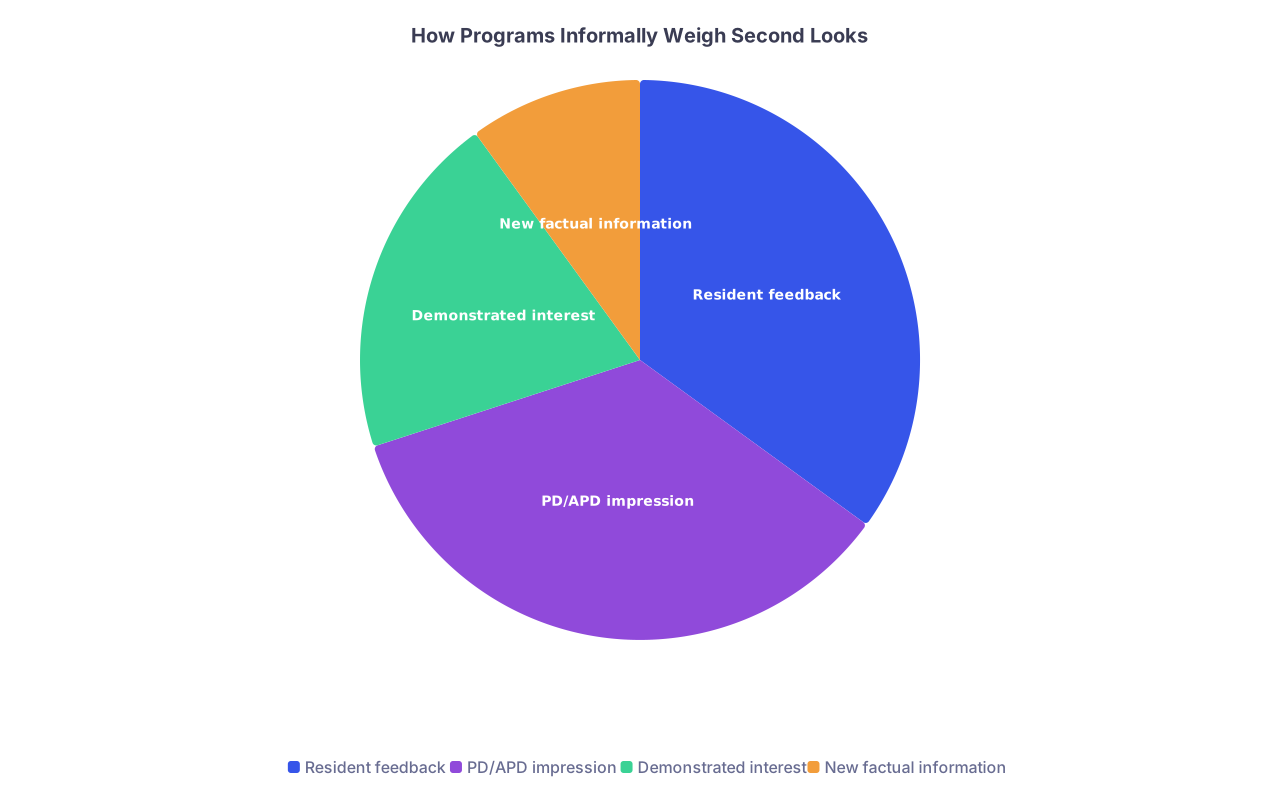
| Category | Value |
|---|---|
| Resident feedback | 35 |
| PD/APD impression | 35 |
| Demonstrated interest | 20 |
| New factual information | 10 |
Notice the largest slices: resident feedback and PD/APD impression. Your behavior on that visit matters more than whatever exact words you say.
A second look that simply confirms you are average does nothing. A second look that shows:
- clear alignment with program strengths
- maturity
- realistic career goals
- and basic likability
…can absolutely nudge you up a few ranks. And in tight specialties, a few spots can be the difference between matching and not.
11. A Simple Second Look Blueprint You Can Actually Follow
To pull this together, here is a tight protocol.

| Step | Description |
|---|---|
| Step 1 | Flat Interview Identified |
| Step 2 | Skip Second Look |
| Step 3 | Self-Assessment |
| Step 4 | List Weak Areas |
| Step 5 | Targeted Program Research |
| Step 6 | Request Second Look by Email |
| Step 7 | Define Visit Goals |
| Step 8 | Meet PD APD |
| Step 9 | Talk With Residents |
| Step 10 | Observe Conference or Clinic |
| Step 11 | Clarify Fit and Goals |
| Step 12 | Thank You Email |
| Step 13 | Reflect and Adjust Rank List |
| Step 14 | Program High Priority |
If you follow that flow—honestly—you will not waste the visit. Even if it does not change their rank list much, it will give you a clearer, more adult decision.
Key Takeaways
- A flat interview can sometimes be repaired—but only at programs you are genuinely willing to rank highly, and only with a deliberate, structured second look.
- Design the second look around specific goals, show up prepared with real questions and clear personal alignment, and let your behavior demonstrate that you would be a solid, thoughtful colleague.
- Close the loop with a focused thank-you and a sober ranking decision; do not use second looks as emotional reassurance or performative enthusiasm.