
It’s late January. You’ve finished most of your interviews, your rank list is half-baked, and you’re staring at your email drafts folder. One of them is a “request for second look” to your top program. You’ve rewritten it five times. You’re terrified of looking disinterested if you don’t go back. You’re equally terrified of looking desperate if you do.
Meanwhile, at that same program, the PD is on their third Zoom meeting of the day, scrolling through a spreadsheet of applicants’ names, glancing at notes like:
- “Came back for 2nd look — good”
- “Came back for 2nd look — intense, overbearing”
- “Multiple emails, feels needy”
- “Nice, but trying too hard”
Let me walk you into that room and show you what they really say about “too eager” second-look applicants. Because yes, there is such a thing. And yes, people get quietly dropped down the rank list for it.
First Reality Check: Second Looks Are Not What You Think
Let’s start by blowing up the myth.
Most students imagine second looks as this magical “extra credit” day. As if simply showing up again will move you five ranks higher. That’s not how it works.
What actually happens behind closed doors depends heavily on the program culture.
At some places (especially big-name academic IM, derm, ortho, plastics, ENT), the party line to applicants is: “Second looks are optional, do not affect ranking, come only if it helps you decide.”
That line is… half true.
Here’s the real breakdown I’ve heard in PD meetings and rank committee rooms:
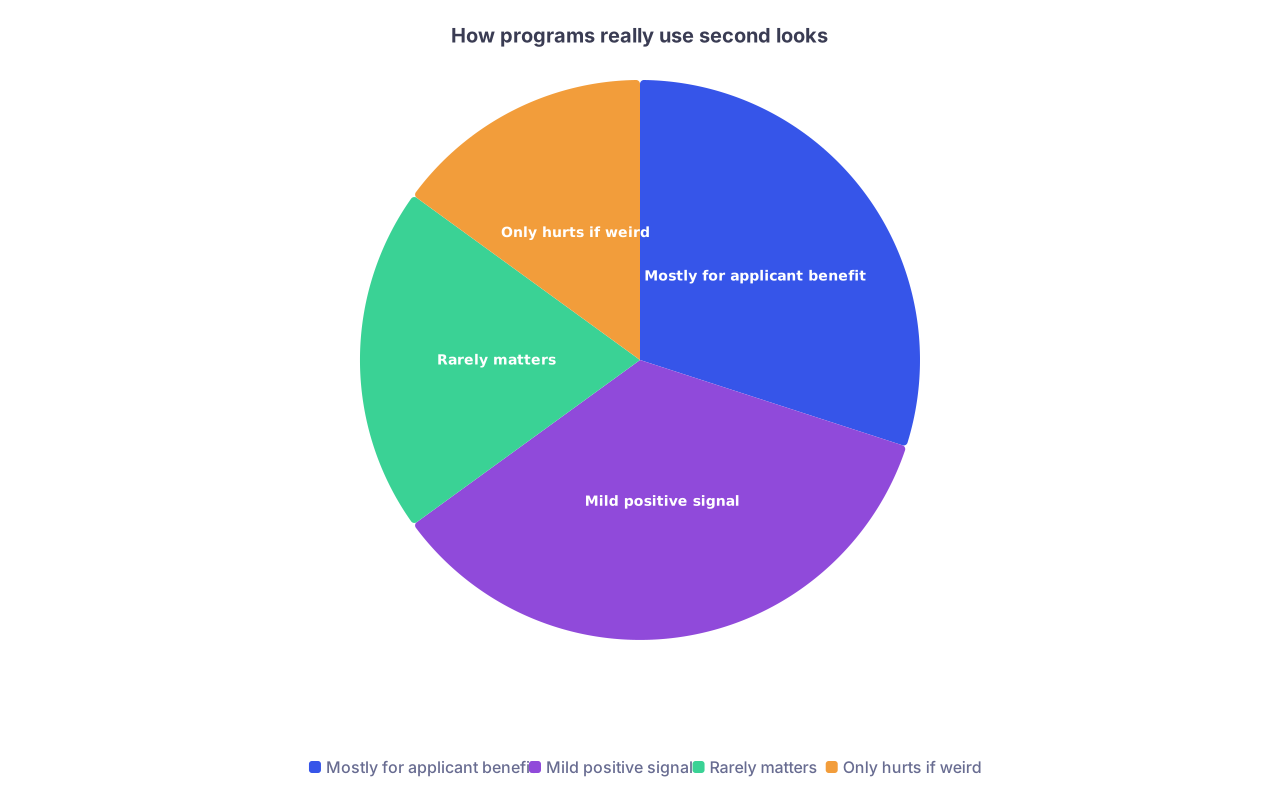
| Category | Value |
|---|---|
| Mostly for applicant benefit | 30 |
| Mild positive signal | 35 |
| Rarely matters | 20 |
| Only hurts if weird | 15 |
Nobody wants to admit that “overly eager” behavior can hurt you. But it does. Not because you cared. Because of how you came across.
You need to understand the archetypes that raise red flags.
The Five “Too Eager” Archetypes PDs Recognize Immediately
I’m going to give you the actual stereotypes people use in conversation. These are phrases I’ve literally heard from PDs, APDs, and core faculty at places like mid-tier IM, university EM, and academic anesthesia programs.
They’ll never say this on a Zoom info session, but they’ll say it in the closed-door ranking meeting.
1. The Serial Second-Looker
This is the applicant doing second looks at half their list. And they’re not subtle about it.
They tell the coordinator: “I’ve done second looks at five programs and yours is one of my top choices!”
Translation in PD-speak: “You’re clearly shopping and trying to game us. Hard pass on the ‘special connection’ narrative.”
How they show up:
- They come for a second look with an energy of “I’m evaluating you.”
- They ask residents: “So would you say this is better or worse than [nearby competitor program]?”
- They drop other program names. A lot. “At [X program] they said they start procedures earlier. How about here?”
Behind the scenes, faculty say things like:
“He’s clearly doing a tour of the city’s programs. I don’t get the feeling we’re special to him.”
Do second looks at multiple programs hurt you automatically? No. But when you advertise it, and when your questions are framed like a Yelp comparison shopping trip, you stop looking “interested” and start looking transactional.
2. The Over-Communicator
Too eager isn’t just about showing up physically. It’s about how often your name shows up in the PD’s inbox.
Here’s the rough internal threshold that many PDs have, whether they’ll admit it or not:
| Type of Contact | Usually Fine | Starts to Feel Too Much |
|---|---|---|
| Pre-interview emails | 0–1 | 2+ |
| Post-interview thank-you | 1 | 2+ follow-ups |
| Second-look related emails | 1–2 | 3+ |
| Total distinct email threads | 2–3 | 4+ |
The “too eager” look here is the applicant who:
- Emails to say thanks after the interview (good)
- Emails again to “confirm interest” (fine)
- Emails again to ask about second look dates (borderline)
- Emails again to clarify that this is their “top choice” (now it’s needy)
- Then sends a post-second-look note with gushy language, plus another “just wanted to reiterate” before rank list deadline (we’re done)
What PDs actually say:
“If they’re this high-maintenance before they’re my resident, what’s it going to be like when they’re on service and not getting what they want?”
If you’re wondering whether to send “one more” email to show your interest, the answer 90% of the time is: do not.
3. The Performative Enthusiast
This is the applicant who looks like they rehearsed “high energy” in the mirror before coming.
You know the type:
- Laughing too loudly at everything
- Over-smiling
- “I just LOVE this program so much” repeated in every room
- Jumping into every silence with another compliment
Residents and faculty are not fooled. Enthusiasm is good. Manufactured enthusiasm is exhausting.
The PD doesn’t say, “They’re too enthusiastic.” They say:
“I don’t know… I couldn’t get a real sense of them. Everything felt a little… much.”
The residents say:
“They were nice, but it felt like they were at an audition rather than just hanging out with us.”
And once you fall into that category, you’re no longer seen as “genuinely excited applicant.” You’re “trying too hard.” Which is not what you want attached to your name on ranking day.
4. The Boundary-Blind Networker
This one is huge. And it’s where a lot of ambitious applicants blow it.
This applicant sees the second look as a networking opportunity more than a fit-evaluation opportunity. They:
- Ask for one-on-one time with the PD during a busy clinical day
- Corner the chair after noon conference with a 15-minute monologue about their research interests
- Drop by faculty offices unannounced because “I just had a quick question about your work”
- Ask senior residents for contact info for “future mentorship” during the second look day
Programs notice who understands boundaries. When you start pulling people out of their workflow or clearly angling for individualized attention, residents roll their eyes and faculty mark you as “a lot.”
You want an example of a note that’s actually been written?
- “Strong application, but second look felt like a job interview. Intense. Might be high maintenance.”
- “Really seeking validation. Multiple asks for 1:1 time with PD, seemed more about being seen than seeing program.”
That’s what “too eager” looks like behind the curtain.
5. The Declaration Junkie
This is the one that makes every PD tired.
The applicant who makes intense, dramatic declarations of intent… to multiple programs.
Classic behaviors:
- Tells residents at second look: “This is my number one. I just know.”
- Tells APD in person AND in email: “I will rank you first.” (Then tells three other places the same thing.)
- Uses language like “dream program,” “my perfect fit,” “meant to be here”
PDs know two things:
- NRMP rules technically say you’re not supposed to pressure programs and vice versa, and everyone dances around that.
- Many applicants double-dip on “I’m ranking you #1” messages.
So nowadays, most PDs heavily discount extreme declarations. When they hear “You’re my first choice,” they translate it as “You’re in my top 3 and I’m anxious.”
What makes you look too eager is when the emotional tone is way out of proportion. Overly intense commitment to a place you visited once, maybe twice, for a combined 10 hours.
Comments I’ve heard:
“They say this is their dream, but I just don’t see the longitudinal connection here. Feels like they’re trying to manage us.”
A simple, straightforward expression of strong interest is fine. Gushing is not.

| Step | Description |
|---|---|
| Step 1 | Thinking about second look |
| Step 2 | Request 1 visit, clear purpose |
| Step 3 | 1 visit, 1 email |
| Step 4 | Skip second look |
| Step 5 | Be normal, low maintenance |
| Step 6 | Do I need it to decide? |
| Step 7 | Do I want to signal interest? |
What PDs Actually Use Second Looks For
This will irritate some people, but it’s true: at a lot of programs, second looks are more about screening problems out than rewarding keeners.
On the PD side, second looks are useful to:
- Confirm that someone they already like isn’t weird in person outside the structured interview day
- Let residents get a better sense of the applicant’s interpersonal style in a more casual setting
- Spot red flags: entitlement, poor boundaries, neediness, arrogance, or lack of self-awareness
There’s a brutal little comment I heard at a rank meeting once, from a PD at a university IM program:
“Second looks don’t usually move people up much. But if they’re bad, they definitely move people down.”
That’s the truth.
You want to know the real internal calculus?
| Scenario | Typical Effect on Rank |
|---|---|
| Great interview, solid 2nd look | Small bump or no change |
| Great interview, weird 2nd look | Drop several spots |
| Borderline interview, great 2nd look | Maybe small bump, usually unchanged |
| Borderline interview, weird 2nd look | Off the viable rank zone |
The second look is not your “save me” moment. It’s your “please do not screw this up” moment. That should change how you approach it.
What “Normal, Interested, Not Too Eager” Actually Looks Like
Let me flip the script. Because you need a positive target, not just landmines.
PDs and residents respond very well to this kind of second-look behavior:
You email once, clearly:
- You thank them for the interview season.
- You say you’re strongly interested and a second look would help you finalize your rank list.
- You ask if there are designated second-look days or if there’s a best way to arrange an informal visit.
- You keep it to a short paragraph, no gushing.
You show up:
- On time.
- Dressed like you care (business casual or whatever they recommend).
- With a couple of specific questions that matter to you (schedule, culture, teaching, specific track).
- With the ability to just… exist like a normal human for a few hours.
You don’t:
- Demand face time with the PD. If they come by, great. If not, that’s normal.
- Monopolize residents. Ask, listen, then give other applicants space.
- Oversell your interest: “I really like this program and could see myself thriving here.” is enough.
- Announce ranking plans to random people. No resident wants to be your confessional.
Then you send one follow-up thank you. Two short paragraphs. Some version of:
- Thank you for hosting me again.
- Seeing X and talking with Y helped clarify A, B, C.
- I remain very interested and can see myself fitting well here.
Done. No more emails. No countdown to rank list time. No “just checking in.” That’s how you stay off the “too eager” list.
Subtle Red Flags You Don’t Realize You’re Giving Off
The worst part? A lot of applicants who look “too eager” think they’re just being polite or “showing commitment.” Let me translate a few common moves.
You think: “I’ll bring a small gift for the coordinator to show appreciation.”
They see: Potential boundary issue. We now have to decide if this is okay, and it makes people uncomfortable. This can be a bad look.
You think: “I’ll ask for feedback during my second look.”
They see: This is not medical school mid-rotation feedback. On the PD side, it reads as “validate me, tell me where I stand.” Many PDs hate this.
You think: “I’ll tell them multiple times how much I love their program so they know I’m serious.”
They see: You’re not reading the room. Once was enough. Now it’s starting to feel like pressure.
You think: “I’ll ask the residents to advocate for me.”
They see: Residents immediately tell each other, “This person asked me to put in a good word.” That almost always backfires. They might mention it to the chief or APD with a raised eyebrow.
You think: “I’ll stay extra late after conference on my second look day to look dedicated.”
They see: Why is this person still here? Don’t they have other things to do? It starts to feel awkward, like you don’t know when to go home. Not a trait they want in a future resident.
The Future of Second Looks: Where This Is All Going
The last few years have shifted this entire game.
Virtual interviews, travel costs, equity concerns, and NRMP anxiety have made programs hyper-sensitive to anything that even looks like pressure or unfair advantage.
Behind the scenes, here’s what many PDs are quietly moving toward:
- More formal, structured second-look days with clear messaging: “This does NOT affect ranking.”
- Stronger discouragement of second looks at highly competitive, far-travel programs, especially for equity reasons.
- Less weight on “showing up again” and more on application + interview + standardized data.
- And yes, more intolerance of applicants who seem to be fishing for an edge via excessive contact.
I’ve watched programs literally debate whether to disallow all second looks during ranking season because they’re sick of managing the “too eager” problem and the optics of it.
But we’re not there yet. Some chairs still quietly like seeing who takes initiative. Some PDs still like meeting their top 10-15 in person again if possible. Culture varies.
What’s consistent is this: no one wants the resident who needs constant reassurance, constant access, and constant attention. A desperate-feeling second look is often their first glimpse of that personality type.
FAQ: Second Looks and “Too Eager” Behavior
1. If a program says “second looks don’t affect ranking,” do they really mean it?
Usually they mean: “We’re not going to formally reward you for coming, and we don’t want applicants feeling pressured.” But informally, a normal, low-drama second look can slightly help at some places, and a bad one can absolutely hurt. So yes, your behavior still matters.
2. How many programs can I do second looks at before it looks excessive?
If you’re flying and doing three or four, that starts to look like you’re trying to game the system. One or two targeted second looks at programs you’re seriously considering at the top of your list is plenty. Past that, the marginal benefit plummets and the “serial second-looker” risk rises.
3. Is it ever okay to tell a program they’re my number one?
Yes, but use that bullet once, and mean it. One program. One clear message. No theatrics. Something like: “I plan to rank your program first because of X, Y, Z.” They’ll file it under “probably true” if your story makes sense. Telling multiple programs that same thing is how you earn an internal reputation for insincerity.
4. What if I’m genuinely excited and just come across as intense? Am I doomed?
Not doomed, but you need to self-regulate. Ask yourself before you email or say anything: “Is this for me (my anxiety), or is this genuinely useful for them or my decision-making?” If it’s the former, don’t do it. Genuine excitement is fine. Repeated, high-intensity signaling is what starts to look like a problem.
Two things to take with you:
- Second looks are not extra-credit auditions. They’re mostly a chance for you to confirm fit and for programs to make sure you’re not a walking red flag.
- “Too eager” isn’t about caring. It’s about coming across as needy, boundary-poor, or performative. One well-planned visit and one or two measured emails will say everything you need to say.
Do that, and you’ll never be the applicant they talk about in the rank meeting as “kind of a lot.” And that alone is a win.