The dirty secret is this: a second-look visit can absolutely hurt you more than skipping it ever will.
Programs will never say that out loud. Publicly, they push the “come see our culture, get to know us” line. Privately, in conference rooms and ranking meetings, there are comments like: “She was fine on interview day, but the second look… changed my mind.” I’ve heard that sentence verbatim.
Let me walk you through how that actually plays out behind the scenes, and where people step on landmines they do not even know exist.
What programs really use second looks for (not what they tell you)
On paper, second looks are “non-evaluative,” “optional,” “for your benefit.” That wording is very intentional. It protects the program from NRMP violations and from having to offer the same opportunity to every applicant.
In reality, here’s what’s happening:
- The program already has a rough rank list in mind before most second looks.
- The PD and key faculty use second looks to confirm impressions or break ties.
- Your behavior, questions, and vibe get informally reported and absolutely influence how people feel about you.
No one is filling out formal “evaluation” forms on your second look in most places. But they are talking. And talk is often worse than a checkbox form, because it’s full of unfiltered perception and bias.
You think you’re just “stopping by to show interest.” They’re thinking, “Is this someone I want to deal with at 3 am on call?”
And here’s the uncomfortable truth: a neutral or slightly positive second look rarely moves you up more than a few spots. A negative second look can drop you 20+ spaces or put you in the “do not rank” bucket.
The biggest ways a second look hurts you
Let’s go straight to the mistakes that kill people behind closed doors. These are not theoretical. I’ve watched rank lists shift over this stuff.
1. Coming when you’re already clearly not a fit
This is the one no one warns you about.
Programs classify candidates mentally into three groups right after interview season:
- “We really want them”
- “Solid, likely to rank somewhere in the middle”
- “Probably not ranking / only if we need to fill the list”
If you’re in Group 3, a second look is usually a net negative. Why? Because now you’re giving them more exposure to reasons not to rank you at all.
I’ve seen this happen:
- Candidate with mediocre interview.
- Faculty note: “Awkward, a bit off, not sure about fit.”
- Candidate comes back for a second look: tries too hard, asks clumsy questions, gets visibly uncomfortable in the workroom.
- Resident afterward: “Honestly, that was painful. I don’t think they’d do well here.”
- End result: moved from low rank to “do not rank.”
If your interview felt cold, strained, or you sensed they weren’t into you, a second look will not fix that. It amplifies what’s already there.
Second look helps you most when you were already in Group 1 or high Group 2 and just need to confirm mutual enthusiasm. It’s not a rescue mission.
2. Acting like it’s a second interview (and overselling yourself)
The worst second looks feel like this: the candidate is performing.
They re-weaponize their personal statement. They repeat canned stories. They’re trying to “impress” instead of just integrating into the day. Residents and faculty pick up on this instantly.
I’ve heard residents say after a second look:
“On interview day they seemed normal. Today they were so rehearsed. It felt fake.”
What that translates to on the rank list:
- “Might be difficult.”
- “Don’t fully trust my read on them.”
- “Maybe high maintenance.”
You hurt yourself when you:
- Reintroduce your entire CV like they’ve never met you.
- Talk about your Step scores, publications, or class rank unprompted.
- Keep driving the conversation back to how “dedicated” and “hardworking” you are.
Program leadership already knows your stats. What they’re testing on a second look is much simpler: can we stand being around you all the time?
If your second look feels like a monologue, you’re losing.
3. Asking entitled, tone-deaf, or poorly timed questions
You’re allowed to ask real questions. But there’s a flavor of question that destroys you.
Here are actual examples I’ve seen sour a room:
- To a tired PGY-2 pre-rounding at 6:30 am: “So what’s your research schedule like? How easy is it to get protected time?”
- To a program coordinator in the middle of juggling 3 pages: “Can you show me where all the call rooms are and what the bedding situation is like?”
- To the PD, first interaction of the day: “What percentage of residents get their first-choice fellowship?” with a slightly demanding tone.
None of those questions are inherently bad. The timing and the tone are.
Programs use these moments to sniff out entitlement, lack of awareness, and whether you’ll be that resident always asking for special treatment.
The behind-the-scenes translation:
- “They’re already worried about research time and call rooms and they haven’t done a single night shift yet.”
- “They might complain a lot.”
- “Not sure they understand how much service is involved in this place.”
This is how you quietly slide down the list.
4. Being weird with residents
You are not really being evaluated by the PD on second look. You’re being evaluated by the residents, who then influence the PD.
Residents report three categories of red flags after second looks:
Social mismatch
- You hover, but do not engage.
- You’re oddly stiff or formal the whole time.
- You only talk to seniors or chief residents, basically ignoring interns.
Boundary issues
- You press people for inside information on how the match list is made.
- You push: “So… how high do you think I am on your list?”
- You ask residents to compare your application to other candidates.
Complaining or negativity
- You criticize the city, the hospital, or another program on your trail.
- You make offhand comments about “not wanting to work this hard forever.”
- You joke too much about hating certain patient populations.
Residents will absolutely share this, usually in brutal language:
- “They were kind of intense.”
- “Seemed like they’d be exhausting.”
- “Got a weird vibe—would avoid doing nights with them.”
The PD doesn’t need a formal evaluation sheet when three senior residents say they wouldn’t want you on their team.
5. Coming off like you’re ranking them low—but still using resources
Programs hate one specific pattern: the applicant who clearly is not serious about the program, but still burns people’s time.
You might think you’re being subtle, but residents see through:
- “Yeah, I’m mainly looking on the coasts but wanted to check this out too.”
- “My partner is in another city, so I’m trying to figure out if we could handle distance.” (Translation: I will rank my partner’s city higher unless I’m desperate.)
- “This is a backup in case I don’t match at X or Y.” (Yes, people actually say this.)
Programs understand they’re on many people’s “backup” list. What they resent is being treated like a backup while you still ask for a full personalized tour and face time with leadership.
I’ve sat in meetings where the PD said: “If we’re their safety, we don’t need to waste a rank spot on them. We’ll fill.”
You can be honest with yourself about where they sit on your list. Just don’t broadcast it at the second look.
How second looks really get discussed in rank meetings
Here’s the part you never get to see.
By the time rank meetings happen, programs have:
- Interview impressions
- File reviews
- Sometimes numerical scoring systems
- Informal feedback emails or comments from residents
Second looks come in as “soft data.” But they’re loud when negative.
Typical sequence:
- Program coordinator: “By the way, three people came for second looks: A, B, and C.”
- PD: “Any thoughts?”
- Chief resident:
- “A was great, fit in, low maintenance.”
- “B was nice but honestly kind of awkward, I still like them though.”
- “C was… intense. Asked about call pay three times.”
What happens next?
Candidate A → “Good, confirms what we thought.” Sometimes bumped up a few spots if they were on the bubble.
Candidate B → Usually neutral. Rarely moves much.
Candidate C → Drops. Sometimes a lot.
The dangerous part is this: second looks disproportionately act as filters for risk, not boosters for goodness.
Meaning: they do not help “average but normal” much. They mostly help identify people who feel off, needy, or mismatched.
If you’re the anxious type trying to “fix” a perceived weak interview with a second look, that’s exactly when you’re most vulnerable to overcompensating and triggering those risk sensors.
When skipping a second look is actually safer
Here’s the truth faculty say privately:
“I’d rather someone skip the second look than come and be weird.”
Second looks are optional. That’s not a trap phrase; that’s actually your protection. You are not penalized for not coming, especially if you interviewed decently.
Programs know:
- Not everyone can afford to fly back.
- People have sub-internships, shifts, and life.
- Some specialties officially discourage evaluative second looks.
Where skipping helps you:
- If your interview was already strong, you’re better off frozen in their mind as that version of yourself.
- If you’re exhausted, burned out, or in a bad mental space, there’s a high chance that will leak into your interactions. Better not to risk it.
- If you know you’re socially awkward in high-stakes situations, doing this twice (interview + second look) doubles the chance something feels off.
Programs do not go through the list saying: “No second look? Must not be interested.” That’s a myth applicants tell each other.
I’ve seen people match at #1 choice programs without ever setting foot in the hospital again after interview day. They were memorable enough. They didn’t screw it up.
Situations where a second look actually makes sense
To be fair, second looks are not always bad. They just need to be used strategically.
Second look can genuinely help when:
- You’re truly torn between 2–3 programs and need real, immersive comparison.
- You had a solid interview but didn’t get to see core rotations or certain teams.
- You’re couples matching and need to understand logistics in a deeper way.
- You’ve had major life changes (like partner moving to that city) and want to quietly signal updated geographic commitment.
The key is this: go with the mindset of a colleague shadowing, not an applicant auditioning.
You’re trying to answer: “Can I do life here?”
Not: “How can I impress them?”
You observe how residents treat each other at 4 pm, not how shiny the tour is. You ask honest but grounded questions: schedules, support systems, how they handle crises.
And then you go home. You do not follow up with five needy emails to the PD trying to “reaffirm” your interest. You do not write a novel about how the second look “changed everything.” PDs have seen that script too many times to take it seriously.
The future of second looks (and why programs are rethinking them)
Here’s the trend faculty are quietly talking about now: second looks are becoming a liability.
Three big reasons:
Equity optics
Programs know second looks favor people with money, flexible schedules, and fewer life obligations. Some institutions are already talking about capping or eliminating them to avoid the impression of “pay-to-play” interest.NRMP scrutiny
The more programs appear to use second looks for evaluation, the closer they get to murky regulatory territory. Many PDs now tell residents: “Second looks are for them, not for us”—but then still listen when residents complain about someone. That tension makes people nervous.Zoom era culture
Post-COVID, a lot of meaningful interaction shifted online. Some PDs honestly trust their structured interview day and virtual socials more than the uncontrolled variable of a second look where a stressed applicant might say something dumb at 7 am in the workroom.
Do not be surprised if you start hearing more programs explicitly say: “We do not consider second-look visits in our ranking.” Some will actually mean it. Others will half-mean it but still react to obvious red flags.
Either way, the era of “you must second look every high-choice program” is dying. Quietly, but definitely.
How to avoid tanking yourself if you decide to go
If you’re going to do a second look, you protect yourself by controlling three things:
Your goal
You’re there to gather information for your rank list, not to sell yourself. If you feel yourself pitching your value, stop talking.Your vibe
Aim for: curious, grounded, low-drama. Not desperate, not overexcited, not aloof.Your footprint
Keep it tight. Half-day or a single shift shadowing is plenty. You do not need to “be seen” by the entire department. More exposure means more chances for missteps.
Think of it this way: second look should be a quiet, professional visit that most people barely remember except as, “Oh yeah, they were nice.”
Forgettable is good. Forgettable gets you ranked based on your interview, which is exactly what you want if the interview went well.
Memorable on a second look? That’s where people get burned.
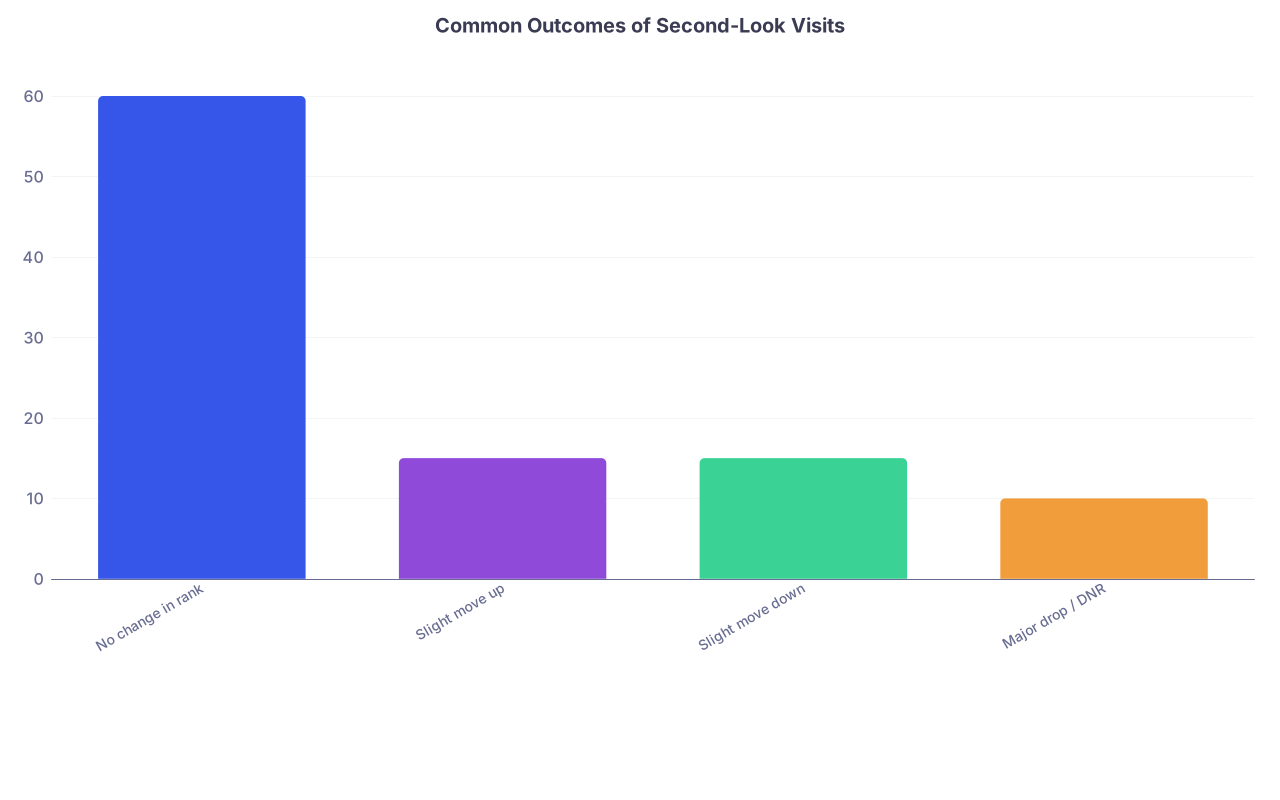
| Category | Value |
|---|---|
| No change in rank | 60 |
| Slight move up | 15 |
| Slight move down | 15 |
| Major drop / DNR | 10 |

| Situation | Impact of Second Look |
|---|---|
| Strong interview, good fit | Mild positive or neutral |
| Mediocre interview, clear mismatch | Often negative |
| You are anxious and over-prepare | Risk of negative impression |
| You need to choose between top 2 programs | Can be genuinely helpful |
| You cannot travel / skip second look | Usually neutral |
FAQ (unfiltered)
1. Will not doing a second look hurt my chances of matching at my top program?
No. Programs do not systematically punish people for skipping second looks. Most matched residents at “top” programs never did one. Your interview, letters, and overall file carry far more weight than a 3-hour visit in February. If your interview was strong, freezing that impression is often safer than risking a weird second exposure.
2. Should I tell a program I’m ranking them #1 during a second look?
If you’re absolutely certain, one clear, concise communication is enough—usually by email to the PD or PC, not as a dramatic speech in person. Overemphasizing your “number one” status during the second look can feel manipulative or desperate. Also, do not say this to more than one program; word gets around more than you think.
3. What’s a safe way to structure a second-look day if I go?
Half-day is ideal. Shadow a team, have lunch with residents, maybe a brief hello with the PD if they suggest it, then leave. Do not try to schedule back-to-back meetings with every big name in the department. The more you turn it into a mini-interview day, the more chances you have to say something odd, seem performative, or wear people out.
4. Are there specialties where second looks are more dangerous or more pointless?
Yes. In highly competitive, small fields (like dermatology, plastics, some surgical subspecialties), second looks can make you look needy or political if handled poorly. Faculty in those areas talk—a lot. In primary care or larger programs, second looks are often logistically easier but also less influential. In some specialties (radiology, pathology), culture is shifting so strongly toward “formal process only” that second looks are increasingly seen as noise. When in doubt, ask current residents whether second looks actually mattered for them—and listen carefully to what they don’t say.
Key takeaways:
Second looks rarely rescue a weak application, but they can absolutely harm a decent one if you come off as entitled, performative, or mismatched. Skipping a second look is almost always safer than forcing one when your interview was already solid. If you do go, keep it short, low-drama, and focused on you evaluating them, not the other way around.