
The most overrated part of residency interview season right now is the second look.
If you remember nothing else, remember this: a poorly chosen second look can hurt you more than never showing up again. People rarely tell applicants that. I will.
You are being pushed—by group chats, by Reddit, by well‑meaning classmates—to believe “showing interest” always helps. It does not. There are situations where going back is a strategic mistake, a professional risk, or just a waste of limited money, time, and energy.
Let’s walk through when not to go back.
What Second Looks Actually Do (And Why That Matters)
Second looks are not magic keys. They are noisy, inconsistently valued signals that programs interpret very differently.
Some programs:
- Do not factor second looks into rank lists at all
- Explicitly tell you they “do not track” visits
- Quietly note behavior, professionalism, and fit during any visit
- Use second looks mostly for you to gather information, not for them to evaluate you
The mistake a lot of applicants make: assuming “more contact = higher rank.” That is false. Programs care far more about:
- Your interview day performance
- Letters of recommendation
- Board scores and transcript
- Fit with their culture and specialty interests
Second looks can matter at the margins. But marginal gains are not worth major risks. So you need to know when the downside dominates.
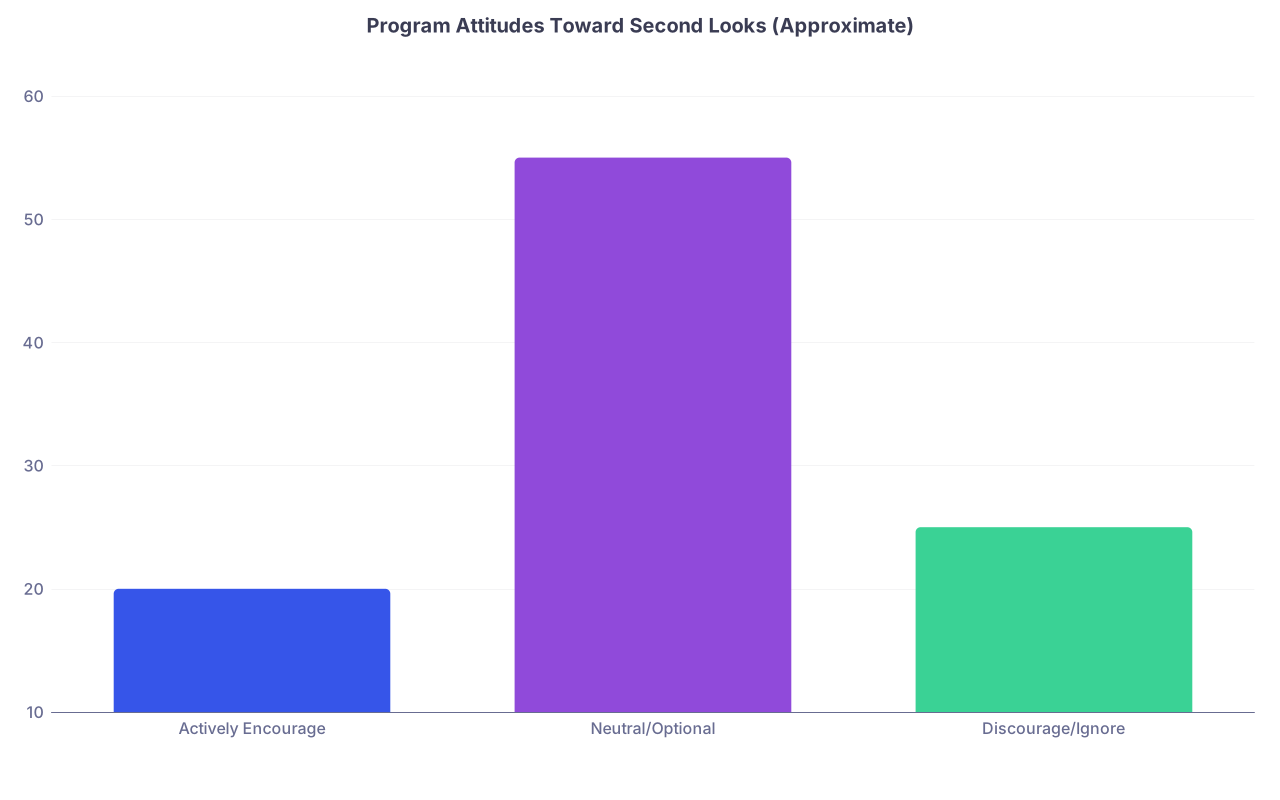
| Category | Value |
|---|---|
| Actively Encourage | 20 |
| Neutral/Optional | 55 |
| Discourage/Ignore | 25 |
1. Never Go Back When the Program Tells You Not To
If a program says any of the following:
- “We do not offer or track second look visits.”
- “Additional visits will not influence our rank list.”
- “Please do not contact us to arrange additional visits.”
Believe them. Do not try to be the exception.
I watch applicants rationalize this every year:
“They say that, but they must secretly care.”
“They have to say that for fairness, but they really want to see you again.”
No. When a program draws a boundary, testing it is not “enthusiasm.” It is a red flag. You look like someone who does not respect instructions. That gets remembered.
Here is what going anyway can signal:
- Poor judgment
- Boundary issues
- Entitlement (“rules do not apply to me”)
- Lack of respect for equity for other applicants
If you truly want more info, ask: “Are there any virtual opportunities to learn more about your program or talk with residents?” Then stop there.
2. Do Not Go Back If You Already Know You Will Rank Them Low
This one sounds obvious. Yet people ignore it all the time out of fear.
If, after interview season, you already know:
- “I would not be happy here.”
- “This city is not workable for my life.”
- “The call schedule / culture / curriculum is off for me.”
then do not waste a day trying to talk yourself into it on a second look.
Common mistake:
“I hated the vibe, but it is a ‘big name’ program. Maybe if I go back it will feel different.”
You do not need to invest more time in a place you already know is not going into your top realistic spots. Rank it appropriately and move on. A second look will not magically fix systemic issues: malignant culture, poor teaching, unsafe workload. Those things leak through on the first pass for a reason.
The trap is prestige anxiety. Or fear of not matching. So people keep chasing programs that are bad fits, and use second looks as emotional band‑aids. Do not do this.
3. When You Are Burnt Out, Sick, or Barely Holding It Together
A second look is still an audition, even if they say “this will not affect your rank.” You are being seen. You are being remembered.
If you are:
- Actively sick (coughing, febrile, exhausted)
- Mentally fried, barely sleeping, snapping at people
- Behind in med school coursework, on thin ice with your own school
- Coming off a brutal rotation with no buffer
you are at high risk of making a worse impression in person than you did on interview day.
I have seen it:
- Applicant shows up late, looks disheveled, barely engages. Faculty later say, “Seemed unprofessional and disengaged.”
- Student tries to “show interest” but comes across desperate and scattered.
- Candidate pushes through illness, spends half the visit fighting a coughing fit and leaving the room.
Your original interview might have been strong. That second, weaker impression can overwrite it.
If you cannot show up as at least your “baseline OK” self—alert, reasonably rested, present—skip the second look. Protect the strong first impression you already made.
4. When You Are Using It To “Fix” A Bad Interview
Second looks do not erase a poor interview. That is fantasy.
If you walked out of an interview thinking:
- “I rambled and never really answered questions.”
- “I said something I strongly regret.”
- “I was obviously out of my depth.”
a second look rarely repairs that. More often, it reinforces it.
From the program side, what it can look like:
- “They are trying to lobby us after the fact.”
- “They seemed anxious and overcompensating.”
- “We already know enough to make a decision.”
If you truly made a factual mistake (e.g., misrepresented an experience) or forgot critical information, a brief, focused email is safer: “I wanted to clarify X from our conversation.” That is controlled, professional, and does not demand extra time from them.
Showing up again, asking for “another chance,” or trying to charm your way into a better evaluation? That is transparent, and not in a good way.
Use your energy to strengthen relationships and performance at other programs, not to chase one that already has enough data and a mixed impression.
5. When You Cannot Afford It Financially (And Are Pretending You Can)
Do not go into more debt for the illusion of advantage.
Application season already wrecks finances:
- ERAS fees
- Flights and hotels
- Lost income if you are working less
If a second look means:
- Carrying a balance on a high‑interest credit card
- Skipping basic expenses (medications, food, rent buffer)
- Having to cancel something important at home (helping family, covering responsibilities)
then no, it is not “worth it for one more touch point.”
Programs are not sitting around saying, “This person did not come back a second time; clearly they are less committed.” They know travel is expensive. They know applicants are stretched.
In fact, some faculty quietly worry the opposite: that applicants with endless second looks live in a financial bubble and may not understand real‑world constraints.
If you feel the pressure to go is more social than strategic—“everyone else is going back”—you already have your answer. Skip it. You will not sink your chances by protecting your wallet and your sanity.
6. When Programs Are Using Second Looks To “Soft Audition” You
There is a quiet, uncomfortable truth: some programs use “second looks” as unofficial extended interviews or free labor previews.
Red flags:
- You are asked (or strongly nudged) to come for “a half‑day on the wards”
- The visit sounds like shadowing real clinical work, not just observing or touring
- There is pressure to scrub into cases or “see how you operate on the team”
- They talk about “seeing how you fit into workflow”
At that point, this is not you exploring the program. This is them extracting extra evaluation time from you. Often in ways that are not clearly shared with other applicants.
You risk:
- Being judged on a rushed, artificial “performance”
- Being compared unfairly to others who never had that pseudo‑audition
- Making a mistake in an unfamiliar environment that sticks in their memory
If they want more standardized information, they have other tools: second interview, additional references, or follow‑up calls. You do not need to put yourself into an unstructured, high‑risk “preview shift.”
You can push back politely:
“I’m very interested in your program, but my schedule and school policies do not allow additional clinical days. I’m happy to speak by video or phone with residents or faculty to learn more.”
If they make that a problem, that tells you something unflattering about their values.
7. When The Culture Already Looked Questionable
Second looks do not fix malignant culture. They just give it more time to show you how bad it is.
If on interview day you noticed:
- Residents afraid to talk honestly when faculty are nearby
- Jokes that punch down: mocking patients, other specialties, or “weak” residents
- Faculty bragging about how “brutal” or “sink or swim” the program is
- Dodged questions about mistreatment, attrition, or grievance processes
a second look is not your opportunity to “confirm it is not that bad.” It is your warning to step away.
I have lost count of how many residents say in PGY‑2:
“I saw some things on the interview day that felt off, but I thought maybe I was overreacting. I went back for a second look and convinced myself I was just anxious. I should have trusted my first impression.”
Your instincts exist for a reason. If your gut says, “Something is off here,” your default should be not to invest more time, not to argue yourself into staying interested.
If you need more data, do it remotely:
- Anonymous programs like Doximity reviews (with skepticism, but still data)
- Alumni from your school who rotated or matched there
- Off‑record calls with residents you met
You do not need a second in‑person visit to hear, “We work hard, but we are like family,” repeated in a conference room.
8. When You Are Clearly Not In Their Realistic Match Range
You will not hear this from advisors who are afraid to sound harsh, but it matters: sometimes you are not competitive enough for a given program this year. No amount of second looks will change that.
For very competitive specialties or top‑tier academic programs, your:
- Step/COMLEX scores
- Class ranking
- Research profile
- Letters
already place you outside the typical match range. Programs may like you as a person, but they are still constrained by metrics and institutional expectations.
If your home PD or specialty advisor—someone who actually knows match data—tells you:
“You should absolutely interview there, but I would not build a strategy around matching there,”
then you do not blow your remaining time and money going back just to “show interest.”
You can still rank them. Of course. Unrealistic long shots sometimes hit. But a second look will not magically rewrite the spreadsheet when they meet as a committee.
Save second looks, if you do them at all, for places where you are in realistic range and you are genuinely torn about where they fall on your list.
9. When You Are Chasing Reassurance, Not Information
This one is subtle but dangerous.
Ask yourself honestly:
“Am I going back to get new, decision‑changing information, or am I going back because I am anxious and want someone to tell me I am making the right choice?”
If it is mostly anxiety, the second look will not help. In fact, it usually makes you more confused:
- You meet one enthusiastic resident → “Maybe this should be higher.”
- You meet one tired, burned‑out senior → “Maybe this should be lower.”
- You get a different vibe depending on the day’s cases, weather, or who shows up.
Rank list building is inherently uncomfortable. You are choosing a path without full information. Trying to “perfect” the choice with one more visit just feeds the anxiety loop.
Do not use second looks as emotional support. That is a therapist’s job, a mentor’s job, or your own reflection time. Use second looks only if there are clear, concrete questions that can realistically be answered in person:
- Housing specifics
- Commuting and call logistics
- How a specific fellowship pathway really functions
- Childcare, partner job options, etc.
If those questions can be answered over Zoom or email, do that instead.
10. When Your Behavior Online Or In Email Has Already Been Questioned
This is the harshest one, but someone needs to say it.
If you have:
- Sent multiple pushy or awkward emails to a program
- Been corrected for unprofessional communication
- Had an issue during interview season (late, no‑show, inappropriate comments)
you may think, “If they could just see me again in person, I could fix this.”
That is rarely how it plays out. Instead, your appearance becomes a topic:
“Why is this applicant back again?”
“Are we comfortable having them in our space after that email chain?”
Going back in person can amplify concerns. It forces faculty and staff to spend more time with someone they are already uneasy about.
Your best move in that situation is quiet, controlled professionalism:
- Answer necessary emails concisely and politely
- Stop trying to “lobby” them
- Focus on other programs where you have not damaged the relationship
Do not double down on a shaky interaction with more face time. It almost never reads as you intend.
Quick Comparison: When Second Looks Help vs Hurt
| Scenario Type | Likely Effect |
|---|---|
| Program encourages visits, you are truly undecided, and you are in realistic match range | Potentially Helpful |
| You already know you will rank them low | Harmful / Wasteful |
| Program states clearly they do not track or want second looks | Harmful / Risky |
| You are exhausted, sick, or not able to present well | Harmful |
| You are seeking reassurance, not information | Mostly Unhelpful |
How To Say No Without Burning Bridges
You do not owe programs a second look. Declining is not an insult.
If invited or nudged, a simple script works:
“Thank you very much for the invitation to visit again. Due to schedule and financial constraints, I will not be able to return in person, but I remain very interested in your program and appreciated the opportunity to interview.”
That is all. No over‑explaining. No apologies for being a normal human with limits.
If you want more info, add:
“If there are virtual opportunities to speak further with residents or learn more about X (research, fellowship outcomes, ICU experience), I would be grateful to participate.”
Polite. Boundaried. Professional.
One More Point About Fairness And Optics
Second looks quietly advantage applicants with:
- More money
- More schedule flexibility
- Fewer caregiving or work responsibilities
Programs know this. Many are trying to level the field by de‑emphasizing or eliminating second looks as an evaluative tool. When you push hard for extra visits, you may be unintentionally participating in a system they are trying to fix.
You do better for yourself—and for your future colleagues—by drawing a line:
- You respect stated policies
- You do not compete on who can spend the most money on flights
- You focus your effort on things that truly matter: interview preparation, letters, and honest self‑assessment of fit
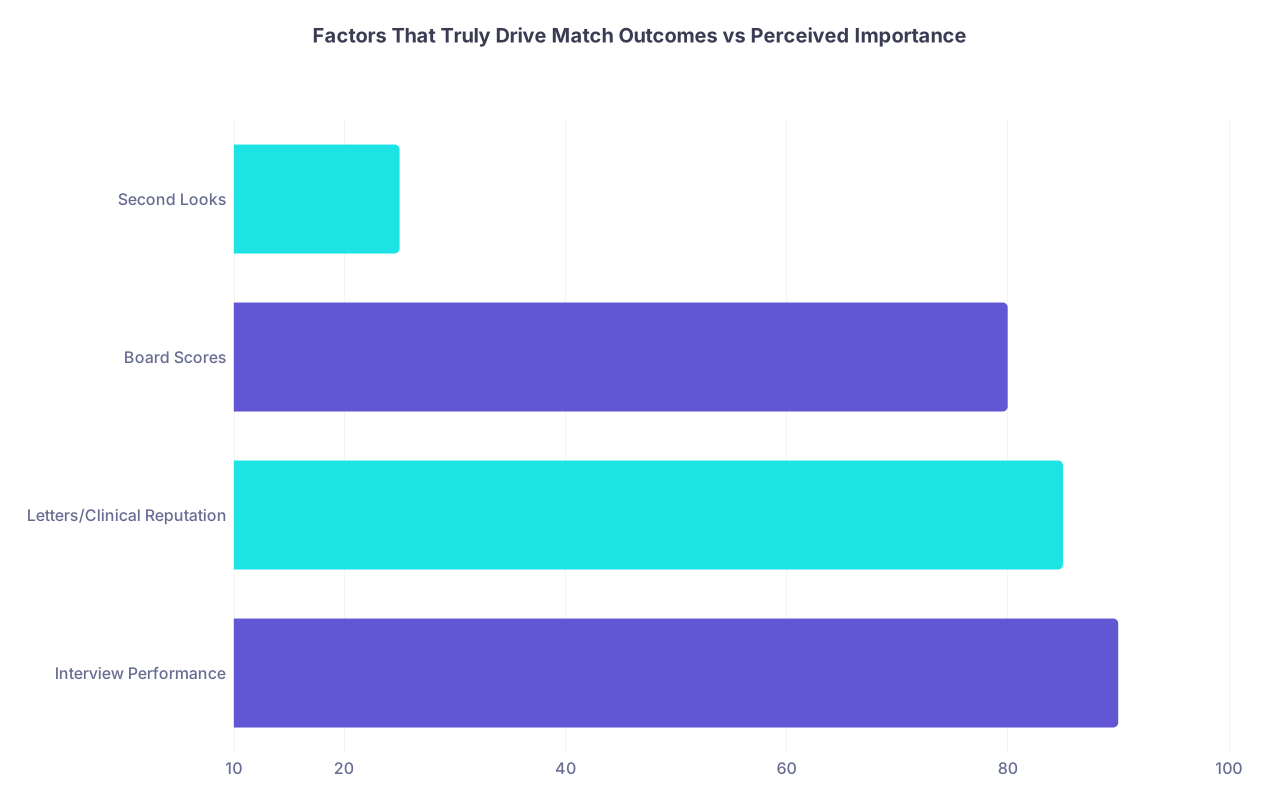
| Category | Value |
|---|---|
| Interview Performance | 90 |
| Letters/Clinical Reputation | 85 |
| Board Scores | 80 |
| Second Looks | 25 |
FAQs
1. If a program offers an optional open house after interviews, is that a “second look” I should avoid?
Not automatically. Virtual or low‑stakes open houses that are clearly informational and offered to all applicants are fine. Attend if it fits your schedule and you still have genuine questions. The mistake is flying across the country, burning time and money, or assuming attendance automatically boosts your rank. Use them for information, not signaling.
2. Will not doing any second looks at all hurt my chances overall?
No. Many applicants never do a single second look and match very well. Plenty of programs either do not track second looks or use them only marginally, if at all. A strong interview, solid letters, and a realistic rank list matter far more than any extra visit.
3. What if I am truly torn between two top programs—should I second look both?
Not necessarily. Before considering travel, exhaust lower‑cost options: follow‑up emails with residents, virtual chats, asking targeted questions about things that matter to you (schedule, support, fellowship outcomes). If you still feel stuck and both programs explicitly welcome in‑person second looks, consider visiting just one—the one where specific unanswered questions genuinely require you to see the place in person. Do not do symmetric second looks just for “fairness.”
4. Can a second look ever push me up significantly on a rank list?
Occasionally, but far less often than applicants think. When it helps, it is usually because you were already in serious contention, and the visit simply confirmed to them that you are a strong fit—professional, collegial, aligned with their values. It does not rescue weak applications and it does not usually move someone from “unlikely to rank” to “top choice.” Treat potential upside as marginal, not decisive.
5. How do I know if my reason for a second look is good enough?
Ask yourself three blunt questions:
- Will I learn something in person that I genuinely cannot get via email or video?
- Am I realistically competitive for this program and willing to rank it highly if it impresses me?
- Can I show up as my best professional self without wrecking my finances or mental health?
If you cannot answer “yes” to all three, skip the second look. Protect your time, your money, and the strong first impressions you have already made.
Key takeaways:
Most second looks are optional, and many are unnecessary. Do not go back to a program that set clear boundaries, that you already know you will rank low, or when you are exhausted or financially strained. Use second looks, if at all, for targeted information in realistic top‑choice programs—not as an anxious reflex or a last‑ditch rescue mission for a shaky interview.