
The fastest way to undermine a strong application at a second look is to mishandle the people you bring—or let tag along.
Second looks are not family open houses. They’re not date nights. They’re not for your parents to “check out” the hospital that’ll be “taking their baby.” Programs may smile politely, but they notice. And they remember.
If you get nothing else from this: treat second-look visits as high‑stakes professional encounters. Your parents, partners, and plus‑ones can help you—or quietly sink you.
Let me walk you through where people mess this up and how you avoid being the cautionary tale residents talk about for years.
The First Mistake: Thinking “Second Look” = Social Visit
Here’s the fundamental error: people treat second looks like revisits to a college campus. They’re not. They’re informal, but not casual. The vibe is softer than interview day, but the stakes are not.
Programs use second looks to:
- Confirm their impression of you
- See how you interact when you think “the pressure is off”
- Gauge your judgment and professionalism in more relaxed settings
You’re not off-duty. You’re just out of a suit.
And that’s exactly why bringing extra people—parents, partners, friends—can become a problem. It shifts the focus from “here’s how I fit into this residency” to “here’s how my entire entourage fits into this place.”
Most programs will not tell you directly: “Do not bring anyone.” They also won’t forget if:
- A parent monopolizes a faculty member to ask about “safety in the city”
- A partner starts interrogating residents about call schedules and fertility plans
- A friend shows up dressed for brunch, not a professional environment
Those moments get recounted. By name.
Who Actually Belongs at a Second Look?
Let’s be blunt: the default answer is you. Just you.
There are a few narrow exceptions where bringing someone else can make sense—but even then, you have to handle it surgically.
| Person Type | Default Recommendation | Exceptions |
|---|---|---|
| Parents | Do not bring | None, unless explicitly invited by program |
| Romantic Partner | Usually do not bring | Serious, long-term partner; major relocation |
| Spouse with Kids | Possible with caution | For relocation logistics, childcare, housing |
| Friends/Roommates | Never | No exceptions |
| Pre-med/Med Student | No | Only if program hosts a specific pipeline day |
Here’s the nuance people ignore:
Parents: I don’t care how close you are. If they need to see the city, they can come separately before or after. They do not attend formal or informal program events. If a program runs a “family open house,” that’s different; otherwise, they stay out of it.
Partners/spouses: This is not “meet my boyfriend/girlfriend” day. If your partner is moving with you, especially across the country, it can be reasonable for them to visit the city, see neighborhoods, and maybe tour the hospital lobby on their own while you’re busy. But they shouldn’t be shadowing you around official events unless a program explicitly welcomes partners.
Friends: Absolutely not. No, your roommate does not need to “get a feel” for the vibe. They’re not the one whose reputation is on the line.
If you’re even slightly unsure whether plus-ones are okay at ANY scheduled activity: assume no. Or, better, ask the coordinator with a crisp, professional email.
Programs Won’t Say It, But They Are Judging Your Boundaries
Second looks are where programs see how you handle blurred lines—work vs personal, formal vs informal. This matters more than applicants realize.
Here’s what they’re quietly evaluating about you through your “plus-one behavior”:
- Do you understand what’s professional vs what’s personal?
- Do you protect clinical spaces from becoming family hangout areas?
- Do you have appropriate boundaries with your parents?
- Do you let others speak for you or over you?
If your mom is asking the PD about call rooms, the message is not “supportive family.” The message is “this resident may have boundary issues.”
If your partner is poking residents with, “Be honest, how bad is the call?” while you stand there awkwardly, the message is “we may be inheriting two people’s dissatisfaction, not one physician.”
Keep this in your head: on second look, everyone around you is data. How you manage them is part of your evaluation—even if no one says that out loud.
The Parent Problem: Over-Involved vs Appropriately Supportive
I’ve watched this play out more than once.
Applicant shows up with parents “just walking around the hospital.” They “accidentally” end up near the group. Mom or dad starts chatting with a chief resident: “How safe is the overnight parking? Where exactly will she be on call? What about maternity leave?”
On your side, it feels like love. On the program’s side, it reads as: helicopter parents, boundary issues, possible future conflict.
Common parent-mistakes at second looks:
- Speaking for you: “He really wants a program with more research.”
- Asking about call, salary, or benefits in front of faculty.
- Voicing skepticism: “We’re not sure about this neighborhood.”
- Treating staff like concierge: “Can someone show us the pediatrics floor?”
- Appearing at the pre-dinner social or resident-only events “just to say hi.”
Do not make this mistake: thinking “They’re polite, it’ll be fine.” It might be polite in the moment. But later, in a ranking meeting, someone will say, “That’s the one whose parents came on second look and asked about X,” and the room will nod. You don’t want to be that applicant.
How to handle parents correctly:
Set the rule clearly before the trip:
“The official events are just for me. You won’t be joining the tours, lunches, or meetings. We can explore the city together before or after.”If they insist on “seeing the hospital”:
They can walk around public areas alone. You don’t introduce them to faculty or residents unless it’s a brief, unplanned, and clearly optional moment (“This is my mom; she’s just visiting the city with me.” Then move on).Do not let them ask program-specific questions.
If they start, you shut it down kindly but firmly: “We can talk about the details later, Mom.” And then change the subject.
You’re a doctor now—or about to be one. Act like it.
Partners and Spouses: Where People Get Sloppy
Partners are trickier, because unlike parents, they’re part of your actual adult life plan. Residency is brutal on relationships. Programs know this. They want you to have support. But they don’t want your second look turning into couples therapy on their time.
The biggest mistakes partners make (usually with your silent permission):
- Interrogating residents about work–life balance in a way that sounds accusatory
- Asking questions that should come from you (“What are his moonlighting options?”)
- Oversharing personal plans: “We want three kids during residency so the timeline matters.”
- Dominating social events: telling stories, steering conversation, filling silences
Residents will be polite. Some will even empathize. But if your partner feels like the main character of the visit, that’s a red flag.
If you decide it’s important for them to come to the city for second look:
- Separate logistics from program contact. They can explore neighborhoods, check out daycare centers, peek at the hospital from afar.
- Program events are for you—unless the invitation explicitly mentions “partners and families welcome.” Many do not.
And if there IS a genuinely family-friendly event?
Coach your partner beforehand:
- “This is not the time to grill residents.”
- “Please don’t ask about salary or benefits; I’ll handle those questions.”
- “Short introductions, let them talk more than us.”
You’re not being controlling. You’re protecting both of you from coming across badly.
The Silent Killer: Letting Others Speak For You
One of the ugliest impressions you can give at a second look: you look like you’re not in charge of your own life.
I’ve seen this exact script:
Faculty: “What kind of research are you interested in?”
Applicant opens mouth. Parent or partner jumps in: “She really wants to do cardiology research; she’s always loved the heart.”
Painful. And unforgettable.
Or:
Resident: “How are you feeling about moving so far from home?”
Partner: “Honestly, I’m nervous about the winters here. We’re really hoping for somewhere warmer.”
Everyone hears that “we.” Everyone knows who’s actually uncomfortable.
Your job: never let others answer questions directed at you. If someone starts, you gently but clearly reclaim the moment: “That’s something I’ve thought a lot about—I’m excited about X, and here’s how I’m looking at Y.”
The mistake is not having an opinionated partner or parent. The mistake is not setting the boundary that you are the one speaking for yourself in professional spaces.
If you can’t manage that at a second look, programs doubt you’ll manage it with patients, nurses, or attendings either.
The Physical Space Problem: Where People Should Not Be
There are places where non-employees and non-patients already feel borderline. Drop your plus-ones into those spaces during a second look and you’ll look clueless at best.
Areas where your family/friends do not belong during your visit:
- Resident lounges or workrooms
- Call rooms or sleep areas
- Staff-only cafeterias or break rooms
- Conference rooms during educational sessions unless explicitly invited
- Any clinical area where patients might reasonably assume everyone is staff
I’ve watched people parade partners into resident lounges “just to see where I’d be hanging out.” Everyone is too polite to say it in the moment, but it leaves a bad impression.
The unspoken rule: if you’re not badged staff, a patient, or a formally cleared visitor, you’re a guest. Guests do not wander into staff spaces behind the scenes. You absolutely do not bring extra guests into those spaces.
If your partner wants to see where you might work, show them:
- The front of the hospital
- The lobby
- The public campus
- The outside of affiliated clinics or buildings
That’s enough. They don’t need to inspect call rooms to love you.
When It’s Actually Reasonable to Involve Others
There are a few scenarios where involving a spouse/partner at some level is defensible—and even smart—if you do it with discipline.
Examples:
- You have children and need to verify realistic childcare options
- You’re moving a two-career household and your partner is also job-hunting
- You’re relocating internationally or across multiple time zones with major logistical strain
In those cases, the program may even appreciate that you’re trying to understand whether you can actually thrive there.
But here’s how to do it without tanking your reputation:
Use separate time blocks. Morning/afternoon for official second-look activities (you alone). Off-hours for scouting neighborhoods with your partner.
Keep them away from resident socials unless explicitly included. Even then, brief appearance, low profile.
Ask complex family/logistics questions 1:1 with the coordinator or PD, not in front of a group. “My spouse works in X field—are there typical opportunities in the area?” is better than “We’re worried we’ll be miserable here.”
Residents and faculty respect people who are realistic. They do not respect people who offload all their discomfort into side comments and partner drama.
Red-Flag Behaviors Programs Talk About Later
You want the inside gossip? Here are the stories that come up in resident rooms after second look days. You do not want to be in any of these categories.
- The applicant whose dad grilled the PD about malpractice coverage.
- The partner who said, “So will you actually be home at night, or is this like… bad?”
- The mom who asked a chief resident, “Would you let your own daughter match here?”
- The couple who argued in the hallway about moving “to this awful city” within earshot of residents.
- The applicant who brought a friend to free-drink resident social and let them get tipsy.
Programs are not looking for reasons to hate you. But remember: they have a stack of strong applicants. So small lapses in judgment, especially visible ones, become tie-breakers.
Every extra person you bring is one more potential source of those lapses.
A Clean, Low-Risk Second Look Plan
If you want a second look that helps you rather than hurts you, here’s the safe template.

| Step | Description |
|---|---|
| Step 1 | Decide on Second Look |
| Step 2 | Travel alone |
| Step 3 | Limit to partner or spouse |
| Step 4 | Separate program events from family time |
| Step 5 | Attend official activities solo |
| Step 6 | Ask questions yourself |
| Step 7 | Leave with clear professional impression |
| Step 8 | Need others present? |
Practical rules:
- Attend all official events alone unless explicitly told otherwise.
- Keep any plus-ones in the background—physically and conversationally.
- Schedule your “life logistics” time around, not inside, second-look programming.
- Do not use residents or faculty as sounding boards for your relationship or family anxieties.
It sounds strict. It’s not. It’s just how professionals handle mixed personal/professional situations.
Quick Reality Check: What Programs Actually Care About
Let’s be honest: most rank decisions are not going to swing wildly based on whether you used “we” or “I” once in front of a resident. But second looks can confirm or break borderline impressions.
What they want to see from you:
- You’re an adult making your own decisions.
- You understand professional space vs personal life.
- Your support system exists, but does not run your life for you.
- You’re not going to bring constant drama into the program’s already stressed ecosystem.
Everything about parents, partners, and plus-ones at second look boils down to this: are you capable of drawing healthy boundaries and protecting the professionalism of the training environment?
If the answer, based on your behavior, feels like “maybe not,” you just made yourself an easy one to slide down the rank list when they have too many good options.
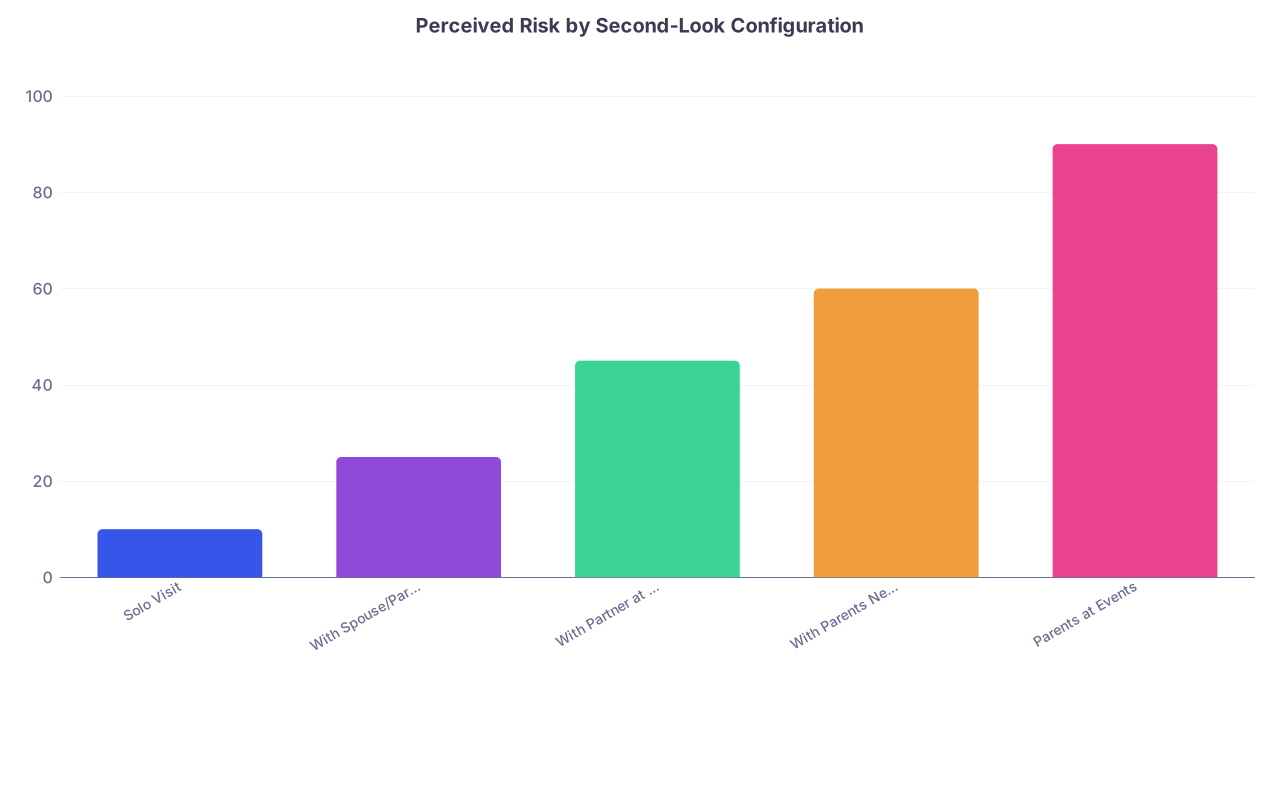
| Category | Value |
|---|---|
| Solo Visit | 10 |
| With Spouse/Partner - Separate Events | 25 |
| With Partner at Events | 45 |
| With Parents Nearby | 60 |
| Parents at Events | 90 |
The Bottom Line: Boundaries Protect You
Let me end this simply.
First: Second looks are professional events, not family field trips. Treat them that way.
Second: Every extra person you bring is an extra way to look unprofessional, over-dependent, or disorganized. Minimize the risk.
Third: If you’re going to involve partners or family, do it with deliberate, explicit boundaries—separate from program time, and never at the center of the visit.
Protect your rank list outcome by protecting your own professional image. Your future colleagues are watching, even on the “casual” days.