It’s late January. Your interviews are basically done. Your inbox has slowed to a trickle. And now you’re staring at that “Second Look” email from a program you liked… while you’ve heard nothing from two other places you loved even more.
Your classmates are talking about flying back for second looks “to show interest.” One chief resident offhandedly told you, “Honestly, they notice who comes back.” But when you check another program’s website, there’s a line buried in the FAQ: “Second look visits are neither required nor encouraged.”
So which is it?
Let me tell you what actually happens behind those polite official statements and what PDs say when you’re not in the room.
Some programs aggressively signal second looks without ever saying it out loud. Others quietly sabotage them, discourage them, or make them logistically impossible.
And the reasons are rarely the ones they tell you in public.
The Official Line vs. The Real Policy
Publicly, nearly every residency program now says some version of: “Second look visits are optional and not required for ranking.”
That’s the safe, NRMP-compliant, low-risk line. It avoids accusations of pressuring applicants, evens the playing field for those without money or time, and keeps them out of legal trouble.
But internally, there are three broad categories of programs in how they actually handle second looks:
| Program Type | Real Attitude Toward Second Looks |
|---|---|
| Quietly discouraged | Prefer you do not come back |
| Quietly encouraged | Notice and value in borderline cases |
| Actively weaponized (rare but real) | Used to signal, pressure, and sort |
The ones you’re asking about—the ones that secretly discourage second looks—almost always fall into that first group. And they have very specific reasons.
Let’s walk through the ones no one tells you during the social.
Reason #1: They’re Protecting Themselves From You (And Your Lawyer)
This is the part nobody says out loud in any brochure.
Program directors have been burned. And they talk to each other.
There have been NRMP complaints, email screenshots sent to the Match Violations Committee, applicants claiming they were “pressured” during second looks, and even lawyers involved when people didn’t match where they “thought they were promised.”
Here’s what actually happens:
A second look is usually less structured, less guarded, and less scripted than interview day. Residents are tired. Faculty are off their “faculty development” leash. PDs feel more relaxed and start speaking more freely.
And that’s where the problems start.
I’ve heard it with my own ears:
- “If you rank us highly, there’s a good chance we’ll end up together.”
- “We really hope you’ll come here.”
- “We see you as a great fit for our top spots.”
Those kinds of lines, spoken in a casual second-look hallway conversation, later show up in an NRMP complaint as “they told me I’d be ranked highly if I did X.” Or, worse, applicants interpret warmth and enthusiasm as commitment.
Programs know this now. PDs swap horror stories at national meetings. Chairs remind them: “Say less. Put nothing in writing. Avoid creating expectations.”
The easiest way to prevent trouble? Make second looks rare, optional, and clearly “not evaluative.” And then… quietly discourage them.
So they do things like:
- Offer no official second-look day.
- Have GME send out a blanket policy saying visits don’t affect rank.
- Be vague or slow in answering second-look emails.
- Push everything to virtual “Q&A sessions” where they can script and control the interaction.
You may interpret that as “they don’t want me.” Often it’s actually: “We don’t want the liability.”
Reason #2: They Don’t Want the Hidden Socioeconomic Bias
Here’s a conversation I heard almost verbatim from a large midwestern academic IM program:
PD: “We’re just selecting for who has the money and time to come back.”
APD: “Exactly. It’s all coastal kids with credit cards and no jobs.”
Chief: “And they act like this proves they’re more committed. Please.”
They’re right.
Second looks heavily favor:
- People who can afford another flight, hotel, and Ubers.
- People with flexible schedules (read: no childcare, side jobs, or family caregiving).
- People already geographically close.
And if you let second looks influence rank—no matter what you say publicly—you’re essentially rewarding wealth, flexibility, and proximity.
The better programs know this. The ones that are serious about equity do not want their rank list skewed by who can swallow another $600 weekend.
So what do they do?
They adopt an internal rule: “Second looks will not be used for ranking decisions.” Then they take it a step further: “Let’s discourage them outright so we’re not even tempted.”
That’s why you see phrases like:
- “We do not track second-look visits.”
- “We strongly discourage second-look visits; they confer no advantage.”
- “We are unable to accommodate individual second-look requests.”
They’re cutting off the pipeline before bias sneaks in. Some of them are dead serious about it. Not for optics. Because they’ve watched how easily the ranking discussion slides into, “Well, she came back for a second look, she must really want us.”
So they remove the temptation.
Reason #3: They Don’t Want to Be Played by Your “Interest” Game
Programs are not naïve anymore. They know applicants are playing all sides.
You tell three programs: “You’re my top choice.”
You attend two in-person second looks and three virtual ones.
You send “love letters” to your #1, #2, #3.
Programs talk. Trainees rotate between institutions and gossip. PDs share applicants’ behaviors over drinks: “Oh, she came for a second look here too? She told us we were her top choice.”
They’ve realized that second looks often do not meaningfully predict who will actually rank them first. Especially at competitive or “destination” programs.
From their perspective, a second look has become:
- A noisy, unreliable signal of genuine interest.
- A logistical nuisance (see Reason #4).
- A potential source of disappointment when they rank you highly and you put them at #5 anyway.
So some PDs have basically decided: We will not be emotionally or strategically blackmailed by second looks.
What that looks like behind the scenes:
- Faculty are told: “Assume every applicant is gaming you. Ignore second looks in rank deliberations.”
- Coordinators are instructed: “Offer group Q&A, not one-on-one second looks.”
- Rank meetings include explicit reminders: “Remember, per GME policy, second looks are not to affect our decisions.”
To avoid the emotional tug of “but she flew all the way back to see us,” some programs just shut the door quietly. No official second-look day. No individualized tours. Maybe a virtual session and that’s it.
Reason #4: Second Looks Break Their Workflow (And Burn Out Residents)
You need to understand this from their side of the table.
By late January or early February:
- Residents are fried from interview season.
- PDs are drowning in emails, rank meetings, and hospital admin stuff.
- Faculty are behind on their clinical, research, and teaching commitments.
Interview days are at least scheduled, staffed, and planned. Second looks? Those are random disruptions.
What they see when a second-look request hits the coordinator’s inbox:
- Someone has to be pulled off a busy service to “walk you around.”
- A chief or senior has to do another “informal meet” on a post-call day.
- PDs might get roped into yet another “quick 15-minute chat” that turns into 45 minutes.
Multiply that by 15–20 applicants and it becomes chaos. All for something they officially cannot (and often genuinely do not) use to change their rank list significantly.
So programs that are trying to protect their residents’ time—and not turn them into unpaid tour guides—start quietly sabotaging second looks:
- “We only offer a single virtual open house for all applicants.”
- “We unfortunately do not have capacity for in-person visits.”
- “You are welcome to independently visit the city, but we cannot arrange in-hospital experiences.”
Translation: We are not rearranging our lives for your ‘interest signal’ that may or may not mean anything.
Residents, by the way, often push hard for this. I’ve watched chiefs tell PDs bluntly: “If you schedule a second-look day, you’d better be the one giving the tours.”
Reason #5: They Don’t Want Back-Channel Ranking Pressure
Second looks are where the cringey, borderline-unethical conversations tend to happen.
Not always malicious. Often just careless.
- “From what I’ve seen, you’re a strong candidate for our top spots.”
- “We’ve really been talking about you a lot.”
- “Between us, I think you’d have a very good chance here.”
Applicants hear these and walk out thinking: They basically promised me. Then, if they don’t match there, they feel misled. That turns into gossip, social media posts, or formal complaints.
PDs know this is a minefield. They don’t fully trust their own faculty and residents to stay NRMP-compliant in informal settings. Especially after a long day when they’re tired and trying to be nice.
So some programs cut it off at the root: fewer unscripted second-look interactions, fewer chances for someone to say something stupid.
That’s why you’ll see language like:
- “There will be no individual meetings with the program director during second looks.”
- “Second looks are purely informational and not part of the evaluation process.”
- “We encourage you to email our coordinator instead of visiting in person.”
Behind closed doors, this is really: “Let’s keep our people from making verbal promises.”
Reason #6: They Already Know Where You Likely Rank Them
Here’s a more subtle one, but it’s real.
By late interview season, programs have a decent sense of:
- Who is local and likely to stay.
- Who has a partner or spouse in the area.
- Who has strong ties to the region.
- Who openly stated “I want to be here long-term.”
Those people are more likely to rank the program highly regardless of a second look.
Then there are the “reach” applicants:
- 260+ Step 2s applying broadly.
- Students from top 10 med schools with superstar letters.
- People expressing strong interest in 5–6 programs at once.
Programs know these folks are flight risks. A second look is not going to magically vault them to #1 on that applicant’s list. At best, maybe from #6 to #4.
From a program’s perspective, the ROI on second looks is awful. They lose time and energy and get very little predictive value in return.
That’s one of the big unspoken truths: most serious ranking decisions are made off the interview day, application, letters, and (sometimes) post-interview communications. Second looks are background noise.
So a lot of programs quietly decide: We’re not investing in this. It doesn’t change the game enough to matter.
Reason #7: They’re Preempting Future Rules and Scrutiny
The match world is moving. Virtual interviews, equity pushes, and more scrutiny on the costs and fairness of the process.
Many GME offices and institutions are already thinking:
- “If we let second looks influence rankings, we’re on thin ice.”
- “If we appear to be favoring students who can afford more visits, we’re going to get hammered on equity.”
- “If we require in-person presence in any way, we’re going against the spirit of virtual access.”
So they’re getting ahead of it.
You’ll see hospital-level or GME-wide policies that say:
- No program-sponsored second-look days.
- No program-arranged hospital tours after interviews.
- Only virtual supplemental events allowed.
This isn’t paranoia. They’re anticipating:
- Future NRMP guidance.
- A push to fully regulate or standardize post-interview contact.
- Pressure from med schools and applicants on fairness grounds.
So some programs are already living in that future. They’re clamping down now so they don’t have to change practice later, or defend themselves when everyone else is under a microscope.
What This Means For You (And How to Read the Signals)
The obvious question: if a program “discourages” second looks, should you back off?
Most of the time: yes.
If they explicitly say in writing “we do not encourage or accommodate second-look visits,” respect that. Pushing harder just annoys them and does nothing for your rank.
Where it gets subtle:
- A program says “second looks are not required and do not affect rank,” but residents during interview day say, “Yeah, people come back sometimes, just email us.”
- The website has generic language, but the coordinator responds warmly and offers dates without you begging.
Those are programs that are “officially neutral” but practically open. You can go if it helps you decide. Just don’t delude yourself that it will dramatically move your position on their list.
Here’s the key insider rule:
Treat a second look as for your clarity, not their evaluation.
Programs that secretly discourage second looks have already made the internal choice that these visits won’t help you. They’re not bluffing. You will not interest-game your way into a higher spot there by forcing a visit they don’t want.
If you still want to go—because you’re truly undecided and this might be your future for three to seven years—go on your own terms:
- Short, focused visit.
- Minimal demands on their time.
- No expectation of special treatment.
- Clear in your communication: “This is for my own decision-making; I understand it does not affect your rank list.”
That tone reads as mature, not manipulative. The PDs notice.
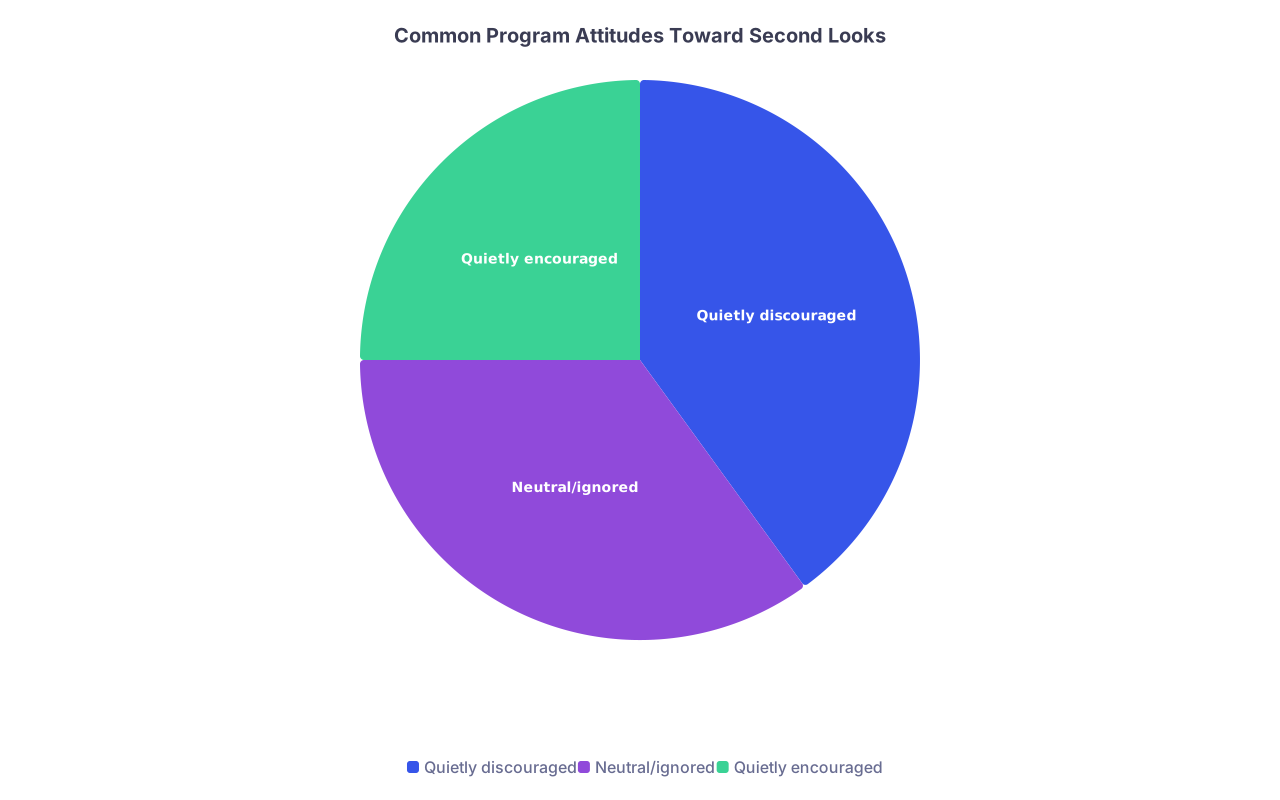
| Category | Value |
|---|---|
| Quietly discouraged | 40 |
| Neutral/ignored | 35 |
| Quietly encouraged | 25 |

| Step | Description |
|---|---|
| Step 1 | Program Website |
| Step 2 | Do not request visit |
| Step 3 | Ask residents about culture |
| Step 4 | Skip second look |
| Step 5 | Request low impact visit |
| Step 6 | Clarify fit for yourself |
| Step 7 | Discourage second looks? |
| Step 8 | Still undecided about ranking? |
FAQ: Second Looks and “Secret” Program Behavior
1. If a program discourages second looks, does that mean they’re not interested in me?
No. It usually means one of three things: they’re serious about equity, they’re trying to avoid NRMP/complaint problems, or they’re protecting their residents’ time and their own sanity. A blanket “we discourage second looks” policy is almost never about a single applicant. Don’t take it personally. Read their overall tone toward you: timely communication, how the interview felt, resident enthusiasm. That’s far more honest than their second-look stance.
2. Can a second look ever hurt me?
At programs that openly or quietly discourage them, yes, it can annoy people if you push too hard or create work. Showing up uninvited or insisting on faculty/PD time after they’ve said no is a bad look. Also, if you act off during a second look—entitled, uninterested, complaining—that can absolutely get back to the PD. Even if they “don’t use second looks for ranking,” human memory is human memory. The safe rule: if you go, be low-maintenance, respectful, and clear that you’re there to learn, not to hustle.
3. If second looks don’t change rank much, are they ever worth doing?
They can be worth it for you, even if they don’t move your position a single slot. Seeing how residents treat each other on a random day, how the hospital actually feels, how the city lands for you—those are real. For borderline choices (your #2 vs #3, or your only academic vs strong community program), a second look can give you clarity. Just stop thinking of it as a weapon in your application arsenal. It’s not. It’s a tool for your decision-making only.
Key takeaways:
- Programs that secretly discourage second looks are usually protecting themselves—from bias, from burnout, and from NRMP headaches—not trying to push you away.
- A second look almost never vaults you up a rank list; treat it as a way to clarify your own preferences, not as a performance.
- When a program clearly says “we discourage or don’t accommodate second looks,” believe them—and spend your energy refining your rank list, not trying to outmaneuver their policy.