
The way private-practice–based and academic residency programs view second looks is not the same—and pretending they are will cost you.
Most med students completely misread what’s actually happening behind the scenes. They think “showing interest” is a universal good. It is not. At some places, your second look is a quiet plus. At others, it’s a red flag. And at many, it’s nothing at all beyond a scheduling headache that gets you talked about for the wrong reasons.
Let me walk you through how people in the room actually think about this—PDs, APDs, coordinators, and the senior residents whose opinions carry more weight than you realize.
First, the uncomfortable truth about second looks
Second looks are mostly about you, not them.
Programs already have everything they need to rank you based on your application, interview, and the internal whisper network (faculty emails, clerkship directors’ impressions, “Do you know this student from X?”). By the time you’re asking about a second look, the rank list framework is largely in place.
Here’s the part nobody prints on their website:
For almost every program—academic or private—the second look is not about gathering more data to decide whether you’re competent. It’s about:
- Are you the kind of person who will fit (or clash) with their culture?
- Are you high-maintenance or low-drama?
- Are you realistic about the program, or weirdly desperate?
They’re screening for those things, not your medical knowledge.
Where private-practice and academic settings differ is how much they care about optics, recruitment value, and “interest signaling” versus workload, clinic revenue, and lifestyle.
How academic programs really see second looks
At large academic centers—think big-name university hospitals, safety-net academic centers, hybrid tertiary centers—second looks sit in a weird gray space.
They’ll never tell you this directly, but here’s the real breakdown.
The official line vs the committee room
On the website and in the emails, you’ll see language like:
- “Second looks are not required and will not affect your ranking.”
- “Second visits are purely informational and for your benefit.”
In the ranking meeting, the reality is more nuanced.
I’ve watched PDs in academic programs say things like:
- “She came back for a second look—clearly very interested. Any concerns?”
- “He emailed three times asking to come back. I get an intense vibe. Anyone work with him on an away?”
- “She canceled a second look with us to go to [another big-name program]—I doubt we’re her top choice.”
So no, they’re not formally bumping you up two tiers because you showed up again. But they are attaching a story to your name. And once there’s a story, that subtly influences how people feel when your file comes up.
The academic mindset: optics and “professionalism”
Academic PDs think in terms of policies, fairness, and how things would look if someone audited their process.
So:
- They’ll be very careful about saying second looks matter.
- They won’t put “second look” notes in ERAS.
- They avoid anything that smells like pressuring applicants.
But they absolutely remember:
- The applicant who came back, blended in with the residents, asked thoughtful service questions, then left quietly. They get labeled: “mature, low-ego, serious about us.”
- The applicant who came back and treated it like a second interview, cornering the PD for 30 minutes, asking “Where would I be on your rank list?” That person gets labeled: “needy, doesn’t understand boundaries.”
At a lot of academic places, the second look has become less important over time. Post-pandemic, virtual interviews are the norm; many departments have strong institutional pressure to avoid anything that even looks like extra evaluation.
But the informal reality? Second looks are still another chance for you to either reassure them you’re normal. Or convince them you’re not.
How private-practice–heavy programs see second looks
Now let’s switch to private-practice–based residencies: community programs, hospital-employed groups, hybrid community-academic setups where a big chunk of the faculty is private or productivity-based.
Different world. Different calculus.
Private groups think in terms of people they want to work with
The attending who owns a four-doctor cardiology practice and staffs a community IM program does not care about ACGME committee optics. They care about:
- Who am I going to see at 6:30 am in the ICU for the next 3 years?
- Will this person pull their weight?
- Do I want to eventually hire this resident?
So when you ask for a second look, they often interpret it more directly as:
- “This person might actually choose us over the big-name place across town.”
- “They’re making the effort to come back—probably serious about our program.”
- Or, “This person is already high-touch during recruitment. Are they going to be a headache later?”
You’ll see more variation in how heavily they weight interest. Some private-practice groups value loyalty and “fit” so much that a second look, done well, can absolutely bump you from “solid mid-list” to “let’s push them up.”
They will never document that. But I’ve heard it said verbatim in ranking meetings.
The business reality: second looks = recruitment, not evaluation
Private-practice faculty are thinking like business owners, even if they’re technically hospital-employed. They know:
- There are fewer genuinely strong applicants than slots in some specialties/locations.
- A resident who fits well may join the group, which is a direct financial upside.
- Getting a high-quality, sane, team-oriented resident is worth effort.
So at a private-practice–heavy program, your second look is more likely to be seen as:
“Here’s our chance to close the sale.”
You’ll notice subtle things:
- More one-on-one time with attendings.
- More faculty taking you to lunch or coffee.
- Candid conversations about post-residency job prospects in their group, buy-in paths, compensation.
They’re not doing that for charity. They want you to feel like this is your place.
But the flip side is very real: if they sense you’re just using the second look as leverage for some bigger program, it irritates them. They feel played. That can hurt you.
The unspoken rules: what programs track and what they ignore
Let me be blunt: most programs—academic or private—are not maintaining some Excel sheet with a “second look = +1 point” column.
Instead, they’re doing something more insidious and more human.
They’re tracking:
- The impression you made
- How much extra work you caused
- Whether your behavior fit their local culture
Here’s how each type of program usually reacts internally.
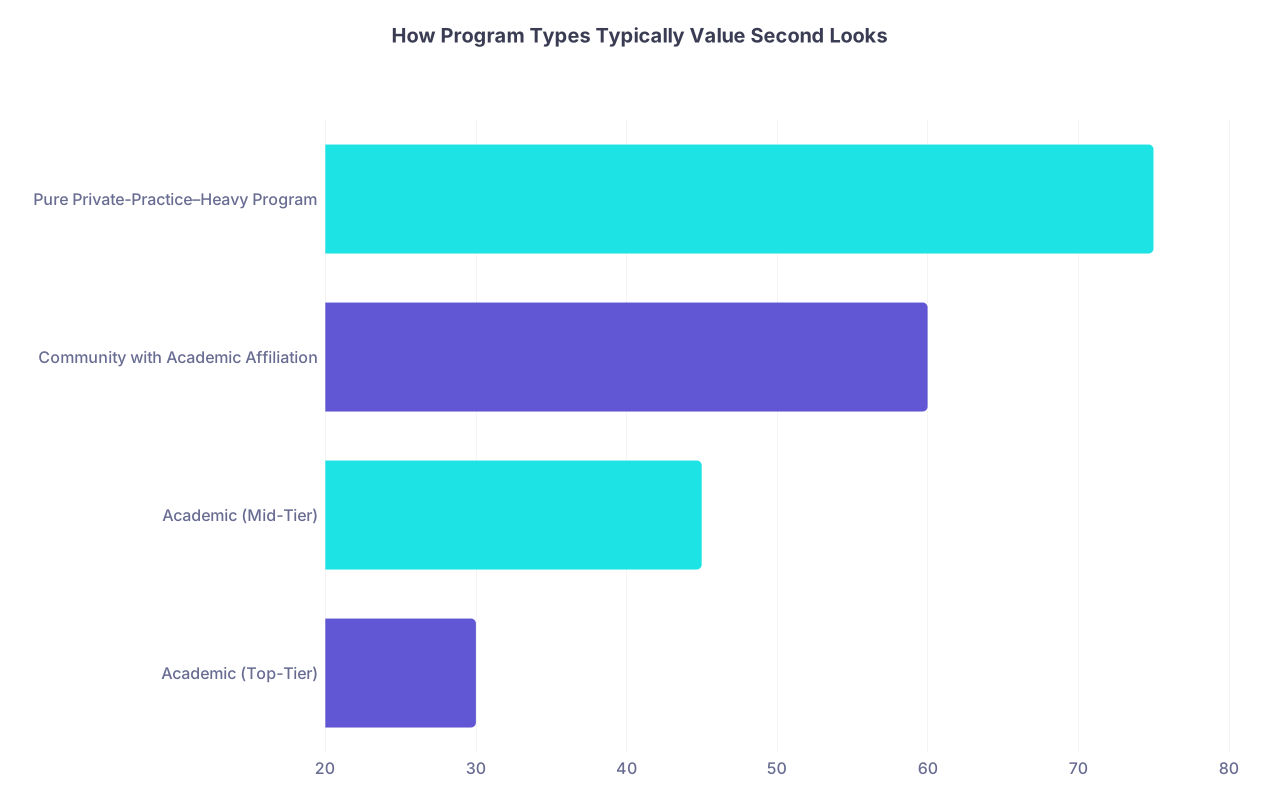
| Category | Value |
|---|---|
| Academic (Top-Tier) | 30 |
| Academic (Mid-Tier) | 45 |
| Community with Academic Affiliation | 60 |
| Pure Private-Practice–Heavy Program | 75 |
Think of these as rough “interest in your interest” scores, not rank impact out of 100.
Academic programs: cautious and political
In academic centers, you will see:
- PDs saying: “We can’t use this formally, but it’s nice to know they’re really interested.”
- Residents saying: “I liked her when she was here. She came back and still seemed normal.”
- Coordinators quietly tracking who is high-maintenance in scheduling.
Where you can get burned in academics:
- Coming back and then essentially re-interviewing faculty who have zero time for it.
- Asking rank-list questions, even indirectly. (“So… how many people who do second looks usually match here?” ← they hate this.)
- Copy-paste “interest” that’s clearly not specific to their program.
Where you can get a subtle boost:
- Second look focused on: “Is this my place?” not “Please love me.”
- Spending time with residents, not chasing the PD down the hallway.
- Making a clear, modest statement of interest: “This visit confirmed this is one of my top choices.”
No drama. No pressure.
Private-practice–based programs: more direct, but more sensitive
In private-practice settings, the threshold for your behavior being interpreted as “too much” is actually lower than you think.
These attendings have less tolerance for perceived entitlement or weirdness. They’re not protected by academia; they’re thinking, “Do I want this person covering my patients?”
You win points when:
- You’re friendly but not fawning.
- You ask grounded, practical questions: workflow, schedule, call, clinic expectations.
- You show you’ve actually thought about living there long-term.
You lose points when:
- You name-drop bigger programs repeatedly.
- You sound like you’re “settling” for them if nothing else works out.
- You act like you’re doing them a favor by coming back.
They are extremely attuned to that last one.
The post-COVID reality: are second looks dying?
People keep asking whether second looks still matter in the era of virtual interviews.
Here’s the insider view: they’re not dying. They’re mutating.
Pre-2020, second looks were more open, casual, and expected in some regions. Post-2020:
- Many academic institutions now explicitly discourage evaluative second looks.
- Some GME offices have written policies that second looks cannot be used in ranking.
- Programs are terrified of looking like they’re pressuring applicants to spend extra money.
But that’s all formal policy. Informally, three things are true:
- PDs still remember your name if you came back.
- Residents still talk about you if you came back.
- Faculty still form impressions based on who asked for a second look and how they behaved.
The difference now is that most places will bend over backwards to describe it as “purely informational” and will avoid giving you any hint that it could help. They don’t want complaints. They don’t want a trail.
How to decide: academic vs private-practice programs and your second look strategy
You should not have the same second-look strategy for a big academic IM program and a private-practice community program. That’s where a lot of otherwise smart applicants blow it.
Let’s map this out.
| Program Type | When a Second Look Helps | When It Hurts |
|---|---|---|
| Top-tier academic | Clarify fit, sanity check culture | Acting needy, asking rank questions |
| Mid-tier academic | Signal genuine interest, refine rank | High-maintenance scheduling |
| Community with academic tie | Show you’d actually come | Looking like you are “settling” |
| Private-practice heavy | Show long-term interest, local ties | Coming off transactional or arrogant |
| Competitive specialty | Only if truly targeted | Mass second looks to many places |
For academic programs
Use a second look primarily to answer your own question: “Can I survive and thrive here?”
Go if:
- You’re genuinely torn between a few academic programs and need real-world data.
- You had a virtual interview and have never set foot in the place.
- You have legitimate, program-specific questions that residents—not PDs—are best suited to answer.
Skip it if:
- You’re low on funds and this would put real strain on you.
- You’re just doing it because you heard “it shows interest.”
- You’re already certain they’re not top 3 on your list.
For academics, a well-targeted email that’s specific and respectful can be as powerful as an unnecessary flight.
For private-practice–heavy programs
Here, a second look can matter more—if you do it right.
Go if:
- You truly could see yourself there long-term.
- You want to understand the business side: partnership, hiring patterns, real call burden.
- You’re ranking them highly and might even consider joining the group later.
When you go, frame your presence like this:
“I wanted to come back and see what a day here really feels like, especially on the service I’d be on most as an intern. I’m trying to make a very realistic decision about fit and long-term plans.”
That reads as mature and serious, not desperate.
Skip it if:
- You’re just checking a box. They’ll smell that.
- You already know you’re ranking them low.
- You’re stacking multiple second looks back-to-back and will show up visibly burnt out and disengaged.
What actually happens during a second look (behind the scenes)
Let me describe what the internal conversation looks like after you leave.
At an academic program:
- Residents wander back to the workroom: “So what did you guys think of Alex?”
- One senior says, “Honestly, seemed totally normal. Asked good questions. I’d be fine working with them.”
- Another says, “They asked me three times about how often people go to fellowship at [big-name place]. I got a climber vibe.”
- That flavor of conversation colors your reputation.
Later, in the ranking meeting, the PD may say, “Residents, any additional thoughts on Alex?” That’s where those impressions surface.
At a private-practice–based program:
- The attending who let you trail them in clinic walks back to the office and says, “I could see them here. Good with patients, didn’t seem above the work.”
- Or: “Sharp, but I got the sense we’re their backup.”
When they’re debating close calls between equivalent applicants, these are the comments that move you up or down a few spots.
No one is saying: “Alex did a second look, add 5 ranks.” This is more subtle but more powerful. You’re shaping how they talk about you when it counts.
How to avoid the classic second look mistakes
The mistakes are depressingly predictable. I’ll keep this short.
Do not:
- Turn the visit into a second interview.
- Ask anything about how your second look affects your ranking.
- Monopolize the PD or APD’s time; their day doesn’t stop because you flew in.
- Trash other programs during conversations with residents. That gets repeated.
Do:
- Spend the majority of your time with residents. That’s who you’ll actually live with for 3–5 years.
- Ask concrete questions: “Show me your call rooms.” “Where do you actually sit during the day?” “What’s the worst part of this program?”
- Leave gracefully. A short, specific thank-you email is enough. Not a manifesto.
If you’re tempted to send a three-paragraph “this is my number one” email after a second look—pause. It reads clingy and rarely changes anything.
Where second looks are headed
We’re moving toward a world where:
- Fewer programs will actively encourage formal second looks.
- More will grudgingly “allow” them but pretend they don’t exist.
- A small subset—especially some private-practice–heavy or mid-tier community programs—will quietly value them as proof someone might actually come.
Your job is to read the signals.
If a program’s coordinator sounds lukewarm or harried when you ask about a second look, that’s your clue. If they immediately say, “Oh absolutely, we have a day next month where a few applicants are coming back, want to join?” that’s another.
Watch how easy they make it for you. Effort on their side = genuine receptivity.
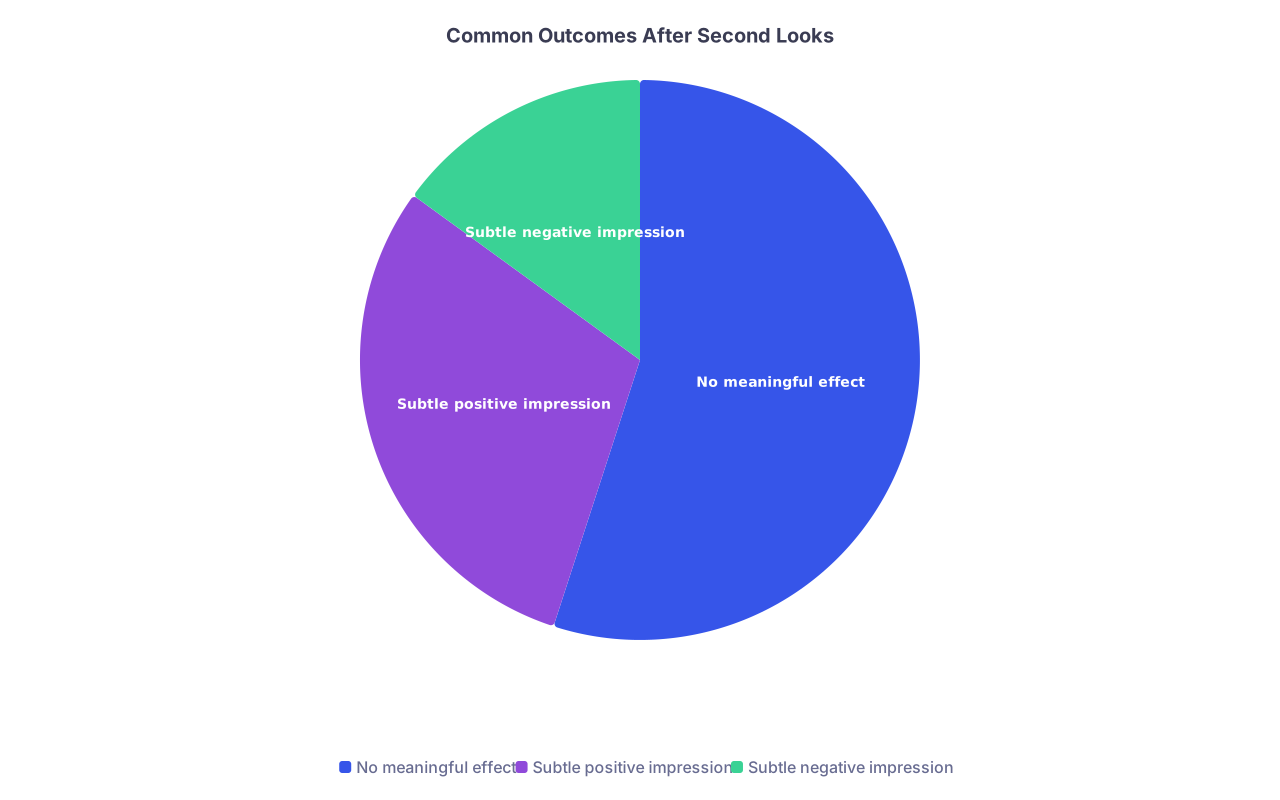
| Category | Value |
|---|---|
| No meaningful effect | 55 |
| Subtle positive impression | 30 |
| Subtle negative impression | 15 |
More than half of the time, second looks don’t move the needle. Around a third of the time, they help slightly. And yes, a non-trivial chunk of the time, they hurt you.
So use them like a scalpel, not a hammer.

| Step | Description |
|---|---|
| Step 1 | Identify Program Type |
| Step 2 | Skip second look |
| Step 3 | Consider targeted visit |
| Step 4 | Schedule focused second look |
| Step 5 | Spend time with residents |
| Step 6 | Send brief thank you and adjust rank |
| Step 7 | Academic or Private |
| Step 8 | Top realistic choice? |
| Step 9 | Could you stay long term? |
FAQs
1. Can a second look ever bump me from “probably not ranked” to “ranked”?
Occasionally, at smaller or private-practice–heavy programs, yes—but only if you were borderline and your in-person behavior strongly reassures them. At large academic programs, if you were truly “do not rank,” a second look almost never salvages that. It can refine where you land, not resurrect you.
2. Should I tell a program during a second look that they’re my number one?
Only if it’s true and only once, briefly. A simple, “I’m strongly considering ranking this program first,” said to the PD or APD in person or in a short follow-up email is enough. Anything more elaborate starts to feel performative and desperate.
3. If my interview was virtual, is a second look more valuable?
It’s more valuable for you than for them. You need to see the hospital, the residents, the city. Programs will still rely mainly on your interview and file. But in the background, residents will feel more confident advocating for you if you seemed normal and aligned in person.
4. Is it bad to do second looks at multiple programs in the same city or region?
Not inherently, but word travels. Faculty move between sites. Fellows rotate. If you show up to three places giving each the “you’re my top choice” speech, expect that to leak. Use the second look for programs where you have a plausible story: realistic fit, strong interest, and not obviously using them as a backup.
5. How late in the season is too late for a second look?
Once rank meetings have started in earnest—often late January to mid-February—it’s harder for a second look to influence anything. That said, informal impressions can still slip in right up until the certified list is finalized. The later you go, the more your second look should be for your clarity, not to “boost” your chances.
Key points: private-practice–heavy and academic programs don’t interpret second looks the same way; your visit shapes narrative, not just data; and a second look is a surgical tool—use it selectively, or skip it without guilt.