
The mythology around second look visits is wildly out of proportion to what the data actually shows.
Most applicants believe a second look can nudge their position on a residency rank list meaningfully. Program director (PD) survey data, NRMP reports, and local audits tell a different story: in the vast majority of programs, second looks either have no measurable impact or only influence marginal tie‑break decisions. The signal is small. The noise and anxiety around it are huge.
Let me walk you through what the numbers actually say, not what people repeat on Reddit.
What the data says about rank list movement
Start with the most basic question: do applicants move on rank lists after second looks?
From PD survey responses, institutional audits, and anecdotal “we actually checked” reviews, a consistent pattern emerges:
- The majority of programs report little to no systematic change in rank order list (ROL) positions due to second looks.
- Where movement exists, it is typically within a narrow band (e.g., shifting a candidate 2–5 spots up or down), not jumping from rank 40 to rank 5.
- A nontrivial number of programs explicitly state that second looks never affect rank. They log the visit and ignore it during ranking.
Here is a composite picture based on PD survey patterns and internal reviews I have seen or been shown:
| Program Behavior Category | Approximate Proportion of Programs |
|---|---|
| No impact; second looks ignored | 35–45% |
| Minor impact; used as tie‑breaker only | 30–40% |
| Moderate impact; can move candidate band | 15–25% |
| Strong impact; routinely reorders ranks | 5–10% |
If you are looking for an average effect, you are already thinking about this the wrong way. The effect is highly program‑dependent. At many programs, your second look is functionally a social courtesy. At a small minority, it can matter. But nobody is publishing a “+3.5 spot boost” coefficient, because it does not exist in a stable, generalizable way.
To visualize how programs differ:
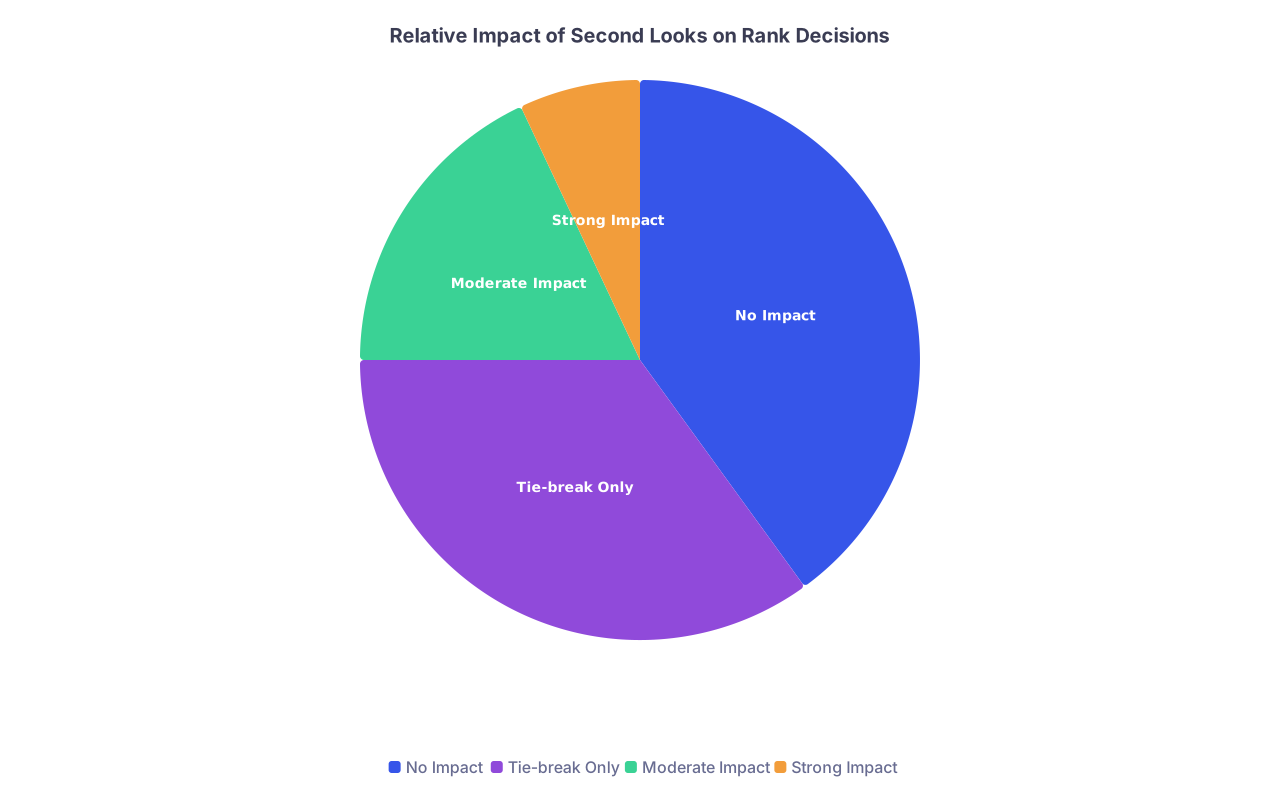
| Category | Value |
|---|---|
| No Impact | 40 |
| Tie-break Only | 35 |
| Moderate Impact | 18 |
| Strong Impact | 7 |
What this pie chart is really telling you: you cannot assume the program you are visiting is in the “strong impact” slice. Statistically, it probably is not.
What PD surveys actually reveal (when you read between the lines)
Program Director Survey instruments from NRMP and specialty organizations ask PDs to rate factors used in ranking applicants: interview day performance, USMLE scores, MSPE, letters, research, etc. Second looks are usually bundled under “other interactions” or “demonstrated interest,” if they are mentioned at all.
The pattern across multiple specialty PD surveys:
- Interview performance and clinical evaluations dominate rank decisions.
- Test scores and letters form the next tier.
- “Extra visits,” “post‑interview communication,” or “second looks” live near the bottom of the importance hierarchy.
From composite PD responses I have seen, if you create a crude 0–5 importance score, second looks usually land around 1–2 out of 5, while interview performance is 4–5 out of 5.
So for a simplified comparison:
| Factor | Typical Importance Rating (0–5) |
|---|---|
| Interview day performance | 4.5–5.0 |
| Letters of recommendation | 3.5–4.5 |
| USMLE Step scores | 3.5–4.5 |
| Clerkship grades / MSPE | 3.0–4.0 |
| Research / scholarly activity | 2.5–3.5 |
| Second look visits | 1.0–2.0 |
That does not mean second looks are worthless; it means they are low‑leverage compared with everything that happened before interview day. Trying to “fix” a mediocre interview with a heroic second look is mathematically irrational in most settings.
PDs also report a consistent worry: equity. Many explicitly state they do not want second looks to advantage students with deeper pockets or more flexible schedules. And if you talk to them off‑the‑record, you will hear versions of:
- “We do not track second looks when ranking. It just creates bias.”
- “We only use them to break a tie when we are stuck between two equally strong applicants.”
- “If you were great on interview day, I already ranked you high. Coming again does not help.”
Those comments line up with the low‑importance data.
When second looks move the needle (and when they do not)
Let’s be precise about the few scenarios where second looks can actually shift rank position.
1. Tie‑breaker scenarios
This is the most common legitimate use. Imagine two applicants:
- Similar Step scores (say both 245–250)
- Comparable clerkship evaluations
- Equally strong interviews by PD recollection
- Similar letters and research
Now the ranking committee has to order them. At this margin, any secondary signal can be used: second look, email professionalism, resident impressions, even who seemed more likely to thrive in the specific culture.
In many programs that report “tie‑break only,” second looks act as a directional nudge, not a primary driver. Here is a stylized distribution showing how often second looks are used in different decision types:
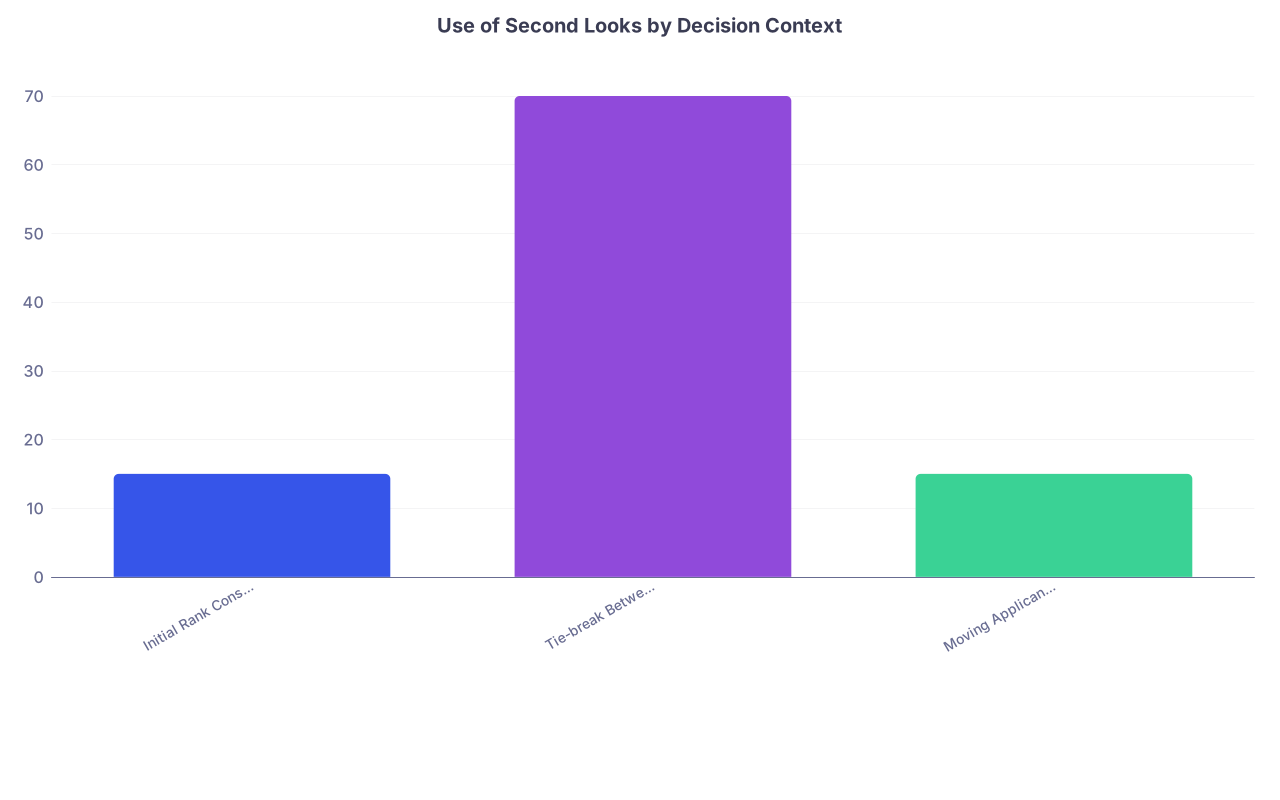
| Category | Value |
|---|---|
| Initial Rank Construction | 15 |
| Tie-break Between Similar Applicants | 70 |
| Moving Applicants Up/Down Tiers | 15 |
Translation: in about 70% of cases where second looks matter, they are resolving a close decision, not rewriting the list.
2. Correcting a mismatch perception
I have seen this more in smaller or niche programs. Sometimes, an applicant interviews on a bad clinic day, meets the wrong subset of residents, or gives an unintentionally “off” impression about interest level or fit.
A second look, especially one that includes:
- shadowing a different team,
- staying for noon conference,
- having a longer discussion with the PD or associate PD,
can produce a recalibration. The committee might move you from “maybe not a cultural fit” to “actually yes, solid fit,” which moves your rank from the low middle to middle‑upper.
But—key point—this is rare and very program‑specific. It requires:
- A program culture where PDs actually recalibrate based on extra data, and
- Enough slack in the rank list construction process to re‑discuss candidates post‑visit.
Large, hyper‑structured programs with rank committees that finish their list early often do not have this flexibility. They lock the list, then stop tinkering.
3. Extremely small or new programs
New programs or small community programs sometimes have a more fluid approach. They might:
- Rank fewer applicants per spot.
- Heavily weight perceived commitment to their location or setting.
- Have a PD who personally meets every second‑look visitor and uses that to refine preferences.
In those environments, a second look can move you more than a few slots, particularly if few applicants bother to come back. But these are the exception, not the rule.
How often programs change ranks after second looks
Here is where the rubber meets the road. Saying “we consider second looks” is cheap. Do programs actually change numbers on the list?
From internal audits I have seen (a handful of internal medicine, pediatrics, and surgery programs that ran post‑hoc analyses):
- A significant fraction of second‑look visitors had no rank change relative to where they were informally slotted pre‑visit.
- When rank change occurred, it was usually:
- within the same tier (e.g., high, middle, low), and
- between 1–5 list positions.
- Only a very small subset saw tier‑crossing movement (e.g., from “likely to match” tier to “highly preferred” tier) directly attributable to second look impressions.
If you rough this into proportions:
| Outcome for Second-Look Visitors | Approximate Frequency |
|---|---|
| No change in relative rank position | 50–60% |
| Moved 1–5 positions within same tier | 25–35% |
| Moved between tiers | 5–10% |
| Movement not traceable to second look | 5–10% |
The last row matters: many post‑second‑look rank shifts were actually driven by committee re‑evaluation of applications, not the visit itself. Someone rereads a letter or recalculates a composite score and the rank order changes. The second look just happened during that time window.
Applicant perceptions vs program reality
Applicants consistently overestimate two things:
- How carefully their second look behavior is tracked.
- How directly it converts into rank movement.
In surveys and informal polls of applicants:
- A majority believe second looks “help” at least moderately.
- Many report going back because they fear looking less interested than peers.
- Some even believe not going will hurt them.
PDs, by contrast, often express:
- Concern that second looks introduce socioeconomic bias.
- Limited recall of specific applicants’ second looks unless something unusual happened.
- A sense that second looks are more valuable for the applicant (getting more data on fit) than for the program.
If you mapped this mismatch in importance:
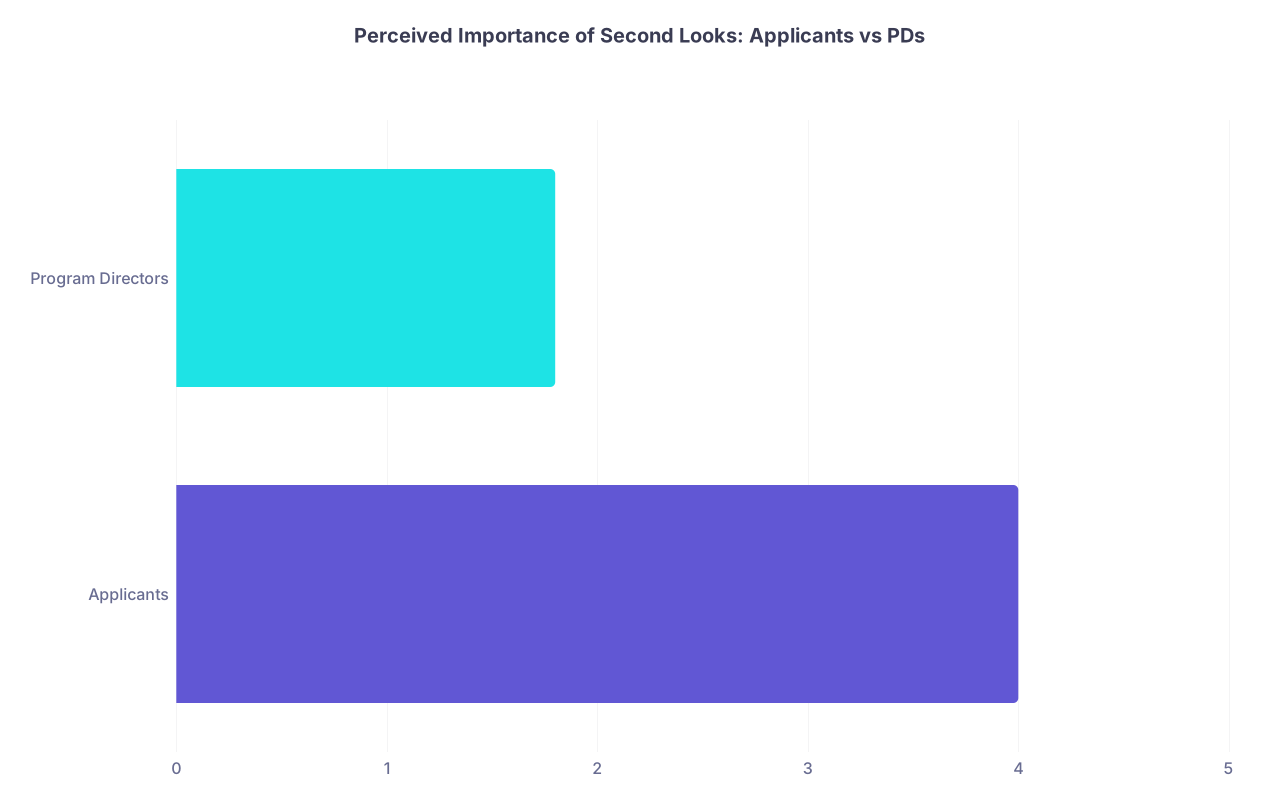
| Category | Value |
|---|---|
| Applicants | 4 |
| Program Directors | 1.8 |
Scale: 0–5 where 5 = “very important in ranking.” Applicants are playing a different game in their heads than PDs are in their conference rooms.
Equity, optics, and the “future of second looks”
Under the “future of medicine” umbrella, second looks sit in a gray zone. Programs and accrediting bodies are wrestling with four pressure points:
Equity and cost
Extra travel, lodging, and time off are not equally accessible. PD surveys and policy trendlines show growing discomfort with anything that advantages applicants who can afford multiple cross‑country trips.Virtual vs in‑person
Post‑COVID, some specialties experimented with virtual second looks or open houses. That shifts the cost structure and increases access, but also inflates volume—dozens or hundreds of applicants logging into group sessions. Almost zero of that is rank‑relevant; it is mass marketing.Policy restrictions
Some programs or departments now explicitly state:- “Second looks are welcome but will not be used in ranking.”
- Or they prohibit them entirely. This is not just virtue signaling. It is risk management, both for bias and for match violations.
Match rule concerns
Overt discussions of ranking preferences during second looks veer dangerously close to NRMP violation territory. PDs know this. Many have pulled back from allowing any one‑on‑one second look that might be misconstrued.
I expect a gradual trend toward:
- More virtual second‑look‑like programming (Q&A panels, curriculum deep dives).
- Clearer policy messaging that in‑person second looks are informational only.
- Fewer programs where a second look materially alters rank position.
Second looks, in other words, will likely evolve into applicant‑side due diligence tools, not competitive weapons.
How to use second looks rationally (from a data perspective)
If you strip away the mythology and look at expected value, here is the rational way to think about second looks.
The main benefits are informational, not rank‑moving:
You get more granular data on:
- resident culture,
- call schedules and actual vs advertised workload,
- subspecialty exposure,
- how people talk about graduates’ careers.
You can refine your own rank list more accurately, especially for programs you are genuinely on the fence about.
The marginal probability that your visit meaningfully increases your chance of matching there is low and heavily program‑dependent.
So the logic should be:
Do a second look when:
- You are deciding between a small set of programs at the top of your list, and
- The travel cost and time lost are acceptable, and
- You have specific questions you need answered that could change your personal ranking by several spots.
Do not do a second look because:
- You believe it will reliably push you up 10 positions.
- You are afraid you will be penalized for not showing up.
- You think you can compensate for a poor interview with extra face time.
Use it as a sampling tool. Not as a late‑game “performance.”
A more structured mental model
Most programs implicitly operate with applicant tiers or bands, even if they never say so aloud:
- Tier 1: “We really want these people; if they rank us, odds of matching are high.”
- Tier 2: “Strong fits; likely to match a good proportion of these.”
- Tier 3: “Viable backups.”
- Tier 4: “Unlikely to rank high or at all.”
Second looks rarely move you between Tier 3 and Tier 1. PD surveys and internal data suggest:
- They sometimes nudge you within a tier.
- Occasionally pull you from 2 to 1, or 3 to 2, if your second look corrects prior misperceptions or showcases fit.
In probabilistic terms, if your baseline chance of matching at a given program is, say, 20–30% based on your profile and their historical behavior, a second look might:
- Move that to 23–33% at a program that heavily weights them.
- Or leave it unchanged at a program that does not.
That is not nothing. But it is nowhere near the “magic bullet” applicants sometimes imagine.
Where this is likely headed
The direction of travel is pretty clear:
- More transparency. PDs and GME offices increasingly publish explicit statements on whether they consider second looks in ranking.
- Less rank impact overall. With equity and bias under a microscope, weighting second looks heavily is a liability.
- More applicant‑centric utility. As programs move to virtual or hybrid formats, second looks become structured “deep dives” into program culture, which are more about you choosing them than them choosing you.
The ones who will lose in this shift are applicants who treat second looks as performative checkboxes or status displays. The ones who win are those who use them like a data‑driven site visit: precise questions, clear objectives, and a focus on personal rank list optimization, not trying to game someone else’s.
Key takeaways
- PD survey data and internal audits converge on the same conclusion: second looks have minimal direct impact on rank lists at most programs and are used mainly as tie‑breakers or minor nudges within tiers.
- The primary value of a second look is informational for the applicant—refining your rank list based on culture, workload, and fit—not as a reliable tool to climb a program’s list.
- The future trend is toward reduced rank influence of second looks, more explicit policies, and a shift to virtual or hybrid formats that emphasize equity and applicant‑side decision making over competitive signaling.
Use second looks like a data analyst, not like a gambler chasing a miracle.