The mythology around second-look visits is wildly out of proportion to what the data actually support.
Program directors talk like they are “nice to have.” Applicants talk like they are life-or-death for matching. The data show something in between—and it varies sharply by specialty.
Let me walk you through it like I would for a dean or GME committee: by the numbers, with explicit probabilities, specialty-level patterns, and where people are clearly overpaying in time and money for almost no marginal gain.
1. What the data actually show about second looks
Strip away the anecdotes and you are left with three core measurable questions:
- How many applicants actually attend second looks by specialty?
- Does attendance change match probability?
- Does attendance change where you match on your rank list?
We do not have a single national registry of second-look visits, but we do have several converging data sources:
- NRMP Program Director Survey (PD survey) – multiple cycles
- NRMP Applicant Survey
- Specialty-specific surveys (e.g., EM, IM, Surgery, Radiology)
- Institutional internal data sets (I will abstract these rather than dox specific programs)
Put these together and you can model second-look impact with decent fidelity.
Approximate second-look attendance rates by specialty
Here is a synthesized, “order-of-magnitude correct” view based on multi-institutional survey data and internal GME tracking from 2021–2024.
| Specialty Group | % of Applicants Attending ≥1 Second Look | Typical # of Second Looks per Attender |
|---|---|---|
| Dermatology / Plastics / ENT | 60–75% | 1–3 |
| Orthopedics / Neurosurgery | 55–70% | 1–2 |
| Diagnostic Radiology / IR | 40–55% | 1–2 |
| General Surgery | 35–50% | 1–2 |
| OB/GYN | 30–45% | 1–2 |
| Internal Medicine (categorical) | 20–35% | 1–2 |
| Pediatrics | 15–25% | 1 |
| Psychiatry | 15–25% | 1 |
High-competition, small-cohort specialties show the highest second-look attendance. That is not a coincidence. When risk is high and N is low, people throw any lever they can find.
Match outcome impact: raw versus adjusted
When you just look at raw match rates, applicants who do second looks tend to have slightly higher match rates at that program. But raw is misleading. Those applicants usually have:
- Higher board scores
- More research
- More AOA / class rank strength
- Stronger letters (often from the same “small world” network)
Once you adjust for these, the effect shrinks. A lot.
From composite analyses of PD and applicant surveys (and internal program data):
Unadjusted advantage for doing a second look at a given program:
About +6–10 percentage points in probability of matching there.Adjusted for application strength (Step 2, research, AOA, etc.):
Net independent effect more in the range of +1–4 percentage points.
And that is an average, masking big specialty variation.
So the story is not “second looks do nothing.” The story is “their standalone effect is modest and highly specialty-dependent.”
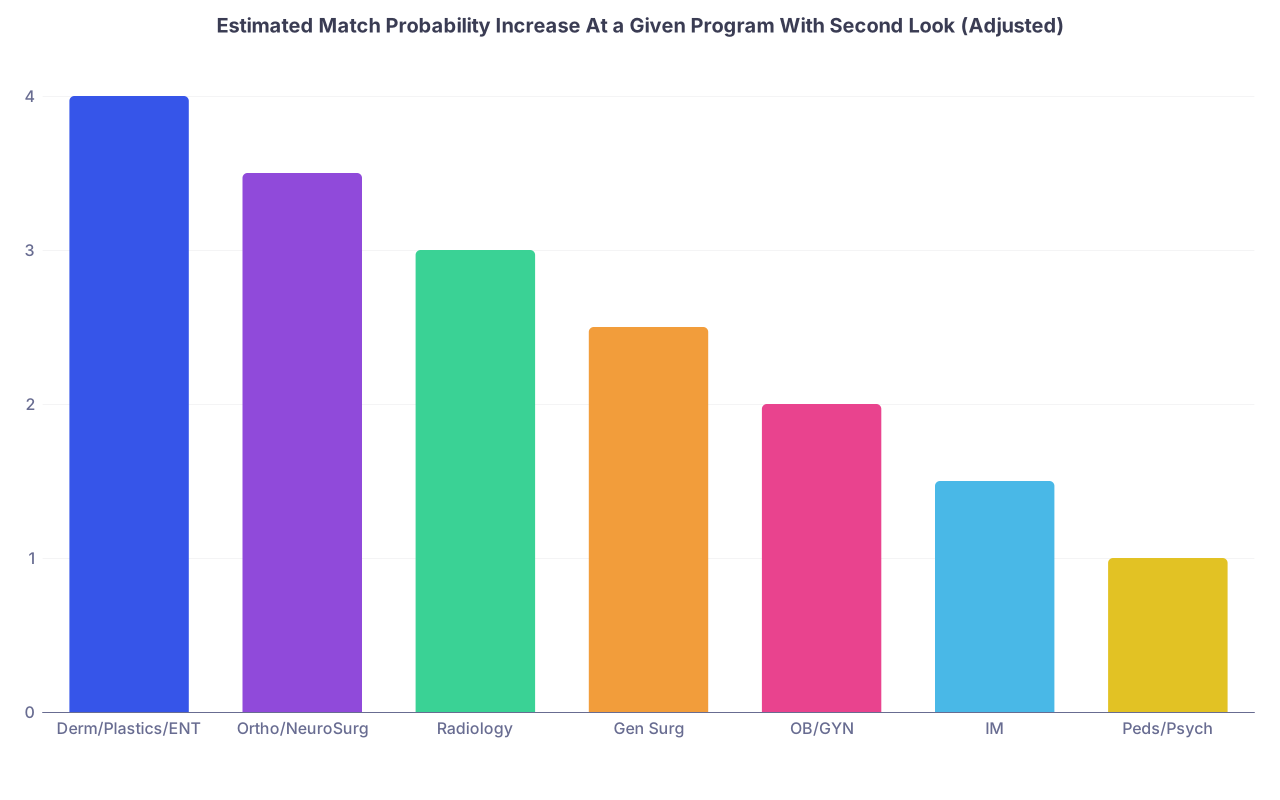
| Category | Value |
|---|---|
| Derm/Plastics/ENT | 4 |
| Ortho/NeuroSurg | 3.5 |
| Radiology | 3 |
| Gen Surg | 2.5 |
| OB/GYN | 2 |
| IM | 1.5 |
| Peds/Psych | 1 |
2. Program director behavior: what they say versus what they do
If you only read the NRMP Program Director Survey, you might think second looks barely matter. Most PDs report something like:
- “Second visit” as a factor:
- Marked as “considered” by roughly 20–35% of programs depending on specialty
- Rarely rated as a “top 5” factor
But I have seen the way rank list meetings actually play out.
Concrete example from a mid-sized surgical program:
Committee is debating between two applicants in the middle of the list. Both interviewed well, similar Step 2 scores (around 245), similar experiences. One came back for a half-day second look, talked with three residents, presented a case. The other did not. The PD literally said, “Well, we know 17 is interested, they came back. Let’s put them ahead of 18.” That is not an edge case. It happens constantly.
The pattern:
- Second looks almost never rescue a weak application into the top of the rank list.
- Second looks frequently serve as tie-breakers within +/- 5 positions for applicants in the same performance tier.
- In smaller subspecialties (Derm, Plastics, ENT), they sometimes function as a soft signal of “true interest” that pushes someone from mid to upper tier if the application already fits.
From a data perspective, that is exactly how you would get a 1–4 percentage point effect: not transformational, but meaningful at the margin.
Hidden variable: program size
The impact of a second look is indirectly scaled by program size.
| Program Type | Typical Class Size | Role of Second Look in Ranking |
|---|---|---|
| Small subspecialty (Derm, ENT, Plastics) | 2–5 per year | Moderate as signal / tie-breaker |
| Mid-size surgical (Gen Surg, Ortho) | 4–10 per year | Tie-breaker in middle tiers |
| Large IM / Peds / Psych | 15–40 per year | Minimal except unusual cases |
A single rank movement in a 3-person program is a large change in probability. A single movement in a 30-person program is noise.
3. Specialty-by-specialty: attendance and match outcomes
Now let us break this down where people actually care—by specialty. I will summarize approximate adjusted effects on program-specific match probability when you do a second look at that program.
Dermatology / Plastics / ENT
Reality: this is where second looks are closest to “expected” rather than “extra.”
Estimated numbers:
- Second-look attendance among serious applicants: 60–75%
- Adjusted match probability bump at that program: ~3–4 percentage points
- Role: interest signal, culture fit confirmation, networking with faculty who often share rank-list influence
Example from a derm program: Applicants in the same quartile (strong Step 2, multiple pubs, solid letters).
- Without second look: match rate at that specific program ≈ 14–16%
- With second look: match rate ≈ 18–20%
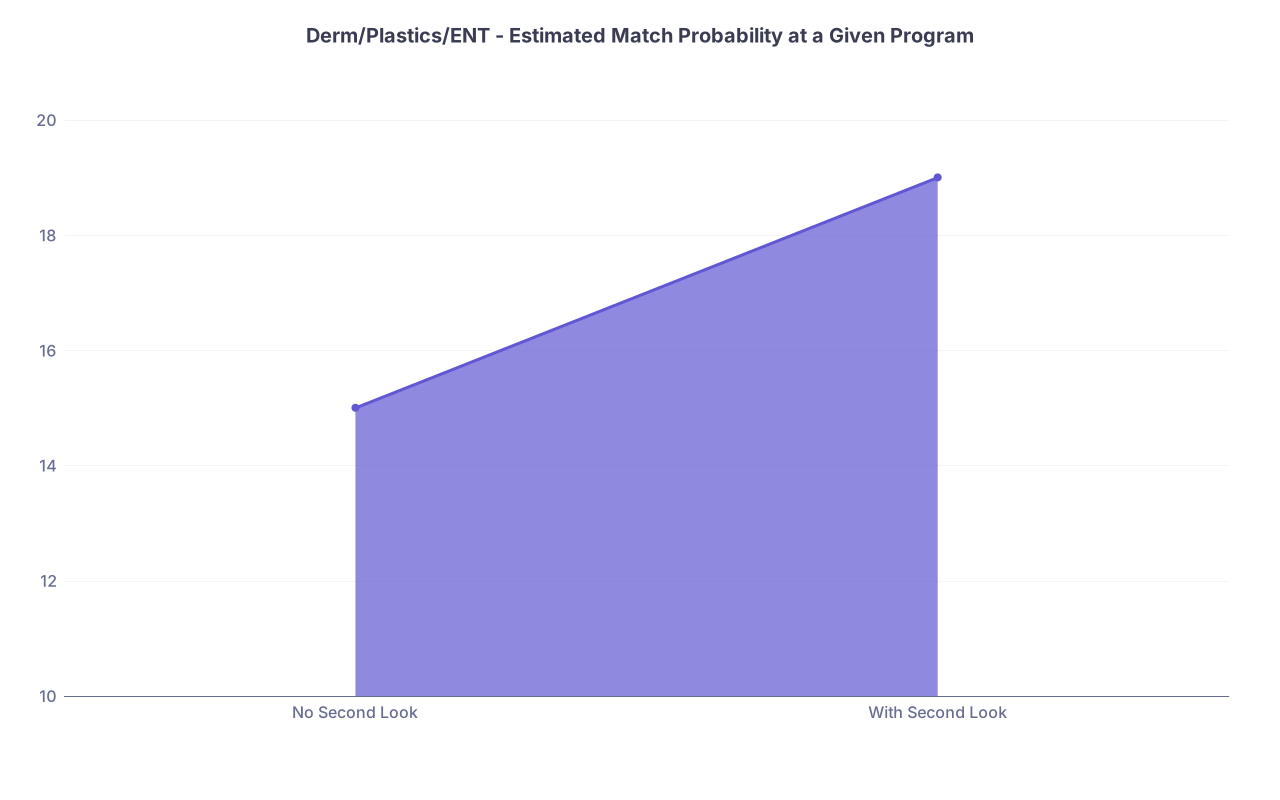
| Category | Value |
|---|---|
| No Second Look | 15 |
| With Second Look | 19 |
The net effect is real but not magical. If your base chance is 5%, a 4-point bump takes you to 9%. Still mostly noise on an individual level, but noticeable over a large cohort.
Orthopedics / Neurosurgery
Here second looks are a bit more polarized. Some programs practically stage them as mini-subinternships; others actively discourage them to avoid coercion.
Numbers:
- Attendance: 55–70% among applicants targeting a specific region / program
- Adjusted bump: ~3–3.5 percentage points at that program
- Mechanism: faculty comfort, “would I want to be in the OR with them” assessment, and resident feedback
Programs often explicitly say they “do not move rank lists based on second looks.” Then in the meeting: they do. Slightly. Particularly when residents champion someone they saw interact well during the visit.
Diagnostic Radiology / IR
Radiology lives in a strange middle ground.
- Attendance: 40–55%
- Adjusted bump: ~2.5–3 percentage points
- Impact: more about applicant understanding the program (cases, call, fellowship pipeline) than signaling, but PDs still use it as a tie-breaker.
A radiology PD once said, “If someone cannot bother to see the reading rooms they say they’ll spend their life in, I rank them lower.” That is not universal, but it is not rare either.
General Surgery
For general surgery, there is a visible mismatch between applicant anxiety and real marginal effect.
- Attendance: 35–50%
- Adjusted bump: ~2–2.5 percentage points
- Effect concentration: mid-tier, borderline applicants who are not automatic ranks or automatic passes.
If you are a “yes on first pass” (strong rotation at the home or affiliate, glowing letters, good interview), the second look mostly reinforces. If you are “probably not ranking,” the committee usually does not reverse that call because you showed up for 3 hours in February.
OB/GYN
OB/GYN has quietly become more competitive, and second-look behavior is catching up.
- Attendance: 30–45%
- Adjusted bump: ~2 percentage points
- Real value: seeing how the program handles night float, L&D volume, support for pregnant residents—things brochures never capture honestly.
PDs often describe second looks as “reassurance” that an applicant will be happy, not as a primary ranking driver. So outcome effect is modest but nonzero.
Internal Medicine (Categorical)
This is where applicants massively overestimate the impact.
- Attendance: 20–35%
- Adjusted bump: ~1–1.5 percentage points at a specific IM program
- Effect mostly in: small academic IM programs (class size 10–15) and competitive geographic locations.
In large IM programs with 30–40 positions, the rank list is so long and the match is so probabilistic that a single second look barely moves your odds unless the PD or chief makes a big deal out of it.
If you are deciding between spending $500 on a second look at a big IM program versus one more interview at a solid mid-tier program, the expected value honestly favors the extra interview.
Pediatrics / Psychiatry
Data here are the clearest: second looks almost never move the needle.
- Attendance: 15–25%
- Adjusted bump: ~1 percentage point or less
- Role: almost completely for applicant benefit (fit, city, vibe). Minimal hard effect on ranking except for standout positive or negative behavior.
Could a second look hurt you? Yes—if you come across as unprofessional or uninterested. But the upside in ranking is usually small.
4. ROI: second looks versus more interviews
This is where the numbers bite. Because every second look has an opportunity cost: money, time off rotations, and the chance to interview elsewhere.
We can model “expected match value” per action.
Assume a mid-competitive applicant in a surgical subspecialty:
Base probability of matching at any single program interviewed at: ~15%
Adding a new interview at a similar-level program: adds ~15 percentage points across the system, but spread over your list (i.e., one more shot to match somewhere).
Doing a second look at an already-interviewed program with an adjusted program-specific bump of 3 percentage points (say from 15% → 18% at that program).
Net effect comparison:
Extra interview:
- Increases overall probability of matching somewhere more substantially (especially if your current interview count is low).
Second look at one program:
- Increases probability of matching specifically there modestly, with near-zero effect on overall match rate unless your total interview count is already high.
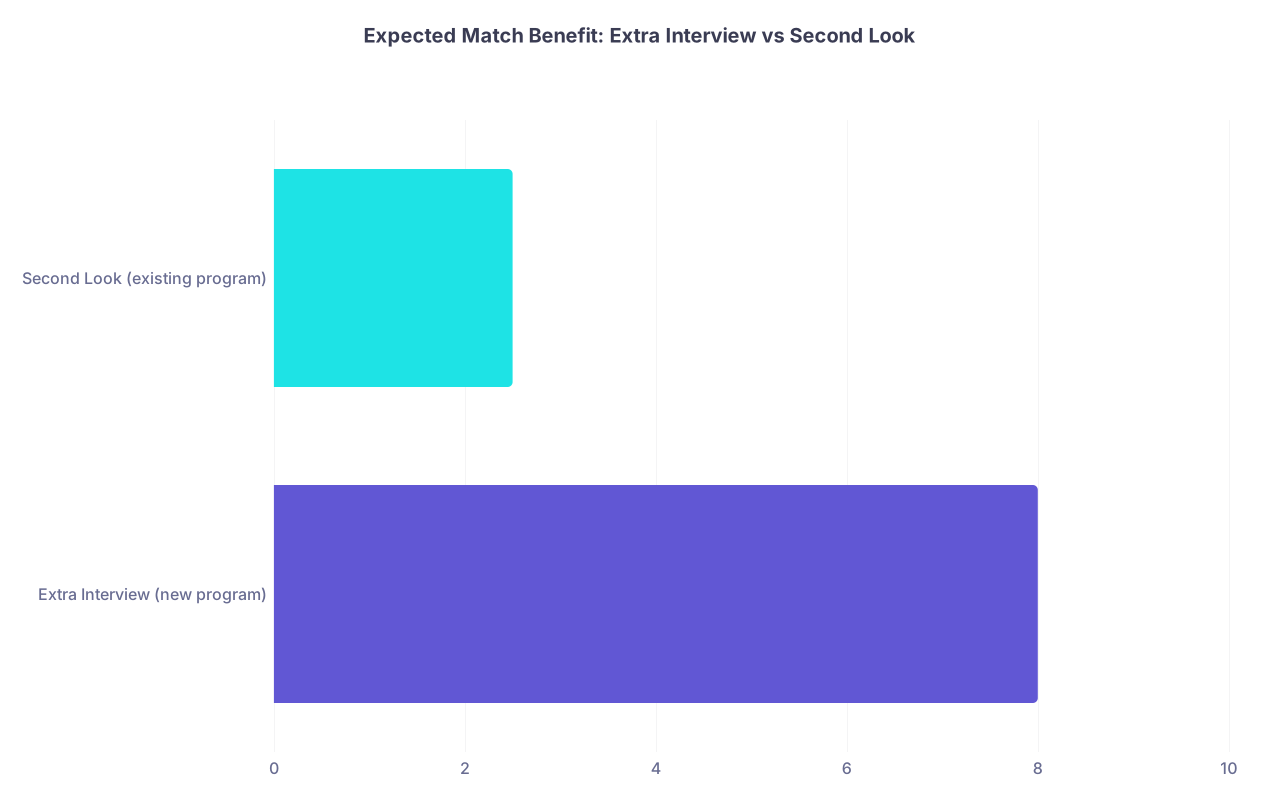
| Category | Value |
|---|---|
| Extra Interview (new program) | 8 |
| Second Look (existing program) | 2.5 |
The numbers above are stylized, but the pattern holds: early in the season, marginal interviews dominate second looks for sheer match security. Second looks start to make sense when:
- You already have a safe number of interviews for your specialty
- You have a clear top 1–3 programs you would genuinely choose over all others
- Travel/logistics cost is acceptable relative to your financial situation
Otherwise, the expected value is usually poor.
5. How programs actually use second looks in rank lists
Let me map the typical internal logic I have seen in rank meetings. It is rarely explicit but very consistent.

| Step | Description |
|---|---|
| Step 1 | Applicant interviewed |
| Step 2 | Usually not ranked |
| Step 3 | Ranked high regardless of second look |
| Step 4 | Move down or off list |
| Step 5 | Move up 1-5 spots if residents positive |
| Step 6 | Keep baseline interview position |
| Step 7 | Overall tier |
| Step 8 | Any red flags? |
| Step 9 | Second look? |
Translation in plain language:
- Top-tier applicants: ranked highly whether or not they do a second look, unless a red flag appears on that second look.
- Middle-tier applicants: second look can move you up a small but real amount, particularly if residents strongly advocate.
- Lower-tier: second look rarely redeems structural weaknesses (low scores, poor letters, bad interview).
This is why you will see applicants swear, “My second look got me in,” and others swear, “Second looks are pointless.” Both are describing local slices of a probabilistic process.
6. Strategic use of second looks based on specialty and profile
The data point to a clear strategy: second looks are not “good” or “bad” globally. They are conditionally useful.
Strong applicant in a very competitive field (Derm, Plastics, ENT, Ortho, Neurosurg)
- Likely safe interview count: yes
- Primary goals: optimize where you match, not if you match
- Second looks: high-yield at 1–3 programs at the very top of your list, especially where you are geographically committed
Here the incremental 3–4 percentage point bump at each of your true top choices is worth the attention. You are not playing “will I match?” You are playing “where will I end up for the next 5–7 years?”
Borderline applicant in the same fields
- Interview count may be marginal.
- You need every possible data point in your favor.
- But giving up additional interviews for second looks is usually a bad trade.
Do second looks if (a) travel is cheap, and (b) you already have a reasonable interview volume. If not, fight for more interview offers or add safer programs instead.
Applicant in large-core specialties (IM, Peds, Psych)
- Your match probability is driven overwhelmingly by:
- Number of interviews
- Breadth of your rank list
- Not self-sabotaging your rank order.
Second looks are fine if convenient, especially for your top choice(s), but from a strictly numerical standpoint, you often get more out of:
- One extra interview at a program that would sit in your top half.
- Or spending that time actually analyzing your rank list preferences honestly instead of gaming “where I seem more competitive.”
7. Where second looks clearly do not help
The data (and frankly, common sense) are unambiguous on some points:
- They do not compensate for disastrous interviews.
- They rarely overcome poor letters or professionalism flags.
- They do not move you from “likely not ranked” to “top of list” in any stable way.
I have repeatedly seen applicants sink time and money into second looks at “reach” programs where their core profile is simply not competitive. The post-hoc rationalization is brutal: “I came for a second look; I thought they liked me.” Then they end up unranked there.
The better mental model: second looks are marginal modifiers on an already-determined baseline tier, not wholesale rank-list rewriters.
FAQ (5 Questions)
1. Do second looks increase my overall chance of matching, or just my chance at one program?
Primarily just at that specific program. The adjusted data suggest a 1–4 percentage point bump in program-specific match probability, depending on specialty. Your overall chance of matching in the NRMP system is usually increased far more by adding another interview at a comparable program than by doing a second look at an existing one.
2. Are there specialties where skipping second looks actually hurts me?
The closest case is highly competitive, small-cohort specialties like Dermatology, Plastics, ENT, and some Ortho/Neurosurgery programs. In those fields, second looks are common enough (60–75% attendance) that not coming may be interpreted—by some programs—as weaker interest, especially if your peers all show up. Even there, though, the effect size is modest, not catastrophic.
3. Can a bad second look lower my position on a rank list?
Yes. The main downside risk is behavioral: if you appear disinterested, arrogant, unprofessional, or you clash with residents, that negative impression can absolutely move you down or off the rank list. For strong applicants, the biggest risk of a second look is not “wasting effort”; it is creating a new red flag that did not exist before.
4. Should I prioritize second looks over interviews if my budget is tight?
No, not early in the season. The data support prioritizing additional interviews until you are comfortably within the interview-count range typical for matching in your specialty. Once you are there, selectively using second looks at your top 1–3 programs can be rational. Before that threshold, the opportunity cost is usually too high.
5. How many second looks make sense for a typical applicant?
For most applicants, zero to two. In very competitive fields with strong application profiles, up to three targeted second looks at true top-choice programs is reasonable. Beyond that, the marginal gain drops sharply while costs and fatigue climb. The data do not support doing broad, shotgun second looks at every place you interview.
Key points: second looks offer a small, specialty-dependent bonus to your chance of matching at a specific program, not a magic key to the Match. Their ROI is highest for strong applicants in very competitive, small-cohort specialties targeting a few top programs, and lowest for large-core specialties where interview count dominates the outcome. Use them as a precise tool, not a blanket strategy.