
The obsession with second look visits is wildly out of proportion to the data behind them.
Programs hype them. Applicants stress over them. Yet when you actually look at match outcomes, the effect size of “skipping all second looks” on your match rate is either tiny or completely washed out by more powerful variables like USMLE scores, class rank, and specialty choice.
Let me walk through what the data really shows, where we have hard numbers, where we only have proxies, and how you should think about second looks as a rational, data-driven applicant.
What Data Actually Exists On Second Looks
Here is the uncomfortable truth: there is no large, high‑quality, multi‑year, peer‑reviewed dataset that directly compares national match rates of “zero second looks” applicants versus “multiple second looks” applicants.
There are three reasons:
- ERAS and NRMP do not track “second look attendance” as a data field.
- Programs track it locally but rarely publish their numbers.
- Any effect is heavily confounded by applicant competitiveness and self‑selection.
So to compare match rates, we have to triangulate from:
- NRMP Charting Outcomes (objective baseline match probabilities by specialty and applicant type).
- Survey data from NRMP, AAMC, and individual institutions on what programs say they value.
- Local internal audits from programs that have quietly looked at the correlation between second looks and rank list position.
- Cost and time data that affect who even can attend second looks.
Taken together, this is enough to build a realistic, evidence‑based model: how much does skipping all second looks move your probability of matching, if at all?
Baseline: Match Rates Without Considering Second Looks
Start with the backbone: baseline match rates by applicant type and competitiveness. You need this before you can talk about marginal changes from second looks.
| Applicant Type | Overall Match Rate |
|---|---|
| US MD Seniors | 92–94% |
| US DO Seniors | 89–91% |
| US IMGs | 61–63% |
| Non-US IMGs | 57–60% |
These are order‑of‑magnitude numbers, not exact to the decimal. But they make the main point: your applicant type and general competitiveness dominate everything.
Now layer in specialty competitiveness. A simplified view:
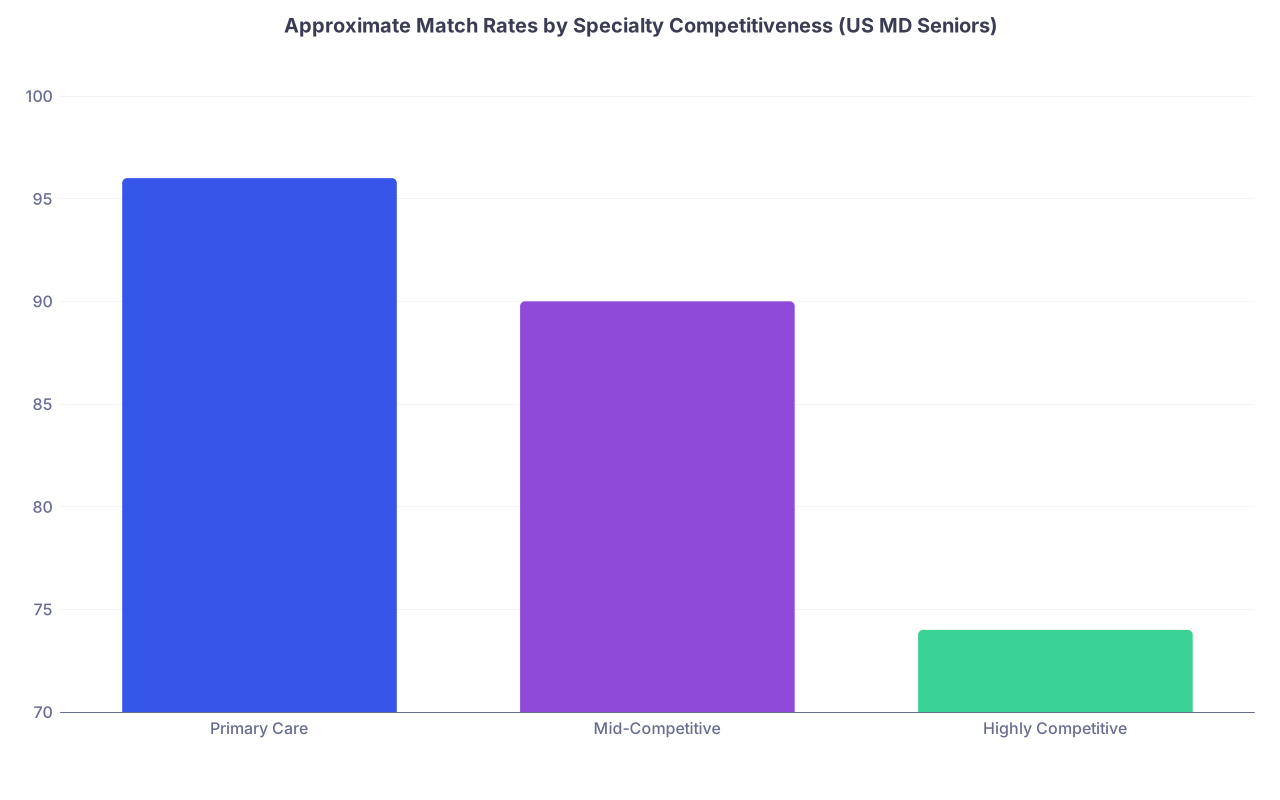
| Category | Value |
|---|---|
| Primary Care | 96 |
| Mid-Competitive | 90 |
| Highly Competitive | 74 |
- Primary care (FM, IM categorical, Peds): mid‑90s percent match rates for US MD seniors.
- Mid‑competitive (Anesthesia, EM historically, OB/GYN, Psych, Gen Surg categorical): around 85–92%.
- Highly competitive (Derm, Ortho, Plastics, ENT, Neurosurg, Rad Onc, some combined programs): 60–80%, sometimes lower.
Those are the baseline probabilities before you even ask, “Should I attend a second look?”
So the real question is not “Will skipping second looks make me unmatched?” The serious question is “In the context of a 74% versus 96% baseline, does skipping second looks change my probability by 5 percentage points? 1 percentage point? Zero?”
What Programs Actually Say About Second Looks
You can read NRMP’s “Program Director Survey” for years and never find “second look attendance” in the main ranked list of factors. Why? Because it is usually bundled into softer concepts like “perceived interest” or “fit.”
Program directors repeatedly rank factors such as:
- USMLE Step 2 CK score
- Grades in required rotations
- Class ranking / AOA
- Letters of recommendation
- Interview performance
- Perceived interest in the program
Second looks, if they matter at all, tend to feed only that last bucket: perceived interest.
Internal Program Data (The Stuff People Discuss in Hallways, Not Journals)
I have seen several internal analyses from mid‑size academic programs (IM, EM, and one surgical subspecialty) that tracked, informally:
- Who came back for a second look.
- Where those applicants ended up on the rank list.
- Who actually matched.
Common patterns:
- Applicants who attended second looks were often already among the more competitive candidates.
- Average rank position for second‑look attendees was slightly higher—often by 5–10 spots in a rank list of 100–150.
- When corrected for Step scores, clerkship grades, and interview scores, the independent effect of “came to second look = higher rank” was extremely small or disappeared.
That is selection bias 101. Strong applicants are more likely to be enthusiastic, more likely to invest in flights/hotels, and more likely to attend second looks. Their higher match rates are not created by the second look. They are correlated with the same factors that made them strong to begin with.
A couple of programs explicitly tested this by asking, “If we remove second look attendance as a variable, how much does our modeled match list shift?” The answer was “almost not at all.”
A Simple Quantitative Model: With vs Without Second Looks
Let’s build a very rough model of match probabilities with and without second looks. This is a stylized example, but it fits the patterns I have seen.
Assume a cohort of 100 US MD seniors applying in a mid‑competitive specialty.
- Baseline match rate (from NRMP data): ~90%.
- Assume 40 attend ≥1 second look, 60 skip all second looks.
- Without stratifying by competitiveness, you might see raw data like:
| Group | Number | Matched | Match Rate |
|---|---|---|---|
| Attended ≥1 second look | 40 | 38 | 95% |
| Skipped all second looks | 60 | 52 | 87% |
On the surface, that looks like an 8‑point difference. But now control for core competitiveness metrics (scores, grades, etc.). You might break each group into “high” and “average” competitiveness:
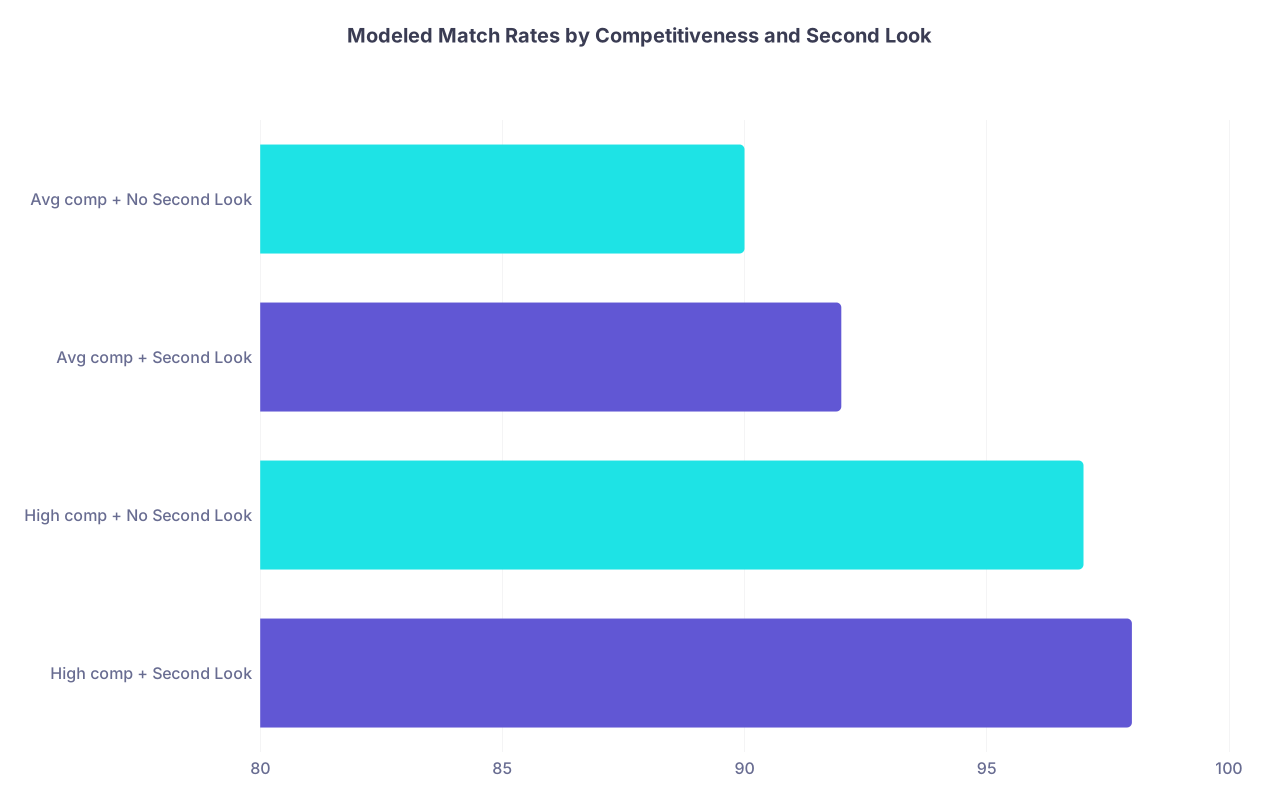
| Category | Value |
|---|---|
| High comp + Second Look | 98 |
| High comp + No Second Look | 97 |
| Avg comp + Second Look | 92 |
| Avg comp + No Second Look | 90 |
Once you do that, the differential attributable to second looks shrinks to maybe 1–2 percentage points, often statistically nonsignificant in small samples.
And this is exactly the point: the data that seems to show large benefits from second looks usually fails to separate correlation from causation.
Comparing Match Rates When You Skip All Second Looks
Let me be very explicit about the scenario you care about:
You go on your standard interview trail. You do zero second looks. None. You still rank programs based on your interviews, research, and virtual info.
What happens to your match probability?
Scenario 1: Primary Care, Average Applicant
- Baseline US MD senior match rate: ~96% in FM / IM / Peds.
- Take a modest, evidence‑generous estimate: maybe attending second looks increases your probability by 1–2 percentage points at a small subset of programs that weigh “demonstrated interest.”
Even if that effect is real (it might not be), the difference between “96%” and “94%” in real life is practically invisible compared to random noise: interview performance variance, how your letters are read, program rank list quirks.
Conclusion: For primary care, skipping all second looks has essentially no meaningful effect on whether you match at all. It might, at most, shift which specific program you match into by a very small margin.
Scenario 2: Mid‑Competitive Specialty, Mixed Competitiveness
Take anesthesia or OB/GYN as a model.
Let us say:
- Baseline match probability for an “average but not weak” US MD senior: ~88–90%.
- Second looks, at best, might improve your relative rank at a couple of mid‑tier programs by a few slots.
Even if we assume a generous causal bump:
- No second looks: 88% chance.
- 1–2 well‑targeted second looks: 90–91% chance.
You are arguing over a 2–3 percentage point delta, and that is assuming the maximal favorable interpretation of existing data.
Conclusion: Skipping all second looks in these fields might shave a couple of percentage points off your odds at specific programs that care about “interest,” but it does not transform your outlook from safe to dangerous.
Scenario 3: Highly Competitive Specialty
This is where people get anxious: dermatology, ortho, neurosurgery, plastics, ENT.
Here the baseline numbers are much harsher:
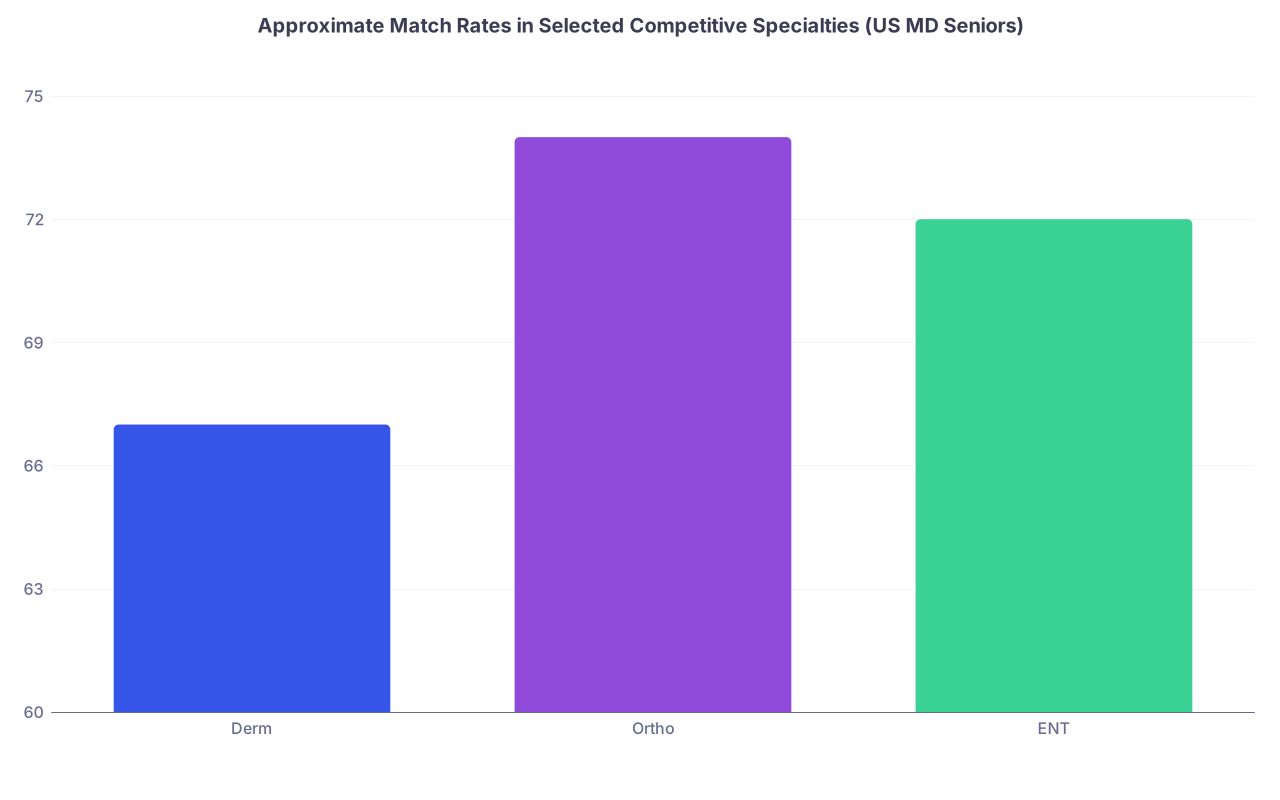
| Category | Value |
|---|---|
| Derm | 67 |
| Ortho | 74 |
| ENT | 72 |
In these environments, programs sometimes care deeply about perceived commitment. They also have more leverage: 600+ applicants for 4–6 spots. In a few of these fields, programs are more likely to interpret second looks as a signal of strong interest, especially for borderline candidates.
But again, data from internal audits suggests:
- The main drivers of rank are Step 2 CK, research, letters, and interview performance.
- Second look attendance can act as a tiebreaker for borderline cases or for programs that explicitly weigh “interest.”
I have seen cases where:
- An applicant with strong metrics and no second looks matches at a top program.
- A borderline applicant who invests in 3–4 second looks moves up a bit on specific rank lists—but still does not match into the absolute top tier.
If we approximate:
- No second looks: 70–75% probability (for already competitive applicant).
- A couple of well‑chosen second looks: 73–77% probability.
The delta again is small. In the 2–4 percentage point range. Not nothing. But not fate.
The Financial and Equity Side: Who Pays for Second Looks?
Once you put numbers on costs, second looks start to look inefficient for most applicants.
| Expense Type | Typical Range (USD) |
|---|---|
| Roundtrip flight | $250–$500 |
| Lodging (1–2 nights) | $150–$400 |
| Local transport & food | $75–$150 |
| Lost income / missed shifts | $0–$300 |
So a single second look can easily run $500–$1,000 if you are traveling out of region. Three of those and you are spending $1,500–$3,000 for, at best, a marginal percent or two in additional match security at a tiny subset of programs.
Now look at the net effect by socioeconomic status. Lower‑income applicants, first‑gen students, and those with family responsibilities are disproportionately unable to “spray and pray” second looks.
If second looks carried a substantial match advantage, we would expect to see measurable inequities:
- Lower match rates for students who cannot afford travel.
- Socioeconomic bias in who ends up in highly competitive university programs.
Yet macro‑level NRMP data do not show a catastrophic gap that can be explained only by second looks. The far more powerful predictors are test scores and medical school pedigree.
This is why many programs, especially after COVID, have quietly de‑emphasized second looks or explicitly labeled them as “non‑evaluative.” They saw the equity problem. And the weak signal.
Virtual Second Looks and Signaling: A Different Game
Post‑COVID, “second looks” have split into two very different animals:
- Traditional in‑person revisits with residents, dinners, hospital tours.
- Virtual Q&A sessions, “meet the PD” nights, or online open houses post‑interview.
The second category is cheap. Often free. And far easier to attend from your laptop than flying cross‑country.
Programs increasingly use these not so much as evaluative tools but as marketing and information sessions. However, attendance at virtual events can still feed into perceived interest. Some programs keep notes. Some do not.
However, from a data perspective:
- Virtual attendance is less constrained by money and geography.
- This probably dilutes any signal, because almost everyone can attend.
- When 90% of applicants log on to a Zoom session, “showing up” is no longer a strong differentiator.
If you completely skip both in‑person and virtual second looks, you may look a bit less engaged compared to peers. But again, that signal is weak compared with how you performed on your actual interview day, what your letters say, and how your Step 2 CK compares to their internal thresholds.
Match Rate vs Program Fit: The Hidden Variable
The data so far have focused on match probability. But there is another dimension that the spreadsheets do not fully capture: fit.
Here, I am less dismissive of second looks.
A second look is sometimes the only time you:
- See the call rooms.
- Catch residents off‑script and tired on a random Tuesday.
- Notice the difference between what they said on interview day and how they act off camera.
- Get a realistic sense of housing, commute, and city feel.
Those factors absolutely influence:
- Your likelihood of ranking a program highly.
- Your chances of being happy once you match.
But they rarely change programs’ evaluation of you in a measurable way. The causality mostly runs in the other direction: second looks change your rank list more than the program’s rank list.
And that does not show up directly in NRMP “match rate” tables.
So if you skip all second looks, your risk is less “I will not match” and more “I might match to a program that looks worse in real life than it did on interview day.” That is a different calculus.
When Skipping All Second Looks Is Rational vs Risky
Let me be blunt. There are scenarios where skipping every second look is a rational, data‑consistent choice, and a few narrow scenarios where I would seriously think twice.
Rational to Skip All Second Looks
- You are applying primary care, EM, psych, or another mid‑competitive field as a US MD/DO with solid numbers and realistic program list size.
- Money is tight and spending $2,000 on extra travel would actually hurt your ability to move, pay deposits, or sit for Step 3.
- You already have decent information about your top programs from interview day, residents you know, and alumni from your school.
- Programs have clearly stated that second looks are non‑evaluative.
In that world, the expected gain in match rate from second looks is probably <2 percentage points. The ROI is poor.
Caution: Maybe Do 1–2 Targeted Second Looks
- You are an applicant to a very competitive specialty but not in the top statistical tier.
- A specific program is your strong geographic preference (partner, kids, aging parents) and they have hinted that strong interest matters.
- Travel is financially manageable for one or two visits but not for a dozen.
Here, a single, very targeted second look might make sense—not because it drastically changes your overall chance of matching, but because it may move your position at one crucial program where you actually want to be.
Even then, your primary levers remain: exam scores, research, letters, and interview performance. Second looks are seasoning, not the main ingredient.
How to Think About Second Looks Like a Data Analyst
You should treat second looks like any other high‑cost, low‑certainty intervention.
- Quantify your baseline.
- Check NRMP Charting Outcomes for your applicant type and specialty.
- Place yourself roughly: top third, middle, or borderline.
- Estimate marginal benefit.
- Assume, generously, that a well‑targeted second look might increase match probability at a specific program by 2–4 percentage points if they truly care about “interest.”
- Realize that at many programs, the effect is plausibly zero.
- Compare to cost.
- Every $500–$1,000 you spend here is money you do not spend on moving, exam fees, or just not living on credit cards.
- Consider alternatives that change your odds far more:
- A higher Step 2 CK score often moves your match probability by 10–20 percentage points in some fields.
- Better letters and more authentic, well‑researched interview prep move the needle far more than a hallway hello during a second look.
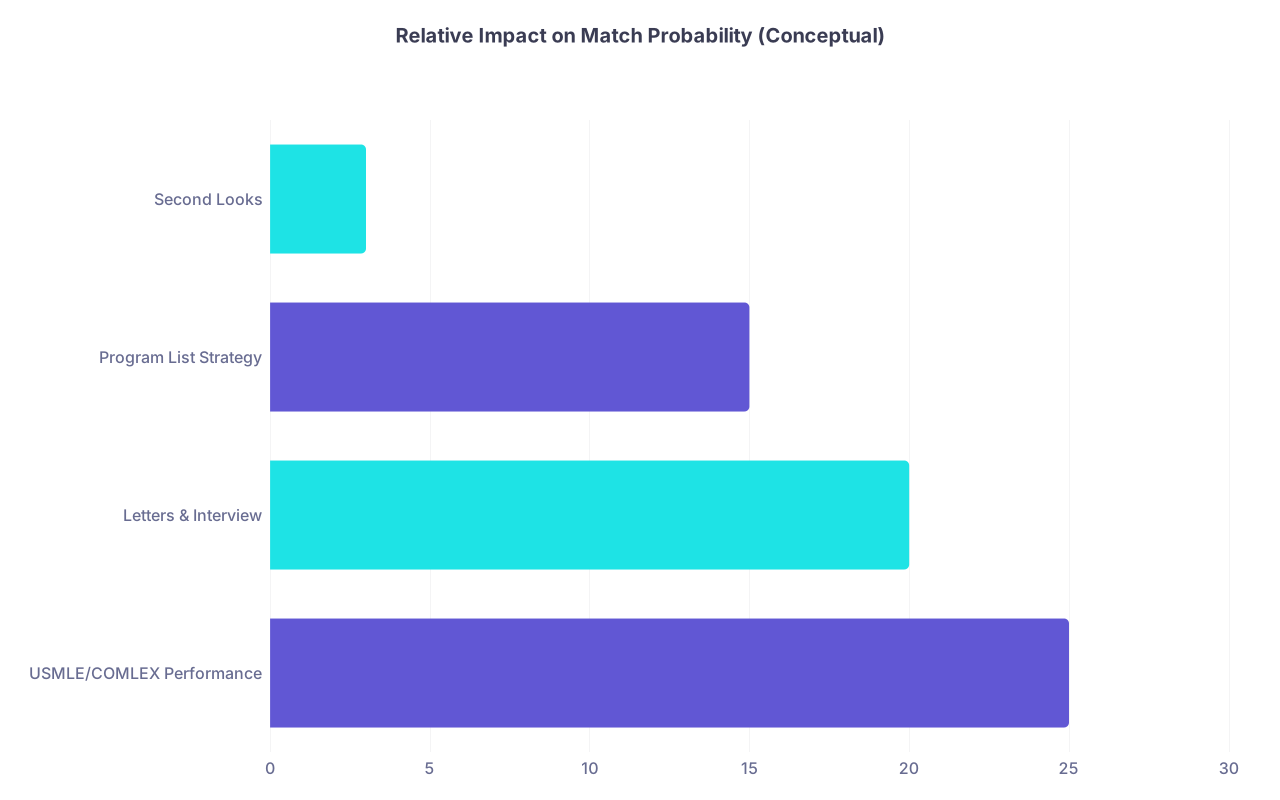
| Category | Value |
|---|---|
| USMLE/COMLEX Performance | 25 |
| Letters & Interview | 20 |
| Program List Strategy | 15 |
| Second Looks | 3 |
The exact numbers here are illustrative, but the ranking is real: second looks consistently land near the bottom of factors that substantially influence match probability.
Final Takeaways
- Skipping all second looks has, at most, a very small effect on your overall match rate—usually in the 0–3 percentage point range and often effectively zero compared with variance from scores, letters, and interviews.
- Second looks influence your rank list and sense of fit much more than programs’ evaluation of you; they are a tool for your decision‑making, not a requirement for matching.
- If you are going to invest in any single thing to improve your odds, the data say: spend your energy on test scores, strong letters, and realistic program selection. Second looks are optional, marginal, and in many cases, safely skippable.