
You are here
It is 3:15 p.m. on a random Tuesday in January. You just finished your last scheduled interview for your top-choice residency. The PD said, “Reach out if you have more questions,” and a chief casually mentioned, “You are always welcome to come back and see a typical day.”
So the next week, on your day off, you drive three hours, show up unannounced at 10:30 a.m., and ask the front desk, “Hi, I am an applicant. I just wanted to do a quick second look and maybe see the residents on rounds?”
The coordinator is clearly confused. The chief is paged away from a busy service. Residents are in the middle of notes, consults, and family meetings. You get a rushed 15‑minute hallway chat with a PGY‑2 who keeps glancing at the clock.
You leave thinking you “showed interest.”
They remember that you showed up. On the wrong day. At the wrong time. For the wrong reasons.
Let me be blunt: bad timing on a second look can hurt you more than never coming at all.
This is the guide to avoid that mistake completely.
The Core Timing Mistakes That Quietly Sink You
There are a few very specific ways people mess up the timing of second look visits. I have seen all of these, multiple times, at big-name places and small community programs alike.
1. Showing Up Too Late in the Season
You think: “I will squeeze in some second looks right before rank lists are due, so they remember me.”
Reality: By the time you are thinking that, the decision-makers are usually done thinking about you.
For many programs:
- Rank meetings happen earlier than you think.
- Committee impressions are formed off interviews, files, and internal notes, not your late-season cameo.
- Second looks that happen after serious ranking discussions are either:
- Ignored completely, or
- Interpreted as anxiety-driven hand-waving.
The typical pattern I see:
- February: applicants suddenly panic and start emailing, “Can I come for a second look?”
- Program: “Our rank meeting is next week” (translation: nothing you do now moves your needle).
If your second look happens:
- After the final rank meeting – it will not matter for ranking. At all.
- Within days of rank submission – it may even look manipulative, like a last-ditch attempt to game the system.
You must know the rough time window programs use:
| Program Type | Common Rank Meeting Window | Risk of Too-Late Second Look |
|---|---|---|
| Large university IM | Late Jan – early Feb | High |
| Competitive surgical | Mid Jan – late Jan | Very high |
| Community-based IM/FM | Early Feb – mid Feb | Moderate |
| Smaller prelim/transitional | Variable, but often late Jan – mid Feb | High |
If you are planning a second look:
- Do it while interviews are still ongoing or early in the post-interview lull.
- Not after everyone else realized they waited too long.
The mistake to avoid: assuming “later = fresher in their mind.” In reality, “later” usually equals “after the decisions were already made.”
2. Coming on a Completely Dead or Misleading Day
Another common self-sabotage move: picking a day where the program looks nothing like the place you will actually work.
I have seen applicants show up on:
- Research days when half the residents are at home or in conference rooms.
- Post-call mornings where everyone looks destroyed and nobody is selling the program.
- Fridays at 3 p.m., when the mood is: “How fast can we close these notes and escape.”
You walk away thinking, “Wow, low energy, not much teaching, this place might be malignant.”
The residents walk away thinking, “Why were they here today of all days?”
Or worse, you accidentally pick a fake good day:
- Noon conference with free fancy catering and lots of people hanging out.
- “Wellness afternoon” with no real clinical work.
- Unique academic showcase day that is not representative of daily life.
You build your rank list based on a day that is either unusually terrible or unusually pleasant. Both are bad data.
The better move is to ask explicitly:
- “If I came for a second look, is there a day that reflects a typical inpatient service?”
- “Is there a clinic day where I can see how ambulatory is structured?”
- “Any days I should avoid because they are atypical?”
If the answer is vague, push slightly: “I do not want to come on a fake good or fake bad day. I would prefer something representative.”
Do not just grab the one day you are free and show up.
3. Dropping in Unannounced
This one sounds too obvious to mention. Yet it still happens.
You cannot:
- Drive over.
- Walk into the hospital.
- Declare, “I am here for a second look.”
Even if a chief, resident, or PD said during interview day, “Come back any time” – that does not mean without notice, and definitely not without going through the coordinator.
What actually happens behind the scenes when you drop in:
- The coordinator is annoyed because they have a thousand other tasks, and now urgent logistics for you.
- Residents get pulled off actual patient care (“Can someone talk to the applicant who is here?”).
- Any goodwill you hoped to create turns into, “They do not understand clinical workflow or boundaries.”
Programs are hypersensitive to applicants who might become high-maintenance residents. The “I drove in and thought I would just swing by” move is a red flag.
The minimum standard:
- Email the coordinator.
- Ask if second looks are allowed this cycle (some programs have banned them entirely).
- Ask for specific dates and windows that work for them.
- Accept “no” gracefully. Do not push.
If they say yes, lock down the timing in writing: “So I will arrive at 8 a.m. on X date and stay through noon conference – does that still work best for your team?”
Anything less is a timing error and a professionalism problem rolled into one.
, Multiple repeat visits](https://cdn.residencyadvisor.com/images/articles_svg/chart-common-second-look-timing-mistakes-reported-by-pro-5333.svg "Common Second Look Timing Mistakes Reported by Programs")
| Category | Value |
|---|---|
| Too late in season | 70 |
| Unannounced visits | 50 |
| Wrong type of day | 45 |
| During [protected time](https://residencyadvisor.com/resources/second-look-visits/common-attending-etiquette-errors-during-second-look-rounds) | 35 |
| Multiple repeat visits | 25 |
The Hidden Landmines: Protected Time, Exams, and Match Rules
Some timing errors are not just “bad look” mistakes. They cross into serious territory: unprofessionalism, NRMP concerns, or at least very uncomfortable gray zones.
4. Scheduling During Protected Resident Time
I have watched this one blow up in real time.
Applicant asks to come “for teaching.” Program generously says, “You can sit in on our Thursday afternoon didactics.”
Applicant then:
- Arrives late.
- Leaves early.
- Tries to pull residents aside for long side conversations while the faculty is teaching.
Or worse, asks the PD, “Can I meet with you one-on-one during resident conference time?”
Understand what protected time means: the program is on the hook to provide it. For accreditation. They already fight clinical pressure to preserve it.
If your presence competes with that time:
- You become the problem.
- Not the resident. Not the workload. You.
So avoid:
- Asking to meet PDs during noon conference or didactics.
- Requesting resident-only spaces during protected teaching blocks.
- Planning your entire second look around conference only, without seeing real clinical time.
You want to see both:
- A normal clinical block (morning or afternoon).
- A slice of teaching or conference, without hijacking it.
Ask explicitly:
- “Is there a way to see some teaching without pulling residents away from conference?”
- “Could I maybe join for conference but save any Q&A or resident chats for before or after?”
If a program invites you to conference, great. Stay quiet. Take notes. Do not perform.
5. Overlapping with In-Service Exams, Major Meetings, or Holidays
You will not always know this in advance unless you ask. But coming on one of these days is a classic blunder:
- In-service exam day
- Program retreat
- ACGME site visit prep week
- Pre- or post-holiday skeleton-crew days
On those days:
- Residents are stressed or half-absent.
- Attendings are distracted.
- Everyone is operating in “just keep the thing running” mode.
You show up bright-eyed, ready to “evaluate culture,” and the culture that day is: “Do not bother me.”
You misinterpret normal stress spikes as systemic toxicity. Programs misinterpret your expectation of attention as self-centeredness.
Preventable.
Ask the coordinator:
- “Are there any dates I should avoid because of exams, retreats, or holiday schedules?”
- “Is there a good stretch where the program is in its usual rhythm?”
If you can only come during a clearly bad week, you are usually better off not coming at all than forcing a bad second look.
6. Violating the Spirit of Match Rules with Last-Minute Second Looks
Here is the part no one explains clearly: programs and applicants are both under NRMP Match communication rules. While second looks are allowed, they sit in a gray zone if used to signal or pressure.
Bad timing patterns that raise eyebrows:
- Applicant requests a second look after hinting “You are my top choice” in an email.
- Applicant times the visit for right before rank meetings and then tries to say, “So if I rank you high, will that help me?”
- Applicant frames decision as transactional: “I am trying to decide if I can rank you number one.”
Programs are on high alert for anything that feels like:
- “Tell me where you are ranking me.”
- “I will commit to you if you do X.”
- “I need to know if I am a strong candidate.”
Using a second look as a timing weapon right before rank meeting makes programs suspicious that you do not understand Match rules or ethics.
You cannot control the exact date of their rank meeting. You must not angle your second look like a last-minute negotiation.
Better framing:
- “I am still learning about programs and deciding what matters most. If possible, I would like to see a regular inpatient day to understand your workflow and resident support.”
- Then go. Watch. Leave. Send a brief thank you. No pressure, no “Where am I on your list?” nonsense.
If your internal reason is “I want them to remember my face,” keep that to yourself. Treat the visit as for you, not as a bargaining chip.

| Step | Description |
|---|---|
| Step 1 | Want second look |
| Step 2 | Do not push. Skip visit |
| Step 3 | Email coordinator |
| Step 4 | Ask for alternative or skip |
| Step 5 | Confirm schedule in writing |
| Step 6 | Attend briefly and respectfully |
| Step 7 | Send short thank you and stop |
| Step 8 | Program allows second looks |
| Step 9 | Dates representative and before ranks? |
How to Time a Second Look Without Looking Clueless
You want the practical playbook. Fine. Here is the clean version that avoids the common traps.
Step 1: Decide if You Actually Need a Second Look
Timing mistake zero: doing a second look at all when you do not need one.
Bad reasons (red flag motivations):
- “Everyone on SDN says second looks show interest.”
- “My friend matched there after doing one, so I should too.”
- “I am worried they will think I am not interested if I do not come back.”
Good reasons:
- You genuinely could not see critical parts during interview (e.g., call rooms, ICU, clinics).
- You are torn between 2–3 programs and need clarity on day-to-day resident life.
- You want to assess a specific concern: workload, resident support, culture across different rotations.
If you do not have a crisp question you are trying to answer, you are probably wasting everyone’s time.
Step 2: Time the Ask (Not Just the Visit)
Do not wait until:
- The last week of interviews.
- February panic.
- After talking to 10 other applicants who mention second looks.
If you think you will need a second look, send the email soon after your interview, while:
- Your face and file are still vaguely fresh.
- Schedules are more flexible.
- Rank meetings are still far off.
Something like:
Dear [Coordinator Name],
Thank you again for organizing my interview day on [date]. I am very interested in [Program Name] and am hoping to better understand [clearly stated goals – e.g., inpatient workflow and resident support on busy services].
If your program allows second look visits this year, are there any dates in [month] that would provide a representative view of a typical day, and that would not interfere with exams, retreats, or protected time?
I completely understand if this is not possible or if your policy is to avoid second looks this season.
Best regards,
[Name], [AAMC ID]
Notice what you are doing:
- Asking whether second looks are even allowed.
- Respecting their time and constraints.
- Showing you are thinking about timing politely and intelligently.
Step 3: Choose the Right Type of Day
If they offer options, filter based on what you want to see:
- Interested in inpatient grind? Choose a ward or ICU day, not consults only.
- Interested in outpatient-heavy fields (FM, psych, PM&R)? Choose a clinic day, not just didactics.
- Interested in procedural exposure? Ask if there is a day you might observe pre/post-op or see sign-out.
Watch out for days that are likely distorted:
- Pre-holiday or immediately post-holiday.
- “Special education days” that are once a year.
- Days when half the residents are away at a conference.
If the only offered day is obviously bad, you can decline once:
“Thank you for the offer. If that is the only possible date, I will plan to rely on what I saw on interview day so as not to add to the strain during a busy week.”
That line tells them you understand timing, stress, and respect.
Step 4: Limit the Length
Another timing error: staying too long.
Second looks are not second interview days. You do not need:
- Full 8‑hour shadowing.
- Back-to-back meetings with PD, APD, chiefs, and every chief resident.
- Tour 2.0 of every single hallway.
Ideal structure:
- Arrive: 7–8 a.m. (pre-rounds, sign-out, or clinic huddle).
- Observe: 3–4 hours of realistic work.
- Optional: stay through noon conference if they invite you.
- Leave: early afternoon.
You want a snapshot, not a time-lapse.
Staying all day:
- Increases the risk you are in the way.
- Increases the chance you catch people at their worst moment and misjudge them.
- Makes you look like you are trying too hard.
Ask in advance:
“How long would you prefer I stay – is a half day more appropriate than a full day?”
Then follow their lead without trying to negotiate more time.
5. Timing Your Follow-Up (Without Being That Person)
Last timing trap: what you do after the visit.
Bad sequence:
- Second look one week before likely rank meeting.
- Same day: long email to PD recapping how much you loved every slide of every conference.
- Two days later: second email clarifying they are your “number one.”
- One more “just checking in” before rank submission.
This screams insecurity and poor judgment.
Better pattern:
- Same day or next day: very short thank-you note to coordinator and, if appropriate, the PD.
Something like:
Dear Dr. [PD],
Thank you again for allowing me to briefly visit on [date]. Seeing [specific thing: e.g., how the senior protected interns during a busy morning, or how clinic staff worked with residents] gave me a much clearer sense of the training environment.
I am grateful for the opportunity and appreciate the time your residents and faculty shared with me.
Best regards,
[Name]
Then you stop.
No “You are my top rank.” No “I hope this helps my chances.” No second thank-you. Silence.
If you later choose to send a single, honest “you will be ranked highly” message independent of the second look, that is separate. Do not stack them together.
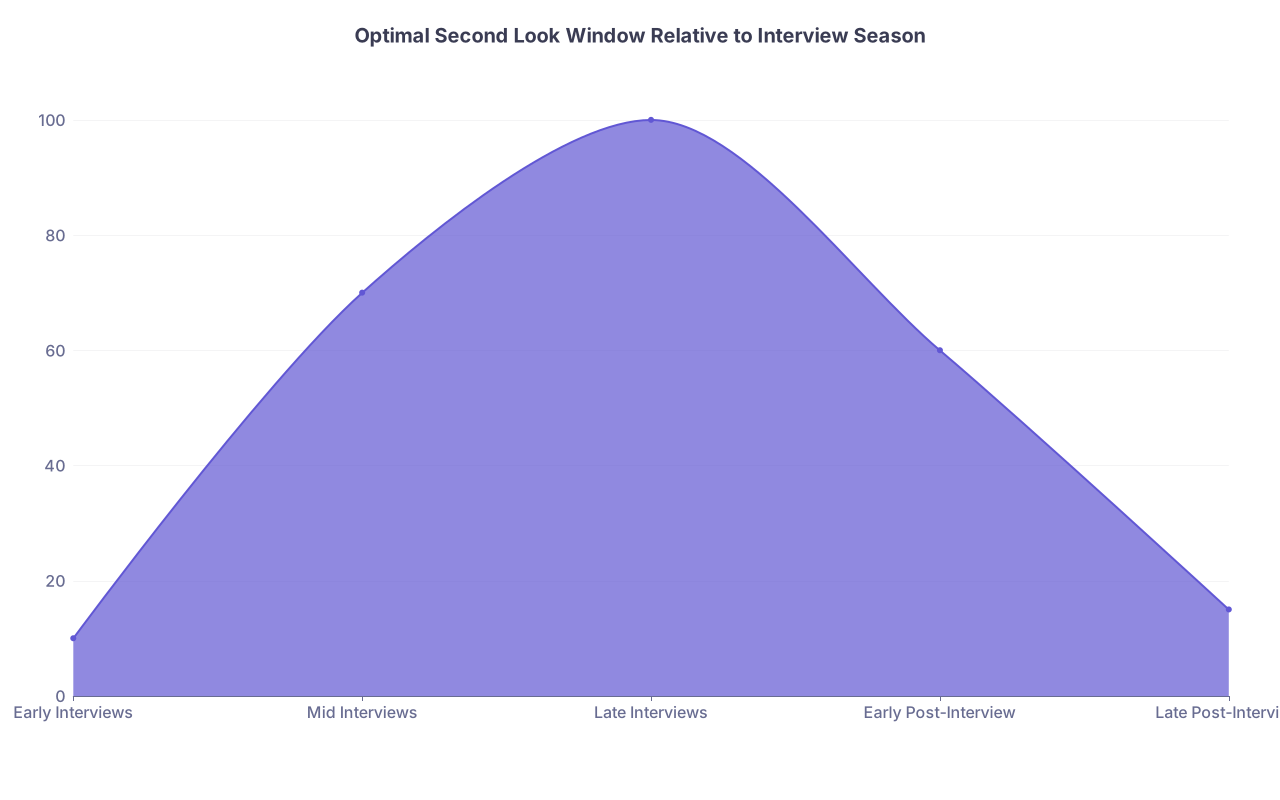
| Category | Value |
|---|---|
| Early Interviews | 10 |
| Mid Interviews | 70 |
| Late Interviews | 100 |
| Early Post-Interview | 60 |
| Late Post-Interview | 15 |
The Future: Why Timing Will Matter Even More
One last angle you are probably not thinking about.
Programs are increasingly:
- Limiting or banning second looks for equity reasons.
- Standardizing communication to avoid any appearance of gaming the Match.
- Tracking every applicant interaction in ERAS/Thalamus spreadsheets.
Your badly timed second look does not just land as an annoying one-off. It becomes a data point:
- “Showed up during protected time without clear purpose.”
- “Requested late-season visit after repeated emails asking about rank status.”
- “Arrived unannounced in clinic.”
Programs talk. PDs move between institutions. You carry a reputation more than you think.
As more selection moves toward structured scoring (even for “fit”), predictable professionalism becomes more valuable than theatrics.
Good timing signals:
- You understand clinical workflow and stress cycles.
- You grasp that resident time is not an infinite resource.
- You can plan ahead, respect boundaries, and still advocate for your needs.
Those are the traits PDs quietly prioritize when the committee is split between applicants with similar scores and letters.

Your Next Step Today
Do one concrete thing now:
Open the list of programs where you are even considering a second look. For each one, write down three dates:
- Earliest reasonable second look date (while interviews are still active).
- Latest date that is probably before rank meetings (based on typical timelines).
- A backup: “If I cannot fit it respectfully in this window, I will skip the second look.”
Then send one carefully worded email to at most one program you care about, using the template above – asking if they even allow second looks and what days are representative.
If the timing does not work, do not contort it. Do not force a bad day, a late visit, or an intrusive drop-in.
Missing a second look will not sink your chances.
Showing up on the wrong day, at the wrong time, in the wrong way just might.