
The hard truth: most applicants obsess over second-look visits way more than programs care about them.
Second looks can help you make a better rank list. They almost never “save” your chances at a program. If you treat them like secret weapons for matching, you’re using them wrong.
Here’s how to decide if you actually need a second look — and how to do it strategically instead of out of FOMO.
What second-look visits actually do (and don’t do)
Let’s strip the hype.
Second-look visits usually:
- Happen after your interview day
- Are optional and low-key (shadowing, dinner, conference)
- Are not formal interviews (no score sheet, no big committee)
They can help you:
- Clarify “vibes” and culture
- Compare two programs that still feel tied in your head
- Get a more realistic view of call, teaching, and resident life
- See the city/neighborhood when you’re not stressed in a suit
They do NOT reliably:
- Rescue a weak application at that program
- Catapult you above stronger applicants
- Guarantee a higher spot on their rank list
Plenty of PDs have said some version of: “Second looks don’t move the needle unless something extreme happens.” You showing up politely and asking good questions? That’s baseline. Not bonus.
So the default assumption is: you probably don’t need many (or any) second looks unless they change your decision-making.
Step-by-step: Do you need a second look?
Here’s the short version of the framework:
- Are you choosing between programs you’d be genuinely happy at?
- Is there critical info you still don’t have that could be answered virtually or by email?
- Would an in-person visit actually change your rank order, or just soothe your anxiety?
- Can you afford the time, cost, and energy without wrecking rotations or your sanity?
If you start saying “no” to #2–4, you’re in “probably skip it” territory.
Let’s break it down properly.

| Step | Description |
|---|---|
| Step 1 | Considering Second Look |
| Step 2 | Skip - too costly |
| Step 3 | Email or Zoom instead |
| Step 4 | Do focused second look |
| Step 5 | Key info missing? |
| Step 6 | Can info be virtual? |
| Step 7 | Could visit change rank? |
| Step 8 | Time and money ok? |
Step 1: Identify what you’re trying to decide
If your question is “Will a second look help me match here?” — wrong question.
Ask instead:
- Am I unsure between Program A and Program B for my top few spots?
- Do I feel like my interview day was an outlier (bad call day, limited exposure, virtual-only)?
- Did I leave with big unknowns that actually matter (call schedule reality, operative autonomy, fellowship placement, on-service teaching)?
If the uncertainty is about:
- “Do they like me enough?”
- “Will they remember me?”
- “Everyone else is doing second looks…”
Then you’re not making a strategic decision. You’re managing insecurity. Don’t burn money and days off for that.
When a second look IS worth it
Here’s when I tell people: yes, this makes real sense.
1. You’re stuck between top programs that feel “tied”
Example: You’re choosing between:
- A big-name academic IM program with strong research
- A mid-sized academic community hybrid that felt warmer and more supportive
You liked both interviews. Faculty were fine. Residents seemed okay. But you keep hesitating on which one should be #1.
A second look is justified when:
- It’s for a program in your realistic top 3–4
- You can clearly articulate the decision: “I want to see how the residents interact when not in scripted interview mode,” or “I want to see a real teaching conference and a call day.”
- You’re prepared to actually move a program up or down based on what you see
If there’s almost no chance you’ll change your rank, don’t go.
2. Your interview day felt off, incomplete, or fake
Maybe:
- You had a weirdly quiet interview day (half the residents were off, key faculty you wanted to meet weren’t there)
- It was entirely virtual and felt packaged
- You never saw inpatient units, ORs, clinics, or call rooms
A second look can give you the “real” day:
- Sit in on sign-out or morning report
- Walk the wards with residents
- Ask the PGY-2 about whether the call schedule on the website matches real life
This is especially useful in fields where environment and autonomy matter a lot: surgery, EM, OB/GYN, anesthesia.
3. You’re seriously moving cities or regions
If you’ve never:
- Lived in a big city and you’re considering NYC/Chicago/LA
- Dealt with harsh winters and you’re thinking about Midwest/Northeast
- Lived far from family and you’re ranking programs across the country
Seeing:
- Commute times
- Neighborhoods you could actually afford on a resident salary
- Hospital parking, safety, public transport at weird hours
can absolutely change your rank list. That’s a valid reason to go.

When a second look is a waste of your time
Be honest with yourself. A lot of second looks are glorified security blankets.
Skip the second look if:
- The program is already clearly below others on your list
- You wouldn’t rank it #1–3 no matter how “nice” the visit was
- You’re using it to try to “signal interest” or “show commitment” more than to gather information
Also skip if:
- You’re on a brutal rotation and days off are rare
- The travel costs will actually hurt (flights, hotels, Uber across town — it adds up fast)
- You’re burned out, behind on life stuff, or compromising Step 3/completion of med school work
Your rank list clarity matters. So does you not crawling into residency already exhausted and broke.
How much do programs care about second looks?
Short answer: usually not much. Occasionally, a bit. Rarely, a lot.
Programs fall into three buckets:
| Program Type | How They View Second Looks |
|---|---|
| Most large academic programs | Neutral, minor positive |
| Many community / smaller sites | Nice but not essential |
| A few outliers | Value as strong interest |
Some specifics I’ve seen or heard directly from PDs/APDs:
- “We don’t track second looks at all. We rank based on interview day.”
- “It’s a small plus if they seemed engaged and normal, but it doesn’t outweigh letters, scores, or our interview scores.”
- “If someone is borderline and clearly shows up, connects with residents, and seems like a great fit? That can nudge them up a little.”
What hurts you:
- Being demanding, negative, or unprofessional
- Asking inappropriate questions (salary gossip, throwing shade at other applicants, complaining about other programs)
- Acting uninterested or entitled
What helps you (marginally):
- Showing up prepared with focused questions
- Showing genuine curiosity and humility
- Getting a resident to say, “Yeah, they’d fit in well here”
But remember: the big moves up and down the rank list happen from your actual interview day, not your second look.
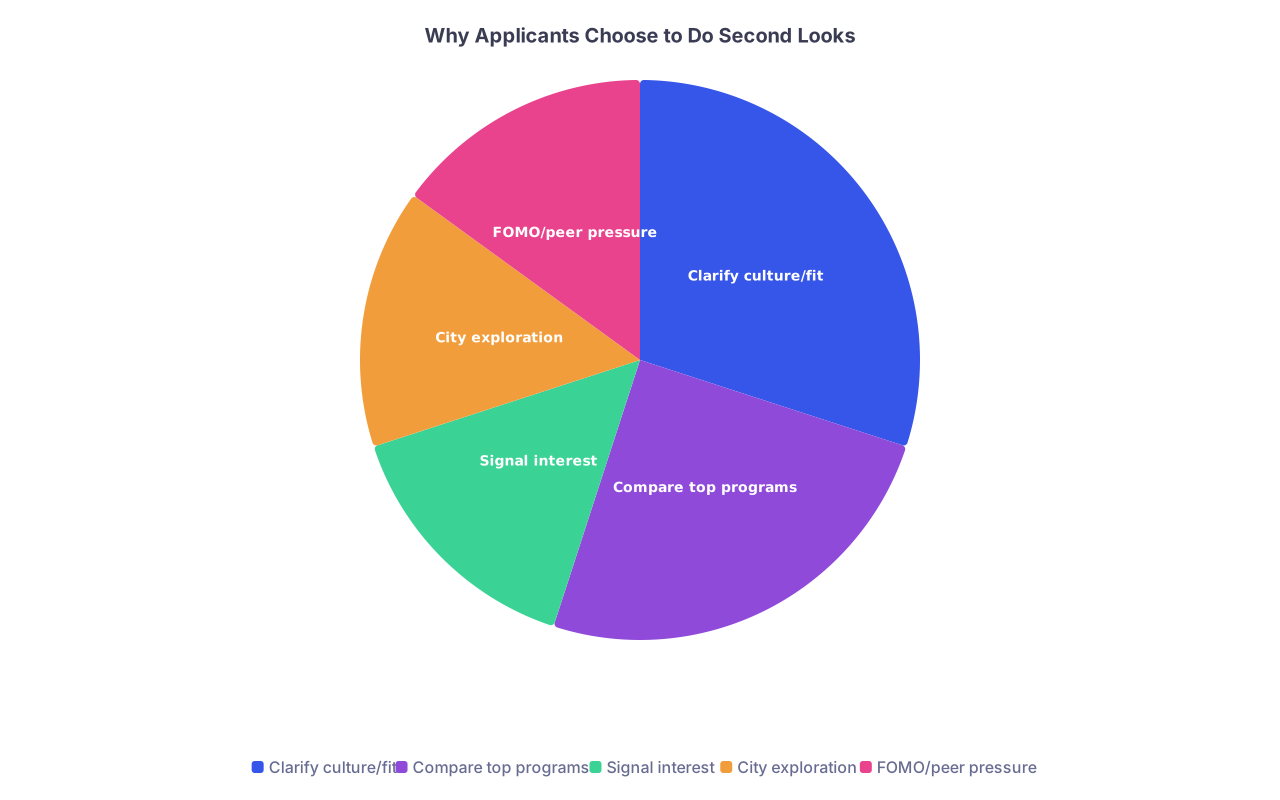
| Category | Value |
|---|---|
| Clarify culture/fit | 30 |
| Compare top programs | 25 |
| Signal interest | 15 |
| City exploration | 15 |
| FOMO/peer pressure | 15 |
How many second looks is reasonable?
You’re not doing victory laps around the country. You’re making surgical strikes.
Reasonable range for most people:
Maybe:
- 1 targeted second look for your top question mark program
- 1 more if you have a real geographic move decision (e.g., staying near family vs moving across the country)
Red flags:
- 4–6 second looks “just in case”
- Going to second looks at programs you’d rank in the middle of your list
- Sacrificing electives, sub-I performance, or mental health to squeeze in multiple visits
If your list still feels fuzzy after a couple of very intentional second looks, it’s not a data problem. It’s a tolerance-for-uncertainty problem. No extra visit fixes that.
How to do a second look well (so it actually helps you)
If you’re going to go, make it count.
Before you go
Email the right contact
Usually the program coordinator or a resident you met. Keep it simple:- Remind them who you are and when you interviewed
- Say you’re strongly considering ranking their program highly
- Ask if there’s a chance to:
- See a typical day
- Sit in on teaching conference or sign-out
- Talk briefly with a couple of residents on and off service
Define 3–5 key questions
Examples:- “How’s the real workload on nights and weekends?”
- “How often do residents feel they can make clinic/OR educational instead of just service?”
- “What happens when someone is struggling — how is that handled?”
- “How does the program respond to feedback? Can you give me a recent example?”
Decide what would actually move them up or down your list
Write it down. “If I see X, I’ll move them up. If I see Y, I’ll move them down.”
During the visit
Focus on:
- Watching resident-resident interactions (eye rolls? tension? laughter? support?)
- Seeing how attendings talk to and about residents
- Eavesdropping on honest side comments, not the official sales pitch
Ask residents:
- “What surprised you after you started here — good and bad?”
- “If you had to pick again, would you choose this program?”
- “What’s one thing you’d change if you were PD for a day?”
Take quick notes on your phone when you step away. You won’t remember specifics later.
After the visit
Same day if possible:
- Write 4–5 bullet points: positives, negatives, gut feeling
- Immediately compare to your next-closest program: did this move them up, down, or keep them the same?
Optional: short thank-you email to the coordinator or resident who set it up. Do not gush. Do not over-sell. Just:
- Thank them
- Mention 1–2 specific things you appreciated
- Say you’ll be thinking carefully about your rank list
Done.
Special cases: Virtual interviews and the “future of second looks”
Post-pandemic, a lot of interviews are still virtual. That’s changed the game.
What’s happening now:
- More applicants feel blind about “real culture”
- Some programs host optional in-person open houses / second looks
- Some specialties are starting to discuss whether second looks should be discouraged or standardized to keep equity reasonable
Here’s my opinion:
- If the interview season was fully virtual and a program offers a clearly-structured, optional, in-person open house that’s affordable for you — that can be worth it for top choices.
- If the specialty culture is starting to frown on second looks (some have), lean more on:
- Talking to alumni from your school who matched there
- Cold-emailing current residents for a quick Zoom chat
- Asking targeted follow-up questions by email
Second looks may get more regulated in the future to avoid disadvantaging applicants who can’t travel. Use them now only where they materially help your decision, not to chase a fake “edge.”
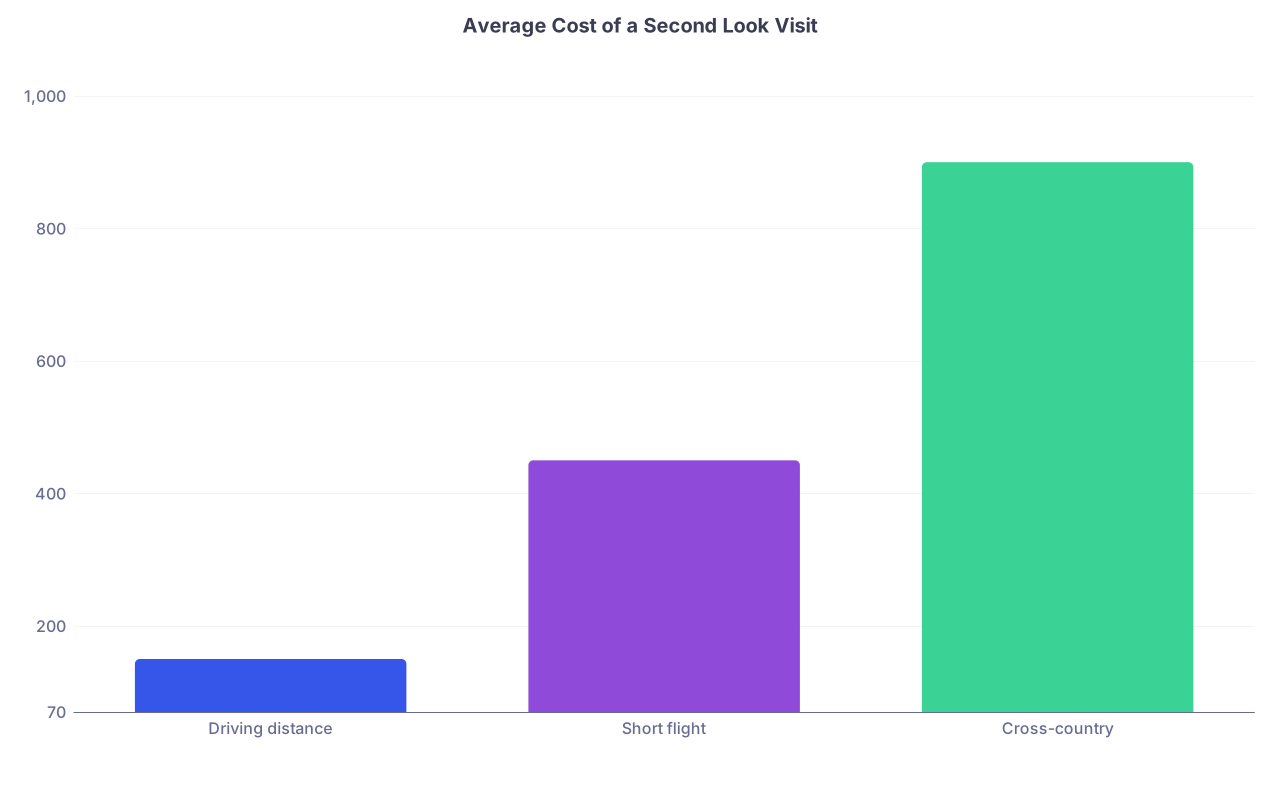
| Category | Value |
|---|---|
| Driving distance | 150 |
| Short flight | 450 |
| Cross-country | 900 |
Bottom line: A simple rule set
If you remember nothing else, use this:
- If the program is likely outside your top 3–4 → skip the second look.
- If your main goal is to impress them → skip it; it rarely moves their rank list.
- If you have high-stakes uncertainty about fit, workload, or location at a top-choice program → consider 1 targeted second look.
- Keep total second looks in the 0–2 range, max, unless you have truly unusual circumstances.
Trust what you already saw. Trust what residents told you off-script. And accept that no rank list will ever feel 100% certain.