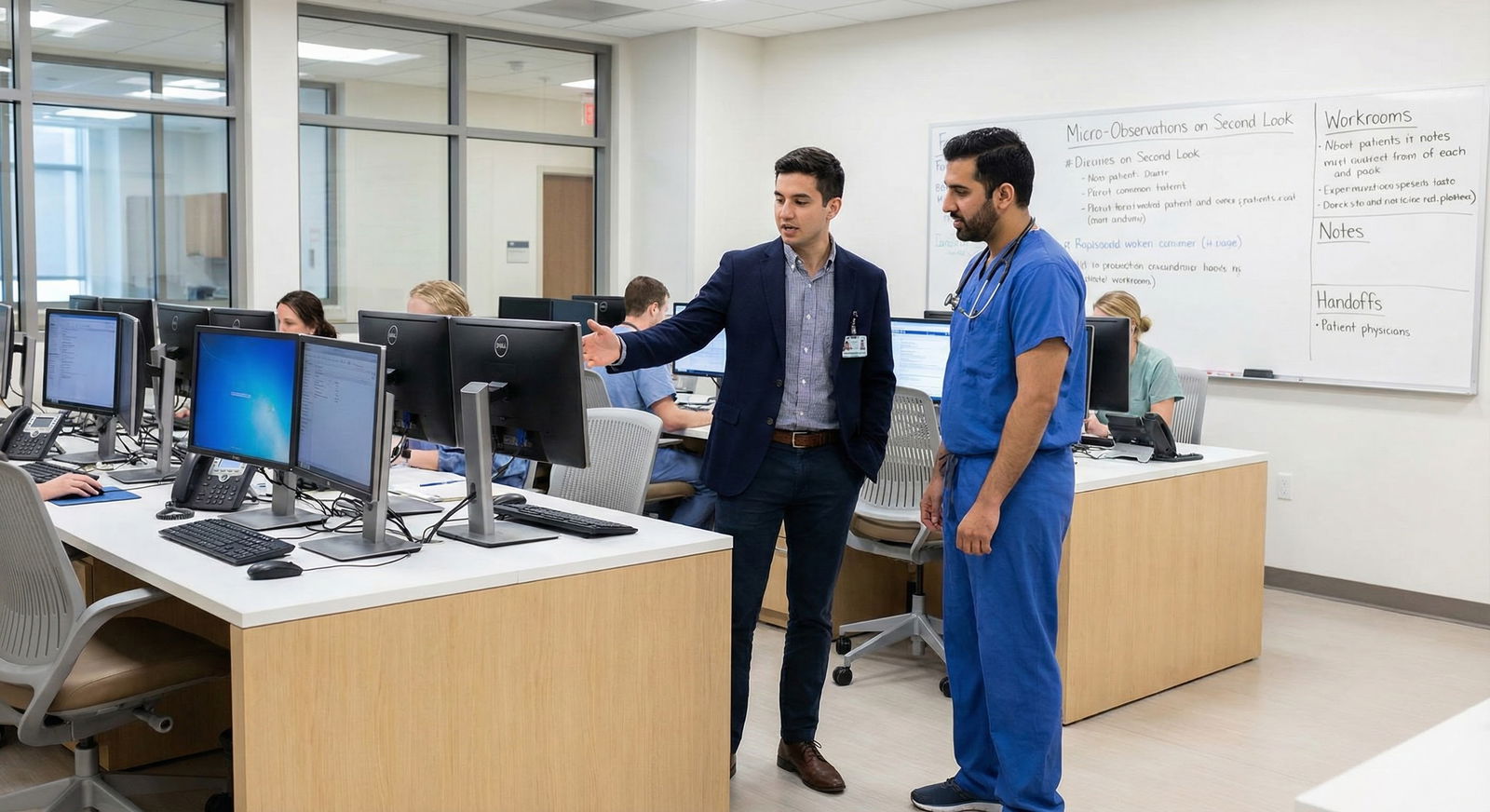
The biggest mistake applicants make with second look visits is emailing the wrong person with the wrong ask.
You’re not alone if you’re thinking: “Who exactly do I email for a second look, and what do I actually say so I don’t sound needy or weird?” Let’s clean this up.
Who You Should Email for a Second Look
There are three main players. Only one is your default.
- The residency program coordinator
- The program director (PD)
- A specific faculty member or resident you connected with
Here’s the rule of thumb:
Start with the program coordinator unless the program explicitly tells you otherwise.
The coordinator is the gatekeeper. They know:
- Whether the program even allows second looks
- What dates are acceptable
- Any rules about contact with PDs during ranking season
- Logistics (parking, schedule, who you can meet, what you can see)
If you email the PD directly with logistics questions, it can look unsavvy. PDs are busy ranking; coordinators handle visits.
When to email the program coordinator
You email the coordinator when:
- You want to request a second look, generally
- You’re flexible about who you meet
- You’re not asking for anything special beyond seeing the program again
Example roles in ERAS/website that usually mean “coordinator”:
- Program Coordinator
- Program Administrator
- Program Manager
- Education Coordinator
If you’re unsure who that is, go to the residency program’s website. They almost always list the coordinator with an email.
When to email the program director directly
You email the PD directly only in a few situations:
- The program/PD explicitly invited second-look contact in an info session or post-interview email
- You already have a direct conversation going with the PD (e.g., they replied personally to a thank-you and invited follow-up questions)
- You’re asking something higher-level, not logistics (e.g., clarifying scholarly opportunities, long-term career fit, or a specific niche interest like global surgery)
Even then, if your primary goal is “see the program again,” I still recommend copying the coordinator (CC) so they can manage logistics.
When to email a specific faculty member
You email a particular faculty member when:
- They told you, “If you’re back in town and want to chat more, reach out.”
- You have a focused academic/clinical interest that you want to explore more deeply (e.g., palliative care track, ultrasound curriculum, health equity work)
- You’d like to shadow that specific clinic or service they lead
But: for anything that involves a visit on-site, CC the coordinator. Otherwise, your email risks getting lost or delayed because faculty rarely manage the schedules for pre-interview or second-look logistics.
When to email a resident
You email a resident when:
- You want the informal truth about lifestyle, call, culture
- You want to grab coffee or chat on Zoom to supplement your understanding of the program
- The program discourages formal second looks but you still want more data
If you want an in-person second look that’s more than “let’s grab coffee nearby,” the coordinator still needs to be the hub.
How to Decide If You Should Even Request a Second Look
Not every applicant needs a second look. In fact, a lot of people overdo it.
Second looks make sense if:
- You’re genuinely torn between 2–3 programs and seeing one again might change your rank list
- You never got to see the city/hospital in daylight or during a normal workday
- You interviewed virtually and this is your one chance to see the physical environment before ranking
- You have a spouse/partner/kids who need to see the area and get a sense of what life there might look like
They do not make sense if:
- You already know you’ll rank the program low or not at all
- You’re doing it because you think it will “boost your rank” (most programs explicitly say second looks don’t affect ranking)
- You’re hoping to “impress” people with your presence—honestly, that’s almost never how it works
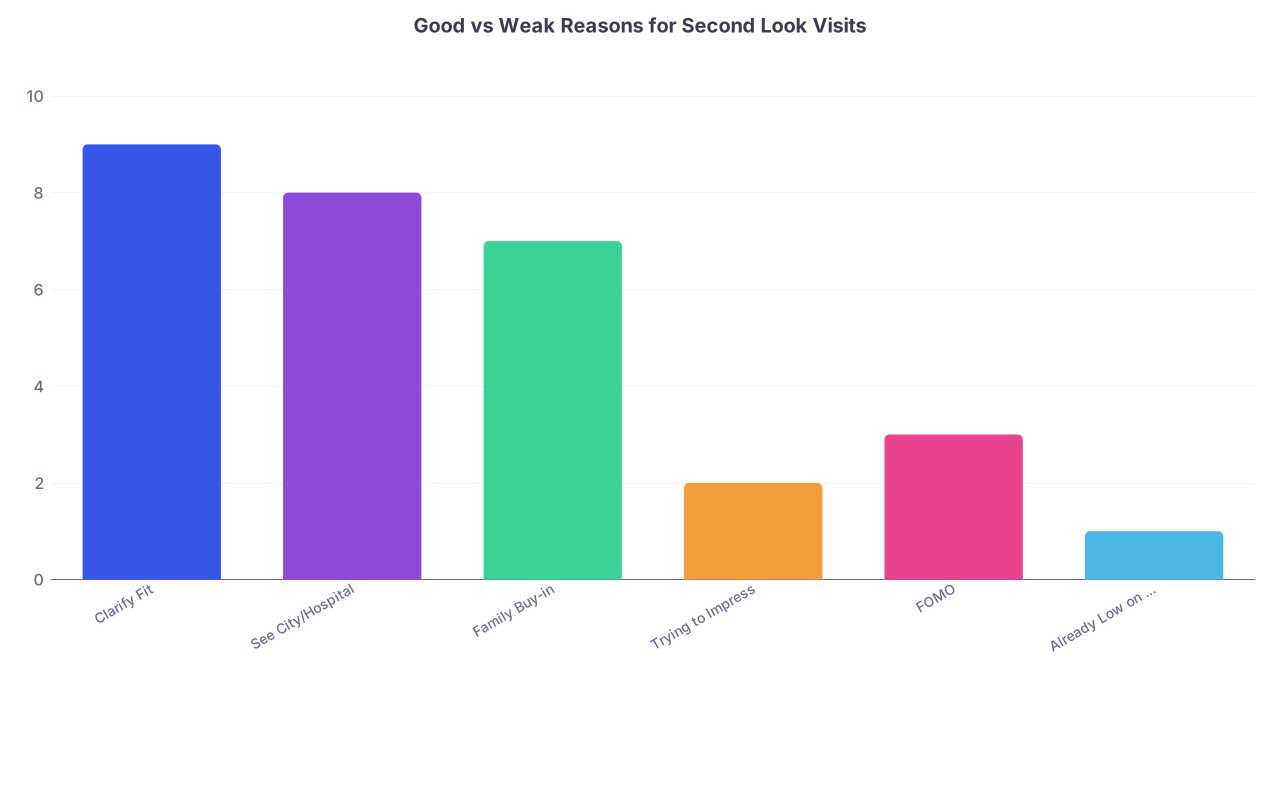
| Category | Value |
|---|---|
| Clarify Fit | 9 |
| See City/Hospital | 8 |
| Family Buy-in | 7 |
| Trying to Impress | 2 |
| FOMO | 3 |
| Already Low on List | 1 |
Use this filter:
“If they never knew I did this second look, would it still be worth my time and money?”
If the answer is no, skip it.
Timing: When To Send the Email
You want to thread this needle:
- After you’ve reflected on your interviews
- Before most programs finalize their rank lists
- Early enough that the program can actually schedule something
General window:
Late January through mid-February for most Match timelines. If you’re in a specialty with an earlier match or a non-ERAS process, adjust accordingly.
Too early (right after your interview) and it looks impulsive.
Too late (final week of ranking) and they may simply say no because they’re done hosting visitors.
What To Say in the Email (Core Templates)
Here’s what you actually came for: scripts.
Use these, customize lightly, and send. Do not overthink.
1. Email to the program coordinator (standard second look request)
Subject options:
- Second Look Visit Request – [Your Name], [Specialty] Applicant
- Second Look Inquiry – [Your Name]
Template:
Dear [Coordinator Name],
I hope you are doing well. I interviewed with the [Program Name] [Specialty] Residency on [interview date], and I left with a very strong interest in the program.
I am currently finalizing my rank list and would greatly appreciate the opportunity to return for a brief second look visit to better understand the day-to-day experience of residents and the clinical environment.
Could you please let me know if your program is offering second look visits this season, and if so, what dates or formats are available? I am particularly interested in seeing [example: inpatient wards / continuity clinic / a typical resident noon conference], but I am happy to follow whatever structure you already have in place.
Thank you very much for your time and for all of the coordination you provide for applicants.
Best regards,
[Full Name]
[Medical School]
AAMC ID: [#######]
That’s it. Clean, respectful, not over-eager.
2. Email to the program coordinator when you know they “don’t consider second looks”
Some programs clearly state that second looks don’t affect ranking or are discouraged but still allow limited visits.
Subject:
- Clarifying Second Look Possibility – [Your Name]
Template:
Dear [Coordinator Name],
Thank you again for organizing the interview day for [Program Name]. I know from the website and interview that second look visits are not used in your ranking process, and I respect that approach.
I am, however, strongly considering [Program Name] and was wondering if there is any opportunity—formal or informal—to briefly visit again simply to better understand the hospital environment and the surrounding area before I submit my rank list. I completely understand if this is not possible this year.
Thank you for any guidance you can provide.
Sincerely,
[Full Name]
[Medical School]
AAMC ID: [#######]
You acknowledge their policy. You remove pressure. You still ask.
3. Email to the program director (higher-level follow-up + CC coordinator)
Only use if appropriate in your context.
Subject:
- Follow-Up Questions and Possible Second Look – [Your Name]
Template:
Dear Dr. [PD Last Name],
Thank you again for the opportunity to interview at [Program Name] on [date]. Our conversation about [specific topic you discussed] has stayed with me as I consider my future training.
As I finalize my rank list, I have a few additional questions about [briefly state: e.g., research support in health services, the leadership track, etc.]. If you prefer, I would be happy to send these questions by email, but I also wondered if there might be an opportunity for a brief second visit—virtual or in person—to better understand how [Program Name] could support my goals in [your interest].
I have copied [Coordinator Name] here, as I know they manage the logistics of any additional visits.
Thank you again for your time and consideration.
Best regards,
[Full Name]
[Medical School]
AAMC ID: [#######]
Short. Purposeful. PD for content, coordinator for logistics.
4. Email to a resident (informal second look or Zoom chat)
Subject:
- Quick Follow-Up and Possible Visit – [Your Name]
Template:
Hi [Resident First Name],
Thank you again for talking with me on interview day for [Program Name]. I really appreciated your honesty about [specific thing they mentioned].
I am working on my rank list and still have a few questions about day-to-day life as a resident there—especially around [e.g., call schedule, support on nights, how people actually use their elective time].
Would you be open to a brief Zoom call or phone call sometime in the next couple of weeks? If in-person second looks are possible this year and you think that would be helpful, I am open to that too.
Thanks again for your time. I know you are busy, and I really appreciate any insight you are able to share.
Best,
[First Name]
No need for your full CV here—this is peer-to-peer.
What NOT To Say in a Second Look Email
This is where applicants quietly damage their credibility.
Avoid:
“I will rank you number one if…”
Just don’t. Premature, and often against program policies to solicit or respond to that kind of statement.“I’d like a second look to show you how committed I am.”
The goal is for you to gather information, not to prove your worth by showing up twice.Novel-length life stories.
Your email should fit on one screen without scrolling much.Attaching extra statements or PDFs “for your consideration.”
Second looks are not another application round.
What Actually Happens During a Second Look
If the program says yes, here’s what you can reasonably expect:
- A half-day or less. Sometimes just a couple of hours.
- Observing morning report, noon conference, or rounds (often observing more than participating, depending on policy).
- Very limited patient contact (for liability and workflow reasons).
- Time with a resident or small group of residents.
- Maybe a brief PD or APD check-in, but not a formal second interview.

| Step | Description |
|---|---|
| Step 1 | Arrive and Check In |
| Step 2 | Meet Coordinator or Resident |
| Step 3 | Attend Conference or Rounds |
| Step 4 | Tour Hospital or Clinic |
| Step 5 | Informal Q and A with Residents |
| Step 6 | Brief PD or APD Hello optional |
| Step 7 | Head Home and Reflect |
You know what it isn’t?
A secret audition. Programs say this again and again. They’ve seen applicants try to “perform” on second looks and it can be awkward.
Use the time to look around:
- Do residents look tired but supported, or burned out and alone?
- How do attendings speak to residents in public?
- Does the physical environment feel safe and workable for three to seven years of your life?
This is reconnaissance. You’re the one evaluating.
How Second Looks Affect (or Do Not Affect) Your Rank
Hard truth: at most programs, second looks barely move the needle.
Patterns I’ve seen:
- Programs often lock in their initial rank impressions from the interview itself, letters, and application.
- Second looks may push someone slightly up or down if there’s significant new information, but that’s uncommon.
- Many PDs actively try to avoid being swayed by who shows up again, because they know it reflects schedule flexibility and money, not necessarily merit.
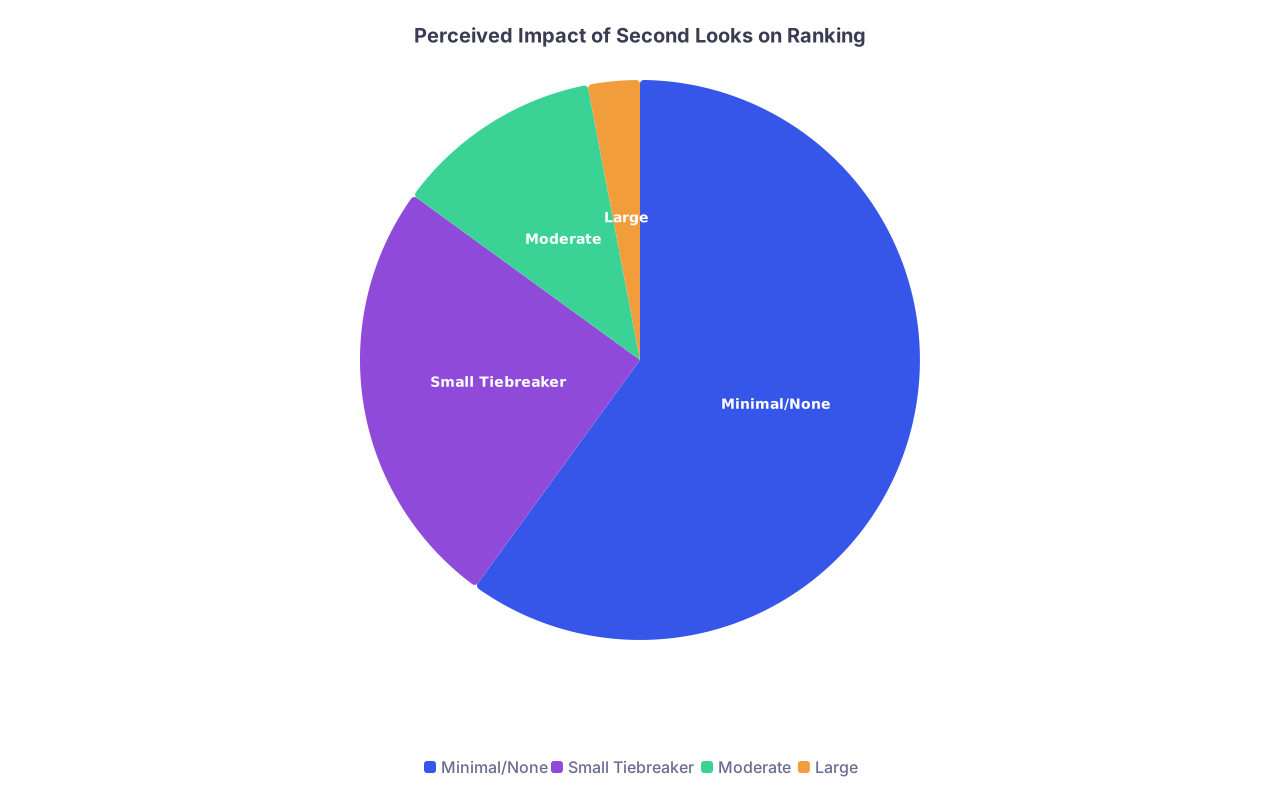
| Category | Value |
|---|---|
| Minimal/None | 60 |
| Small Tiebreaker | 25 |
| Moderate | 12 |
| Large | 3 |
So why do one?
Because the Match locks you into a program for years.
If a 3–4 hour visit helps you avoid a catastrophic mismatch, that’s worth it even if it does nothing for your position on their list.
Future of Second Looks: Where This Is Headed
You’re applying in a weird transition era.
There’s growing pressure to:
- Reduce cost and travel burden on applicants
- Prevent inequity (not everyone can afford multiple flights for “optional” visits)
- Limit subtle arm-twisting around post-interview communication
What that means in practice:
- More programs moving toward virtual second looks (Zoom resident panels, virtual hospital tours)
- Clearer policies posted on websites: “Second looks do not impact ranking”
- Some specialties or institutions discouraging in-person second looks altogether
So you’ll increasingly see:
- Optional virtual Q&A sessions in late January/February
- Structured “second look days” rather than ad hoc requests
- Explicit OR that second looks will not influence rank lists
Your job is to read their policy, respect it, and use what’s offered strategically.
| Policy Type | What It Usually Means |
|---|---|
| No second looks allowed | Use email/virtual only |
| Virtual second looks only | Zoom Q&A, no on-site visit |
| In-person second looks ok | Limited, scheduled, structured |
| Second looks discouraged | Only if truly essential for you |
| “No impact on ranking” | Do it only for your information |
FAQ: Second Look Emails and Strategy
1. Should I say I’m ranking them “very highly” or “number one” in my email?
If you’re truly planning to rank a program number one and they allow that type of communication, a brief, honest statement later in the season can be reasonable. But it doesn’t belong in your initial second look request. Keep the first email about information gathering, not promises.
2. How long should I wait after interview day before requesting a second look?
About 1–3 weeks is a good window. Long enough that you’ve seen most of your interviews and can compare, but not so late that the schedule is full or rank meetings are nearly done. For many, that means late January into early February.
3. Is it rude or desperate to ask for a second look?
No—if you do it once, politely, and accept the answer. It looks thoughtful when framed as “I want to make an informed choice.” It looks desperate when you send multiple follow-ups, try to negotiate dates aggressively, or frame the visit as a way to show you’re “more committed” than others.
4. What if the coordinator never replies to my second look email?
Give it 5–7 business days. Then send one short, polite follow-up:
“Hi [Name], I just wanted to follow up on my email below in case it got buried. If second looks are not possible this year, no worries at all—I simply wanted to check.”
If there’s still no response, take that as your answer and do not escalate to the PD just to chase a visit.
5. What should I wear and bring to an in-person second look?
Business casual is usually perfect: slacks or a modest skirt, button-down or blouse, closed-toe shoes. White coat only if they explicitly told you to bring it. Bring a small notebook or notes app list of 5–7 specific questions. Do not show up in full interview suit unless you’ve been told the day is more formal; you’re there to observe, not audition.
6. After the second look, should I send a thank-you email?
Yes, but keep it tight and low-pressure. A 3–4 sentence email to the coordinator (and PD if you met them) acknowledging the visit, mentioning one or two things you learned, and saying it helped you as you finalize your rank list is enough. Do not gush or imply a ranking you are not prepared to follow through on.
Open your email right now and draft one coordinator-focused second look request for the top program you’re genuinely unsure about—then trim it to under 200 words before you hit send.