How Long Should a Second-Look Visit Be to Count as Meaningful?
Is a 45‑minute coffee with residents enough for a “real” second look, or do you need to burn a full day of PTO and fly back for 8 hours to make it worth it?
Here’s the bottom line, then I’ll unpack it:
- A truly meaningful second look usually runs 3–6 hours of focused time with the program.
- 1–2 hours can still be meaningful if it’s targeted and high-yield (e.g., focused meetings, key clinic or conference).
- Anything that’s basically just a quick hello + tour under 60 minutes is usually more symbolic than actually useful for decision-making.
Let’s go through what actually matters and how to decide what you need.
What Makes a Second Look “Meaningful” – Time vs Content
People obsess over the clock. Programs don’t. They care more about what you do than how many hours you log.
A second look is meaningful if it helps you:
- Clarify your rank list with real information (not vibes and brochures).
- See the actual day-to-day: workflow, culture, teaching, autonomy.
- Ask targeted questions you couldn’t answer on interview day.
- Meet the people you’ll actually work with: residents, fellows, core faculty.
You can do that in half a day if the visit is well-structured.
Where it goes wrong is when people:
- Fly in for a 15–30 minute “swing by” just to say they came. That’s basically a photo-op.
- Wander the hospital with a self-guided tour and then call it a second look.
- Spend hours passively shadowing in OR/clinic without anyone really debriefing things with them.
So yes, time matters. But only as a proxy for depth and exposure.
Time Ranges: What Different Lengths Actually Get You
Let me be specific and a bit blunt here.
| Length | Typical Usefulness | What It Can Realistically Do |
|---|---|---|
| < 1 hour | Low | Quick hello, no real depth |
| 1–2 hours | Moderate | Focused Q&A, brief tour |
| 3–4 hours | High | Real feel for culture, workflow |
| 5–6 hours (half day+) | Very high | Conferences, clinical time, social |
| Full day (8+ hours) | Often overkill | Only worth it for very conflicted top choice |
Under 1 Hour: Almost Never Worth Calling a “Visit”
If your plan is:
- Pop into the hospital,
- Say hi to one resident or faculty,
- Walk around the lobby and maybe the call room,
- Then Uber back to the airport…
That’s not a meaningful second look. It’s tourism.
The only time this is worth it is if:
- You’re already in town for something else, and
- You can at least sit for a focused 30–45 minute conversation with the PD/APD/chief + quick look at key spaces.
Even then, call it what it is: a quick follow-up, not a proper second look.
1–2 Hours: Can Be Useful if Highly Targeted
This is the minimum I’d consider truly meaningful, and it only works if you plan it right.
A 1–2 hour second look can be substantial if it includes things like:
- 30–45 minutes with residents (ideally without faculty) to ask real questions.
- A focused tour of high-yield spaces: resident lounge, workrooms, ICU, main call areas.
- A short sit-down with the PD or APD to clarify structure, mentorship, or career fit.
Example of a solid 90-minute visit:
- 15–20 min: Meet chief resident, quick orientation.
- 40–45 min: Sit with 2–3 residents between cases/clinic, talk about schedules, culture, how they’re actually treated.
- 20–30 min: Walk through call rooms, workrooms, main clinical areas.
Is it perfect? No. But you’ll walk away with real data to help rank.
3–4 Hours: The Sweet Spot for Most People
This is where most high-yield second looks live.
A 3–4 hour visit can meaningfully include:
- Morning conference or noon conference (so you see teaching and resident engagement).
- Time on a ward/clinic with residents, just observing workflow and how staff interact.
- Tour of key areas.
- Long-form Q&A with residents (often with food).
- Brief but focused meeting with PD/APD or future mentor.
This length is usually enough to answer:
- “Can I see myself working with these people at 3 am?”
- “Is the scut level insane or reasonable?”
- “Does teaching actually happen or is it just a buzzword?”
- “Do people look dead inside or mostly okay?”
3–4 hours is very reasonable to justify travel if this is a program somewhere on your realistic top 5.
5–6 Hours / Half-Day: Deep Dive for Top Contenders
If you’re truly torn between 2–3 programs for your #1–3 spots and need real differentiation, a half-day can be smart.
What you can do with 5–6 hours:
- Attend sign-out, morning report, or tumor board.
- Sit through noon conference to see teaching depth.
- Shadow a resident on rounds or in clinic for 1–2 hours.
- Eat lunch with 3–5 residents who aren’t on scripted best behavior.
- Meet with at least one faculty member in your interest area (cards, critical care, peds heme/onc, whatever).
- Debrief with chief or PD/APD about structure, fellowships, research, etc.
This is more than enough to deeply understand fit. If you still feel unsure after a half-day, that usually means the program isn’t right, not that you need more time.
Full Day: Rarely Necessary, Sometimes Justified
Spending 8+ hours is overkill for nearly everyone.
When it might make sense:
- You’re choosing your #1 and you’re extremely conflicted.
- You’d have to uproot a partner/kids and want to see schools, neighborhoods, commute while you’re there.
- You’re trying to see day + evening culture (for example, joining residents for a post-call brunch and sticking around later for their resident social).
But understand this: a full day comes with serious opportunity cost—travel, money, energy, potentially missed interviews or shifts. Don’t do it just because you think longer automatically looks better to the program. It doesn’t.
Most PDs honestly don’t care if your second look was 3 hours or 9. They care that you were engaged, respectful, and seemed like someone they’d want to work with.
What Matters More Than Length: Structure and Intent
Instead of asking “how long,” ask:
“What do I need to see or learn to comfortably rank this program?”
Then build your visit around that. For example:
- If you’re worried about resident happiness → prioritize time with residents, not a long solo hospital walk.
- If you care about clinical volume and autonomy → see a real clinical setting (rounds, ED, ICU, clinic) for at least 60–90 minutes.
- If you’re focused on fellowship placement or niche interests → schedule 20–30 minutes with the right faculty member.
Here’s a simple way to design a meaningful second look:

| Step | Description |
|---|---|
| Step 1 | Decide to do second look |
| Step 2 | Schedule resident Q and A |
| Step 3 | Attend conference or clinic |
| Step 4 | Tour housing and area |
| Step 5 | Request 2 to 4 hour visit |
| Step 6 | Email coordinator with clear plan |
| Step 7 | What am I unsure about? |
Your email should be something like:
“I’m hoping to come for a 3–4 hour visit to attend morning report or noon conference, briefly see the wards/clinic, and spend some time talking with residents. What would be feasible on your end?”
That signals you’re serious and focused, not just hanging around.
How Programs Actually View Second Looks (Important Reality Check)
Couple of key points people misunderstand:
- Most programs do NOT factor second looks into their rank lists (and they’ll often explicitly tell you that, for fairness).
- A longer visit does not make them like you more by default. Being weird, demanding, or negative for 8 hours hurts you more than a 2-hour visit ever could.
- What second looks are really for: you, not them. It’s for your rank list, your sanity, your clarity.
So don’t treat this like some required performance. You’re not earning “bonus points” by staying all day. You’re trying to get specific questions answered.
When a Shorter Visit Is Completely Fine
You do not need a half-day for every program where you’re mildly curious.
Shorter (1–2 hour) visits are totally reasonable when:
- You already like the program and just want a sanity check on culture.
- You’re in town anyway (visiting family, another interview, conference).
- The program is mid‑rank for you; you don’t want to burn PTO or cash for a deep dive.
Example of meaningful 1.5–2 hour second look:
- 30 min: Attend part of noon conference.
- 40 min: Resident Q&A (while they eat).
- 20 min: Quick tour of resident spaces and main clinical areas.
- Optional 20 min: Short PD/APD check-in if offered.
That’s enough to bump a program up or down a few spots on your list with confidence.
When You Should Probably Skip a Second Look Entirely
You don’t need to “second look” every place you interviewed. In fact, if you do, you’re probably procrastinating on making decisions.
Skip a second look when:
- You already know a program is low on your list and nothing will change that.
- You’re only doing it because “other people are” and you’re anxious.
- Money, time, or stress costs are high, and your remaining questions are minor.
If your gut is already saying “this is clearly top 1–3” or “clearly bottom half of my list,” you might gain almost nothing from going back.
Quick Rule of Thumb
Use this as a simple guide:
- No visit: You’re already sure about where it’ll sit on your list.
- 1–2 hours: Sanity check + targeted questions; mid-priority or convenient trip.
- 3–4 hours: Strong contender; you want solid data on culture and training.
- 5–6 hours: True top-tier candidate for #1–3; you need real clarity.
- Full day: Edge case. Only if family, relocation, or intense uncertainty justifies it.
If you want a number for your original question:
To “count as meaningful,” aim for at least 2–3 hours with intentional structure.
The ideal zone for most people is 3–4 hours.
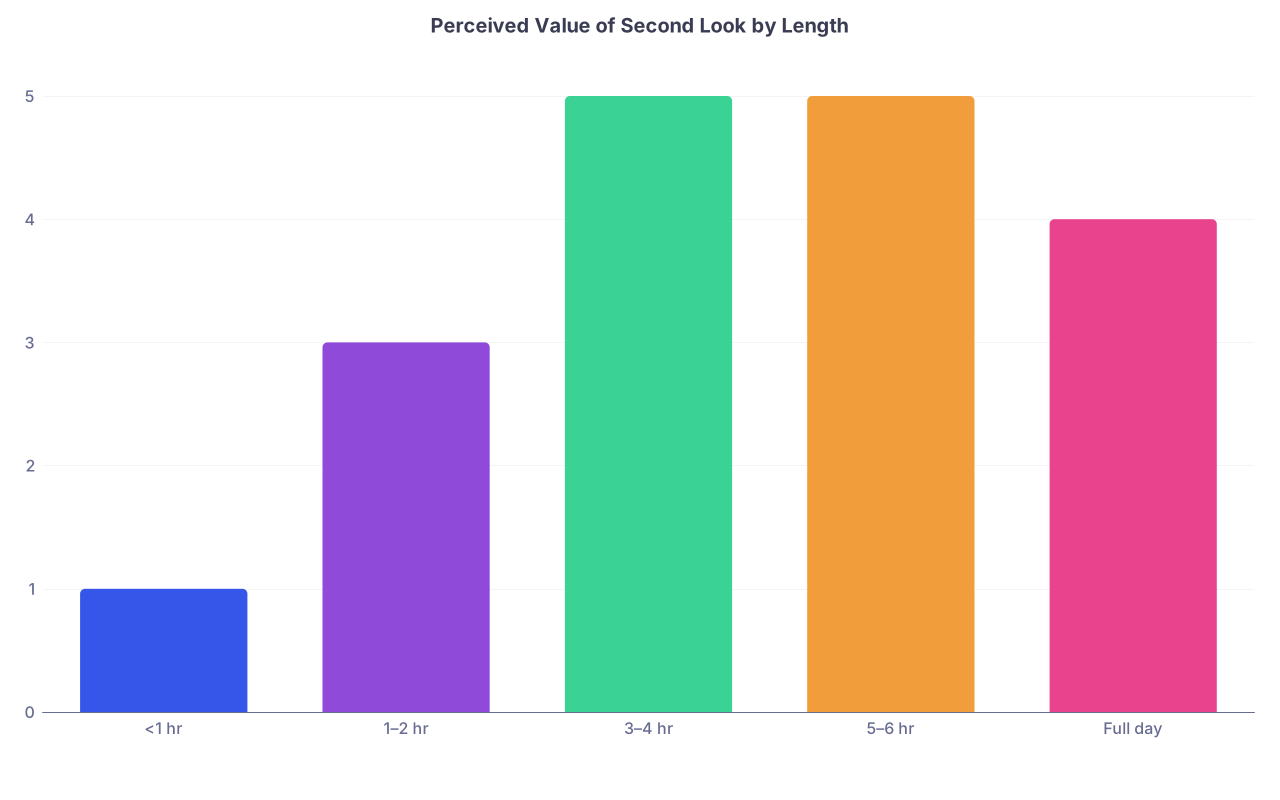
| Category | Value |
|---|---|
| <1 hr | 1 |
| 1–2 hr | 3 |
| 3–4 hr | 5 |
| 5–6 hr | 5 |
| Full day | 4 |
Scale: 1 = low value, 5 = highest typical value.
FAQs: Second Look Length and Logistics
1. Will a longer second look make a program rank me higher?
Usually no. Most programs will tell you that second looks do not factor into the rank list, partly for fairness (some applicants can’t afford travel). They notice extreme behavior, not time: if you’re rude, negative, or oddly intense for six hours, that can hurt you. But simply being present longer doesn’t boost you.
2. Is a virtual second look worth doing, and how long should that be?
Virtual second looks can absolutely be useful. A 60–90 minute virtual session with residents + maybe a 15–20 minute PD/APD Q&A can be plenty. You’re not touring physical spaces, so the value is in conversation and clarity, not duration. Virtual visits don’t need to be more than 2 hours total.
3. If I can only afford one second look, how should I choose where to go?
Pick the program where your rank decision most likely changes with more information. That’s usually a place you’re considering for your top 1–3 spots, where you feel genuinely torn. If extra data won’t move them up or down much, it’s not worth the cost.
4. Is it bad if my second look is only 1–2 hours?
Not at all. A focused 1–2 hour visit can be very effective if it includes resident time and a look at key clinical areas. Don’t apologize for the length in your email; just be clear about what you hope to see or discuss. Quality beats duration.
5. Should I try to shadow in the OR/clinic for an entire day?
Only if a half-day isn’t enough for your clarity and the program is extremely high on your list. Full‑day shadowing can be misleading: you might catch an unusually good or bad day and overgeneralize. For most people, 1–2 hours observing plus structured conversations is more informative than silently trailing a team for 8 hours.
6. How far before rank lists are due should I schedule a second look?
Aim for 1–3 weeks before your rank list deadline. That’s close enough that you remember it clearly, but not so close that you’re scrambling. If you’re applying to NRMP Match, that usually means late January to mid‑February for most specialties.
7. Do I need to tell programs I’m doing a second look at multiple places?
No. You’re not obligated to disclose where else you’re going. Just be professional with each program you contact. Second looks are for your decision-making, not for signaling loyalty. Programs assume you’re comparing them to others—that’s the whole point of a match.
Key takeaways:
- A second look becomes “meaningful” around 2–3 hours, with the 3–4 hour range being ideal for most people.
- Structure and intent matter more than raw time; prioritize resident conversations, real clinical exposure, and specific questions over just hanging around all day.