
It’s late January. You’re halfway through a string of interviews, you finally have a free weekend coming up, and you’ve started to settle into a rough rank list in your head. Then your email pings:
“Hi [Your Name],
We’re offering a final in-person second-look opportunity next week. We’d be delighted if you could join us…”
It’s from the program that just rocketed from “sounds interesting” to “wait, this might be my #1.” Problem: the date is terrible, flights are expensive, your schedule is already a mess, and you’re not sure if going will help or just drain you.
This is where people make impulsive, expensive, and occasionally dumb decisions. Let’s not do that.
Here’s how to handle a last-minute second-look invite when the program has suddenly become your new favorite.
Step 1: Get Clear on What a Second Look Can and Cannot Do
First thing: strip away the fantasy.
A second look does not:
- Move you from “we’re not ranking you” to “top of our list”
- Fix a weak application
- Guarantee anything at all
Most programs have already formed 90% of their rank impressions from:
- Your application
- Your interview day
- Internal discussion afterward
By the time they’re sending second-look invites, their list is at least sketched.
What a second look can do:
- Help you decide how to rank them
- Clarify fit: culture, workload, geography, call vibe
- Let you meet residents/faculty you missed the first time
- Give the program a sense that you’re genuinely interested (but this is a soft factor, not a magic lever)
If you’re in a competitive specialty (Derm, Ortho, ENT, Plastics, etc.), second looks can sometimes matter a bit more for “interest signaling” and for you to understand the pecking order of mentorship. In less hyper-competitive fields, they’re much more about your clarity than their ranking.
So the real question is not “Will this make them rank me higher?”
It’s: “Will this visit genuinely affect how I order my rank list?”
If yes, keep reading. If no, you may already have your answer.
Step 2: Time, Money, and Sanity — Do a Quick Reality Check
Before you get emotionally pulled in, do a cold calculation: can you afford this in time, money, and mental bandwidth?
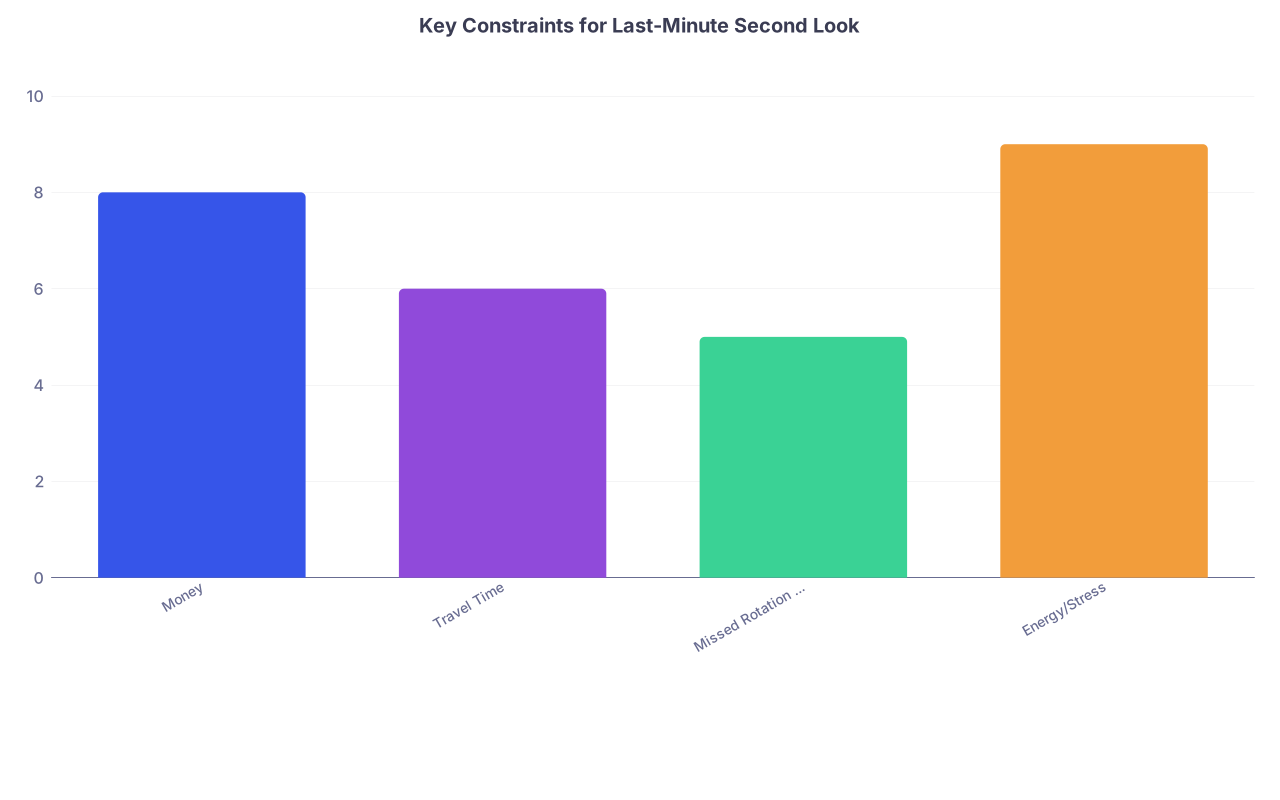
| Category | Value |
|---|---|
| Money | 8 |
| Travel Time | 6 |
| Missed Rotation Time | 5 |
| Energy/Stress | 9 |
(Values here are just to remind you: all four matter; energy and cost are usually the heaviest hitters.)
Ask yourself:
Money
- How much is this going to cost: flights, hotel, rides, maybe food?
- Are you already stretched from interview travel?
- Will going mean credit card debt you’ll drag into intern year?
Time / schedule
- Are you on an easy elective, or are you on ICU/Sub-I/required clerkship?
- Will you need to miss mandatory days or ask for favors from residents/attendings?
- Will missing those days risk an evaluation or a grade?
Energy
- Are you bone tired from back-to-back interviews?
- Is this going to wreck the one recovery weekend you had?
- Are you just doing this because of FOMO?
If the answer is: “This trip will hurt, but it might actually change my rank list,” then it’s at least worth planning out. If the answer is: “This trip will hurt, and I already know they’re top 3 but not beating my #1,” that’s a strong argument to decline politely.
Step 3: Clarify How Serious This “New Favorite” Status Really Is
New favorites are dangerous. Recency bias is real. You just liked them because the interview day felt smooth and the residents laughed at your jokes and the PD seemed kind.
Pause. Compare them directly with your current top contenders.
| Factor | Current #1 | New Favorite | Another Top Choice |
|---|---|---|---|
| Gut feeling | 9 | 8 | 7 |
| Location fit | 7 | 9 | 8 |
| Resident happiness | 8 | 9 | 7 |
| Training/Case mix | 9 | 8 | 9 |
| Support for fellows | 8 | 7 | 9 |
Make yourself do this exercise. On paper. Not in your head.
Where does this program actually sit?
- If they’re clearly in your top 2 and you have open questions that a second look could answer, they’re worth serious consideration.
- If they’re floating around #4-6, a last-minute flight probably isn’t justified unless you have almost no data from the first interview (virtual only, super short day, etc.).
You’re not trying to “win” by going to the most second looks. You’re trying to build a rank list you won’t regret.
Step 4: Decide: Go, Ask to Adjust, or Decline
Now you have enough context to pick a lane. You basically have three realistic options.
Option 1: Go — but Make it Strategically Worth It
You decide: yes, this might really be my #1, and I have big unanswered questions.
Fine. Then you don’t just “show up and vibe.” You treat this like a targeted recon mission.
Before you reply:
- Check your schedule: what days can you actually miss?
- Look for cheaper travel options: nearby airports, trains, driving, points.
- Check weather if it’s winter. Blizzard-risk trips have burned people.
Then respond quickly, within 24 hours if possible. Something like:
Dear Dr. Smith,
Thank you very much for the invitation to the second-look day. I was really impressed by [specific aspect] during my interview, and your program is one of my very top choices.
I’d be happy to attend on [date] and will arrange travel accordingly.
Best regards,
[Your Name]
Once you’ve committed, you prep like you would for another interview — but with a different focus: this time, it’s your turn to evaluate them.
Option 2: Ask for a Schedule Adjustment or Alternative
Sometimes the invite is for a single impossible date, like:
- You’re on ICU and can’t get out
- You already committed to another second look that day
- Weather or distance makes it absurd
You’re not powerless here. You can ask if there’s flexibility.
What you write:
Dear Dr. Smith,
Thank you for the second-look invitation. Your program has become one of my top choices after my interview. I would very much like to visit again.
Unfortunately, I am scheduled on a required rotation on [date] and cannot be excused that day. If there is any flexibility for me to visit on an alternate day to attend rounds, meet residents, or speak further with faculty, I would be very grateful.
If an in-person visit is not feasible, I’d also welcome the chance to schedule a brief virtual follow-up with [PD/APD/resident].
Best regards,
[Your Name]
Two outcomes:
- They say yes to an alternate day / informal visit: great, you go then.
- They say no, this is the only option: then you’re back to a clean yes/no, but at least you tried without looking flaky.
Asking for flexibility doesn’t hurt you if you’re polite and show clear interest.
Option 3: Decline — Without Burning a Bridge
Sometimes the mature move is: “No, I can’t, and I won’t wreck my finances and rotation for this.”
Then do that. And message them like an adult.
Dear Dr. Smith,
Thank you very much for the invitation to the second-look day. I truly enjoyed meeting your residents and faculty during my interview, and your program remains one of my top choices.
Unfortunately, due to [pre-existing travel commitments / constraints with a required rotation], I’m not able to return in person on the scheduled date. If feasible, I’d appreciate any opportunity to speak with a resident or faculty member virtually to learn a bit more.
Thank you again for your consideration.
Best regards,
[Your Name]
You’re signaling interest, explaining the constraint, and leaving the door open. Perfect.
And no, declining a second look does not automatically tank your rank at most programs. I’ve seen people match at places where they never went back, over people who did multiple second looks and tried way too hard.
Step 5: If You Go, Treat It Like a Targeted Mission
You decided to go. Now don’t waste it wandering the hospital cafeteria.
You need three things out of a second look:
- A realistic sense of resident life
- Honest information you could not get on interview day
- A clearer gut feel: can you actually see yourself there at 2 a.m. on night float?
Design your day around that.

| Step | Description |
|---|---|
| Step 1 | Get Invite |
| Step 2 | Decline Politely |
| Step 3 | Accept or Request Alt Date |
| Step 4 | Prepare Questions |
| Step 5 | Attend Second Look |
| Step 6 | Debrief and Rank Adjustment |
| Step 7 | Can I Afford It? |
| Step 8 | Could It Change Rank List? |
Before you go
Email the coordinator:
- Ask for a rough schedule for the day
- Ask if you can:
- Join morning sign-out or rounds
- Talk 1:1 with a senior resident on nights/floors
- Meet with PD/APD briefly if that’s allowed
Prepare a short list of specific questions grouped by theme:
Workload / schedule:
“How many patients does a typical intern cover on wards by mid-year?”
“What does the average call night actually look like?”Culture:
“What happens when someone is struggling here?”
“Would you feel comfortable saying no to an unsafe request?”Future-facing stuff (since you’re in that ‘Future of Medicine’ phase):
“How is the program adapting to telehealth / AI / changing reimbursement?”
“What changes have you seen in the last 2-3 years, and what’s coming?”
You’re trying to see how this place will handle the next 3–7 years, not just how shiny it looks right now.
During the visit: watch behavior, not presentations
Anyone can give you a polished PowerPoint about wellness.
Watch:
- How residents talk to each other during downtime
- How they talk about nurses, consultants, night float
- Whether they can joke about the hard parts without sounding bitter or fake
- Whether there are any senior residents who look truly burned out
If you can, hang around during:
- A handoff
- A busy pre-round period
- A late afternoon when dispo is a mess
That’s who they really are.
You’re not there to impress anymore. You’re there to eavesdrop and observe.
How much to “signal interest”
A second look itself is already a signal that you care.
You do not need to:
- Announce to everyone “You’re my #1!”
- Corner the PD to declare your eternal love
- Email half the faculty afterward with effusive paragraphs
What’s reasonable:
- Tell 1–2 key people (PD, APD, chief) something like:
“I came back today because your program is very high on my list and I wanted to be sure this would be the right fit if I’m fortunate enough to match here.”
That’s enough. Programs know everyone’s gaming preference signaling. You don’t need to overdo it.
Step 6: Debrief the Trip Before Your Brain Rewrites It
The real value of a second look happens after you get home, before your brain starts smoothing over the rough edges or glamorizing the free lunch.
As soon as you can, preferably that night:
- Take 15–20 minutes
- Write down:
- 3 things that made you more excited about the program
- 3 things that gave you pause
- Concrete details: “PGY-2 on night float looked wrecked and said ‘This year is rough but fair’” vs “residents seemed tired”
Ask yourself a blunt set of questions:
- If I match here and not at my previous #1, will I feel disappointed or relieved?
- Was there anything today that felt like a deal-breaker?
- Can I picture myself walking into that workroom as an intern on Day 1 and not hating my life?
Only after that, adjust your rank list. Not while you’re still high off the visit.
Step 7: Don’t Let Second Looks Hijack Your Whole Strategy
Some people start chasing second looks like trading cards. That’s how they end up exhausted, broke, and weirdly more confused.
Here’s the hard truth:
- Second looks are optional.
- Programs know they’re expensive and logistically painful.
- A single strong interview day plus good communication is usually enough.
Over the last few years, especially post-COVID with telehealth and virtual interviews, a lot of programs are dialing back on second looks or framing them explicitly as “for you, not for us.” They’re not supposed to be second interviews.
Use that to your advantage. If a place tells you explicitly: “This will not affect our rank list,” believe them. And plan accordingly.
Your rank list should be based on:
- Training quality
- Location + support system
- Resident culture and burnout
- Your long-term career goals
- Your actual life (partners, kids, health, visa, etc.)
Not on who invited you back with the nicest email subject line.
Step 8: Quick Edge Cases and How to Handle Them
A few weird-but-common scenarios.
You get two last-minute second-look invites for the same weekend
Pick one. Do not kill yourself trying to do both.
Choose the one that:
- You’re more likely to rank higher
- You have less information about
- Is more geographically feasible for your real life
And tell the other one:
I’m grateful for the invitation, but I’ve already committed to another visit that weekend and unfortunately cannot attend.
No drama. No over-explaining.
You feel like you “owe” a second look to your home or away rotation site
You don’t. Your rank list is yours.
If going back helps you compare them to your new favorite, sure. If it’s just guilt because “I did an away there,” skip it.
You’re international or very far away and travel is ridiculous
Then you lean harder on virtual second looks:
- Ask for a resident panel or 1–2 one-on-one chats
- Ask the PD or APD for a short follow-up if you have serious questions
- Ask for a quick virtual tour or extra materials if they have them
You can absolutely construct a solid opinion on a program without seeing them twice in person. Many people match happy that way every single year.
Step 9: Remember the Long Game — You’re Training for the Future, Not the Weekend
Last piece that most people ignore when they’re in the weeds of Match season: residency is happening during a rapidly changing time in medicine.
Ask yourself:
- Is this program preparing residents for telehealth, AI tools, new care models, value-based care?
- Are faculty talking about burnout, staffing shortages, and changing patient expectations like they’re problems to solve or just “the way it is”?
- Do residents seem involved in QI, systems redesign, or are they just surviving the pager?
A second look is a good chance to see how a program thinks about the future, not just your three years there. You’ll graduate into a system that is not static. If your “new favorite” doesn’t seem to be evolving, that should matter.
You’re not choosing a summer camp. You’re choosing where you’re going to become the kind of physician who can still practice and adapt in 2035.
Bottom Line: How to Handle This Without Losing Your Mind
If you’re staring at that last-minute second-look invite from your shiny new favorite, here are the three things to remember:
Make a cold decision first, an emotional one second.
Can you afford it, and could it truly change your rank list? If either answer is no, decline politely and move on.If you go, treat it like reconnaissance, not an audition.
Go with targeted questions, watch the residents when they’re not performing, and write everything down before your brain rewrites the story.Use the second look to sharpen your rank list, not to chase validation.
You don’t need to collect second looks like trophies. One focused visit to a genuine top contender beats three frantic, last-minute trips to places that were never going to be your #1.
Do that, and this “new favorite” becomes just another data point—useful, but not in charge of your life.