The weather did not “ruin” your second look. It just forced you to show you can think like a resident.
You’re not being tested on attendance. You’re being tested on judgment. Programs know flights get canceled, ice storms hit, and blizzards shut down whole regions. What they care about is: how you handle it, how you communicate, and whether you still get what you need to make a smart rank list.
Here’s how to salvage this without panicking, wasting money, or annoying the program.
(See also: If You’re on an Away Rotation and Can’t Travel for Second Looks for tips when you can’t make an in-person visit.)
Step 1: Stop Thinking “Missed Opportunity” – Think “New Leverage Point”
You are not the only one whose second look got wrecked by weather. When a storm hits a region, programs often lose half their second-look list overnight.
What that means for you:
- Programs are already on alert. They will not be surprised by your email.
- They often scramble to offer virtual alternatives or extra access.
- This is actually an opportunity to have more one-on-one time than you would’ve had in a packed in-person day.
The wrong mindset right now: “I lost my chance; I’ll just rank off my gut feeling from interview day.”
The right mindset: “I’m going to treat this like a targeted information-gathering and relationship-building mission. Efficient, direct, and visible.”
Step 2: Same Day: Send the “Weather Killed My Trip” Email
Do not wait three days. As soon as your travel is clearly not happening, you send one clean, professional email.
Send it to the program coordinator and CC the generic program email or assistant PD if there is one. Subject line matters—make it easy to sort.
Example subject lines:
- “Second Look – Travel Cancellation Due to Weather”
- “Unable to Attend Second Look – [Your Name], [Specialty] Applicant”
Here’s a script you can adapt:
Dear [Coordinator Name] and [Program Name] Team,
I was scheduled to attend the second look on [date], but my flights were canceled due to the [storm name/weather issue], and I am unable to safely reach [city].
I remain very interested in your program. I was specifically hoping to learn more about:
– [Item 1: e.g., ICU experience and autonomy as a PGY-2]
– [Item 2: e.g., outpatient clinic structure and continuity]
– [Item 3: e.g., call schedule and night float at each site]If there is a virtual alternative, small-group session, or brief opportunity to speak with a resident or faculty member, I would be very grateful.
Thank you for understanding, and I hope the second look day goes smoothly despite the weather.
Best regards,
[Full Name]
[AAMC ID or ERAS ID if you want to be extra clean]
You’ve done three things here:
- Signaled maturity (safety, weather, calm tone).
- Reaffirmed interest without sounding desperate.
- Given them a clear pathway to help you (virtual time, targeted topics).
Do not write a life story. Do not complain about airline chaos. They do not care.
Step 3: Decide If It’s Worth Re-booking In-Person (Brutally Honest Take)
A lot of people burn hundreds of dollars chasing a “vibe check” at programs they will rank 5–10 anyway. That’s emotion, not strategy.
Ask yourself three cold questions:
- Is this program realistically in my top 3–4?
- Is there something I absolutely cannot assess virtually? (like multi-site commuting, pediatric vs adult exposure, operative volume in surgical fields, etc.)
- Does the city/environment matter heavily to my quality of life, and have I never been there?
If your honest answer to all three is “yes,” then re-booking a simple, 4–6 hour solo visit might be worth it if the program allows it.
But if:
- You already visited the city.
- It’s a mid-tier preference.
- Money is tight. Then you switch to a full virtual salvage plan. Which is absolutely acceptable.
Step 4: Build Your “Virtual Second Look” in Three Layers
You’re going to reconstruct what second look gives you, minus the bagels and awkward icebreakers.
I’d break it into:
- Program leadership perspective
- Resident reality check
- City and lifestyle intel
You don’t necessarily need all three for every program, but if this is a top program for you, aim for them.
1) Program Leadership: One Short, High-Yield Touch
You may or may not get direct access to the PD or APD. That’s fine. Coordinators often offer:
- A virtual Q&A with leadership (group)
- A short one-on-one or small-group Zoom
- A faculty contact who’s willing to chat
If you get leadership time, show up ready. You don’t ask them questions that are answered on the website. You focus on “how things actually work.”
Here are the kinds of questions that are worth it:
- “How do you see the program changing over the next 3–5 years? Any planned expansions or restructuring?”
- “How do you support residents who are interested in [fellowship X / hospitalist track / academic career]?”
- “Can you give a concrete example of how resident feedback led to a change in schedule or curriculum this past year?”
- “How are you thinking about X future-of-medicine topic in the context of your program?”
(For example: telemedicine integration, AI decision support, value-based care, point-of-care ultrasound, etc., depending on specialty.)
You’re signaling: I’m thinking about training I’ll finish into the future, not just year one misery.
2) Resident Reality: This Is Where You Get the Truth
If your second look is canceled, your best move is to engineer 2–3 short conversations with different types of residents:
- One junior (PGY-1 or PGY-2)
- One senior (PGY-3+)
- One with a personal situation relevant to you (parent, IMG, couples matcher, research-heavy, etc.)
How to get them:
You can ask the coordinator like this:
Since I cannot attend the second look, would it be possible to connect with 1–2 residents for a brief call to understand day-to-day life and culture? I’m especially interested in speaking with [PGY-1s / seniors / residents with research interests in X].
If they say yes and connect you, great. If not, look for residents on the program website or social media and send a short, respectful message (email or LinkedIn/Instagram if that’s clearly how residents connect).
Script:
Hi Dr. [Name],
I interviewed at [Program] this season and was supposed to attend the second look on [date], but my travel was canceled due to the storm.I’m trying to get a realistic sense of the resident experience before finalizing my rank list. If you have 10–15 minutes for a quick call sometime this week, I’d really appreciate hearing your perspective on the program.
Totally understand if your schedule is full.
Best,
[Your Name]
During the call, you’re not making a friend. You’re running a focused intel op.
Ask about:
- “What surprised you most after starting here, good or bad?”
- “On your worst weeks, what makes it hard?” (Not just “we’re busy” — everyone is busy.)
- “How has the program responded when residents raised concerns about workload or wellness?”
- “What does a typical call/night look like, hour by hour?”
- “If you had to rank here again, would you? Why or why not?”
- “How is the program adapting to future-of-medicine stuff: new EMR tools, AI, telehealth, changing reimbursement? Are residents actually involved in those projects or just spectators?”
If they sound too polished or scripted, you follow up with: “Off the record—what do applicants usually underestimate about this program?”
One uncomfortable truth: the best intel sometimes comes when you just stop talking and let a resident fill the silence.
3) City & Lifestyle: You Can Simulate This Too
Second looks are often as much about, “Can I live here?” as “Can I train here?”
Your substitutes:
- Ask residents very bluntly: “Where do people actually live? What do rent and commute look like for you?”
- Ask: “On a post-call day, what do you actually do? What’s realistically accessible from where you live?”
And then, on your own:
- Use Google Maps to trace actual commute times from resident-described neighborhoods to each hospital campus, at 7 am on weekdays.
- Check cost-of-living websites, then compare to your current city.
- If you’re serious, drop into a local Reddit city sub or physician sub and search “[Program name] residency” and “[City] residency life”.
It’s not perfect. But honestly, neither is a three-hour bus tour in the rain.
Step 5: Clarify What Information You’re Missing Before You Panic
People get weirdly vague here. “I just wanted to get a feel.” A “feel” is not actionable.
You need a list of 5–10 concrete questions you still cannot answer about each program. That’s your to-do list.
Examples:
- How much do residents actually rotate at the community site vs main hospital?
- How the night float system really feels — human or miserable?
- How flexible is the elective time and do people actually get the electives they want?
- What the fellowship match has looked like in your specific interest area in the last 3 years.
- How supportive they really are about parental leave, visa issues, couples match logistics, etc.
Once you have that list, you identify: which of these can I get from:
- The coordinator/leadership
- Residents
- Website/handbook
- Old presentations and recorded sessions (some programs will share slide decks or old town halls if you ask)
You keep going until the list is mostly checked off. If there are one or two lingering unknowns, that’s normal. No program will ever be fully transparent about every flaw.
Step 6: Use This to Show Maturity, Not Neediness
There’s a line between appropriately engaged and exhausting.
Good signals:
- One clear email about the cancellation + interest in alternatives.
- Graciously accepting what they offer (group Zoom, resident contact).
- A sincere thank-you note if a resident or faculty spent time with you.
Bad signals:
- Multiple follow-ups in 24 hours.
- Fishing for “love letters” or hints on rank order.
- Asking questions that show you haven’t read the website.
Your goal isn’t to impress them into changing their rank list. At this stage, most programs have their list roughly set. What you’re really doing is making sure you have enough data to rank them wisely and not come back in PGY-1 saying, “I had no idea it was like this.”
And yes, your professionalism does still get noticed. Coordinators and PDs remember the people who handled chaos calmly.
Step 7: Put This in the Context of the Future of Medicine
Since you’re in the “Miscellaneous and Future of Medicine” phase, let me be blunt. Weather canceling your second look is practice for the rest of your career.
Medicine going forward is:
- Unpredictable (pandemics, climate events, reimbursement shifts)
- Increasingly virtual (telehealth, remote monitoring, hybrid care teams)
- Systems-based (you will work inside organizations that must pivot quickly)
How you respond to a disrupted second look is a small-scale version of what you’ll do when:
- A hospital system abruptly changes EMRs.
- A clinic converts half its visits to telehealth during a surge.
- A planned rotation disappears because a partner site closes.
Programs that are thinking about the future watch for residents who can handle this type of thing without melting down.
When you ask questions about:
- Telemedicine integration
- How they’re responding to AI in diagnostics or documentation
- How they train residents for population health, value-based care, or multidisciplinary teams
You’re not just checking boxes. You’re aligning yourself with where the field is going. A program that can’t answer those questions in 2026 is already behind.
Step 8: Translate All This into Your Rank List
So how does all this input actually adjust your rank list?
Use a simple scoring system for yourself. Not fancy. Just brutally honest.
| Factor | Program A | Program B | Program C |
|---|---|---|---|
| Resident culture (1–10) | 9 | 7 | 6 |
| Clinical training (1–10) | 8 | 9 | 7 |
| Future-focused (1–10) | 7 | 6 | 9 |
| City/lifestyle (1–10) | 6 | 8 | 5 |
| Gut feeling (1–10) | 8 | 7 | 6 |
You don’t show this to anyone. It’s for you.
You weight what actually matters:
- If you care most about fellowship → training + recent match outcomes matter most.
- If you’re older, have a family → lifestyle + city support structure may weigh more.
- If you’re obsessed with innovation → “future-focused” probably jumps up.
Re-read your notes from:
- Interview day
- Virtual second look stuff
- Resident calls
Update your scores. Then make your rank list. And stop re-litigating it every night.
Step 9: What If the Program Offers a Mass Virtual Second Look?
Take it.
Do not whine that it “won’t be the same.” Of course it won’t.
How to get value out of a 2-hour Zoom second look:
- Come with your 3–5 key questions already defined.
- Use the chat wisely: ask questions that help everyone, not just you.
- Pay attention to how residents answer: do they clearly know each other, joke, seem comfortable being honest even with faculty present?
- Watch who’s talking: is this a top-down program where only leadership speaks, or do residents have real voice?
If they use breakout rooms, volunteer to unmute and actually talk. Programs remember the person who asked the smart, concise question over the person staring silently.
Step 10: When to Just Let It Go
There is a point where more outreach is not helping you. It’s just soothing your anxiety.
You’re done when:
- You’ve clarified your top concerns for that program.
- You’ve gotten at least one resident perspective.
- You’ve had at least one program voice (leadership or structured session).
- You understand the city enough to know if it’s livable for you.
After that, any more calls are just emotional insurance. And like most insurance, it doesn’t feel satisfying until disaster—but disaster is rare.
At some point, you have to trust your process, make the rank list, and move on.
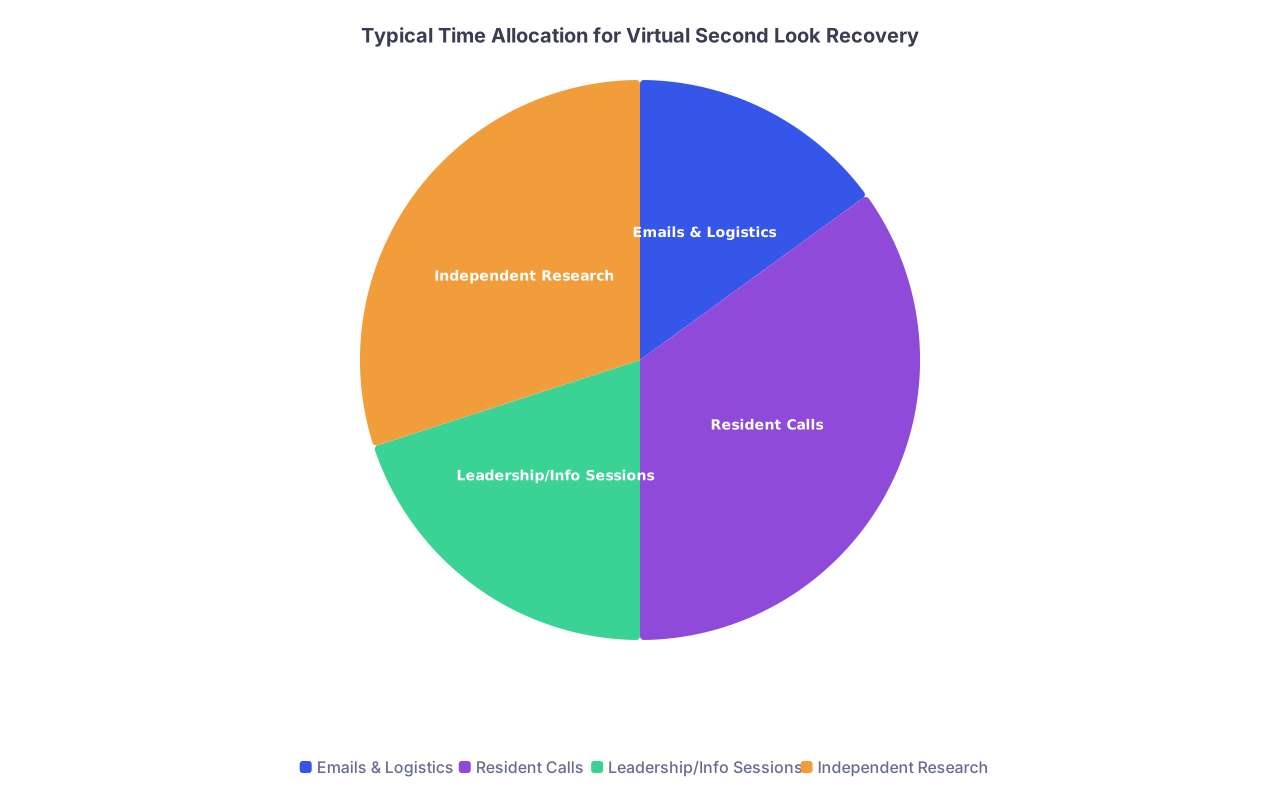
| Category | Value |
|---|---|
| Emails & Logistics | 15 |
| Resident Calls | 35 |
| Leadership/Info Sessions | 20 |
| Independent Research | 30 |

| Step | Description |
|---|---|
| Step 1 | Second look canceled |
| Step 2 | Email coordinator same day |
| Step 3 | Email coordinator same day |
| Step 4 | Ask about short in-person visit |
| Step 5 | Request virtual alternatives |
| Step 6 | Schedule resident calls |
| Step 7 | Clarify missing info list |
| Step 8 | Adjust rank list |
| Step 9 | Top 3-4 program? |
| Step 10 | Safe, affordable re-trip? |


FAQ: Weather-Canceled Second Look
Will missing second look hurt my chances of matching at that program?
Almost certainly not, especially if the reason is weather and you communicate promptly. Most programs don’t use second look attendance to move people significantly on their rank list. They know travel can fail. What can hurt you is coming across as disorganized or entitled in your communications. A calm, concise email explaining the situation and expressing continued interest is enough.Should I tell the program where I plan to rank them when I email about the cancellation?
Only if it’s 100% true and you’re very sure. Saying “I plan to rank you highly” is safer and honest if they’re in your top tier. Do not say “I’m ranking you #1” unless that is actually locked in. Programs can tell when applicants are spraying “you’re my top choice” messages everywhere. It looks weak and desperate, not strategic.Is it worth spending $400–$600 to re-book travel for an informal visit?
It depends how much that specific program matters to you and what you still don’t know. If it’s your probable #1–2 and you’ve never even seen the city or hospital, that money may actually be a good investment in your future sanity. If it’s a mid-list program, or you already know the city well, I would lean heavily toward a smart virtual plan and save the money. You’re about to make resident pay. You’ll want those dollars later.How many residents should I try to talk to if I missed second look?
For a program you’re serious about, two to three is ideal: a junior, a senior, and someone whose life circumstances resemble yours (partnered, parents, IMG, research-focused, etc.). More than that usually turns into noise. You’re not doing field research for a publication. You just need enough perspective to see patterns: if three different residents all hint that ICU months are brutal but fair, that’s useful. If one person vents about one bad month, that’s data, not destiny.Is it okay if I do nothing and just rank based on interview day?
Yes, if you genuinely have enough information already and the second look was more “nice to have” than essential. Many people match to programs they never second-looked at and do just fine. But if you’re lying awake because you have glaring unanswered questions about workload, culture, or city logistics, then doing some targeted outreach is smarter than stewing in uncertainty. The goal isn’t perfection—it’s reducing avoidable surprises.
Open your email right now and draft the “second look canceled due to weather” message for your highest-priority affected program—before your anxiety talks you into silence.