
What if I told you your carefully planned second look and your obsessively re-edited rank list can’t fix the one thing you’re secretly hoping they will: control where you match?
Let’s tear into two of the most myth-soaked parts of the residency process: second look visits and rank order lists. Not how they’re “supposed” to work. How they actually work.
The Big Myth: “Second Looks Help Me Match Here”
This is the story students tell themselves every year:
“I loved Program X. If I go back for a second look, meet more people, show my face, they’ll remember me and rank me higher.”
What second looks realistically do for programs
From the program side (yes, I’ve seen this up close), here’s how second looks usually land:
- Your ERAS file is already complete.
- Your interview eval is already in, scored, and likely discussed.
- Your overall rank position is basically stable unless there’s a major new piece of information (eg, failed Step becomes a pass, huge professionalism event, etc.).
A second look is rarely considered “major new information.”
Most programs now have some flavor of this policy in writing or in practice:
Second looks are optional, not evaluative, and will not affect your rank.
Do they always live up to that? Mostly yes. For three reasons:
Legal/NRMP risk.
NRMP rules and institutional lawyers are not messing around. Documented evidence of “we bumped this applicant because they came back and this other one didn’t” is a nightmare scenario.Fairness optics.
Programs know second looks disproportionately favor students with money, flexible schedules, and light away rotations. Saying they’re required or heavily weighted is a bad look.Absolute chaos.
If 50% of interviewees did second looks and each one moved on the list, ranking would turn into a circus. Most programs finalize their rank list based on the interview day data.
Could an individual program quietly give you a micro-boost for a second look? Sure. Humans are humans. But that’s not something you can bank on strategically.
What second looks actually do for you
Second looks are far more valuable to you than to them. And not in the way people think.
They can:
- Confirm whether the vibe on interview day was real or staged.
- Show you what the place is like on a random Tuesday afternoon, not a curated “interview show day.”
- Expose resident burnout, weird power dynamics, or hidden strengths you missed the first time.
They cannot:
- Turn a mid-tier program into a dream fit.
- Turn a malignant program into a “maybe it’s not so bad.”
- Guarantee any movement of your position on their rank list.
A second look is a data-gathering trip, not a performance.
If you treat it like an audition, you’re misunderstanding the power dynamic. They’ve already seen your audition. This is you deciding if you’re willing to spend 3–7 years of your life there.
The Broken Logic of “I Have to Do a Second Look”
The fear loop goes like this:
“If I do not do a second look, they’ll think I’m not interested. Less interest = lower rank.”
Sounds plausible. It’s also mostly wrong.
Programs know the match algorithm is applicant-favoring. They don’t need your second look as a “commitment signal.”
Look at it from their side:
- They already know applicants are applying to 40, 60, 80 programs.
- They know you can’t second-look everywhere.
- They see that travel is expensive and time is limited.
- They’ve been told (in writing) to avoid coercive behavior around post-interview contact.
If a program expects a second look from you to consider you serious, especially if they say or heavily imply it, that’s a red flag. That’s either:
- Out of touch with equity and reality, or
- Testing if you’ll jump through unnecessary hoops.
You know who jumps through every ridiculous hoop without pushing back? The same residents who get leaned on later to pick up extra shifts, cover chronic staffing gaps, and absorb systemic dysfunction.
Second looks don’t just show you a program. They also show the program who you are. That cuts both ways.
What the Match Algorithm Actually Cares About (And What It Doesn’t)
Let’s demolish another popular fantasy:
“If I play games with my rank list, I can strategically increase my chances at my favorite programs.”
No. The NRMP algorithm is not Tinder. It doesn’t reward clever “strategy.” It rewards honesty.
What the algorithm literally does
Stripped down, for each applicant, the algorithm:
- Starts at the top of your rank list (Rank #1).
- Tries to place you there.
- If the program has space, you’re tentatively placed.
- If it’s full, it checks whether you’re higher than someone else on their list.
- If you’re higher than a currently held applicant, it kicks that person out and holds you instead.
- That kicked-out person then tries their next choice.
- This iterates until everyone has been run through all their ranked choices.
What matters:
- Your true preference order.
- Programs’ true preference orders.
- Positions available.
That’s it.
Where you hurt yourself is not “ranking a competitive program first.”
You hurt yourself by not ranking programs in your real order of preference.
Rank list myths that refuse to die
Let’s lay a few of these out cleanly.
| Myth | Reality |
|---|---|
| Ranking a reach program #1 will hurt my chances | It cannot hurt you; if you do not match there, the algorithm moves to your #2 |
| Programs see how you rank them | They do not. They get no data on where you listed them |
| I should rank based on where I’m “most competitive” | You should rank based on where you most want to train, full stop |
| Moving a place up signals interest and helps me match there | The algorithm isn’t “watching” you; it just processes lists mechanically |
The algorithm does not:
- Give you bonus points for “realistic” ordering.
- Punish you for shooting high.
- Factor in whether you did a second look, sent a letter, or wrote a poem to the PD.
It just matches two ranked lists.
Second Looks and Rank Lists: How They Interact (And Don’t)
Here’s where people fuse the myths:
“I’ll do a second look. If they like me more, they’ll bump me. I’ll also move them up my list. Win–win.”
Let’s be precise.
What a second look might legitimately change
Second looks can absolutely change your rank list. And sometimes they should.
You might discover:
- Night float is brutal and residents look wrecked.
- The fellowship pipeline is a story, not a reality.
- The “supportive” PD is barely present and decisions are all top-down from GME.
- Or, the opposite: culture is phenomenal, education is real, and it just felt right.
Second looks are powerful for:
- Breaking ties between programs that seemed equal on paper.
- Correcting “halo effect” from a glossy interview day.
- Giving you confidence that your #1 is actually #1, not just the fanciest logo.
What they don’t do is guarantee any movement on their list that meaningfully changes your odds.
A realistic scenario
You interview at Program A. You’re probably in their rank zone somewhere between #45–#80 out of 120 interviewees.
You do a second look.
Result options:
- They don’t adjust your score at all (most common).
- You get a tiny bump from “interested, engaged” comments by residents.
- You get a tiny penalty if you’re somehow unprofessional or weirdly intense.
Those tiny shifts might move you from #63 to #58. Or from #52 to #47.
If the program fills at #40 on their list, none of this matters. Whether you were 47 or 63, you were never going to match there because they never got down to you.
Your far bigger lever is simple:
How high you rank them on your own list compared to other programs where you’re also within striking distance.
When a Second Look Is Worth It (And When It’s Not)
Let’s stop pretending second looks are all-or-nothing. Some are smart. Some are a waste.
Worth considering a second look when:
- You’re torn between 2–3 programs that feel similar on paper and interview day.
- You have specific, serious unanswered questions: operative autonomy, clinic structure, call schedule, fellow/resident tension.
- You want to see how residents interact when faculty aren’t hovering.
- You can go cheaply and without tanking rotations or finances.
In that context, yes, a second look can improve your rank list quality, which indirectly improves your match happiness. Not the odds at any particular program—the odds that you like where you land.
Probably not worth it when:
- You already know the program is your clear #1 or clear “never.”
- The program has explicitly said second looks are not part of evaluation and you’re only going to “show interest.”
- You’d be going into credit card debt or missing critical clinical time.
- You’re trying to “rescue” a mediocre interview.
Second looks are expensive. Time, money, energy. Treat them like an investment in clarity, not in favor.
The Future: Second Looks Under the Microscope
Programs and accrediting bodies are moving—slowly—toward more sane policies.
Trends I’m seeing:
- More programs explicitly tell applicants:
- Second looks = optional
- Not evaluative
- No new letters/emails needed
- A growing push for:
- Virtual second looks (resident-only Q&As, unrecorded sessions)
- Structured “second look days” to minimize one-off travel arms races
- Increased scrutiny on anything that smells like coercive interest signaling.
And there’s a reason for this: second looks magnify inequity. The student with family money near a big coastal city can hit 5–6 second looks easily. The student from a rural state school with loans and a sick parent cannot.
If your plan to stand out hinges on second looks, you’re playing a game that’s being actively de-incentivized.
A Quick Reality Check on What Actually Moves the Needle
Let’s be brutally honest about hierarchy of impact.
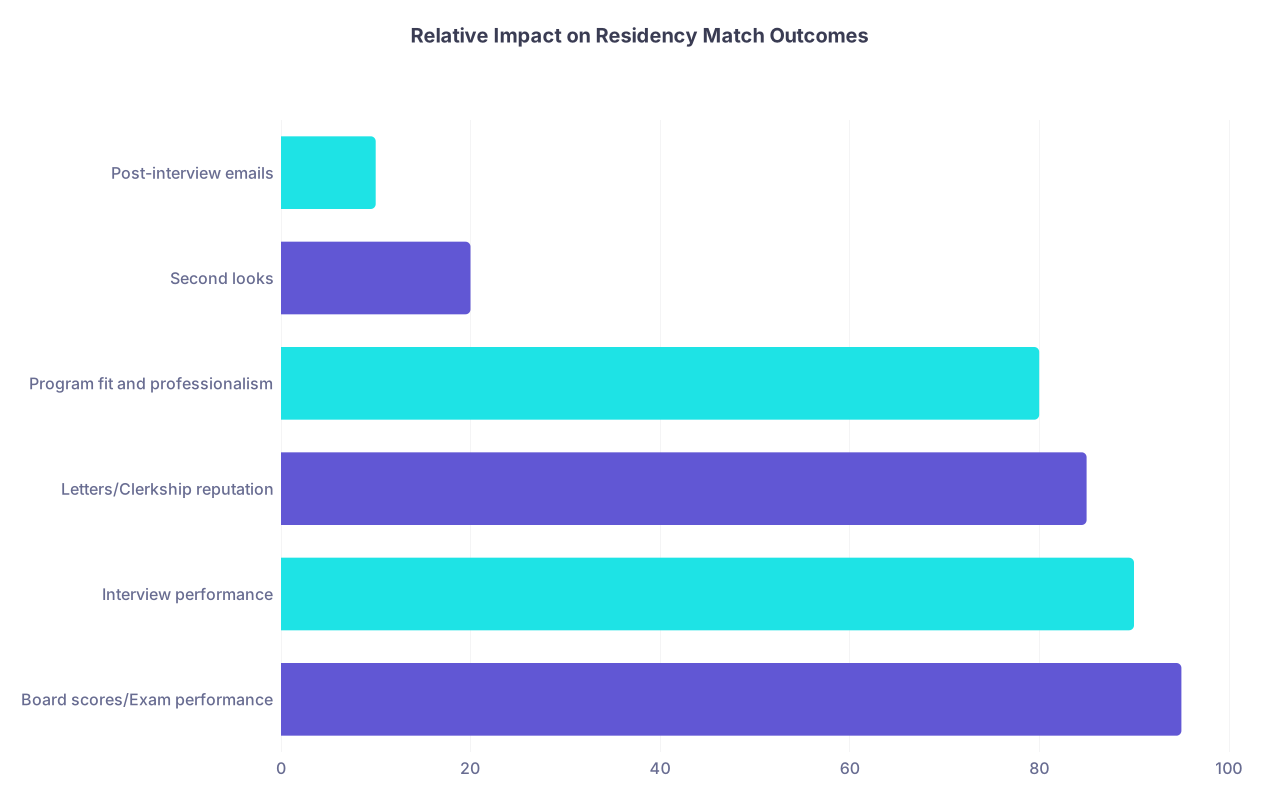
| Category | Value |
|---|---|
| Board scores/Exam performance | 95 |
| Interview performance | 90 |
| Letters/Clerkship reputation | 85 |
| Program fit and professionalism | 80 |
| Second looks | 20 |
| Post-interview emails | 10 |
Are the numbers above exact? No. But the shape is right.
Second looks and post-interview “love letters” are low-yield moves compared to:
- How you performed on exams.
- How you performed on rotations.
- How you came across during the actual interview day.
Second looks are in the “marginal, situational tool” category, not the “core strategy” category.
So How Should You Actually Use Second Looks and Rank Lists?
Let me strip this down to something you can act on.
For second looks:
Use them to answer questions like:
- Do I like these residents as people?
- Do I trust the seniors and attendings to train me?
- Does this city and hospital feel livable for years, not a weekend?
- Are people honest when I ask, “What’s the worst part of training here?”
Do not use them as:
- A loyalty demonstration.
- A last-ditch attempt to fix a bad interview.
- A substitute for serious self-reflection on fit, geography, and lifestyle.
And if you can’t afford second looks—financially or logistically—stop apologizing. You’re not handicapping your match. You’re just not indulging in low-yield optics.
For your rank order list:
- Rank programs strictly in the order you’d want to train there. Not prestige. Not where you “think” you’re competitive. Where you actually want to wake up for years.
- Don’t drop a program you’d be happy to attend because you think it’s a “reach.” That’s not how the algorithm works.
- Don’t move a program up just because you did a second look and feel emotionally sunk-cost into it. If the second look gave you real new information, fine. If it just made you feel more attached because you invested time and money, that’s not data. That’s bias.

The Bottom Line: What They Can’t Actually Do
Second looks and rank lists are full of superstition because this phase of training feels out of your control. You want levers. You reach for whatever looks like a lever.
Here’s the unpleasant truth:
- Second looks cannot reliably move you up a program’s list in a way that meaningfully changes match odds.
- Your rank list cannot “game” the algorithm; honest preference is the only winning strategy.
- Post-interview theatrics—extra visits, extra emails—are marginal at best, and sometimes just noise.
Use second looks for what they’re actually good at: sharpening your sense of fit and reality.
Use your rank list for what it’s actually built for: stating, clearly, where you most want to go.
That’s it. That’s the whole play.
Key points to walk away with
- Second looks are for you, not for them. They rarely shift your standing; they mainly help you judge fit.
- The match algorithm is applicant-favoring but brutally literal. Rank in true preference order or you’re sabotaging yourself.
- Don’t let low-yield myths (second looks = interest signal, “strategic” ranking) distract you from the basics: solid performance, honest self-assessment, and a rank list that reflects where you actually want to live and work.