
Second looks are wildly overrated.
There. Let’s start with the part nobody at the pre-interview social wants to say out loud: a second-look visit will not guarantee you match at that program, will not magically shoot you up their rank list, and in many cases will not move the needle at all.
Programs do not build their rank lists around who bought the most expensive plane ticket in February.
You’re being sold a story—by older residents, by anxious classmates, sometimes even by programs themselves—that “showing interest” via a second look is the key to locking in your spot. The actual data and the way rank lists are built tell a very different story.
Let’s walk through what’s myth, what’s real, and when a second look is actually worth your time.
What Programs Actually Use to Rank You
Before we even touch second looks, you need to understand how power is distributed.
Programs build their rank lists mostly off what they already had before your interview day ended:
- Application (scores, grades, research, letters)
- Interview evaluations
- Committee discussion and consensus
- Sometimes a post-interview global score or “tier”
Here’s the uncomfortable truth I’ve heard in more than one rank meeting: by the time January hits, most committees already have a pretty stable sense of their list. They tweak at the margins, yes. But nobody is going from “borderline not rankable” to “top 5” because of a second look.
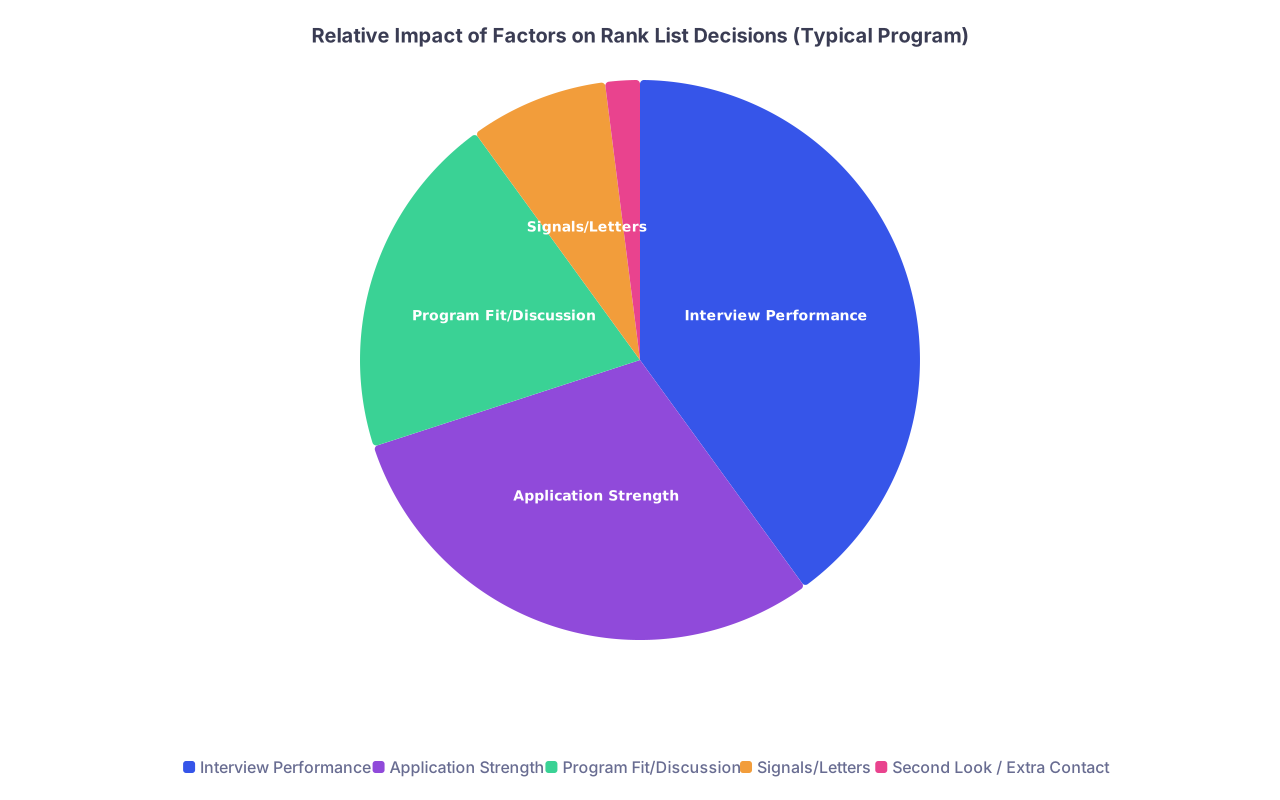
| Category | Value |
|---|---|
| Interview Performance | 40 |
| Application Strength | 30 |
| Program Fit/Discussion | 20 |
| Signals/Letters | 8 |
| Second Look / Extra Contact | 2 |
Even if you quibble with the exact percentages, the ranking is right: second looks are a rounding error compared to your interview and application.
Does that mean they never matter? Not exactly. It means you need to stop treating them as rank-list rocket fuel.
Myth #1: “A Second Look Shows Commitment and Makes You Rank Higher”
This is the core myth: that flying back for a second visit equals “I’m super committed” and that programs reward that commitment with a fat bump on their list.
Here’s what the reality looks like across many programs:
- Some programs do not track second looks at all in any structured way.
- Some track them but explicitly do not allow that information to influence the rank list, to avoid bias and equity issues.
- Some note them informally (“Oh yeah, she came back for a second look”), which might give you a tiny nudge if you’re already in the “we like this person” bucket.
I’ve literally heard PDs say in meetings: “Just so everyone’s clear, we can’t and won’t move people up just because they came back; that’s not fair to people who couldn’t afford it.”
If you want a mental model, think of it like this:
| Factor | Typical Impact on Rank |
|---|---|
| Amazing interview | Large |
| Extremely strong letters | Moderate–Large |
| Exceptional fit discussion | Moderate |
| Thoughtful post-interview email | Tiny–Small |
| Second-look visit | Tiny (often zero) |
The myth that “they’ll rank you higher if you come back” survives mostly on survivor bias. The stories you hear tend to be:
“I did a second look at [Big Name Program], told them they were my top choice, and I matched there!”
People don’t tell the equally common story:
“I did three second looks, spent $1,200, and matched at a fourth program.”
Guess which one makes better Reddit content.
Myth #2: “Programs Expect You to Do a Second Look If You’re Serious”
No. They don’t—at least not in any official, defensible way.
Especially post-COVID, a lot of program leadership is very aware of:
- Cost burden (flights, hotels, time off rotations)
- Equity issues (who can afford to do five second looks?)
- Ethical and NRMP concerns about implicit pressure
Look at how second looks are framed on many program websites now: “Optional,” “no impact on ranking,” “for your information only.” They put that language there for a reason.
Some programs would frankly prefer you not come back, because:
- They’re busy;
- They don’t want to create a two-tier system where those who can afford trips get extra face time;
- They’re trying to avoid the optics of “pay-to-compete.”
That doesn’t mean no program ever subconsciously values second looks; humans are humans. But the idea that there’s a broad, unspoken expectation that “serious” applicants must second-look is fiction.
If a program leader or resident implies that you need a second look to be taken seriously, that’s a red flag about the culture, not a hidden rule you must obey.
Myth #3: “Second Looks Let You ‘Fix’ a Mediocre Interview”
This one is dangerous.
I’ve heard students say, “My interview there felt flat, so I’ll do a second look to show them my real personality.”
Here’s the truth: the interview day is your shot. That’s the arena. Everyone is formally scoring you, comparing you, and the committee is on high alert. The second look is none of that.
What a second look won’t do:
- Erase a poor or awkward interview
- Undo a red flag comment
- Transform a lukewarm global impression into “must-have”
What it might do:
- Confirm that they were right about you (for better or worse)
- Give one faculty/resident another data point to support an opinion they already had
- Help you realize, “Yeah, this place isn’t actually what I imagined”
I sat in one rank meeting where a faculty member said, “Remember, she came back for a second look and really seemed committed.” The PD’s answer? “She was already in our top third. Good to know she likes us, but it doesn’t change the order.”
That’s typical, not exceptional.
What Second Looks Are Actually Good For
Now we get to the part everyone ignores because it’s not sexy: second looks are for you, not for them.
Used correctly, they’re a fact-finding mission, not a performance.
You can actually answer questions that matter:
- Do the residents seem burned out or genuinely okay?
- What are the call rooms really like at 2 a.m. on a Wednesday?
- How does the program handle scut, consults, admissions in real life?
- What’s the vibe in morning report when the PD isn’t performing for interview day?

Second looks can be especially useful when:
- You’re genuinely torn between 2–3 programs and your rank order will hinge on subtle feel differences.
- You interviewed virtually and feel you never really saw the hospital, city, or facilities.
- You have personal constraints (family, partner, kids) and need to see housing, commute, childcare options.
That is where second looks pay off: not by boosting your position on their list, but by sharpening your own list.
If a second look changes you from “I think I like Program A more” to “Actually, no, Program B is clearly a better fit,” that’s enormous value, even if it didn’t change how either program ranked you at all.
How Second Looks Can Backfire
Nobody likes to talk about this, but yes, a second look can hurt you at the margins.
Not because you “didn’t say the right thing,” but because more exposure means more chances to show mismatch.
Common ways I’ve seen it go sideways:
- You come across as overly intense or desperate. Cornering the PD with “I will rank you #1” for 15 minutes is not charming.
- You contradict your interview persona. If on interview day you were laid-back and then on second look you’re aggressively lobbying everyone for inside info, people notice the dissonance.
- You show up unprepared, disengaged, or late. Now you’ve gone from “good interview” to “bit of a question mark.”
Do most second looks hurt people? No. But the belief that they’re a free roll—only upside, no downside—is wrong. Any extra interaction with humans adds variance.
Where second looks really do damage is to your wallet and bandwidth.
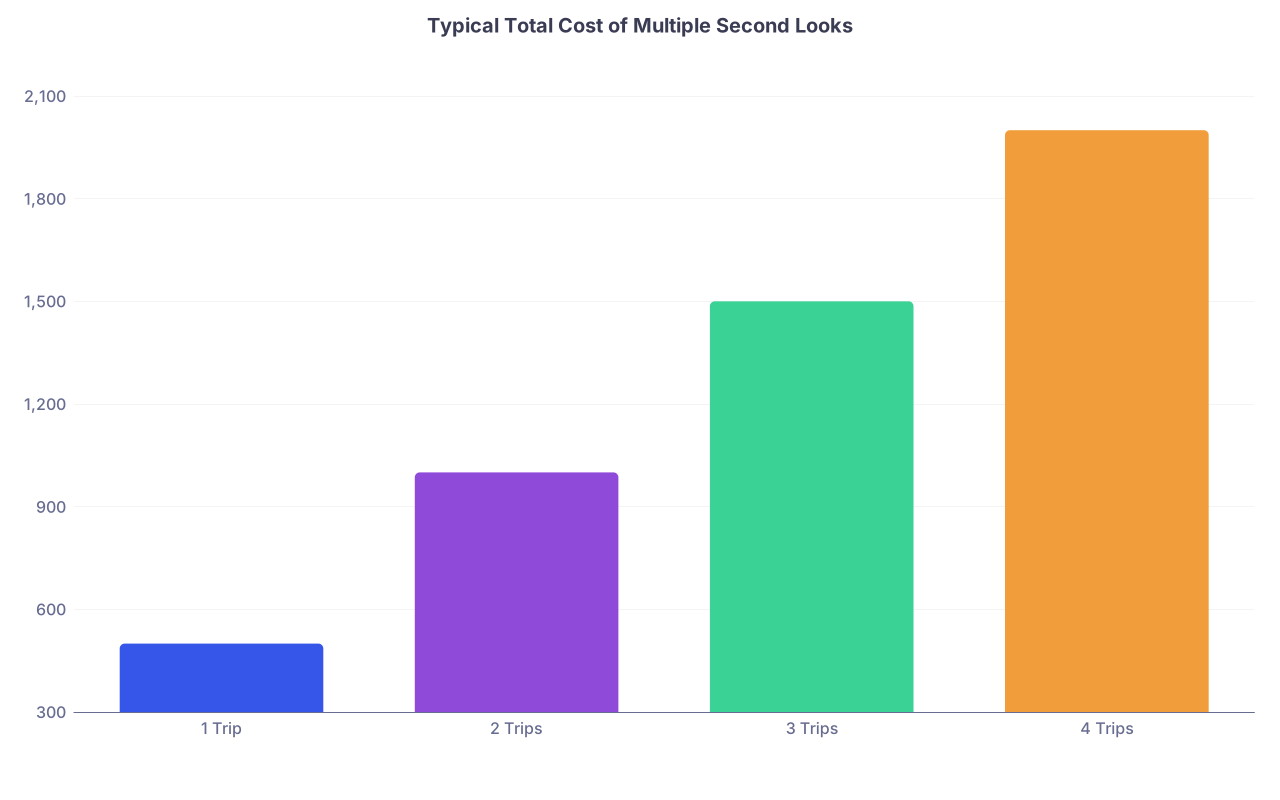
| Category | Value |
|---|---|
| 1 Trip | 500 |
| 2 Trips | 1000 |
| 3 Trips | 1500 |
| 4 Trips | 2000 |
While you’re stressed about booking flights, missing rotations, and sitting in airports, you’re not doing the one thing that matters most: constructing a thoughtful rank list based on your current information and values.
Second Looks in the Era of Virtual and Signaling
The ground has shifted under everyone’s feet: virtual interviews, preference signals, geographic signals, VSLOs, all of it.
Second looks make less sense as a “signal of interest” when:
- You’ve already used official preference signals.
- Programs get hundreds of “you’re my top choice” emails they half-ignore.
- PDs are explicitly told during faculty development that they should not reward costly behaviors like extra visits.
In some specialties, you now have:
- Gold-standard signals: official ERAS preference signals, home sub-Is, away rotations.
- Soft signals: nice emails, faculty championing you, knowing someone at the program.
- Low-yield signals: second looks that don’t add new faculty contact or written advocacy.
If you’ve already done an away there or a strong home rotation and your application is solid, a second look is not going to be the deciding factor. You already sent the loudest possible signal: you worked with them for 4 weeks.

| Step | Description |
|---|---|
| Step 1 | Applicant Interest |
| Step 2 | High Impact |
| Step 3 | Moderate Impact |
| Step 4 | Low Impact |
| Step 5 | Home rotation |
| Step 6 | Away rotation |
| Step 7 | Strong faculty advocate |
| Step 8 | Preference signal |
| Step 9 | Thoughtful thank you email |
| Step 10 | Second look visit |
| Step 11 | Generic mass email |
Second looks sit down there with “low impact” unless they produce something else high-impact, like a strong faculty advocate who actually speaks up in the rank meeting. And that’s rare from a 3-hour shadow experience.
How to Decide If a Second Look Is Worth It
So, how do you make a rational decision, instead of following the herd?
Ask yourself these questions bluntly:
Will this realistically change my rank list? If the answer is “probably not,” the trip is vanity.
Am I already sure enough about this program? If you already know it’s #1 or clearly below several others, you don’t need to go back.
Can I afford the cost without stress or guilt? If it’s going on a credit card you can’t pay off, stop. Second looks are not worth debt.
What can I learn there that I truly cannot get from current residents over Zoom or phone calls? Residents will usually give you the real story honestly via a call. Use that first.
Is the program making this feel subtly mandatory? If yes, that’s information about power dynamics. Proceed carefully.

If you cannot articulate a clear decision-use case for the second look—“I’m deciding between A and B specifically, and I need to see call structure and talk to senior residents about fellowship placement”—you’re probably chasing emotional reassurance, not new information.
How to Do a Second Look Without Wasting It
If you do go, don’t treat it like a second interview. Treat it like reconnaissance.
Show up with an actual agenda:
- “I want to see where residents live and how far they commute.”
- “I want to understand how jeopardy call works when someone is out.”
- “I want to talk to women residents with kids or dual-physician couples.”
- “I want to sit in on morning report or tumor board if allowed and see the tone.”
Tell the coordinator or resident host what you’re trying to learn. You’re not there to “perform commitment.” You’re there to test whether this place is compatible with the life you want for the next 3–7 years.
And when you leave, force yourself to write notes the same day: what surprised you, what worried you, how your gut reaction compares to other places. Otherwise the whole trip gets flattened into “felt nice” and you’re right back where you started.

The Future of Second Looks: Less Magical, More Practical
As medicine moves (slowly) toward more equity and transparency in the match process, second looks are going to keep shrinking in significance. Programs are being pushed—by NRMP, by applicants, by their own residents—to stop rewarding behaviors that depend on who has more money and free time.
You’ll still hear scattered stories where someone swears their second look “sealed the deal.” Maybe it gave a slight nudge. Or maybe they were already going to match there and the narrative got rewritten in hindsight.
From a systems perspective, second looks are noise, not signal.
They’re a tool, not a cheat code.
Use them to gather information you genuinely cannot get otherwise, in edge cases where your rank decisions are close and consequential. Ignore the pressure to treat them as mandatory displays of loyalty.
The match machinery does not care how many times you walked their hallways in February.
The Bottom Line
- Second-look visits do not guarantee you match at a program and usually have minimal impact on how they rank you.
- The real value of a second look is for your decision-making, not as a “signal” to impress them.
- Only do a second look when it will clearly change your rank list, not because you’re afraid of missing some imaginary secret advantage.