What exactly do program directors think when you email, “I’d love to come for an in‑person second look if possible”? Are you helping your chances—or just burning money and vacation days to impress nobody?
Let’s cut through the mythology around second looks, virtual or in‑person. Because there’s a lot of superstition here, and very little actual signal.
The Big Myth: “If I Don’t Show Up In Person, They’ll Think I’m Not Interested”
This is the core fear that drives people to book last‑minute flights and sleep on friends’ couches to walk the same hallways they already saw on interview day.
Here’s the uncomfortable truth: for most programs, second looks—virtual or in‑person—have little to no impact on how you’re ranked.
Not “limited.” Not “small but meaningful.” Basically none. And when they do matter, it’s usually in very constrained, specific ways.
Multiple national surveys of program directors across specialties have all found roughly the same thing:
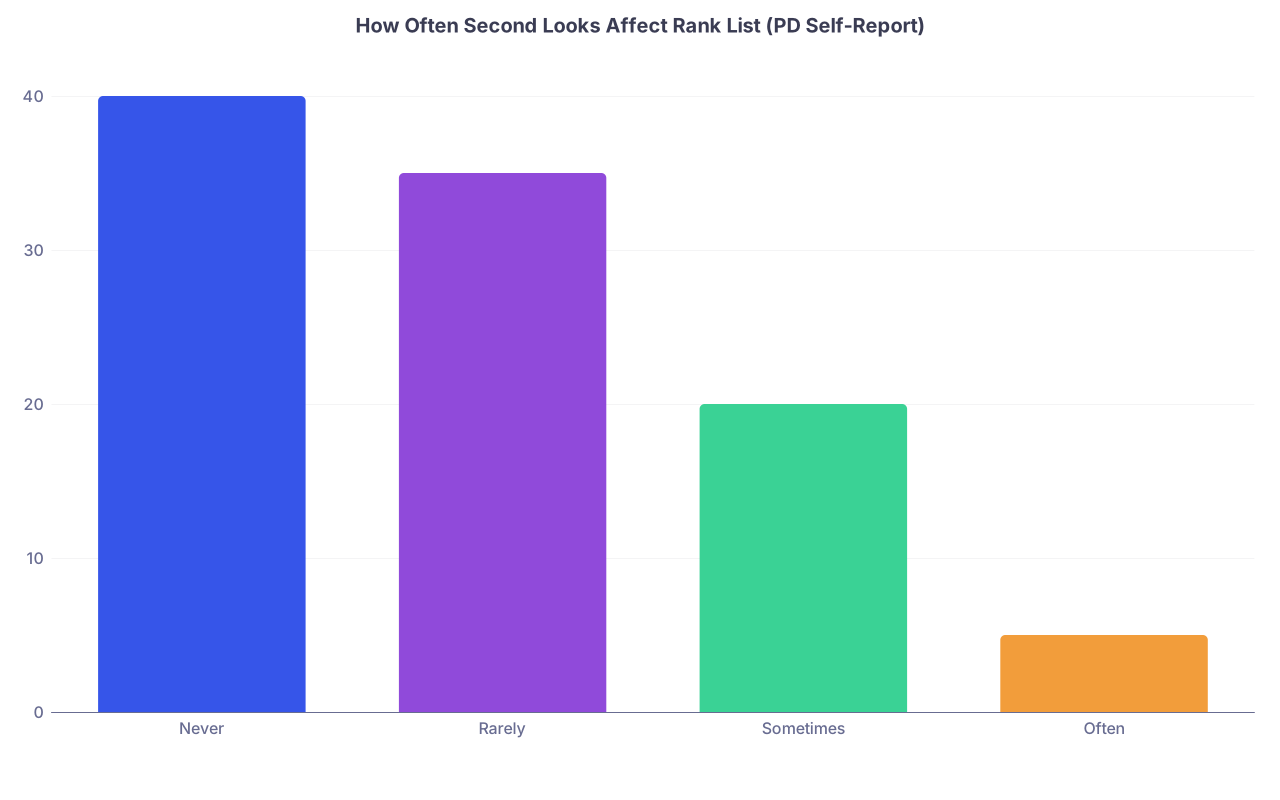
| Category | Value |
|---|---|
| Never | 40 |
| Rarely | 35 |
| Sometimes | 20 |
| Often | 5 |
The exact numbers vary by specialty and year, but the pattern repeats: most PDs either never or rarely change their rank list based on a second look. And “often” is basically rounding error.
That matches what I’ve seen behind the scenes in IM, EM, and surgery programs: by the time you’re thinking about second looks, the rank meetings are either already done or essentially locked. A second look at that point is background noise.
So the myth that not showing up in person hurts you? Mostly fiction.
Now, before you stop reading and cancel every trip: there are things that matter to PDs in this whole second‑look universe. They’re just not what applicants think.
What Second Looks Are Actually For (From the PD Side)
You think second looks are an extra audition. PDs think they’re… logistics.
Second looks—especially in‑person—are primarily designed around you deciding whether the program fits, not the other way around. Even virtual “revisits” are usually structured as:
- extra Q&A with residents
- program updates
- another overview of schedules, research, curriculum
- maybe a social event or virtual tour
That’s informational, not evaluative.
Residents will occasionally report back impressions. A chief will say, “That candidate from Hopkins seemed genuinely excited about our ICU training.” But those comments are usually soft, vague, and happen after rank lists are essentially written. Rarely does someone say, “We had them ranked 15th, but after the second look we moved them to 3rd.”
If a program director tells you, “Second looks are for your benefit, not ours,” they’re not being coy. They’re telling you how it actually works.
Second looks do matter for PDs in three narrower ways:
Red flags – If you act wildly unprofessional, rude, inappropriate, or clearly intoxicated at a social event, a PD might drop you on the list or remove you. But that’s about avoiding disaster, not rewarding enthusiasm.
Tie‑breaking anecdotes – If two candidates are truly neck‑and‑neck, a particularly strong positive impression from residents at a second look might nudge someone up or down a couple of spots. This is rare and usually informal.
Future recruitment optics – Programs like to know someone is genuinely excited, because they become good ambassadors later. But that doesn’t mean they move you up 20 spots because you drove 8 hours to see the resident lounge.
Notice what’s missing: “We rewrote the rank list for people who came in person instead of doing the virtual thing.” That story mostly lives in applicant group chats, not in PD meeting rooms.
Virtual vs In‑Person: What PDs Really Use (And Ignore)
You’re trying to game out: “If I do a virtual second look, do I look less serious than the people who show up at the hospital?”
From a PD’s chair, here’s the comparison stripped of drama.
| Aspect | Virtual Second Look | In-Person Second Look |
|---|---|---|
| Impact on rank list | Minimal | Minimal |
| Professionalism signal | Yes, via questions/interaction | Yes, via questions/interaction |
| Logistical burden (you) | Low | High (time, cost, travel) |
| Logistical burden (PD) | Low | Higher (space, staff, tours) |
| Risk of red flags | Low | Slightly higher (social context) |
Here’s the unstated truth: virtual is easier for everyone and accomplishes 90–95% of what PDs need from a second look.
They see:
- Do you show up on time?
- Are you engaged?
- Do your questions show you did your homework?
- Do you seem genuinely interested or just logging obligatory minutes?
They cannot see:
- How fancy your outfit is from the knees down
- Whether you spent $600 to stand in the workroom saying, “So where is the call room again?”
I’ve sat in rank meetings where someone said, “They came to the virtual revisit and asked smart questions about our QI curriculum.” I have almost never heard: “They spent money on an in‑person visit, so they clearly want us more, bump them up.”
If anything, a few PDs are quietly uncomfortable with applicants spending big money to show up, especially in the era of equity, virtual interviews, and NRMP guidance discouraging second‑look pressure.
The Policy Reality: What PDs Can’t Say Out Loud
NRMP and many specialties have been explicit: programs should not require or even imply that second looks are necessary, and should avoid anything that advantages applicants with more money or time.
So PDs sit in a weird position:
- They’re not supposed to pressure you to visit.
- They’re not supposed to use visits to meaningfully alter rank lists.
- They still know that applicants think showing up might help.
Which means the official line becomes: “Second looks are entirely optional and won’t affect your ranking.” And then students whisper, “Yeah but they have to say that.”
In most places, the official line is actually accurate.
Do some rogue programs quietly reward in‑person enthusiasm? Of course. There are always outliers. But you can’t reliably identify who they are, and even when they do, the effect is marginal. A strong Step 2, solid letters, and a good interview overshadow your physical presence on a random Tuesday in February every time.
The programs that truly care about you coming in person usually leak it somehow: residents hint “It’s really good if you can come,” coordinators “encourage” visits a little too warmly, or there’s mysteriously a lot of talk about second looks during interview day. That behavior is sliding into policy gray‑zone, and more PDs know it.
What Actually Changes PD Perception—Virtual or In‑Person
Let’s talk about the 5% that might matter. Because while second looks rarely move the needle, how you use them can leave a trace.
Here’s what PDs and residents actually notice, regardless of format:
The quality, not quantity, of your interaction.
You asking one sharp, specific question about their night float changes perception more than eight generic “What’s the culture like?” questions.Consistency with your interview persona.
If you were engaged and curious on interview day and appear disengaged or checked out on second look, that discrepancy is what they remember. Same the other way.Respect for boundaries.
Applicants who subtly try to fish for, “So where am I on the list?” or hint that they’ll rank the program first if given a “sense” of their chances—those get remembered, and not in the way you want.Whether you create extra work or awkwardness.
A simple, professional email to the coordinator asking if a visit is allowed is fine. Repeated emails to multiple people, asking to meet specific faculty, or demanding a custom schedule starts to feel like you think you’re the main character. PDs do notice that.
Basically: whether virtual or in‑person, they pay attention to how you act, not how far you traveled.
Where In‑Person Still Has a Legit Edge (And It’s Not Where You Think)
There is one big place where in‑person second looks can matter significantly.
But it doesn’t matter to PDs as much as it matters to you.
An in‑person visit gives you a much more accurate feel for:
- how cramped and chaotic the resident workrooms actually are
- how far the call rooms are from the units
- whether people look ground‑down and exhausted vs tired but functional
- how the hospital feels at 8 pm when no one’s putting on their best face
Virtual second looks simply can’t replicate that.
If you’re choosing between two programs that look similar on paper, an in‑person second look can absolutely change your rank list. You might walk into what looked like a “top choice” and realize the residents look destroyed and the hospital feels like a factory. Or you might find that a “backup” feels like home.
PDs know this. Many of them actually prefer that you use second looks this way. They’d rather match residents who really understand the place they’re joining, instead of people chasing perceived prestige from a slideshow.
So yes, in‑person visits matter. Just not mainly for scoring points with PDs.
They matter for avoiding a miserable three to seven years of your life.
The Quiet Future: Second Looks Are Trending Less Important, Not More
Everyone’s acting like second looks are this escalating arms race: now that interviews are virtual, you have to visit in person or you’re falling behind.
The trend is the opposite.
Programs are under pressure—from NRMP, from their own GME offices, from equity conversations—to not create a backdoor “travel requirement.” Residents and PDs are also burned out. Running multiple official second‑look days, hospital tours, dinners, and logistics is work.
Expect more of this pattern in coming years:
- interview day is fully virtual
- there’s one optional virtual revisit/second‑look panel
- in‑person visits are quietly allowed but not broadly encouraged, and explicitly described as “for your information only”
Some specialties will probably pilot structured, standardized second‑look formats: fixed dates, coordinated with NRMP timelines, and explicit no‑impact-on-ranking rules. The more formal this gets, the less likely any single PD is going to risk their reputation by secretly bumping people just for showing up in person.

| Step | Description |
|---|---|
| Step 1 | Virtual Interview |
| Step 2 | Initial Rank Discussion |
| Step 3 | Optional Virtual Second Look |
| Step 4 | Minor Clarifications Only |
| Step 5 | Optional In Person Visit |
| Step 6 | Applicant Adjusts Own Rank |
| Step 7 | Rank List Finalized |
Notice something important in that flow: the only big change from second looks happens on the applicant side, not the program side.
When Is an In‑Person Second Look Actually Worth It?
Let me be blunt. Flying across the country to see every program you “like” is financially stupid and strategically pointless.
You reserve in‑person second looks for cases like:
- You’re truly torn between 2–3 programs that you could see yourself ranking #1–3.
- They’re in cities you’d realistically live in long‑term.
- The cost and time off won’t wreck your budget or burn precious vacation you’ll need as an intern.
And ideally: you’re going for you, not to “prove” something to them.
On the other hand, a virtual second look can be justified much more broadly. It costs you an hour and zero dollars. You can attend multiple sessions, ask better questions, and refine your list with less drama.
From the PD lens, that’s the sweet spot: you get more information; they get another look at your professionalism and communication, without pretending this is some hidden scoring round.
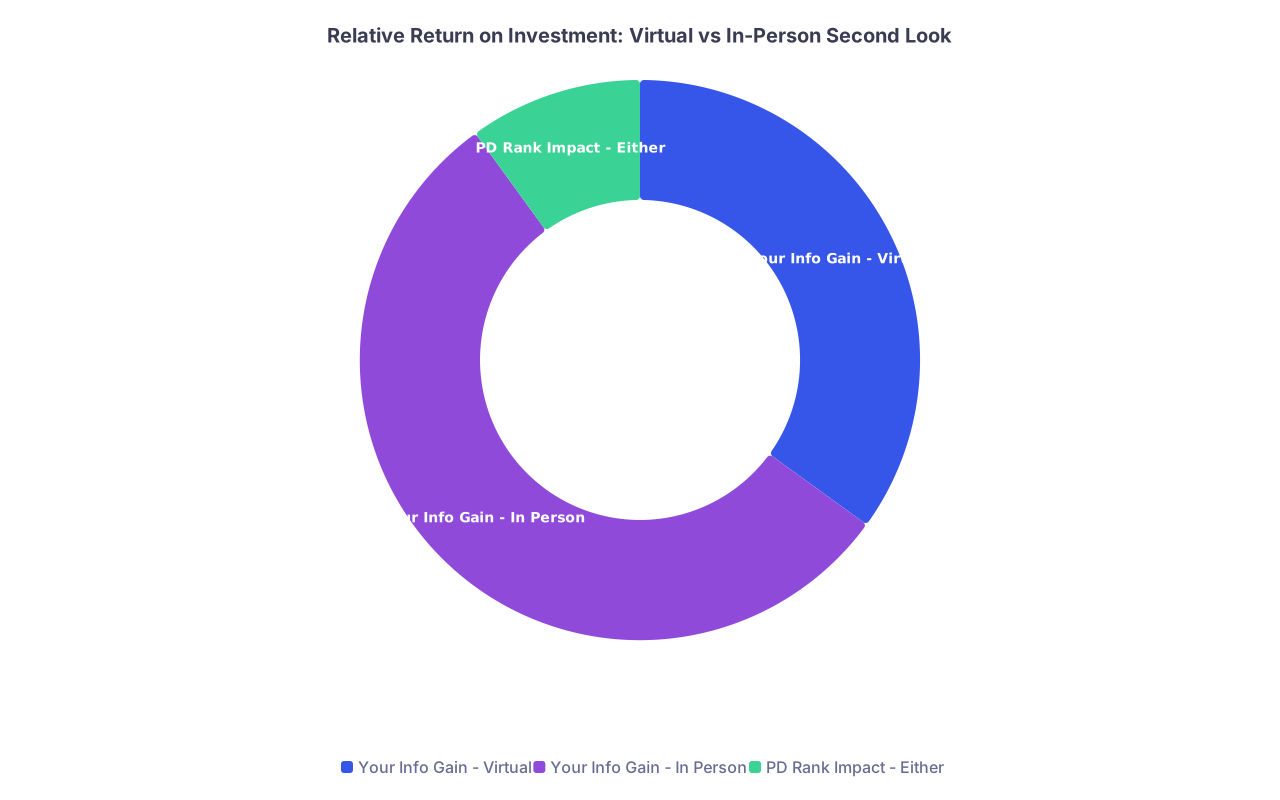
| Category | Value |
|---|---|
| Your Info Gain - Virtual | 35 |
| Your Info Gain - In Person | 55 |
| PD Rank Impact - Either | 10 |
Those numbers are illustrative, not literal. But the proportions are right: most of the value is what you learn, not how you influence them.
How to Signal Interest Without Playing the Travel Game
If you’re still fixated on “But how do I show them I’m serious?” you’re focused on the wrong variable.
Program directors consistently rate these as much stronger signals than whether you showed up in person for a second look:
- A non‑needy, specific email to the PD or coordinator after interview day, expressing sincere interest and naming 1–2 real reasons.
- A clear, honest answer on interview day when asked where else you’re looking and what you value.
- Consistency: your story, your goals, and your questions all line up.
Telling a PD in February, “You’re my number one” means nothing if you told three other programs the same thing. And yes, they talk.
What does matter is that your behavior never contradicts your stated priorities. You can do that entirely virtually.

| Step | Description |
|---|---|
| Step 1 | After Interview |
| Step 2 | Thank You Email |
| Step 3 | Virtual Second Look |
| Step 4 | Targeted Update or LOI |
| Step 5 | Consistent Professionalism |
| Step 6 | Stable PD Impression |
Notice again: none of that requires you to set foot in the hospital.
So What Really Matters to PDs?
Let me strip this down to the bone.
Program directors care about:
- that you’re competent
- that you’re not a headache
- that you’ll work hard without imploding
- that you’ll fit their culture enough not to ignite constant drama
Second looks—virtual or in‑person—give them only a tiny extra data point on those questions, and often none at all.
For you, second looks are about deciding where you’re willing to spend years of your life under fluorescent lights at 3 am. That’s a much bigger deal than impressing someone who may not even be your PD by the time you graduate.
Years from now, you won’t remember who did or didn’t bump you three spots on a rank list because of a Zoom Q&A. You’ll remember whether you chose a place that felt real, sustainable, and honest once the interview polish wore off—no matter how you first saw it.