
Resident socials at second look are not “purely honest” or “totally scripted.”
They are controlled leaks.
You’re getting real information through a filter that programs have carefully designed. If you walk into those socials thinking you’re seeing the raw, unvarnished culture of a residency, you’re setting yourself up to be misled.
Let’s strip this down to what actually happens and what the evidence – both data and lived reality – really supports.
The Myth of the “Unfiltered” Second Look
There’s a persistent myth among applicants:
“If I just get to the second look and talk to residents off the record, I’ll finally see what the program is really like.”
That’s not how this works.
Second looks and their socials live at the intersection of three forces:
- Marketing – Programs want you to rank them highly. They are not neutral.
- Risk management – Residents can be punished, subtly or overtly, for saying the wrong thing.
- Human nature – People want to look good. Even when they’re “being honest.”
So what you see is partially honest, selectively sampled, and strongly contextual.
I’ve watched PDs quietly “reassign” residents who were too blunt at socials. I’ve heard chiefs remind the group right before the doors open: “Remember, do not talk about specific faculty or other programs. Focus on the positives.” That’s not my imagination – it’s standard operating procedure in a lot of places.
Yet here’s the twist: even inside that control, there’s usually enough leakage to get the truth – if you know what to look for and how to interpret it.
How Scripted Are These Socials Really?
Programs differ. A lot. But there are patterns.
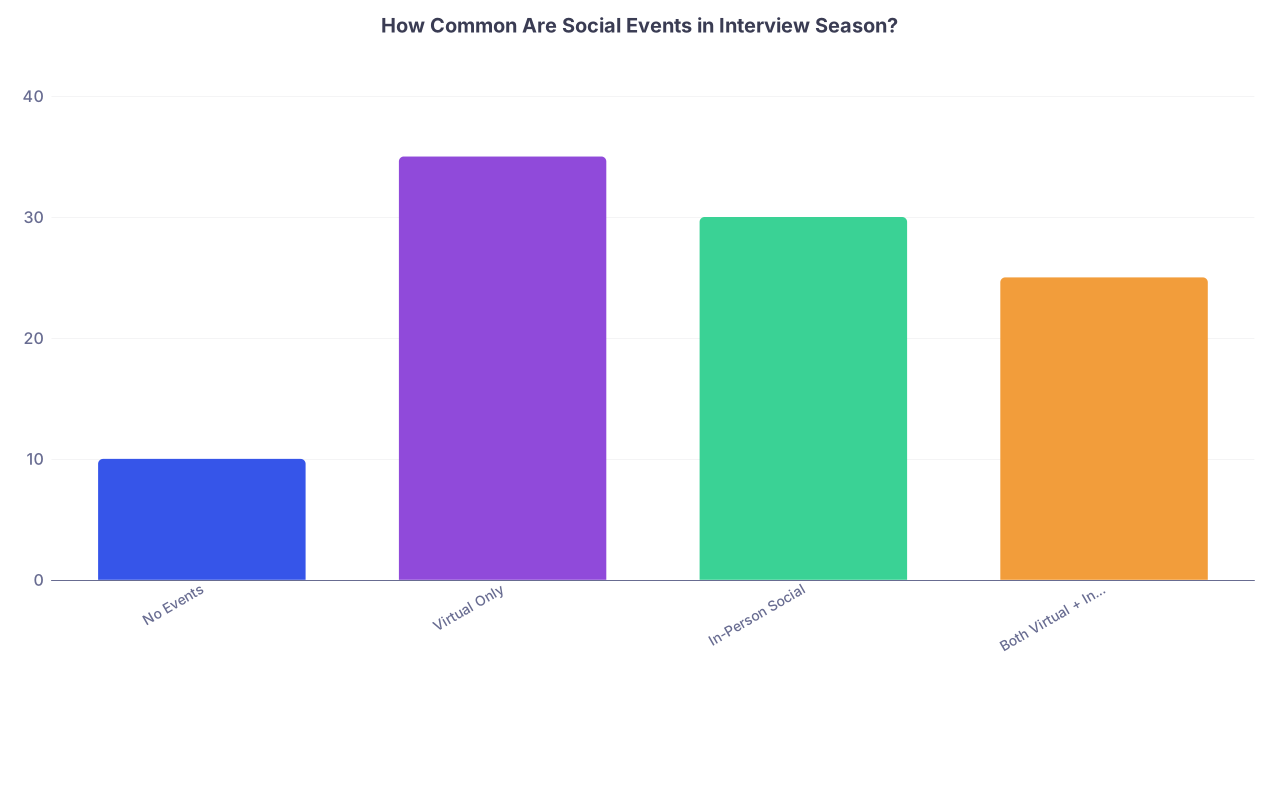
| Category | Value |
|---|---|
| No Events | 10 |
| Virtual Only | 35 |
| In-Person Social | 30 |
| Both Virtual + In-Person | 25 |
Surveys of GME leaders and the NRMP Program Director surveys show that:
- The majority of programs now use some kind of social event during interview season (pre-interview, post-interview, or second look).
- Program directors overwhelmingly believe these events influence how applicants perceive culture and “fit.”
That’s the key: socials are a tool, not a gift. They’re designed.
Here’s how the scripting typically shows up in real life.
1. Who gets invited to represent the program
This is the first layer of curation, and it’s not subtle.
You almost never see:
- Residents on the verge of quitting
- Someone who just filed a hostile work environment complaint
- The intern who hasn’t had a day off in 3 weeks and looks like a cautionary tale
Instead, you see the “safe” mix:
- A couple of upbeat juniors
- One or two seniors or chiefs who are good talkers
- Someone with a family (“We’re very family-friendly here”)
- A token resident from a high-prestige med school or fancy fellowship match (“Look who chose us”)
I’ve literally heard a chief say in the work room: “They asked me to sit this one out; apparently I’m ‘too negative’ about the schedule.” That’s curation. Not honesty.
2. Pre-briefing of residents
At many programs, residents get a short “guidance” talk before meeting you. It’s often framed in soft language:
- “Remember to keep things positive.”
- “If they ask about X, direct them to the PD or coordinator.”
- “Avoid discussing specific attendings or any internal drama.”
I’ve seen printed “talking point” sheets on tables: emphasis on wellness initiatives, research support, leadership accessibility, new educational reforms. That doesn’t mean everything said is false. But the contours of the conversation are mapped out in advance.
3. The environment is structured to steer topics
Look at what’s provided:
- Slides looping on a monitor showing wellness retreats and graduation dinners.
- Strategically placed posters about QI projects and simulation centers.
- Residents spread out at tables labeled by interests: research, global health, wellness, etc.
It’s not random. You are being pulled toward certain narratives: “We care about education, we care about wellness, we care about diversity.” Sometimes that’s true. Sometimes it’s aspirational branding.
Where the Honesty Actually Leaks Out
So if socials are curated, is everything fake? No. That’s the lazy take.
The more accurate truth: socials are honest under constraint. You’re watching people try to be real inside boundaries they understand instinctively.
The honesty tends to leak out in four places.
1. Micro-reactions, not scripted lines
Watch faces, not just words.
When someone says, “Yeah, the hours are typical for this specialty,” do the other residents:
- Nods, relaxed, no tension → probably accurate
- Exchange side glances, awkward chuckles, look at the chief → translation: “We’re getting crushed but we’re not allowed to say it”
You will not get, “Our call schedule is unsafe and everyone is burnt out.” You will get a half-second flash of “god I’m tired” if you’re paying attention.
2. Specificity versus vague platitudes
Real experiences sound detailed. Spin sounds generic.
“I feel supported” is useless.
Compare:
- Vague: “The program is very supportive.”
- Specific and real: “When my dad was in the ICU, the PD personally called me, rearranged my schedule, and gave me a week off with no drama.”
On the negative side, real concerns often show up as “careful specificity”:
- “The trauma volume is great, but the backup system on nights can be hit or miss. It’s been better this year, but if two people call out, it gets rough.”
That’s coded honesty. They’re threading the needle: not so negative they get in trouble, but not outright lying to your face.
3. Inconsistencies between residents
One of the most revealing things you can notice: disagreement.
- One resident: “We get tons of operative time as juniors.”
- Another, two minutes later: “Cases pick up a lot as a senior; intern year is mostly floor work.”
That inconsistency is your data. It tells you there’s probably truth on both sides but the reality is more uneven than the official script suggests.
The more conflict you see between residents’ stories, the more you should assume the brochure version is incomplete or selectively true.
4. Off-to-the-side conversations
The single best signal is what residents say when they think the “event” moment has passed.
- Walking from the lecture room to the bar
- Standing in line for food
- Near the end of the night when people are tired and their guard drops
That’s when you get:
- “Yeah, it was rough during COVID, we were drowning, but it’s a bit better now.”
- “Honestly, intern year is brutal anywhere, this place is no exception.”
Still filtered. But much closer to reality.
What the Data and Outcomes Actually Show
We do not have randomized controlled trials of “resident social honesty.” But we do have adjacent data that exposes the gap between what’s marketed and what’s real.
1. Duty hour violations vs. official messaging
ACGME data show that duty hour violations and resident burnout remain substantial despite programs loudly promoting wellness and “supportive culture.”
Yet on socials, you’ll hear:
- “We basically never violate duty hours.”
- “The program takes wellness seriously; we have yoga and free dinner once a month.”
Reality check: if national burnout is high and your program claims to be a magical exception with nothing but good vibes and yoga mats, you should be suspicious. Programs are not exempt from systemic reality just because their residents smile at socials.
2. Resident satisfaction vs. what applicants are told
Resident and fellow surveys often show:
- High rates of fatigue
- Concerns about workload and staffing
- Variable satisfaction with leadership responsiveness
Yet applicants at second look are told things like:
- “Leadership is incredibly responsive.”
- “If we have an issue, it’s fixed quickly.”
Sometimes that’s true. Sometimes what “responsive” really means is “they sent an email and formed a committee.” The data tell you that programs on average overstate their wellness and responsiveness compared to how residents actually rate them anonymously.
How Programs Quietly Shape the Narrative
Let’s be blunt: there are some recurring tactics programs use to manage what you hear.
| Program Tactic | What You Typically Hear/See |
|---|---|
| Select only upbeat residents | “Everyone seems so happy here.” |
| Highlight a recent wellness initiative | “The program really cares about us.” |
| Emphasize a few big-name fellowships | “You can match anywhere from here.” |
| Downplay volume or scut concerns | “The workload is very manageable.” |
| Showcase one resident with kids | “This place is super family-friendly.” |
Most of these aren’t lies; they’re carefully chosen truths. And curated truth can be more misleading than an outright lie.
A classic example I’ve seen multiple times:
A program heavily promotes that “residents can easily do research and match into competitive fellowships.” Then you dig deeper and find out:
- One superstar resident did a research year, had multiple prior publications, and matched into a top fellowship.
- The rest are going into community jobs or mid-range fellowships, happy but not what’s being implicitly promised.
The social will keep bringing that one superstar up as if it’s the norm. It is not.
How to Extract Real Signal from a Scripted Social
This is where you actually have some power. You will not unscript the event. But you can force more honesty to the surface.
Ask questions that are hard to spin
You want questions that expose trade-offs, not adjectives.
Bad: “Is the program supportive?”
Better: “Tell me about a time the program had to choose between service coverage and resident education. How did they handle it?”
Bad: “How’s the work-life balance?”
Better: “On your last stretch of nights or wards, how many hours sleep did you usually get and what did your post-call day really look like?”
Bad: “Is the volume good?”
Better: “How many [cases/encounters] did you log last month? Would you say that’s typical?”
Specifics force residents out of marketing mode and into memory. Memory is where truth leaks out.
Ask for comparisons to other programs
Residents know you’re interviewing elsewhere. Use that.
- “When you talk to your friends at other programs, what do you think this place does better?”
- “What do you think this program struggles with compared to others in the region?”
They will still be cautious, but comparative framing pulls people toward more honest evaluation instead of pure cheerleading.
Watch how they talk about problems, not whether they admit them
Every program has problems. If residents deny that, you’ve learned something: they’re either scared or fully in marketing mode.
The useful distinction is:
- “We had an issue with X, leadership ignored it, and it’s still bad.” Red flag.
- “We had an issue with X, here’s what they did, it’s not perfect but it’s better.” Normal, even reassuring.
You’re not looking for a problem-free program. That does not exist. You’re looking for a reality-aware, problem-solving one.
Red Flags You Should Actually Take Seriously
Some applicants worry about the wrong things. One resident looking tired? That’s residency. Move on.
Here are the patterns that really should make you pause:
- All residents speak in corporate slogans. “We’re like a family,” “We’re known for our culture,” “Leadership really listens” – with no concrete examples. That’s a script, not a culture.
- Nobody admits to ever being overwhelmed or burnt out. In this healthcare system? That’s not realism, that’s fear.
- Residents glance at faculty or chiefs before answering tough questions. That’s a power dynamic talking, not honesty.
- Every answer centers on future plans: “We’re about to implement…”, “We’re working on…” but you hear very little about what’s already functional.
- You ask, “What would you change if you were PD tomorrow?” and you get silence or nervous laughter.
If they can’t safely voice “I wish call coverage was more evenly distributed” at a supposedly informal social, imagine raising a real concern when you’re trapped in that system for 3–7 years.
What Second Look Socials Are Actually Good For
With all that said, second look socials are not useless. They’re just mis-sold to you.
They are good for:
- Sensing the overall emotional tone of the residents: anxious, relaxed, resigned, bitter, energized.
- Observing how residents relate to each other – joking, supportive, guarded, cliquey.
- Testing your own gut reaction: “Could I see myself sitting at this table, complaining about the same things, laughing at the same dark jokes?”
And they’re a reminder of a hard fact:
Every program is selling something. Your job is not to pretend you’re in a neutral, truth-telling environment. Your job is to be a skeptical consumer of limited, biased information.
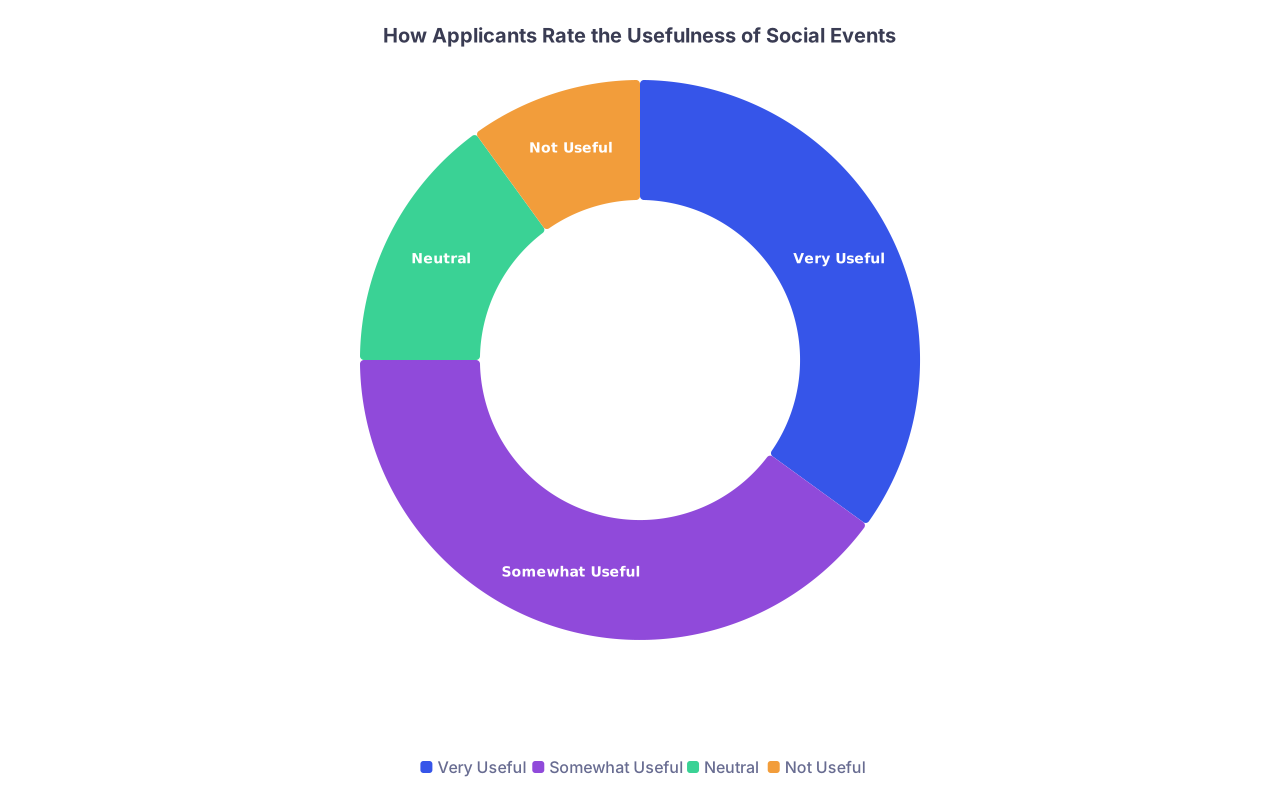
| Category | Value |
|---|---|
| Very Useful | 35 |
| Somewhat Useful | 40 |
| Neutral | 15 |
| Not Useful | 10 |
Most applicants report these events as at least “somewhat useful.” That’s accurate – as long as you remember what you’re actually buying: impressions, not data.
Years from now, you won’t remember the exact words residents used at your second look socials. You’ll remember whether you walked in with clear eyes or let the script do your thinking for you.