What do you actually think you’re learning when you stare at a program director’s face during a second look and try to guess where they’ll rank you?
Let me ruin the magic up front: you are almost always guessing, and you are usually wrong.
Residents swap stories every year: “She smiled so much, I knew they’d rank me high.” “The PD barely looked at me, I knew I was toast.” Then Match Day comes, and half those narratives implode. The “cold” PD’s program ends up a surprise match. The “super warm” faculty never had you in serious contention.
You are not broken. You’re just trying to extract signal from noise that is mostly…noise.
Let’s dismantle the biggest myths about reading PD and faculty “body language” during second looks, and look at what actually correlates with outcomes versus what’s just anxiety theater.
Myth #1: You Can Tell Your Rank Position From Vibes
This is the core fantasy: that if you watch closely enough—eye contact, tone, how they introduce you—you’ll crack the code of where you stand.
No. You will not.
Programs don’t rank you by vibes from a 10-minute hallway chat on second look day. They rank you based on data they already have:
- Your interview performance
- Application content (scores, grades, letters, research)
- Internal advocacy from faculty or residents who know you
- Institutional priorities (geography, diversity goals, couples matches, visa needs, etc.)
By the time you’re at a second look, the rank list is usually either finalized or functionally baked. Not always locked in, but very close. Attendings and PDs know this. Their job that day is to sell the program, not secretly telegraph rank positions to you with micro-expressions like some dermatology-themed poker game.
You know what does predict where you rank a program? Your own pre-existing preferences. People who already love a program are more likely to interpret any small positive cue—laughing at your joke, remembering your name—as “they really liked me.”
That’s called confirmation bias. Not intuition.
And there’s data on this type of thing. In decision-making research, subjective impressions of “how well it went” are notoriously bad at predicting actual outcomes, especially in high-stakes, formalized processes. Medical interviews, residency or otherwise, are no exception.
So if you walk out thinking, “The PD clearly loved me,” you’re really saying, “I want to match here, and I’m trying to soothe myself with a story.”
Myth #2: PD Smiles and Warmth = Higher Rank
I’ve watched this movie for years: applicant goes to second look, PD is friendly, relaxed, maybe even effusive. Applicant leaves convinced: “I’m basically top 10 on their list.”
Then they don’t match there. Or they match but later learn they were nowhere near the top of the rank order.
Programs—especially competitive ones—have learned to overcorrect for the old-school “stone-faced PD” stereotype. They know people care about “fit” and culture now. So they act like it.
That warm PD who:
- Asks about your family
- Jokes about night float
- Tells you to “reach out with any questions”
…is doing what a decent leader does in 2026: being approachable. That’s branding, not secret rank intel.
Also, remember this: some PDs are just like that with everyone. Extroverted, high-energy, good at small talk. You seeing that interaction doesn’t mean it’s tailored to you or your rank position. You’re seeing the public-facing version of the role, not a one-off clue.
Here’s the kicker: PD’s positive warmth correlates more with how you will rank the program than how they will rank you. It’s marketing. Effective marketing, but still marketing.
If you leave thinking, “They liked me,” what the PD actually accomplished is: “You like them more.” Mission accomplished—from their side.
Myth #3: Second Looks Change Your Standing in a Major Way
There’s this persistent idea that second looks are a secret “round two” where your fate can be rescued or wrecked by a handshake, an awkward comment, or a missed social event.
Reality is more boring and more structural.
In many programs, by the time second looks are happening:
- The formal interview scoring is done
- The committee has met or is about to meet
- The ordering of candidates is already tentatively set
Could a second look nudge you a few spots? Maybe. If someone who really matters (PD, APD, a powerful faculty) gets an unusually strong or unusually negative impression. That happens. But it’s the exception.
The more honest version:
Second looks usually:
- Help you refine your rank list
- Let the program strengthen its recruitment story
- Help borderline programs or applicants confirm mutual interest
They rarely function as a new evaluation stage with heavy weight.
To make it clear:
| Factor | Real Impact on Rank | Applicant Obsession Level |
|---|---|---|
| Interview performance | High | Medium |
| Letters/clinical record | High | Low–Medium |
| Program needs/priorities | High | Low |
| Second look attendance | Low–Medium | High |
| PD friendliness/vibes | Low | Very High |
The entire second look culture is skewed: applicants obsess over the lowest-yield signals and hand-wave the highest-yield ones because the latter are already in the past and unchangeable.
So they try to compensate by reading body language. It’s a control fantasy.
Myth #4: You Can Reliably Read “Coldness” As Disinterest
Let’s flip it. The anxious scenario.
You go to a second look. The PD is:
- Brief
- Distracted
- Looking at their phone
- Giving short answers
You walk out thinking, “I’m done. They hate me. I’m ranked low.”
I’ve seen this exact story many times. And I’ve seen those applicants match at that “cold” program.
Why? Because you mis-attributed the PD’s behavior to you.
Other explanations for “coldness” that have nothing to do with your standing:
- They’re post-call or got dragged into a clinical issue right before you arrived
- They’re juggling GME paperwork, system crap, or an institutional fire behind the scenes
- They’re burned out
- They’ve already done 10 of these second looks this week and are socially exhausted
- They honestly do not remember individual applicants that well at this stage
None of that maps cleanly to your ranking.
There’s also a big personality piece. Some PDs are simply:
- Reserved
- Socially awkward
- Discomforted by the fake courtship dynamic of second looks
Yet we still see applicants trying to decode every pause and micro-frown like they’re doing FBI-level behavioral analysis.
This is how you end up with situations where:
- Applicant A meets PD, feels brushed off, ranks the program lower, does not match there
- Applicant B meets same PD, interprets it as “serious but fair,” ranks it #1, matches, and thrives
Same PD behavior. Entirely different stories layered onto it.
Myth #5: Residents’ Body Language Is a Secret Backdoor Signal
Once people realize PDs are hard to read, they pivot: “OK, but the residents. If the senior resident is really warm and says, ‘We’d love to have you,’ that must mean something.”
Less than you want it to.
Residents generally have:
- Limited influence on final rank ordering (with honest exceptions in some smaller programs)
- Poor recall of individual applicants weeks after interview day
- Very little alignment between how much they like you and how the rank committee scored you
Also, residents have their own incentives. They want:
- Good co-workers
- Good coverage (no one wants a short class)
- People who will not make their lives harder
So they’re incentivized to be nice, positive, and encouraging. And they’re smart enough to know that saying, “Yeah, you’re probably mid-tier for us” would be catastrophic and unethical.
You’re not crazy for scanning their faces for signals. But you are over-weighting them.
Here’s where residents can be helpful during a second look: not in how they react to you, but in how they react to talking about the program itself. Facial expressions when they talk about:
- Call schedules
- Leadership responsiveness
- Education time
- Fellowships and jobs
- Burnout and leaving
Those reactions are at least more tied to reality than whether they laughed at your joke about EMR macros.
Myth #6: “We’re Very Excited About You” Means You’re Near the Top
Verbal signals can be just as misleading as nonverbal ones.
Phrases you might hear at second looks:
- “We’d be thrilled to have you here.”
- “You’d be a great fit for our program.”
- “If you end up here, I think you’ll do really well.”
- “Keep in touch as you make your list.”
These are deliberately nonspecific. They’re designed to sound warm without making explicit promises. Because explicit promises to rank you highly are a Match violation, and most PDs are not stupid enough to risk that.
The deceptive thing is that your brain automatically converts these into rank map coordinates:
- “Thrilled to have you” = top 5
- “Great fit” = top 10
- “Do really well” = mid list
In reality, those phrases have almost zero resolution. They’re template lines. Slightly customized, but not a codebook.
And the Match literature is clear on this: post-interview communication and its emotional tone are very weak predictors of match position, and most of the predictive power is on the applicant side: if a program tells you they’re interested, you’re more likely to rank them higher. Exactly what they want.
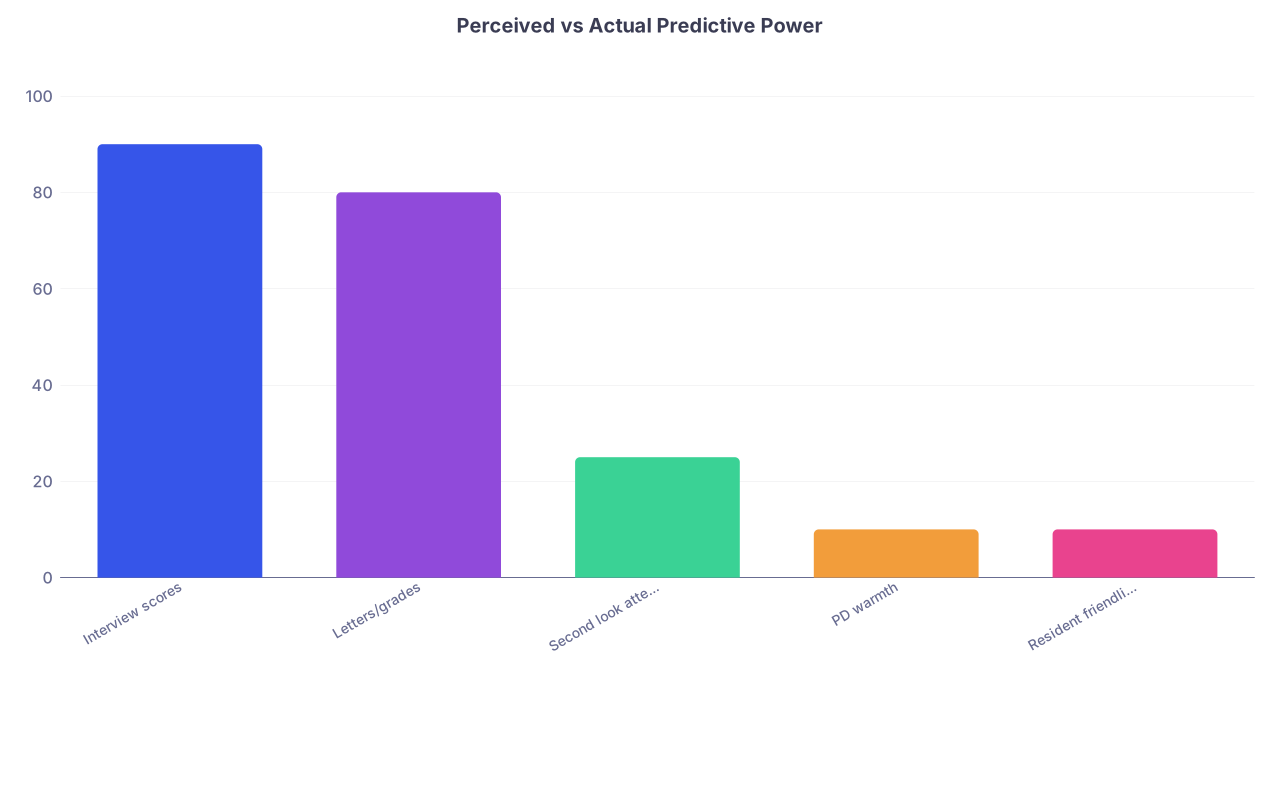
| Category | Value |
|---|---|
| Interview scores | 90 |
| Letters/grades | 80 |
| Second look attendance | 25 |
| PD warmth | 10 |
| Resident friendliness | 10 |
(Values here are conceptual, not literal percentages—but you get the point.)
What Second Looks Actually Are Good For
Now that we’ve smashed the crystal ball fantasy, what is the rational way to treat a second look?
As a field visit, not an interrogation.
You’re not trying to read their minds. You’re trying to assess:
- How do people talk to each other when they’re not focused on you?
- Do residents seem alive or hollowed out?
- How do faculty talk about mistakes, growth, feedback?
- What happens when someone asks a hard question about wellness or autonomy?
This is where your observational skills are actually useful. Watch interactions that have nothing to do with your candidacy:
- How a chief answers a junior’s scheduling concern in real time
- Whether residents feel comfortable disagreeing in front of attendings
- Whether people blame “the system” for everything, or actually own problems
Those are the signals that will matter for your next 3–7 years.
If you’re going to read body language, read their culture’s, not their opinion of you.
A Better Mental Model: Second Looks as One-Way Data Collection
You’ll be less miserable if you flip your assumption.
Wrong model:
“I’m being silently re-judged. I must decipher every expression to know if I’m safe.”
Better model:
“They already have what they need to rank me. I’m here to collect data for my rank list. Their behavior toward me is mostly PR and politeness. I’ll watch how they treat each other.”
If you hold that frame, you’re less likely to:
- Spiral about one awkward PD interaction
- Over-interpret a resident’s enthusiasm as rank security
- Punish yourself for not “performing” enough on a non-evaluative visit
You’ll also ask better questions. You’ll actually listen to answers instead of just monitoring faces for evidence you’re secretly their #3.
When Body Language Might Matter (A Little)
Let me be fair. There are a few rare situations where what you see might carry some actual weight.
If a PD or key faculty:
- Spends unusual 1:1 time with you
- Asks deeper, almost interview-level questions again
- Introduces you to others with language like “this is the applicant I was telling you about”
…then yes, that suggests someone is advocating for you. It doesn’t tell you how high you are on the list, but it does suggest you’re not an afterthought.
Flip side: if at a small program’s second look, everyone else seems known, recognized, and warmly greeted by name and you’re totally invisible and sidelined, and you didn’t feel particularly strong on interview day—then sure, adjust your expectations.
But treat these as weak, context-dependent hints. Not a ranking revelation.
The Future: Less Theater, More Transparency (Maybe)
Second looks and body-language-reading are artifacts of a system that withholds real information.
Imagine a world where:
- Programs publish historical rank position ranges of their matched class (de-identified)
- Applicants get transparent post-interview feedback categories instead of vague vibes
- Communication policies are actually enforced, and second looks are clearly labeled as non-evaluative
You’d have less superstition. Fewer hours spent replaying a PD’s facial expression while you’re trying to sleep.
We’re not there yet. So for now, you protect yourself by refusing to play the “micro-expression = match rank” game.
The Actual Takeaways
You cannot reliably infer your rank position from PD or resident body language at a second look. Your brain will try. Do not believe it.
Second looks are far more useful for you to evaluate program culture than for them to re-evaluate you. Watch how they treat each other, not how they perform friendliness toward you.
Treat warmth, smiles, and “we’d love to have you” as recruitment, not data. Make your rank list based on fit, training quality, and your priorities—not on who seemed the most excited to land you in a 10-minute hallway conversation.