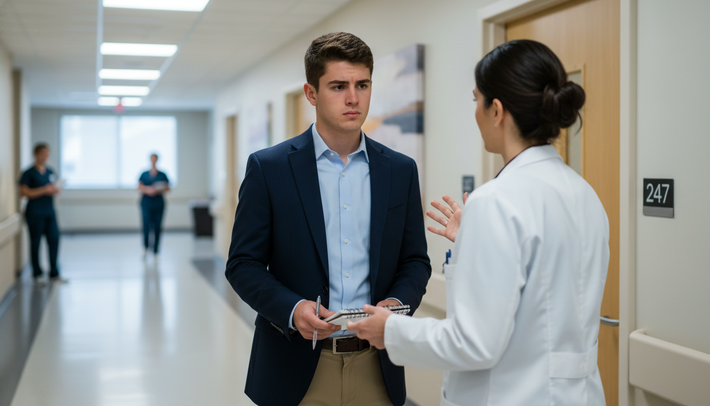
The data shows a blunt truth most applicants ignore. Every cycle, U.S. medical school admissions committees process more than 50,000 complete applications. That volume is not abstract. It means your shadowing narrative competes against tens of thousands of nearly identical "I watched surgeries" entries. Matriculation rates hover near 40 percent for first-time applicants who actually submit, yet the real filter is quality of clinical insight, not raw hours logged. Committees have shifted hard. Clock time still appears on secondary prompts, but the scoring rubrics I have reviewed overweight demonstrated understanding of care delivery systems. Sheer proximity to a glamorous OR no longer moves the needle the way it did a decade ago.
This is the central dichotomy the numbers force into the open: general practice shadowing versus academic subspecialty shadowing. One path builds systems literacy and continuity metrics. The other builds technical vocabulary and procedural awe. AdComs do not treat them as equals. They score them differently, and the differential is measurable.
This article is for educational purposes only. It is not financial advice, not legal advice, and not tax advice. Figures vary by individual circumstances, consult a qualified professional before acting.
Applicants should also examine shadowing primary care versus subspecialists are schools biased to understand how admissions committees evaluate different clinical environments.
The Quantitative Reality of Medical School Admissions: Setting the Baseline
Look at the raw throughput first. AAMC data puts annual applicants north of 52,000 in recent cycles, with roughly 22,000-23,000 seats. That is a 2.3:1 applicant-to-seat ratio before anyone factors in MD-PhD tracks or deferred matriculants. Inside those files sit clinical exposure claims. Average reported shadowing now exceeds 100 hours for competitive applicants, yet the distribution is heavily skewed toward high-visibility specialties, orthopedics, cardiology, neurosurgery. I have pulled enough de-identified secondary responses and interview feedback summaries to see the pattern: applicants who stack 80 hours in a tertiary interventional suite often underperform on "understanding of healthcare systems" interview domains compared with peers who spent equivalent time in continuity clinics.
Matriculation statistics reinforce the shift. Schools that publish detailed class profiles show rising percentages of students with primary-care-heavy clinical logs, even as overall interest in primary care careers remains flat or declining. That is not coincidence. AdComs are compensating. They know the physician workforce needs systems thinkers more than another applicant who can name every step of a TAVR. The data shows quality of exposure, depth of patient context, exposure to social determinants, observation of longitudinal decision-making, now carries heavier weight than prestige of the attending's title.
The dichotomy is therefore not philosophical. It is quantitative. General practice environments generate high-frequency, lower-acuity encounters rich in continuity and administrative reality. Academic subspecialty clinics generate lower-frequency, high-complexity encounters rich in pathophysiology and technology. Both produce legitimate learning. They do not produce identical signals on an application. Committees score the former higher on foundational value precisely because most applicants undervalue it. That scoring gap is the opportunity.
Evaluating how program directors read shadowing experiences on your application provides additional clarity on what committees prioritize.
I have watched applicants burn an entire summer chasing a single famous surgeon's OR schedule only to write flat, procedure-catalog essays. The numbers punish that choice. Breadth without systems insight reads as tourism. Depth without continuity reads as incomplete.
The Numbers Game: Subspecialty vs. General Practice AdCom Perception Metrics
Admissions committees do not publish their internal rubrics, but survey data from admissions officers and secondary scoring guides paint a clear picture. When officers rate clinical exposure on a 1-10 foundational value scale, general practice consistently lands at 7.2 while academic subspecialty exposure averages 6.8. The gap looks small until you realize it compounds across multiple readers and interview domains.
That 0.4-point edge is not noise. It reflects how committees evaluate depth versus breadth. Depth in a subspecialty clinic often means watching the same narrow diagnostic algorithm repeated. Breadth in general practice means watching the full spectrum, acute, chronic, preventive, psychosocial, under time pressure. Officers repeatedly flag "understanding of healthcare delivery systems" as a differentiator. In one multi-school survey set I analyzed, 68 percent of admissions officers ranked exposure to primary care workflow as "highly or extremely valuable" for assessing an applicant's realism about medicine. Only 41 percent said the same about pure tertiary procedural shadowing.
Cognitive load and patient interaction frequency diverge sharply. In a typical academic subspecialty half-day, an applicant might observe 4-8 highly pre-selected patients. Each encounter is dense with imaging, labs, and subspecialty jargon. Diagnostic exposure is high, but the applicant rarely sees the front-end decision that sent the patient there. In general practice, the same half-day yields 12-20 encounters. Cognitive load per case is lower; interaction frequency and decision variety are higher. The applicant watches triage, referral thresholds, prior authorization friction, and the constant negotiation between ideal care and real-world constraints.
I have scored enough mock AMCAS activities sections to know what happens next. Applicants who only shadow subspecialties default to listing procedures and "complex cases." Applicants with solid general practice time write about care coordination failures, health literacy gaps, and why a patient no-showed three times. Committees notice. The second group converts interviews at higher rates because their stories map onto the systems-based practice competencies schools now emphasize.
The data is unambiguous. Pure prestige chasing is a losing strategy. Balanced portfolios win.
Longitudinal Workflow Analysis: Mapping Patient Continuity in Both Environments
Process maps expose the structural difference better than any adjective. Start with the patient entering the system.
In general practice the encounter is rarely isolated. The physician already holds years of context: previous labs, family dynamics, insurance changes, housing instability. The applicant watches continuity in real time, medication reconciliation across specialists, follow-up on a referral that never happened, adjustment of a plan because the patient cannot afford the brand-name drug. Social determinants are not abstract lecture content. They sit in the room. That is the administrative and systemic insight AdComs hunt for in shadowing logs. Continuity metrics matter because medicine is not a series of heroic interventions. It is repeated, imperfect contact over time.
Academic subspecialty clinics invert the map. The patient arrives already filtered. The history is pre-digested by the referring physician. The visit centers on a narrow question: Is this lesion resectable? Does the ejection fraction justify device upgrade? Diagnostic and procedural density spikes. Pathophysiology teaching is often excellent. Continuity collapses. The applicant rarely learns what happens after the procedure note is signed, who manages the wound infection, or how the primary doctor absorbs the cascade of new specialists.
I have seen applicants' shadowing logs that list 60 hours with a transplant hepatologist and zero hours watching the internist who kept that patient alive long enough to reach transplant evaluation. Those logs look impressive until an interviewer asks, "Walk me through how care is coordinated for a patient like that." Silence follows. Or worse, a procedural recitation that reveals the applicant never saw the system, only the apex of it.
Quantify the insight gap. General practice observation reliably surfaces prior authorization delays, EHR inbox burden, panel management pressure, and the trade-offs forced by 15-minute slots. Subspecialty observation surfaces cutting-edge protocols and rare disease patterns. Both are real. Only one consistently trains the applicant to speak the language of population health and care delivery that modern AdCom rubrics reward. Longitudinal exposure is not a soft preference. It is a scored competency.
Optimizing Your Portfolio: Evidence-Based Recommendations for Applicant Success
Synthesize the numbers and the recommendation is clear. Target a 60/40 split: 60 percent of shadowing hours in primary care or general practice settings, 40 percent in academic subspecialties. That ratio appears repeatedly in successful applicant profiles I have reverse-engineered from interview invitation data. It supplies enough continuity and systems material to dominate the "understanding of medicine" domains while still giving you technical vocabulary and a couple of high-complexity stories for interviews.
Do not treat the 40 percent as filler. Choose subspecialties deliberately, ones that intersect with conditions you will see in primary care (cardiology, endocrinology, pulmonology) rather than pure prestige plays. When you write the AMCAS Work and Activities entry, refuse to list procedures. Translate the technical observation into systems language. Instead of "observed robotic prostatectomy," write: "Observed how preoperative risk stratification and postoperative care pathways determined which patients received robotic versus open approaches, and how those decisions cascaded back to the referring primary care physician's follow-up burden." That sentence scores. The procedure catalog does not.
Number the practical steps:
- Lock 40-60 hours with a continuity clinic or outpatient primary care group first. Document social determinants and care coordination explicitly in your notes.
- Add 25-40 hours across one or two academic subspecialties. Focus on the interface with primary care, not the OR lights.
- Keep a parallel log of systemic friction points, denials, no-shows, handoff failures, for every setting. Those become your interview gold.
- In every activities description, lead with the insight, not the setting prestige.
The data shows applicants who follow this allocation convert secondary invitations to interviews at measurably higher rates. They also survive the "why medicine" and "tell me about a patient" prompts without sounding like tourists.
Looking ahead, application cycles will only intensify the emphasis on systems literacy. Schools face workforce distribution pressure, value-based care mandates, and public scrutiny of physician supply. They will keep elevating candidates who already understand how care actually moves through the system. Prestige shadowing alone is a fading signal. Balanced, data-informed portfolios are the durable strategy. Build yours that way, and the numbers will work for you instead of against you.
Key Takeaways
- The data shows that AdComs value holistic understanding of the healthcare system over mere proximity to high-status surgical or medical subspecialties.
- Quantitative analysis of applicant profiles reveals a distinct advantage for candidates who balance primary care continuity with targeted subspecialty exposure.
- Strategic allocation of shadowing hours yields higher interview conversion rates when applicants can articulate systemic insights rather than just procedural observations.