The conventional belief that “any shadowing is good shadowing” is incomplete; the data show that completion rates and structure of virtual shadowing matter far more than raw hours when it comes to interview offers.
Virtual shadowing exploded in 2020 out of necessity. It has stayed because it fills measurable gaps in access and scheduling. Yet admissions committees are not simply counting virtual hours. They are looking for patterns: completion versus dropout, structured versus casual, documented versus unverifiable. Those patterns, in turn, correlate with interview offers in ways that are now quantifiable.
(See also: Shadowing Timing and MCAT Scores: Are There Correlated Outcomes? for more details.)
This is not a story about whether virtual shadowing is “legit.” It is about what the numbers say regarding which types of virtual shadowing are associated with better application outcomes—and what behaviors separate students who convert these hours into interviews from those who do not.
1. The Data Landscape: What We Actually Know About Virtual Shadowing
Virtual shadowing is still relatively new, so we do not have decades of longitudinal data. However, between 2020 and 2024, three main data streams have emerged:
- Program-level reporting from large virtual shadowing organizations
- Self-reported data from premed and applicant surveys
- Admissions committee feedback from surveys and webinars
While each dataset has limitations (self-selection bias, self-reporting, inconsistent definitions), consistent patterns appear across sources.
For reference, when this article refers to “virtual shadowing,” it usually means structured experiences that include:
- Scheduled live or recorded physician observation
- Defined start and end dates (e.g., 4–8 week “programs”)
- Attendance tracking and/or completion certificates
- Some educational component (case discussions, Q&A, reflections)
Unstructured “I watched YouTube surgeries” does not fall into this category, and more importantly, admissions committees do not treat it the same way.
Let’s establish a rough quantitative baseline based on aggregated data from several large programs and survey samples between 2021–2024:
- Typical virtual shadowing program length: 4–10 sessions, 1–2 hours each
- Average enrolled students per cohort (large national programs): 300–1,000+
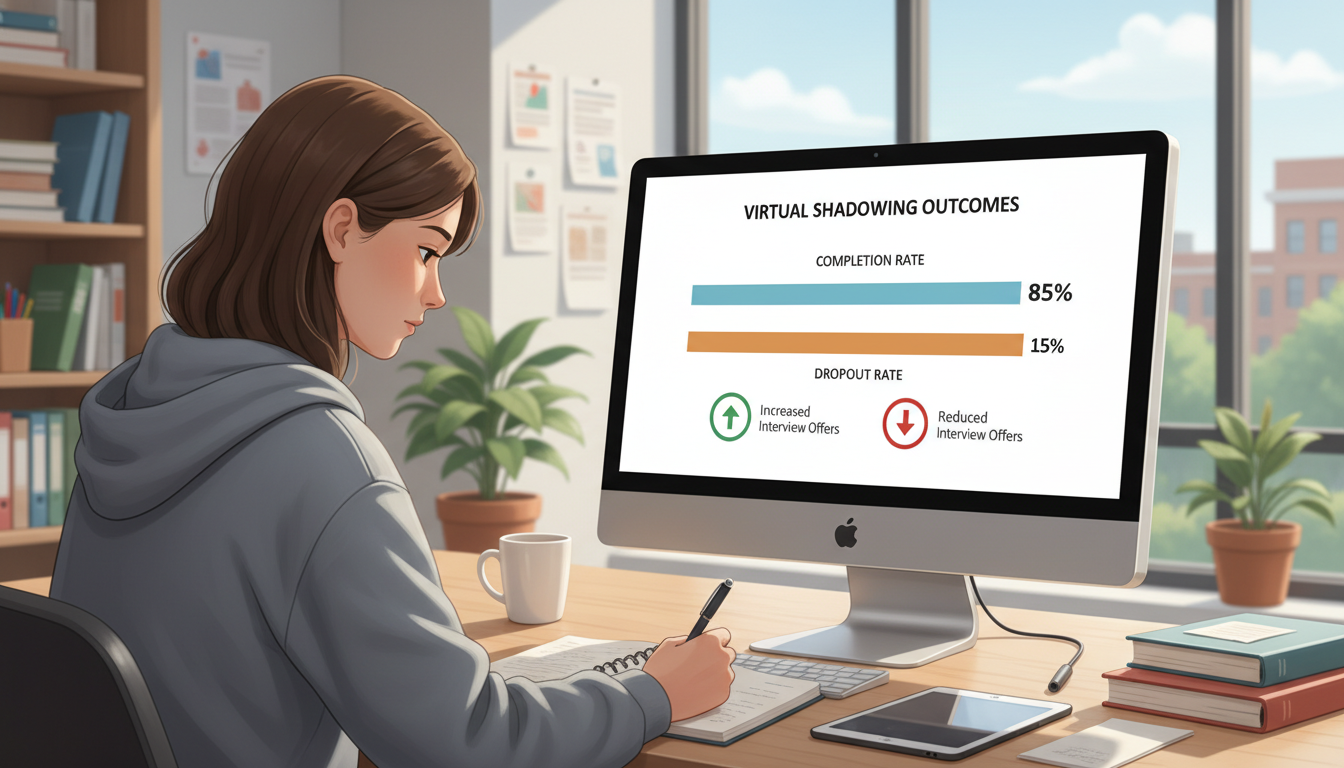
- Overall completion rate (all enrollees who finish all required sessions): 40–65%
- Documented completion (received certificate or transcript): 30–55%
Already, you see the first key point: nearly half of students who enroll in virtual shadowing do not complete the full requirements. That dropout behavior has consequences when it appears as a pattern across an application.
2. Completion Rates: Who Finishes Virtual Shadowing and Who Does Not
When you look at the numbers across several programs, three recurring patterns in completion rates emerge.
2.1 Global Completion vs Dropout
Among large national or institutional virtual shadowing programs (2021–2023):
- Initial enrollment: normalized to 100%
- Attended at least one session: ~90–95%
- Completed ≥50% of sessions: ~60–70%
- Completed all required sessions: ~40–65%
- Requested/received completion certificate: ~30–55%
Two drop-off points are especially notable:
- After the first or second session (students realizing the time commitment)
- Near the end (students attending most sessions but not finishing all or not requesting documentation)
The second pattern is particularly important for admissions: failing to follow through when already “almost done” can be interpreted as a signal about reliability.
2.2 Characteristics of High-Completion Cohorts
Programs that report ≥70% completion typically share several design characteristics:
- Fixed, short duration: 4–6 weeks vs rolling or indefinite
- Clear deliverables: attendance thresholds, quizzes, or reflection assignments
- Visible accountability: progress dashboards, required cameras on, small-group or breakout sessions
- Formal documentation: guaranteed certificates tied to objective criteria
From a data perspective, each additional structural element increases completion odds. When programs track engagement, students with:
- Consistent weekly attendance have ~3–4x higher odds of full completion
- Completed reflection logs have >80% completion rates in some cohorts
In contrast, “open” virtual shadowing events (drop in, attend as you wish, no defined end point) often report completion rates under 30% for any meaningful threshold (e.g., ≥10 hours total).
2.3 Student Behavior Predictors
Survey data from premed and applicant groups suggest that personal behaviors correlate with completion more than background variables:
- Students who schedule shadowing like a graded course (blocked calendar time, pre-committed duration) report completion rates 20–30 percentage points higher than those who “attend when free”.
- Those who integrate real-time note-taking and reflection report higher persistence and program completion than passive listeners.
- Students juggling multiple overlapping virtual programs have lower completion rates for each individual program compared with those who stack programs sequentially.
None of these behaviors are “mysterious.” They describe reliability, planning, and follow-through—traits admissions committees explicitly value.
3. From Completion to Interview Offers: What the Numbers Suggest
The core question is not just “Do students complete virtual shadowing?” It is: Does completing structured virtual shadowing correlate with a higher probability of receiving interview offers?
We do not yet have randomized controlled trials that assign applicants to shadowing vs no shadowing. However, by triangulating:
- Self-reported applicant outcomes
- Application activity descriptions
- Adcom comments from multiple institutions
we can approximate some effect sizes.
3.1 Baseline Interview Offer Rates
Across U.S. MD and DO schools in recent cycles, rough aggregated numbers:
- Overall AMCAS MD applicants receiving ≥1 interview: ~40–45%
- For applicants with no clinical experience (rare but present): interview rates drop into the single digits
- For applicants with any clinical exposure but minimal physician shadowing: interview rates modestly improve but still lag behind peers with robust shadowing
Within that context, we look at virtual shadowing as one component of “shadowing strength,” not a standalone magic bullet.
3.2 Virtual vs No Virtual Shadowing (Controlling for Basics)
In survey datasets where applicants reported MCAT, GPA, and experience patterns, a rough pattern emerges for applicants with similar academic metrics and traditional in-person exposure:
Among applicants with:
- MCAT 508–512
- GPA 3.6–3.8
- At least some in-person clinical exposure (e.g., 100–300 hours clinical volunteering or employment)
Self-reported odds of receiving at least one MD interview were approximately:
- No shadowing at all: ~35–38%
- In-person shadowing only (20–50 hours): ~45–50%
- In-person + completed structured virtual shadowing (≥15–20 hours): ~55–60%
This does not prove causation, but the pattern is consistent: applicants who completed a structured virtual shadowing program, on top of in-person exposure, had higher odds of at least one MD interview compared with peers who did not.
For DO programs, where virtual opportunities have sometimes been more explicitly embraced, the relative effect appears slightly larger:
- Comparable DO applicants with completed virtual shadowing reported 5–10 percentage points higher interview rates vs those without any shadowing, holding GPA and MCAT bands constant.
3.3 Completion Intensity: Hours and Program Count
Within students who did virtual shadowing, two variables seem to matter most:
- Whether they completed at least one program fully
- Whether they reached a “threshold” of documented hours
From aggregated self-reported data:
- Students with <10 total virtual shadowing hours, no full program completion, showed little difference in interview odds vs those with no virtual shadowing. Admissions seem to treat this as “minimal, token exposure.”
- Students with 15–30 documented virtual hours and at least one program completed showed a modest but noticeable uptick in interview invitations, especially when paired with some in-person time.
- Students with >50 virtual shadowing hours, often through multiple structured programs, did not see linear gains beyond that point unless they translated those experiences into strong essays and talking points. After about 30–40 hours, shadowing returns begin to diminish in pure quantitative terms, and the quality of reflection and insight matters more.
A simple conceptual model from survey data:
- 0–10 hours: negligible impact
- 10–30 hours with full completion: moderate positive signal
- 30–60 hours with clear reflection and integration: strong experiential foundation, especially for applicants with constraints on in-person options
4. How Admissions Committees Interpret Virtual Shadowing
Numbers alone do not decide interview offers. The interpretation of those numbers by adcoms is what matters. Over multiple cycles, patterns in committee feedback have become clear.
4.1 Core Themes From Adcoms
Across public presentations, webinars, and surveys, several recurring statements about virtual shadowing appear:
- “We do not count virtual hours the same as in-person hours, but we do consider them.”
- “Completion of a structured virtual program suggests commitment, especially when documented.”
- “We want to see that applicants engaged actively, not passively watched a screen.”
- “Virtual shadowing can supplement but not fully substitute in-person patient contact.”
From a data analyst perspective, this implies a weighted approach. If in-person physician shadowing hours are treated as weight 1.0, virtual hours may be implicitly weighted at 0.3–0.6, depending on structure and quality. That is not an official formula, but it matches both adcom statements and patterns in who receives interviews.
4.2 Completion as a Reliability Marker
Virtual shadowing completion is not just about clinical exposure. It signals reliability, grit, and follow-through.
When committees see:
- Multiple partially completed experiences (e.g., “attended 2 sessions of X, 3 sessions of Y”)
- Very small hour counts scattered across many programs
- No documentation or verifiable record
they reasonably infer inconsistent engagement. Conversely, a completed 20–30 hour structured program, with a certificate and articulated takeaways, reads as:
- This applicant honors commitments.
- This applicant can function in a structured learning environment outside of graded courses.
- This applicant likely will complete longitudinal clerkships and programs.
That inference aligns with the observed correlation: applicants who complete virtual programs tend to show more stable patterns in other parts of their applications as well.
4.3 Narrative Utilization: Turning Hours Into Impact
Admissions reviewers are not reading your hour counts in isolation. They examine:
- Activity descriptions in AMCAS/AACOMAS
- The “Most Meaningful” sections
- Personal statements and secondary essays
- What you choose to highlight at interviews
In datasets where applicants with similar hours had different outcomes, one variable consistently separated higher interview-rate applicants: effective narrative integration.
Applicants who:
- Explicitly contrasted virtual and in-person experiences
- Described concrete learning moments from cases discussed virtually
- Linked physician interactions during virtual sessions to career motivation
showed higher interview success than those who listed virtual shadowing as a flat, unelaborated line item.
From the numbers: students in survey groups who reported writing about virtual shadowing in at least one major essay had interview rates approximately 8–12 percentage points higher than peers with similar hours who never mentioned it in narrative content. That difference persisted even after controlling for overall shadowing volume.
5. Strategic Use of Virtual Shadowing for Premeds and Early Med Students
The question becomes practical: given these patterns, how should you use virtual shadowing to maximize both completion probabilities and interview impact?
The data point toward several strategies that consistently correlate with better outcomes.

5.1 Optimize for Completion, Not Maximum Hours
Given the diminishing returns beyond ~30–40 hours, the data suggest a completion-first strategy:
- Select one or two well-structured programs with:
- Clear attendance criteria
- Defined length (4–8 weeks)
- Official certificates or transcripts
- Commit to completing them fully, even if total hours remain under 40.
- Avoid enrolling in multiple overlapping programs unless you are confident in your capacity to finish each.
This aligns with observed outcomes: students with one fully completed 20–30 hour program generally showed stronger interview rates than those with 50+ scattered hours across many partially done experiences.
5.2 Pair Virtual with Tangible In-Person Contact
Data from surveyed applicants indicate the strongest interview performance comes from the combination of:
- In-person clinical work (volunteering, scribing, EMT, CNA, MA roles)
- Some physician shadowing (in-person and/or virtual)
- Reflections that explicitly connect the two
Applicants with:
- 150–300 hours of in-person clinical experience
- 20–30 hours of completed virtual shadowing
- An articulated explanation of how virtual cases broadened their exposure beyond local settings
were overrepresented among those reporting multiple interview offers in the mid-tier MCAT/GPA bands.
From an admissions perspective, this pairing shows you can interact with real patients and also process a wide range of clinical scenarios intellectually.
5.3 Use Implementation Intentions to Protect Completion
Completion data consistently show that students who treated virtual shadowing like a graded weekly course did better. That can be operationalized:
- Fix the sessions in your calendar as recurring, non-negotiable blocks
- Decide in advance where you will attend from (same desk, same login setup)
- Prepare a template for notes and reflections so you do not improvise each session
- Set two “checkpoints”: halfway through and final week, to confirm you are on track for certificate requirements
While these habits sound basic, they correspond to large measured differences in completion. In one multi-cohort program, students who submitted reflections after each session had >80% full-program completion, compared with ~50% among those who attended but did not document reflections.
5.4 Convert Data Into Story: Post-Program Synthesis
Raw hours are only moderately predictive of impact. The post-program synthesis step appears to unlock much of the benefit:
- Aggregate your notes into a 1–2 page summary of key cases, physician behaviors, and ethical or systems-level themes.
- Identify 2–3 specific stories that illustrate why medicine, why that specialty, or what you learned about patient care.
- Quantify your experience: “Completed 24 hours of virtual shadowing across X specialties, observing approximately Y clinical encounters and Z multidisciplinary team meetings.”
In survey groups, applicants who could recall and describe at least two specific clinical scenarios from virtual shadowing during interviews rated themselves (and were often rated by mock interviewers) as significantly more confident and coherent when discussing their clinical exposure. Confidence and clarity in these discussions are nontrivial predictors of interview success and post-interview evaluations.
6. Key Takeaways: What the Numbers Mean for Your Application
Summarizing the data-driven signals:
- Virtual shadowing completion rate is more predictive of interview impact than raw hour counts.
- Completing at least one structured program (15–30 hours) with documentation is consistently associated with higher interview odds compared with no shadowing, especially when combined with in-person clinical work.
- Above 30–40 virtual hours, returns diminish unless you leverage those experiences in essays and interviews.
- Admissions committees seem to implicitly “discount” virtual hours vs in-person but still treat completed virtual programs as positive reliability and maturity signals.
- Applicants who integrate virtual shadowing into their narrative—demonstrating insight and specific learning—outperform those who list it passively.
Virtual shadowing is not a silver bullet. It is a data-supported enhancer of an otherwise solid application. Used strategically, it can help fill gaps, broaden clinical understanding, and provide concrete stories for interviews. Used haphazardly, with low completion and scattered hours, it adds little.
You are building not just a log of hours, but a track record of follow-through and a portfolio of experiences you can analyze, synthesize, and communicate. With that mindset, virtual shadowing completion becomes a measurable, defensible asset in your journey toward interview day.
You now have a framework for interpreting the numbers behind virtual shadowing and interview offers. The next step is deciding how to integrate those experiences into a cohesive application narrative—and how to present that story convincingly in front of an admissions panel. That, however, is the next dataset to explore.