
You have 1-2 interviews. That is your reality. It is not the time to spiral, refresh your email, or doom-scroll Reddit.
With a small interview count, passive hope is a losing strategy. You need to get strategic. That means you signal flexibility to a backup specialty without ever looking desperate, panicked, or like you're settling. There's a right way to do this. Most students do it wrong.
See also our analysis of historical SOAP match data for more context.
Stop Panicking: The Mindset Shift for a 2-Interview Match Season
I've watched students with 2 interviews match. I've watched students with 12 not match. The difference isn't luck. It's control.
Right now you can't control how many programs reviewed your app. You can control three things: how you communicate flexibility, how you protect your Rank Order List, and how ready you are for SOAP.
Stop telling yourself "I'm screwed." That narrative leaks. It leaks into your emails, your thank-you notes, your interview voice. Programs smell insecurity from a mile away.
Here's the mindset reset I make every low-interview student do:
1. Accept the math. 1-2 interviews in Ortho, Derm, ENT, Neurosurgery, Urology? Your match probability for that primary specialty is under 20%. That's not pessimism, that's NRMP data. You need a parallel plan. Not tomorrow. Today.
2. Reframe backup as strategy, not failure. You are not "dropping down" to Internal Medicine, Family, Peds, Prelim Surgery. You are choosing a viable path to still become a physician who takes care of patients. If you can't say that sentence out loud without cringing, programs will hear it.
3. Work the three principles. Every email, every interview answer, every rank decision has to pass this filter:
- Be specific. Vague = desperate. "I love your program" means nothing. "Your MICU structure with dedicated procedure time is exactly where I excelled during my Sub-I" means everything.
- Be professional. No oversharing about your interview count. No trauma dumping.
- Be prepared for SOAP. If you don't have a SOAP kit ready now, you're already behind.
You're not out. You're just playing a different game now. Let's play it well.
The Signal: How to Show Backup-Specialty Flexibility in Your Application
Do not, under any circumstances, write the words "backup specialty" in any communication with a program. Ever.
I don't care if it's your actual backup. Labeling it as such instantly tells the reader "I don't really want you." The second you do that, you're done.
What you do instead is connect.
Fix your personal statement and ERAS before you send another LoI. You need two versions of your story that are both true. Example: If your primary is Emergency Medicine and your backup is Internal Medicine, your through-line isn't "I love adrenaline." It's "I thrive in diagnostic uncertainty and longitudinal problem-solving for undifferentiated patients." That story works for both.
Pull 2-3 concrete experiences and link them:
- ED shift where you loved resuscitating a septic patient -> IM version: same patient, but you loved managing the floor course and coordinating antibiotics, pressors, goals of care.
- Research: Don't say "my research in orthopedics makes me want ortho." Say "My biomechanics research taught me functional outcome thinking, which I apply to both surgical and non-surgical recovery."
Now, your Letter of Interest/Intent, here's the script that works:
BAD: "I know I applied to Ortho as my primary, but I would be honored to be considered for your Internal Medicine program. I'm ranking you #1 for IM." That screams desperation.
GOOD: "After my Sub-I at [Community Hospital] and my time managing complex medical patients in the ED, I realized how much I value continuity and inpatient medicine. Your program's emphasis on resident autonomy in the CCU and your hospitalist track stood out to me during my interview/Application review. I can see a strong fit for my broader interests in acute care medicine and I am ranking your program highly."
See the difference? No apology. No hierarchy. Just genuine, specific fit.
For programs you haven't heard from: If you are emailing backup specialty programs you never got an interview from (to prime SOAP), keep it short, 120 words max. Subject: Continued Interest, [Your Name], AAMC ID. Body: 2 sentences on why you fit, 1 sentence tying a specific rotation/accomplishment to them.
The Interview Day Script: Phrases That Project Confidence, Not Desperation
When you only have 1-2 interviews, interview day feels like a final exam. Stop treating it like that. Treat it like a consultation. You are consulting them on whether you fit there. They are consulting you.
Three questions will trip you up. Here's how to fix each one with exact language.
1. "So, tell me about your other interests / where else are you applying?"
Never answer: "Honestly, I only have a couple of interviews so I'm looking at everything." That's career suicide.
Use the bridge phrase I teach:
"My clinical experiences have shown me I thrive in both [Primary] and [Backup] settings, fast-paced decision making is core to both. I've focused my application on programs like yours that value [specific skill: e.g., high-acuity inpatient care, procedural competence]."
It's honest. It doesn't reveal scarcity. It bridges.
2. "Why [Backup Specialty] if your application is heavy in [Primary]?"
Bad answer: "I didn't get enough interviews in [Primary] so I'm applying to this as a backup."
Fixed answer:
"Early on I pursued [Primary] because of X. On my [Backup] rotation at [Hospital], I had a patient with [specific case, e.g., refractory heart failure] where I managed her diuresis for 5 days, talked to family, coordinated with cards. I realized that longitudinal piece is what keeps me energized. So I intentionally sought more experience in [Backup], that's why you see my recent QI project in sepsis bundle compliance."
Specific story. Intentional pivot. No desperation.
3. "What will you do if you don't match?"
Don't freeze. That's a preparedness question.
Answer: "I've prepared for multiple possible outcomes, as all applicants should. My priority is finding a program where I can contribute and grow as a clinician. I'm focused on making the strongest case for a good fit here."
Then stop talking. The more you explain, the more desperate you sound.
The Rank Order List: Strategic Moves to Protect Yourself
With 1-2 interviews, your ROL is not about preference. It's about survival.
Here's the brutal truth I tell students: Do not rank a program you would rather SOAP than attend. Otherwise, rank everything you interviewed at. Even if it's not your dream specialty. A match is a match. SOAP is a knife fight.
Action step 1: Rank your 1-2 programs at the top in true order of preference. If program A is your primary specialty and program B is your backup and you would genuinely prefer A, rank A #1, B #2. Don't game this.
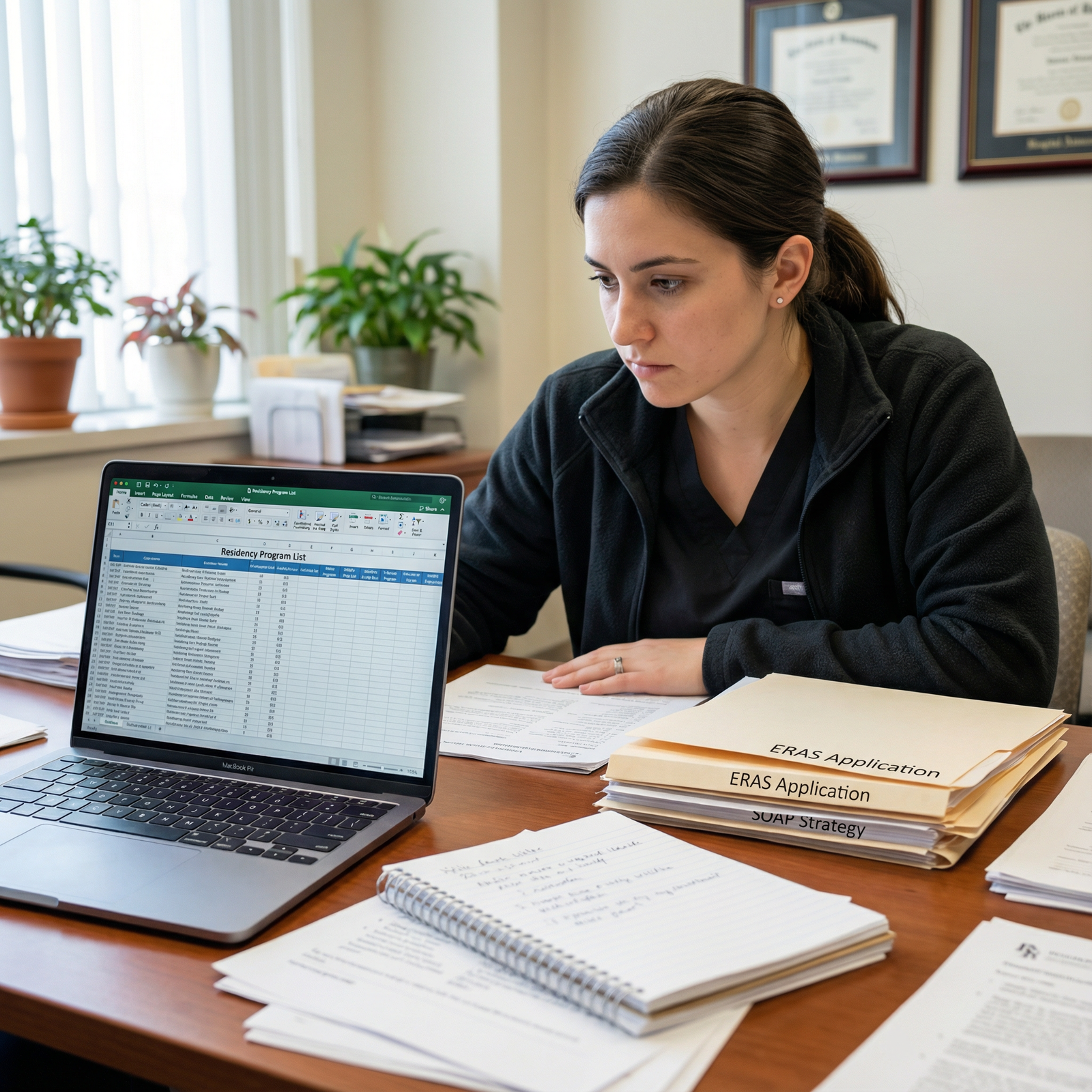
Action step 2: Build your Shadow ROL for SOAP now. Don't wait until Monday of Match Week. Open a spreadsheet tonight.
Columns: Program Name, Specialty (backup), Historically SOAPs? (Check last 3 years of NRMP unfilled list), Program Contact Email, Why I Fit (one line), PD Name.
Aim for 30-40 programs in your backup specialty. Prioritize community, newer programs, and programs that historically go unfilled. University programs in your backup are great, but they SOAP less often.
Action step 3: Understand signaling. Programs can't see where else you applied, but they see your enthusiasm. Your real signal of flexibility isn't what you say, it's that you have a backup ROL ready and you're professionally pursuing it in parallel. That keeps you calm, and calm reads as confident.
That chart isn't to scare you. It's to clarify the move. With 1-2 interviews, applying dual-strategy literally doubles your odds. Use that.
Your SOAP Survival Kit: The 7-Day Protocol for Backup-Specialty Signals
You need this kit finished before Match Week. If you're building it during SOAP, you've lost 24 hours you can't afford.
Here's the exact 7-day protocol I give my students:
Day 1: Intelligence Gathering Pull the last 3 years of SOAP unfilled programs from NRMP/Frieda. Filter by your backup specialty: Internal Medicine, Family Med, Prelim Medicine, Surgery, Peds. Flag any program you rotated at, have geography ties to, or whose mission (e.g., underserved, rural) matches your app. You're looking for 45 total candidates.
Day 2-3: Letters That Don't Suck Draft a 3-paragraph SOAP letter template: Para 1: Who you are, Step scores pass/fail, AOA if any, one-line hook. Para 2: Two specific program features + how your experience fits. Not generic. Para 3: Availability for interview/call immediately, phone number.
Then personalize for top 15 programs. No mail merge disasters. I've seen a student send "Dear University of Michigan" to University of Miami. Instant trash bin.
Day 4: The 30-Second Pitch Record yourself saying this, then fix it until it sounds like a human, not a robot:
"Hi, this is Dr. [Name]. I applied in [Primary] initially, but my core strength is inpatient acute care, I honored my medicine sub-I and led a rapid response QI project. I'm genuinely excited about your Internal Medicine program because of your ICU autonomy and procedures clinic. I'm available anytime today for a call."
Say genuinely excited like you mean it. Because you need to mean it, this is your path to being a doctor.
Day 5-7: Mock and Logistics
- Do 2 mock SOAP phone interviews. Record them. Most fail because they ramble.
- Pack: suit pressed, quiet room with good wifi, charger, laptop, notepad, ERAS login ready.
- Tell your dean/advisor you are SOAP-ready. Don't be embarrassed. They've seen this. They can make calls.
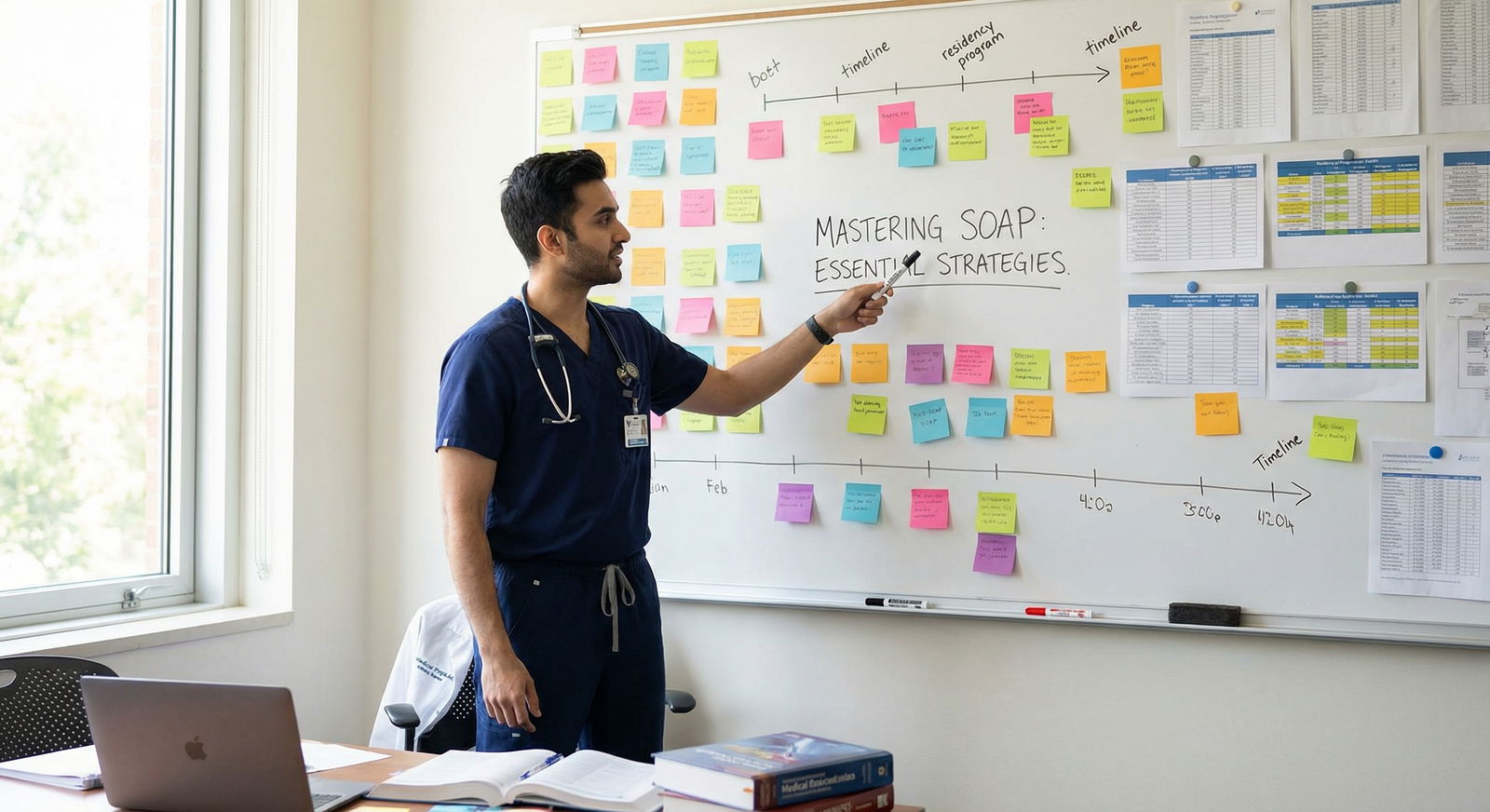
If you follow this, you shift from "I only have 2 interviews" to "I have a primary plan and a practiced contingency." That shift changes everything, how you email, how you interview, how you sleep.
You can't magically create 10 more interviews. But you can stop looking desperate and start looking prepared. Programs want prepared.
Your 72-hour action steps:
- Tonight: Write your bridge story. One paragraph. Practice it out loud 5 times.
- Tomorrow: Rewrite your one thank-you/LOI for your 1-2 programs using the specific-fit rule. Send it.
- This weekend: Build your 30-program SOAP ROL spreadsheet and draft 10 personalized SOAP letters.
- Monday: Do one mock interview with an advisor using the three hard questions above.
You've still got a shot. Make it count.