
Educational disclaimer: This article is for medical education and career-planning purposes only and does not constitute financial, legal, tax, or investment advice. Discussion of away rotation costs, compensation-related considerations, return-on-investment thinking, and budgeting is general educational information only and not financial/legal/tax advice; consult qualified professionals, your medical school, mentors, and VSLO office for individualized guidance.
The data shows a simple truth: when one major screening number disappears, every other signal gets repriced.
That is exactly what happened after Step 1 moved to pass/fail. For years, a three-digit score acted as an early sorting tool. Crude? Yes. Overused? Absolutely. But it was fast, standardized, and easy for programs drowning in applications. Once that number vanished, residency selection did not suddenly become less selective. It became selective in different ways.
Away rotations gained value because they produce something programs now crave: observed performance. Not a test-day snapshot. A live sample. How you think on rounds. How you handle feedback. Whether you are reliable at 5:30 a.m. Whether the team would actually want you back.
I have watched this shift in advising meetings and match outcomes. The students who used to rely on a strong Step 1 to open doors now need a broader portfolio: Step 2 CK, letters, research, interview skill, and in many fields, a strategically chosen away rotation. Not everywhere. Not for everyone. But in competitive specialties, the marginal value of a strong away often went up.
Seven changes stand out most:
- Away rotations became a bigger differentiator
- Competition for slots intensified
- Timing moved earlier
- Step 2 CK changed the role of aways
- Competitive specialties turned them into auditions
- Equity and cost problems became more obvious
- Strategy matters more than volume
The logic is not complicated. When a numeric filter weakens, programs lean harder on higher-resolution data. And away rotations are exactly that.
1. Away Rotations Became a Bigger Differentiator When Step 1 Lost Numeric Signaling
The old model was blunt but efficient. A high Step 1 score could get your application opened, especially in competitive specialties. It was not fair, but it was legible. Once Step 1 became pass/fail, programs lost one of their easiest comparison points across schools, grading systems, and clinical environments.
So what replaced it? Not one thing. A bundle of things. But away rotations moved up the list because they answer questions test scores never could.
The data programs care about during an away is richer:
- Work ethic
- Teachability
- Communication
- Reliability
- Specialty-specific judgment
- Team fit
That is real signal. Higher-resolution signal than "252 versus 244."
The stacked comparison tells the story. Before pass/fail, Step 1 could plausibly account for a large share of early screening emphasis. Afterward, that weight redistributed toward Step 2 CK, letters, and observed clinical performance. Away rotations benefited from that redistribution.
I want to be precise here. Away rotations are not universally essential. In less competitive specialties, or for applicants with strong home programs and clear support, they may still be optional. But in fields where programs need sharper distinction across many strong applicants, the decision-weight of a strong away increased. That is not speculation. That is the market reacting to less numerical separation.
And yes, this changed applicant behavior fast. Students noticed that "good on paper" was no longer enough by itself. They started looking for places to become memorable. An away rotation is one of the few legal ways to do that.
2. Competition for Away Rotation Slots Intensified
Basic supply and demand. More applicants wanted away rotations. The number of available slots did not rise proportionally. Result: competition.
That pressure showed up in predictable ways:
- More VSLO applications per student
- Earlier document preparation
- More parallel planning across multiple institutions
- More backup sites
- More anxiety, frankly
I have seen students apply to twice as many away programs as the class above them because they no longer trusted a narrower strategy. That is rational behavior in a crowded market. It is also exhausting.
The specialties with the biggest demand shock were the obvious ones:
- Orthopedic surgery
- Dermatology
- Neurosurgery
- Plastic surgery
- Otolaryngology
- Radiation oncology
Why there first? Because these fields historically leaned heavily on objective filters, and applicants knew they needed new ways to stand out once Step 1 stopped doing so much early sorting.
The downstream effect is less discussed but more important: advising inequality widened. Students at schools with strong specialty mentors often knew exactly when to apply, which sites were realistic, which letters mattered, and which aways were secretly low-yield. Students without that infrastructure guessed. Guessing is expensive.
The data logic is ugly but clear. In a tighter away-rotation market, information becomes a competitive asset. Not just academic performance. Information. Who knows the timeline. Who knows the unwritten rules. Who knows which programs actually convert aways into interviews.
That is not a great system. But it is the system we have.
3. Timing Matters More: Away Rotations Moved Earlier in the Strategy Calendar
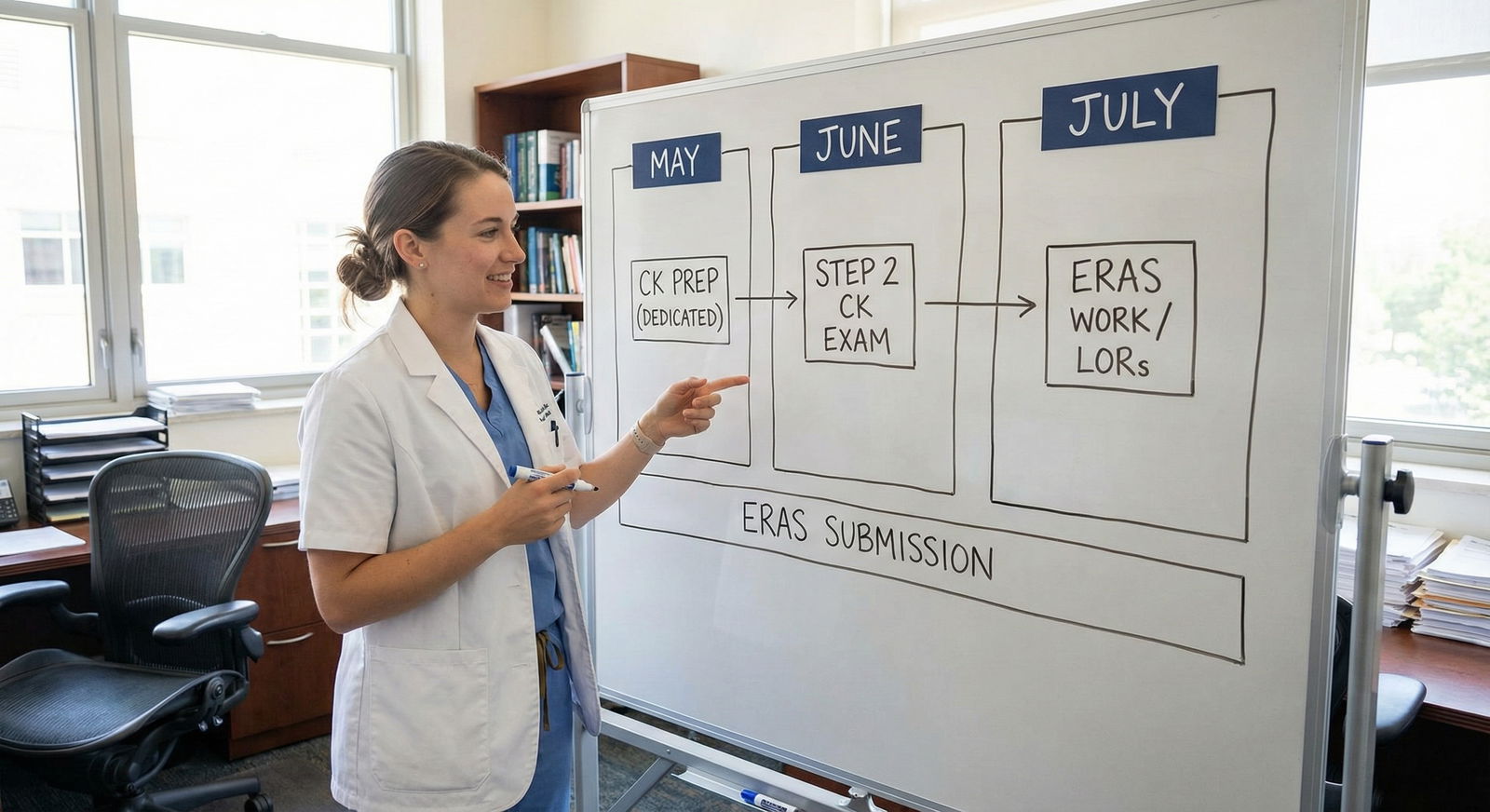
If an away rotation is supposed to help your ERAS application, it has to happen early enough to generate usable output:
- A strong evaluation
- A letter of recommendation
- Faculty advocacy
- A clearer specialty narrative
That means timing now matters much more.
Under the old setup, a great Step 1 score could create early credibility, and an away rotation might serve as bonus exposure. In the pass/fail era, many applicants need the away to produce core application assets before submission. That shifts the calendar earlier.
The sequencing now looks tighter than many students expect:
This is where students get burned. They schedule an away too late, then wonder why the letter is delayed or generic. Or they do the away too early, before they are clinically sharp enough to impress. Both mistakes are common.
The best timing depends on your profile:
- If you have no home program in the specialty: earlier away rotations matter more because you need external evaluators.
- If you are a late specialty decider: you may need to accept a compressed timeline and prioritize one high-yield site.
- If your clinical confidence is still developing: an ultra-early away can be a bad bet. Visibility cuts both ways.
I have seen students chase the earliest slot possible and then underperform because they were still figuring out the basics of workflow and expectations. Bad strategy. Earlier is not always better. Earlier and polished is better.
4. Step 2 CK Became the New Quantitative Anchor, Changing the Purpose of Away Rotations
The data shows that Step 2 CK is now the primary standardized academic metric in residency selection. That does not make away rotations less important. It changes what they are for.
Think of the post-pass/fail model as a two-signal system:
- Step 2 CK = broad academic comparability
- Away rotation performance = direct observed clinical value
Programs use both because they answer different questions. Step 2 tells them whether you can perform on a high-stakes standardized exam. An away tells them whether you can function in their real environment with their people under their pace. Those are not interchangeable.
This is where strategy becomes measurable.
How applicants now use aways relative to Step 2 CK
Average Step 2 CK + excellent away Often the most powerful improvement pathway. You create local advocates who can reframe you as stronger than your score alone suggests.
Strong Step 2 CK + no away Fine in some specialties. Risky in others. A great score can get attention, but it does not prove team fit or specialty-specific performance.
Moderate Step 2 CK + weak away Dangerous. You used one of the best available signal-building tools and turned it into negative evidence.
Strong on both Best-case profile. Easy to understand, easy to support.
That chart is illustrative, but the structure is real. Programs are not replacing one metric with another. They are blending a major quantitative anchor with qualitative high-signal evidence.
And this is the part students often misunderstand: an away rotation is not primarily there to "make up for" a weak score. That is too simplistic. A strong away can complement, reinforce, or partially offset a Step 2 profile, but it works best when it gives programs new confidence, not when it asks them to ignore all the other data.
5. In Competitive Specialties, Away Rotations Became Closer to an Audition
Call it what it is. In many competitive specialties, the away rotation is an audition.
Not officially, of course. Programs love softer language. "Exposure." "Mutual fit." "Opportunity to learn the culture." Fine. But the data and the behavior tell the truth. In orthopedic surgery, dermatology, neurosurgery, plastic surgery, ENT, and radiation oncology, away rotations often function as direct fit assessments with real application consequences.
That effect strengthened after Step 1 went pass/fail because observed specialty-specific competence gained relative value. If twenty applicants all look solid on paper, the student who was reliable, sharp, coachable, and pleasant on service has a massive advantage.
What gets evaluated during these rotations?
- Professionalism
- Clinical reasoning
- Reliability
- Team awareness
- Operating room or procedural presence
- Response to feedback
- Adaptability under pressure
- Whether residents actually want to work with you
That last one matters more than people admit. Residency is labor-intensive and interpersonal. Programs are not just selecting scores. They are selecting colleagues.

The risk-reward dynamic is brutal.
Upside of a strong away
- Interview invitation
- Strong specialty-specific letter
- Internal advocacy during rank discussions
- Proof of geographic or institutional interest
Downside of a weak away
- Visible underperformance
- Lukewarm or absent support
- Damaged reputation in a small specialty network
- A missed chance to remain an unknown quantity
Silence is often less harmful than a bad audition. I have seen students assume that "showing up" helps automatically. Wrong. In the most competitive specialties, a mediocre away can do more damage than no away at all.
This does vary by field. In some specialties, aways are genuinely optional or mainly useful for regional exposure. In others, they are borderline expected for students without a home program. That distinction matters. Treating all specialties the same is one of the dumbest planning errors applicants make.
6. Equity and Cost Concerns Became More Visible
Step 1 pass/fail was sold partly as a fairness reform. And in one narrow sense, it was. But the downstream economics are harder to defend.
When numerical differentiation shrinks, students often compensate by investing in costlier signals:
- Away rotations
- Research years
- Conference networking
- Additional travel
- More applications
That shift has equity consequences. Away rotations are expensive even before you count the stress tax. Students pay in money, time, and opportunity cost. Housing, transportation, food, application fees, credentialing paperwork. It adds up quickly.
The burden falls especially hard on two groups:
- Students without a home program in their specialty
- Students with limited financial flexibility
Those are often the same students. Bad combination.
The data logic here is uncomfortable but unavoidable: the pass/fail era may have reduced one barrier while increasing reliance on other, less standardized and more expensive forms of signaling. That is not progress. That is substitution.
There are smarter responses than just doing more aways.
Better equity-minded strategy
- Prioritize the single highest-yield away rather than stacking several
- Target programs where your geographic or institutional fit is real
- Seek funded visiting student opportunities
- Ask directly whether an away is truly advantageous in that specialty
- Avoid prestige tourism. It is expensive and often low-yield
Some institutions are responding appropriately with funded visiting electives, virtual engagement options, and clearer selection criteria. Good. More programs should do that. Transparency reduces wasted effort. Right now, too many students are paying for ambiguity.
7. The Best Use of Away Rotations Is Now More Strategic, Not Simply More Frequent
More is not better. Better is better.
That is the central lesson of the pass/fail era. The highest-yield applicants are not the ones who accumulate away rotations like airline miles. They are the ones who identify exactly what their application lacks and choose an away only if it improves that variable.
Think like an analyst. Diagnose the weak point.
Questions that should drive your away-rotation decision
- Is your specialty highly competitive?
- Do you lack a home program?
- Do you need a specialty-specific letter?
- Are you targeting a specific geography?
- Does your Step 2 CK need reinforcement through observed performance?
- Are you clinically ready to perform well on an away now?
If the answer pattern says the away will materially improve visibility, letters, or fit assessment, do it. If not, forcing extra aways may just create cost and risk.
One well-chosen away often outperforms three loosely selected ones because:
- Faculty can write a more credible letter when there is real fit
- Your effort is concentrated
- Travel and schedule chaos are reduced
- You preserve time for Step 2, sub-internships, and interview prep
- You lower the chance of a weak rotation contaminating your file
I have seen this repeatedly. The student who does one targeted away at a realistic program where they fit the culture and are ready to perform often gets more return than the student who pinballs through multiple institutions hoping that volume itself will impress people. It does not. Programs are not scoring you for frequent flyer status.
The post-pass/fail environment rewards optimization. Not over-rotation. Not panic. Not prestige-chasing for its own sake.
What the Next Match Cycles Will Likely Reward
The direction is clear. Residency selection is becoming a blended model built from three main inputs:
- Step 2 CK performance
- Observed clinical performance
- Targeted signaling of genuine interest and fit
Away rotations changed because their relative value increased in a less score-driven environment. That does not mean they became mandatory for everyone. It means they became more powerful where differentiation is hard and stakes are high.
The next few match cycles will likely push this even further:
- More pressure on Step 2 CK as the main numeric anchor
- Tighter use of program signaling
- More specialty-specific evaluation
- Ongoing arguments about cost and fairness
- Continued emphasis on letters that come from real observation, not polite familiarity
My position is straightforward. Use away rotations when the expected return is measurably high: stronger letters, better visibility, credible fit, or a needed specialty foothold. Skip the vanity version. Skip the scattershot version. In this market, precision wins.
The data shows that the smartest applicants are not just working harder. They are allocating signal better.