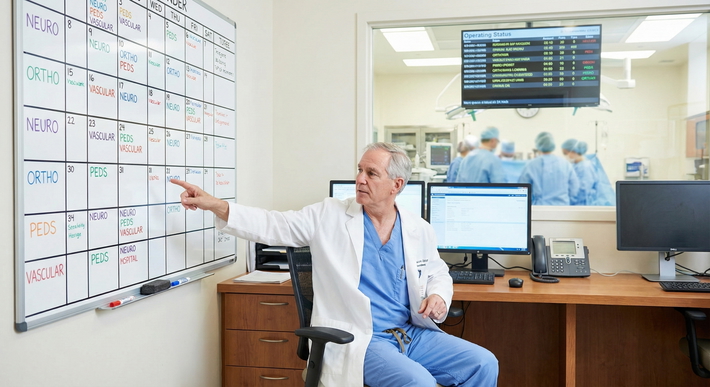
You don't "just get back in the OR" after a clinical pause in the US. That's fantasy. What actually happens is messier: your case numbers are behind, your hands feel half a beat slower, and your documentation often looks like it stopped mid-sentence. Confidence drops fast when access disappears, and it doesn't magically return because your badge works again.
The fix is structure. Not bravado. Not vague promises to "be more proactive." A real recovery plan.
This timeline is built for exactly that: safe skill re-entry, a deliberate ramp in case exposure, and clean proof that you're progressing. Month by month, week by week, day by day, you should know what to check, what to ask for, what to log, and what not to fake. Because faking readiness in surgery is dumb. And people can tell.
First 72 Hours After OR Access Returns: Stabilize, Audit, and Set Guardrails
At this point you should resist the urge to make up for lost time on day one. I've seen trainees come back after a pause and immediately try to act like nothing happened. Bad move. Everyone notices the rust, especially if you pretend it isn't there.
Your first 72 hours are about clarity.
Day 1: Confirm the rules of the game
Before you even think about "catching up," confirm the basics:
- Which site are you actually cleared for?
- Which attendings, fellows, chief residents, and service coordinators know you're back?
- What are your credentialing limits right now?
- Are you allowed:
- to observe only?
- to scrub and assist?
- to perform supervised portions?
- What's the pager, add-on, float, and overnight workflow?
- Are there restrictions on specific service lines, rooms, robots, fluoroscopy, implants, or vendor-supported equipment?
You need the answer to one deceptively simple question: What does "OR access restored" actually mean here? Because "you can come back" and "you can participate meaningfully" are not the same sentence.
Day 2: Do a blunt gap audit
Now be honest. Painfully honest.
Make a one-page audit with four columns:
Procedures missed
- Cases you would normally have seen during the pause
- Bread-and-butter operations now underrepresented in your log
Last known competency
- What you were reliably doing before the pause
- Examples: trocar placement, camera driving, retraction, fascia closure, skin closure, knot tying, basic exposure, stapler handling
Equipment familiarity
- Robot platform version
- Energy devices
- Scope tower setup
- Specialty trays
- Vendor-specific implant systems
Documentation status
- Case logs incomplete?
- Procedure counts missing?
- Evaluations not filed?
- Milestone evidence thin?
If you don't audit this immediately, you'll spend the next month feeling vaguely behind instead of specifically fixing the problem.
Day 3: Set guardrails with supervisors
At this point you should have a short conversation with your supervising team that sounds like an adult talking, not a desperate trainee bargaining for scraps.
Say it plainly:
- "I had a pause in OR access."
- "Here's what I was doing before."
- "Here's where I expect rust."
- "I want a safe progressive ramp."
- "I'll keep a daily case-and-skill log so we can measure progress."
That last part matters. Supervisors trust trainees who bring evidence, not vibes.

Month 1 (Weeks 1-4): Rebuild Technical Foundations and Case Selection Strategy
Month 1 is not about showing everyone how hungry you are. It's about becoming predictably safe again. Predictably useful. Predictably prepared.
Weeks 1-2: Relearn the flow in bread-and-butter cases
At this point you should aim for cases where workflow is familiar and stakes are manageable. That means bread-and-butter lists, not chasing exotic cases because they look good on paper.
Prioritize:
- straightforward general surgery cases
- common gyn, uro, ortho, ENT, or plastics cases in your track
- cases with repeatable setup and role clarity
- rooms with attendings or seniors who teach consistently
Your goals in Weeks 1-2:
- Rebuild positioning awareness
- Relearn prep and drape flow
- Tighten time-out participation
- Refresh instrument names and handoffs
- Re-establish sterile movement habits
- Improve anticipation of the next step
This sounds basic because it is basic. And basic is exactly what gets sloppy after a pause.
A good case in Week 1 might be one where you:
- help position the patient correctly
- know the incision plan before skin prep
- can name the key instruments for opening and closure
- understand where to stand and why
- leave with one technical target for the next case
That's progress. Quiet, real progress.
Weeks 3-4: Ask for progressive responsibility, not random heroics
By this point you should start requesting specific tasks, not "Can I do more?" but "Can I take closure?" or "Can I do the first layer under supervision?" Specific asks are easier to grant and easier to assess.
The progression I like is:
- Observation with active prediction
- Structured assisting
- Retraction and exposure
- Camera control or basic access steps
- Closure
- Discrete portions of the operation
- Stepwise increased responsibility
Don't skip closure because it feels unglamorous. Closure is where rhythm, tissue respect, and economy come back. I've watched trainees regain confidence faster through repetitive closure than through chasing bigger intra-op moments they weren't ready for.
At this point you should also start a daily skills log.
Track:
- date
- case type
- role: observed / assisted / performed step
- exact technical steps attempted
- one thing that went well
- one correction you were given
- one target for next time
That log becomes your proof of recovery.
Month 2 (Weeks 5-8): Catch Up on Case Volume with a Measurable Skill Loop
Now you can push volume. Not recklessly. Deliberately.
At this point you should stop treating each case like an isolated event and start using a repeatable skill loop.
The skill loop
For every meaningful case, do three things:
1. Pre-brief
Before the case starts, define:
- what step you want to perform
- what your attending or senior should watch for
- what your failure point is likely to be
Examples:
- "I want to take skin closure and focus on spacing."
- "I want to place the camera port and be corrected on angle and force."
- "I want to handle retraction more efficiently without losing exposure."
2. Intra-op execution
During the case, keep your focus narrow. Not "do surgery better." That's useless.
Focus on:
- needle angle
- tissue handling
- wrist position
- line of tension
- instrument exchange timing
- exposure discipline
3. Post-brief
Immediately after the case, ask:
- What did I do well?
- Where did I lose efficiency?
- What should I repeat next case?
- What should I not repeat?
This loop works because it turns anxiety into data. Data wins.
Weeks 5-8: Build a realistic weekly volume plan
At this point you should negotiate a weekly case plan that fits your service's actual schedule. Not your fantasy schedule. Actual. If the service has thin elective volume on Tuesdays and stacked add-ons Thursday and Friday, plan around that reality.
A sample ramp might look like:
- Week 5: 6 assisted cases with 2 supervised technical steps
- Week 6: 8 cases with repeated closure/basic step performance
- Week 7: 10 cases with increased consistency in selected portions
- Week 8: 10-12 cases plus formal supervisor debrief
The mistake people make here is overloading every available hour. That's how you get burnout-driven sloppiness. If you're post-call, cognitively fried, and trying to squeeze in "one more opportunity," you're not grinding, you're degrading.
Protect:
- sleep
- post-call recovery
- short sim refreshers
- documentation time
Because unlogged cases don't help you nearly as much as you think, and tired hands learn bad habits.
A checkpoint at the end of Week 6 should include:
- review of your log
- count of missed versus completed targets
- identification of one persistent technical weakness
- plan for one simulation drill tied to that weakness
And at Week 8, you should ask for a direct debrief:
- "Am I back to expected baseline in the OR?"
- "What still looks rusty?"
- "What cases should I prioritize next month?"
That conversation matters more than your private guess.
Day-by-Day During Busy OR Weeks (Template for Wards, Clinics, and Weekend Catch-Up)
Busy weeks are where catch-up plans usually fall apart. Not because the plan was bad. Because nobody operationalized it.
At this point you should run the same repeatable routine every day.
Morning: 10-minute pre-brief checklist
Before the day starts, review:
- case order
- patient positioning
- relevant anatomy
- key procedural steps
- likely instrument or device needs
- your targeted role in each case
- consent and chart highlights relevant to the operation
If there's a case you haven't seen in a while, spend five extra minutes on the sequence. Not an hour of passive reading. Five hard minutes of active review.
Midday: 2-minute reset
Between cases or during a natural pause, ask:
- What did I miss?
- What correction keeps repeating?
- What's my focus for the next room?
Short. Practical. No melodrama.
Evening: evidence capture
Before you go home, or before you collapse into call room regret, log:
- case count
- case type
- role
- supervised steps performed
- feedback received
- one learning point
Do it the same day. Memory gets lazy fast, and delayed logging becomes fiction.

Weekend micro-sprints: the underrated catch-up tool
At this point you should use weekends for micro-sprints, not guilt spirals.
A strong weekend catch-up block looks like this:
- 30-45 minutes simulation
- knot tying
- suturing
- laparoscopic peg transfer
- camera navigation
- basic instrument handling
- 30 minutes documentation catch-up
- update logs
- reconcile missing cases
- note feedback themes
- prepare goals for next week
That's enough. You do not need a six-hour self-punishment session. Those are mostly vanity. Short, focused repetitions beat grand, exhausting plans every time.
If you're balancing wards, clinic, and OR, your daily checklist should be visible and stupidly simple. Phone note. Badge card. Pocket notebook. Whatever you'll actually use. Elegant systems that never get opened are useless.
Final Reminder
Losing OR access after a US clinical pause is disruptive, but it isn't career-ending unless you respond chaotically. Your first job is safe re-entry: confirm the rules, audit what drifted, and agree on progressive responsibility. Then you rebuild volume with evidence, daily logs, weekly targets, and a pre-brief/intra-op/post-brief skill loop that turns each case into a measurable step forward.
At this point you should know the real goal. Not to look busy. Not to impress people with frantic energy. To become reliably ready again. Calm hands. Clear documentation. Honest feedback. Steady numbers. That's how you catch up.